The Story of G.I. Joe Blu-ray Movie
HomeThe Story of G.I. Joe Blu-ray Movie 
Ignite Films | 1945 | 108 min | Not rated | Dec 10, 2024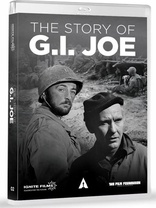

Movie rating
7.1 | / 10 |
Blu-ray rating
| Users |  | 0.0 |
| Reviewer |  | 4.5 |
| Overall | | 4.5 |
Overview
The Story of G.I. Joe (1945)
War correspondent Ernie Pyle joins Company C, 18th Infantry as this American army unit fights its way across North Africa in World War II. He comes to know the soldiers and finds much human interest material for his readers back in the States. Later, he catches up with the unit in Italy and accompanies it through the battles of San Vittorio and Cassino. He learns from its commanding officer, Lt. (later Capt.) Bill Walker of the loneliness of command, and from the individual G.I.'s of the human capacity to survive drudgery, discomfort, and the terror of combat.
Starring: Burgess Meredith, Robert Mitchum, Freddie Steele, Wally Cassell, Jimmy LloydDirector: William A. Wellman
| War | Uncertain |
| Drama | Uncertain |
| Biography | Uncertain |
Specifications
Video
Video codec: MPEG-4 AVC
Video resolution: 1080p
Aspect ratio: 1.36:1
Original aspect ratio: 1.37:1
Audio
English: LPCM Mono
Subtitles
English SDH
Discs
Blu-ray Disc
Single disc (1 BD)
Packaging
Slipcover in original pressing
Playback
Region A, B (C untested)
Review
Rating summary
| Movie | | 4.5 |
| Video | | 4.5 |
| Audio |  | 3.5 |
| Extras |  | 4.0 |
| Overall | | 4.5 |
The Story of G.I. Joe Blu-ray Movie Review
Reviewed by Jeffrey Kauffman November 17, 2024There's a great movie still waiting to be made about some of the incredible journalists who were either embedded with various troops more or less on the front lines during World War II, or were otherwise in the thick of the action, though perhaps covering it from a relatively safe distance. There are any number of iconic names in this illustrious aggregation, including Edward R. Murrow, Margaret Bourke-White, Ernest Hemingway, William L. Shirer, Walter Cronkite, Andy Rooney, and the man whose name is featured prominently in one of the alternate versions of the title of this film, making it (as it is in this presentation's title card) Ernie Pyle's Story of G.I. Joe. Pyle's name has become synonymous with accounts of "everyday" soldiers who left home, sometimes at extremely young ages, to join the fight against fascism and the Nazis, and a lot of The Story of G.I. Joe is culled directly from Pyle's many columns about the conflict, which were written with Pyle right there with whatever battalion he was currently embedded with. Somewhat interestingly, and probably saliently considering this film's director, William Wellman, Pyle also had a long history in writing about aviation. This may have helped him establish a relationship with Wellman, who himself was a celebrated World War I pilot (flying with the French, rather fascinatingly) who had used those experiences to help fashion Wings, famously the first film to win Best Picture at the premiere Academy Awards ceremony. Wellman was evidently a little uptight about crafting a film about so-called "infantry grunts", since Wellman had no experience with that kind of a military unit, but after having met with Pyle and seeing how deeply admired he was by those very "everyday" soldiers, Wellman decided he could get the job done, with the result being this admittedly vignette driven but still highly engaging profile of men in combat.
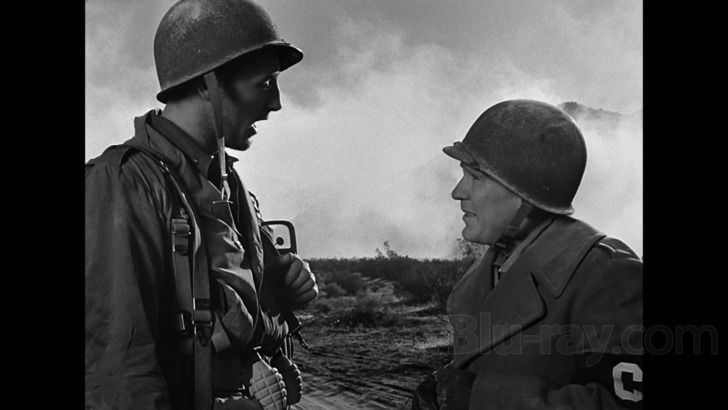
The first thing about The Story of G.I. Joe that may strike younger viewers raised on the gritty likes of everything from Apocalypse Now to (especially relevant in this World War II case) Saving Private Ryan, and as one of the supplements on this disc at least alludes to, is how blatantly theatrical at least some interstitial presentational elements of the film undeniably are. While Wellman actually uses quite a bit of location footage and stock footage to rather good effect, there are any number of other vignettes that offer at times admittedly kind of clunky looking rear projection and set bound work where the obviously aimed for "authenticity" may be just slightly undercut.
That perceived authenticity is probably most notable in the emphasis on what might be called the "human equivalent" of what that G.I. in the film's very title refers to: general issue. While that "theatrical" quality mentioned above will probably extend to at least some of the characterizations offered in some of the supporting performances, at the core of this story is the more naturalistically played relationship between Ernie Pyle (Burgess Meredith, who had to be granted a leave from his own military duties to make the film) and Bill Walker (Robert Mitchum, rather incredibly getting the only Oscar nomination of his long career from this early performance). Walker is the Everyman of this story, gaining experience and eventual command status as he moves through several epochal campaigns. While this relationship provides a narrative tether tying things together (and delivering a solid gut punch at the end), the film also ventures into various sidebars featuring various other characters in Company C.
While The Story of G.I. Joe was lauded at the time of its release in 1945 (actually two months or so before V-J Day) for its "realism", as mentioned above, there are more histrionic moments on display with regard to some of the supporting characters, probably none more so than a sergeant named Warnicki (Freddie Steele, a pretty famous boxer in his non acting life). Other vignettes are probably at least a bit more on the realistic side, and can even show a modicum of humor, as in an unexpected marriage on the front lines. Wellman and cinematographer Russell Metty offer some unusually artistic framings for a perceived "war movie", often filling the frame with nothing other than the face of an infantryman.
The Story of G.I. Joe Blu-ray Movie, Video Quality
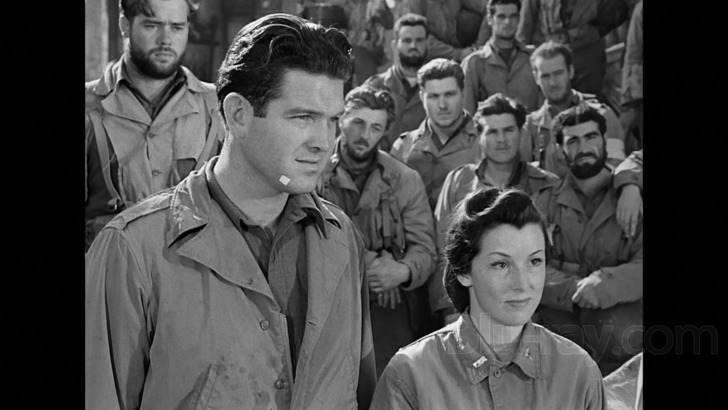
The Story of G.I. Joe is presented on Blu-ray courtesy of Ignite Films and The Film Foundation with an AVC encoded 1080p transfer in 1.36:1. There are several introductory text cards before the film begins which document a history of restoration beginning with photochemical work in 1999 by the Academy Film Archive, continuing on with a 2K scan of that restoration and then further (unspecified) restoration work done in 2024. I was massively enthused by Ignite Films' first release, last year's Invaders from Mars, and if this presentation doesn't quite reach the heights offered by the earlier one, it may be due largely in part to the absence of an original camera negative in usable shape as well as what was evidently some pretty major damage to the element that was utilized, as evidenced by some brief examples in a restoration featurette on this disc. The result here is often quite striking, especially with a maybe just slightly dark but still convincing account of contrast and gray scale. One of the supplements kind of humorously mentions a lack of detail in skies preventing grain from "being able to catch on to anything", with another comment about what might be called "digital magic" to help normalize things, and if there's one fleeting complaint some may have here, it's with regard to the grain field, which, while generally surprisingly natural looking (at least given the above comments), does occasionally have a kind of weirdly mottled, clumpy look. Some digital sharpening may have also been attempted, something that may be more apparent against some of the rear projection scenes. Detail levels tend to be excellent throughout, though in a very real way this film is a story of three presentations, location work, stock footage and set bound material, and there are certainly variances that can be spotted in clarity, damage and grain structure between this trio.
The Story of G.I. Joe Blu-ray Movie, Audio Quality
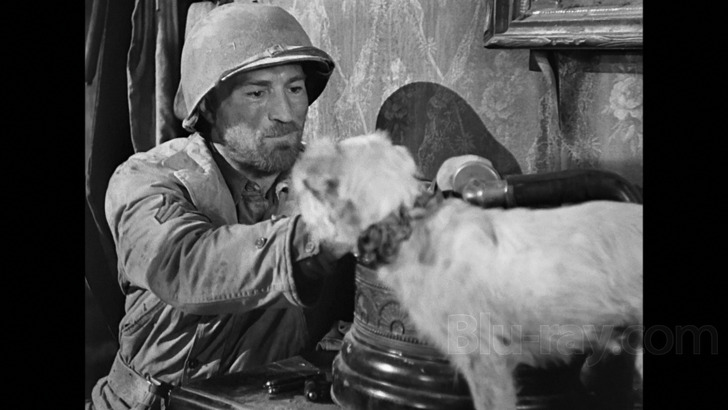
The Story of G.I. Joe features an LPCM Mono track that probably doesn't fare quite as well as the video side of things, but which still is surprisingly vibrant within the context of that era's recording technologies. There's just the slightest hint of crackle and break up in some of the scoring and effects, something that can be discerned in the opening (Oscar nominated) theme music, as well as in some of the later combat material, but on the whole the track offers secure fidelity and while, yes, boxy at times, a still fairly energetic midrange and low end. Dialogue is rendered cleanly and clearly throughout. Optional English subtitles are available.
The Story of G.I. Joe Blu-ray Movie, Special Features and Extras
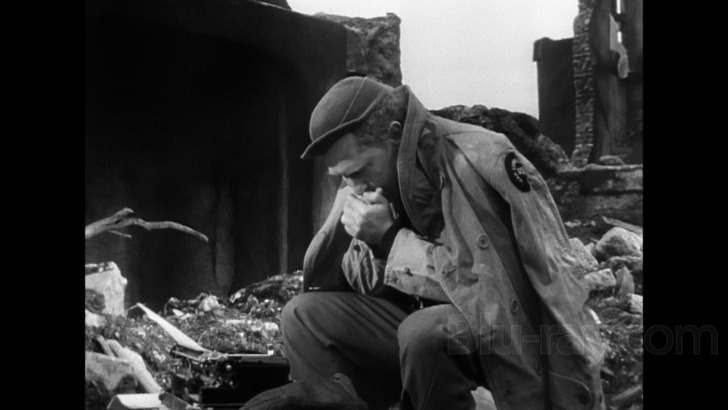
- Wild Bill's Dog Face Blues (HD; 26:15) is a visual essay by Scott Tafoya focusing on William Wellman.
- New Interview with Bill Wellman Jr. (HD; 16:20) is a great reminiscence that has some fun anecdotes, including what was evidently a contentious relationship between his Dad and producer Lester Cowan.
- The Story of The Story of G.I. Joe (HD; 7:00) gives some background while also offering examples of the restoration.
- Audio Commentary by Alan K. Rode
- Original Nitrate Trailer (HD; 2:32) is in pretty bad shape.
- Reconstruction of the original 1945 trailer (HD; 2:55) comes with some prefatory text giving some context and history on the original trailer.
- Photo Gallery (HD)
The Story of G.I. Joe Blu-ray Movie, Overall Score and Recommendation
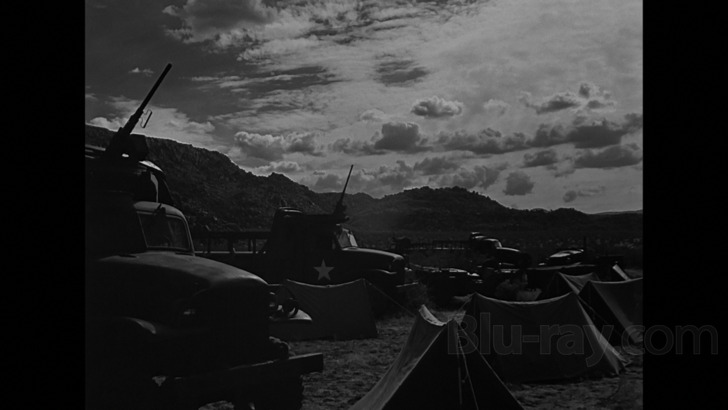
I intentionally left out one legendary name in the annals of World War II journalism in my opening list above so that I could talk about him here. As I mentioned in the closing comments of my now long ago The French Dispatch Blu-ray review, my own father was a celebrated battalion commander in World War II, and his battalion had its own embedded luminary, legendary writer A.J. Liebling (Liebling provided part of the inspiration for the Wes Anderson film, hence the connection). Liebling wrote a series of articles that appeared in the New Yorker about my Dad's extremely unorthodox driver, Mollie, and the so-called Mollie Stories (which, like Pyle's accounts, dealt with campaigns in North Africa and Italy) have become some of Liebling's best remembered tales. I've often said they're kind of a precursor to M*A*S*H, at least in their somewhat anarchic sensibility with an unorthodox officer (that would be my Dad) leading a kind of ragtag group of soldiers who could be on the eccentric side at times, none more so than the memorable Mollie himself. Fox actually optioned Liebling's Mollie stories in the early sixties and put my Dad on payroll as a technical advisor for a planned film which at one point had Paul Newman attached to star as the titular character, but it never came to pass (which makes it another potentially great movie waiting to be made). All of this is to say I felt strongly connected to this piece almost by default, but my hunch is even those without a direct connection to the Greatest Generation will find this a moving tribute to the kind of "general issue" characters who actually contributed manifestly to the Allies winning World War II. So many admittedly grittier war films have arrived in the wake of The Story of G.I. Joe that may make this outing seem a bit more artificial than it was when it first screened in 1945, but the film still retains an awesome power. Technical merits are generally solid and the supplements very enjoyable and informative. Highly recommended.
Similar titles
Similar titles you might also like

Catch-22 4K
1970

The Purple Plain
1954

Stalingrad
1993

The Young Lions
Limited Edition to 3000 - SOLD OUT
1958

To Hell and Back
1955

All My Sons
1948

Men in War
1957

Edge of Darkness
Warner Archive Collection
1943

The Bridges at Toko-Ri
1954

Mudbound
2017

The Man in the Gray Flannel Suit
1956

A Walk in the Sun
1945

Sergeant York
1941
Hail the Conquering Hero
1944

Eagles Over London
La Battaglia d'Inghilterra
1969

The Men
Battle Stripe
1950

Madame Curie
Warner Archive Collection
1943

Big Night
1996
Johnny Belinda
1948

Passage to Marseille
Warner Archive Collection
1944