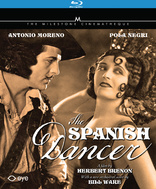
The Spanish Dancer Blu-ray Movie
HomeThe Spanish Dancer Blu-ray Movie 
Milestone | 1923 | 103 min | Not rated | Aug 29, 2023
Price
List price:Amazon: $13.49 (Save 55%)
Third party: $13.49 (Save 55%)
Only 3 left in stock (more on the way).

Movie rating
Movie has not been rated yetBlu-ray rating
| Users |  | 0.0 |
| Reviewer |  | 4.0 |
| Overall | | 4.0 |
Overview
The Spanish Dancer (1923)
A love story between Don Cesar de Bazan and a beautiful Gypsy dancer.
Starring: Pola Negri, Antonio Moreno (I), Wallace Beery, Kathlyn Williams, Adolphe MenjouDirector: Herbert Brenon
| Foreign | Uncertain |
| Drama | Uncertain |
| Romance | Uncertain |
Specifications
Video
Video codec: MPEG-4 AVC
Video resolution: 1080p
Aspect ratio: 1.33:1
Original aspect ratio: 1.33:1
Audio
English: DTS-HD Master Audio 5.1 (48kHz, 24-bit)
English: DTS-HD Master Audio 2.0 (48kHz, 24-bit)
5.1: 2720 kbps, 2.0: 1648 kbps
Subtitles
English
Discs
Blu-ray Disc
Single disc (1 BD)
Playback
Region A (B, C untested)
Review
Rating summary
| Movie |  | 4.5 |
| Video |  | 3.5 |
| Audio |  | 5.0 |
| Extras |  | 2.0 |
| Overall | | 4.0 |
The Spanish Dancer Blu-ray Movie Review
Reviewed by Dr. Stephen Larson November 17, 2023It doesn't often happen in Hollywood when two films based on the same source material are released in close proximity to each other, but that's what occurred in the fall of 1923 when Ernst Lubitsch's Rosita and Herbert Brenon's The Spanish Dancer came out a month apart. Each is based on the three-act play, Don César de Bazan (1844), by Adolphe Philippe Dennery and Philippe François Pinel Dumanoir. In 1901, Victor Hugo shaped the material into the novella, The Spanish Dancer. Critics were rather split about which version they preferred. One may have preferred Mary Pickford's performance over Pola Negri's, while another may have claimed Pickford was ill-suited to play a gypsy. Others thought that Brenon was better suited to the material than Lubitsch. In any case, because The Spanish Dancer followed Rosita in American theaters a month later, its box-office prospects apparently suffered since audiences were already treated to a prior iteration of roughly the same story.
Beautiful Gypsy and fortune teller Maritana (Pola Negri) is courted by the poor yet debonair Spanish nobleman Don César de Bazan (Antonio Moreno). Maritana reads his cards and predicts poverty, a wedding with a veiled bride, prison, and a duel. These story events are told against the backdrop of Spanish King Philip IV (Wallace Beery) and his kingdom. Philip is visited by the ambassador (Charles A. Stevenson) of French Cardinal Richelieu, who wants Philip to sign a treaty between the two countries. However, Spanish Prime Minister Olivarez and his henchman, Don Salluste (Adolphe Menjou), work out a plan to thwart the accord.
In love with Maritana, Don César offers the dancer a purse of gold coins, which she refuses. While they talk, one of the Gypsy musicians filches the pouch from Don César's grasp. Maritana tries to reclaim the purse for Don César from the thief and when she does, the debt-ridden nobleman is pursued by the sheriff's men, who want to arrest him. It turns out that soldiers of the Captain of the Guard catch up to Don César when he attempts to rescue Lazarillo (Gareth Hughes), a poor apprentice. The Royal Court finds Don César guilty of breaching one of its edicts and sentences him to hang. Maritana reaches out to Queen Isabel of Bourbon (Kathlyn Williams) about sparing Don César's life. The queen says she will do all she can and approaches Philip about pardoning the jailed nobleman. The king says he will, but another plot is brewing. Will Don César be saved?
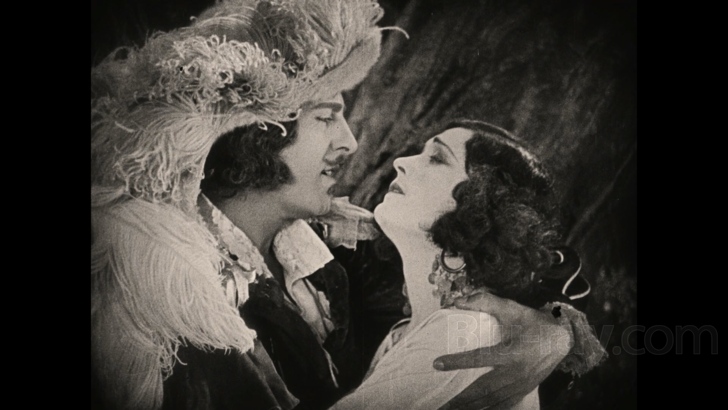
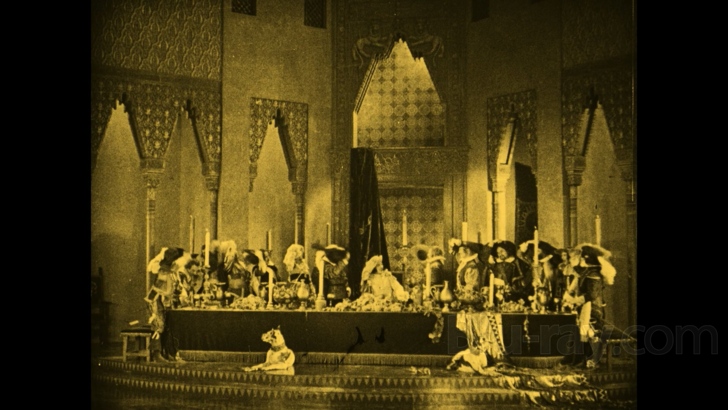
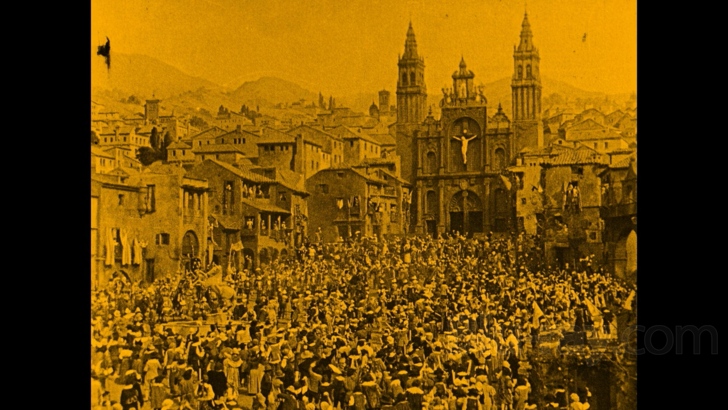
The Spanish Dancer is a swashbuckling epic with elaborate dance sequences, plenty of action, and spectacle. It is exquisitely photographed by legendary cinematographer James Wong Howe. The impressive set for the festival scene, the Square of the Galloping Chargers in Madrid at the Feast of the Madonna, is reminiscent of Griffith's Intolerance (1916). More, there's a scene depicting strappado in a torture chamber that reminds me of a similar scene during the Spanish Inquisition episode in Dreyer's Leaves from Satan's Book (1921). Pola Negri and Antonio Moreno, who stepped in to play Don César after star Rudolph Valentino left Paramount, have wonderful chemistry together.
The original publicity campaign for The Spanish Dancer reported: "This picture is said to represent the largest individual investment that Paramount’s production department has made to date." Another marketing item, which was advertised in the trades, revealed that when the costume department at the Famous Players Lasky studio commenced making preparations for the movie, it was learned that no costumer in Hollywood had ever before been called upon to make clothing for this particular period, King Philip IV's reign (1621–1665).
The Spanish Dancer had its world premiere at Grauman’s Rialto Theatre in Los Angeles on Friday, October 5, 1923. Even before its first public showing, the Los Angeles Times reported it was "widely heralded as a real triumph for Miss Negri. Herbert Brenon, director, is receiving congratulations from every side for the excellence of his work in transcribing the story to the screen." LA Times film critic Edwin Schallert was at the Rialto where he observed a crowd outside "that filled the street to the car tracks. The main thrill was the arrival of Miss Negri herself, and a wave of applause came from the throng as she swept into the lobby. A long and enthusiastic ovation was accorded her later by the audience when she was ushered to her seat. Bouquets of violets were thrown to her, and she was forced several times to rise and bow by the handclappings and the cheers." The reception was echoed by another journalist who attended the premiere.
The Spanish Dancer was received favorably elsewhere. For example, the Lima (OH) Republican Gazette recounted that the Quilna, Ohio theater manager, whose last name was Cunningham, watched a private screening of the film in Detroit a week before bringing it to his town. Cunningham stated that it is a "real screen masterpiece." The reporter for the Lima (OH) Republican Gazette described the picture as "one of rare artistry, each succeeding scene seeming like a painting by one of the great masters." The same newspaper attended an initial "demonstration" (sneak preview) and noted that audiences at the Quilna gave the film "the stamp of their unqualified approval. The theater was crowded at every performance and every one of the many telling points in the engaging romance was roundly applauded....hundreds were turned away Sunday unable to gain admission the engagement will evidently be as big a success financially as it is artistically."
The movie received critical accolades in other parts of the country. A critic for The Pittsburgh Press wrote: "In no production the beautiful screen star has made to date has she been privileged to wear such a gorgeous array of gowns as she disports in The Spanish Dancer, and those who admired her wardrobe in Bella Donna and Passion and other pictures are due for a real surprise when they see her in her latest film. This is perhaps the most intensely dramatic production Pola Negri has been in...Faithful attention has been given to every detail." The Minneapolis Daily Star anointed Negri as "one of the epochs of picture history." San Francisco Chronicle described the production as "tasteful magnificence, artistic extravagance, splendid lavishness....Herbert Brenon deserves great credit for his masterly direction of this picture. His management of the fiesta in the great square is wonderfully effective. One has a complete view of the space, looking perhaps through a window."
The Spanish Dancer Blu-ray Movie, Video Quality
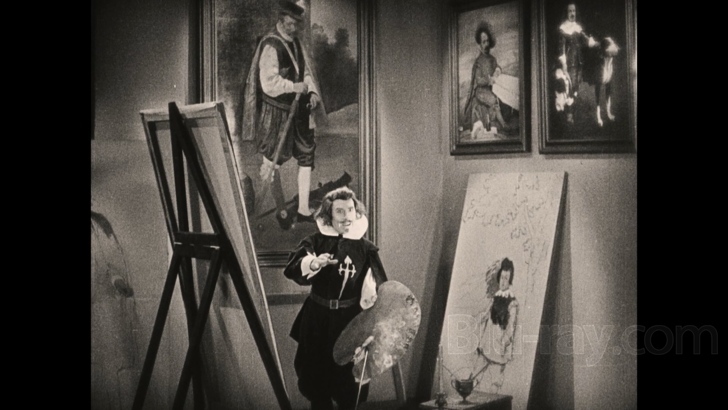
Milestone Film & Video and Kino Lorber's Blu-ray release of The Spanish Dancer represents the most complete version of the picture since its 1923 theatrical run. Milestone co-founder Dennis Doros stated in a "Deep Focus" podcast hosted by Renew Theaters that only a 16-minute version of the film was known to exist before the Eye Filmmuseum in the Netherlands began searching for other prints. Eye explains its discoveries in a restoration demo:
The longest surviving version in the world was found at EYE, but this vintage print contained only 64% of the original version. EYE has reconstructed and digitally restored THE SPANISH DANCER using prints from four European film archives. The story was reconstructed using the best available element, following the original continuity script. The restored version has brought together 95% of the original film, revealing an intricate plot and humorous tone.The Buffalo (NY) Times said in 1923 that 250,000 feet of film went into the making of The Spanish Dancer. When this footage was scaled down for the release version, the revised length was about 8,434 feet, according to The Film Daily. Another paper at the time reported that the original version had nine reels. The restored version has 7,168 feet. Fortunately, there are no scenes missing on this disc. According to Milestone's press kit, the restored edition is culled from a tinted 35 mm nitrate print, a black & white 35 mm nitrate print, and two 16 mm prints. Milestone notes: "All the available material was scanned, digitally restored and re-edited, reinserting the English intertitles as indicated by the script. The resulting digital intermediate was then printed back to 35mm film, using the Desmet method to reproduce the tints." You will notice that the Eye Filmmuseum and Milestone have retained several of the original explanatory titles (e.g., see Screenshot #25) and recreated intertitles from the original Paramount continuity script (frame grab #26).
My screen captures largely reflect the clearest and best moments from this transfer. The high resolution definitely helps to bring out some fine detail. But as to be expected from a film this old, there are damage marks throughout, such as tramlines (see frame enlargement #19). Unfortunately, significant nitrate damage is present for the sequence where Maritana dances in the field for the queen (see #24). The damage suffuses the image with a smoky and hazy look. Other parts of the film are in better condition, but the markings still diminish my overall score for the transfer. The 103-minute feature receives the MPEG-4 AVC encode on this BD-25. Milestone/Kino have only given the feature an average video bitrate of 19996 kbps. My video score is 3.75/5.00.
The Spanish Dancer Blu-ray Movie, Audio Quality
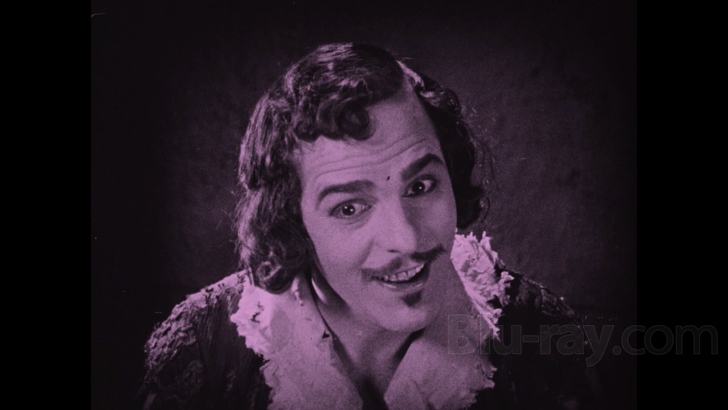
For the new orchestral score written for The Spanish Dancer by Bill Ware, Milestone/Kino has supplied a DTS-HD Master Audio 5.1 Surround track (2720 kbps, 24-bit) and a DTS-HD Master Audio 2.0 Stereo mix (1648 kbps, 24-bit). I listened to both and will concentrate briefly on the 5.1 for this review. Music sounds rich and dynamic. Hand-clappings are accented along the front channels and brass instruments are active along the rears. In the disc's video interview with Ware, the composer said he was inspired by baroque music of the 1600s. For the court scenes and those portraying Spanish royalty, he incorporated Columbian/South American rhythms. For characters that he didn't like, Ware wrote woodwinds for them. He mostly wrote in the triple meter. Ware reported in the podcast interview that he composed 31 cues with 150 instrument tracks. He performed the score on a MIDI. Ware also played bass, vibraphone, and percussion. The trumpet and harpsichord are two other prominent instruments featured in the score.
Director Herbert Brenon played live music on location for the actors. The Tennessean reported that while filming the Busch garden scenes in Pasadena, musical sounds only carried halfway across the lawns. Scores of Gypsy girls dancing on the lawn could not keep step because the music was inaudible. Brenon came up with the idea of using a "megaphonic booth" in which an orchestra played on the large outdoor sets. When the booth was installed and music began playing, it carried three times as far, which greatly aided the dancers.
My historical research indicates that back in 1923, there was a score and musical performances in theaters while The Spanish Dancer played. Pearl Rall of the Los Angeles Evening Express noted that a prologue preceded the start of the picture. Rall observed that "Jan Sofer's score adds much to the enjoyment." A film critic for the Lima (OH) Republican Gazette stated that musical accomplishment to the picture was made on Quilna's big organ: "Mr. Thompson used excerpts from 'Mignon,' 'Maritana' and 'The Fortune Teller' and mingled them deftly with other Gypsy and Spanish selections in a manner that helped wonderfully in sustaining the atmosphere of the story." A reporter for the Minneapolis Daily Star also noted the presence of a prologue: "As an added attraction Production Manager C. P. Murphy of the State [Theater] studios is offering an atmospheric prologue with Frozini, master of the piano accordion, and Jean Whitley, Spanish dancer, as the featured players."
The Spanish Dancer Blu-ray Movie, Special Features and Extras
- Audio Commentary by Film Historian Scott Eyman and Dance Historian Naima Prevots - Eyman and Prevots were recorded separately for this track. Eyman appears first and just spends the initial 58:34 of the featuring doing a running commentary. He gives an informative talk on The Spanish Dancer, which includes production anecdotes. He spends the most time discussing the work and life of star Pola Negri. He also delves into the careers of Wallace Beery and Adolphe Menjou. Producer/director Herbert Brenon is also covered here. Eyman additionally celebrates the work of cinematographer James Wong Howe. Naima Prevots picks up the slack into the second hour. Her talk centers exclusively on choreographer Ernest Belcher, who trained Pola Negri for this film. She delivers a pretty comprehensive encapsulation of Belcher's career as a ballet instructor and choreographer in Hollywood. Prevots goes into Belcher's collaborations with Cecil B. DeMille and the period that he spent training Shirley Temple. In addition, she talks about the work he did on The Phantom of the Opera (1925) and The Jazz Singer (1927). Both Eyman and Prevots speak in English, not subtitled.
- Interview with the Composer Bill Ware (22:19, 1080p) - Ware is interviewed in his studio. He explains how he approached the film from the very start. As inspiration, he viewed one of his favorite films with a Morricone score. (He never specifies which movie that is. The interviewer doesn't ask him any follow-ups.) Ware made notes of the characters in The Spanish Dancer. He said he gave particular instruments and sounds to certain characters. Ware performs pre-recorded cues while watching The Spanish Dancer on a monitor. He discusses the musical genres he employed and how he attempted to imitate the clapping style to the rhythms he came up with in his score. In English, not subtitled.
- Restoration Demonstration (1:48, 1080p) - a 2012 restoration demo produced by the Eye Filmmuseum which shows a quadrant of extant prints from The Spanish Dancer, including Dutch and Russian prints. They are accompanied by restoration titles explaining what survives. Footage from the restored version is shown.
The Spanish Dancer Blu-ray Movie, Overall Score and Recommendation
The Spanish Dancer (1923) is a great find by Milestone Film & Video. The Eye Filmmuseum performed a yeoman's job in restoring the film from four different prints. The museum restored the original tints from a nitrate print. The film was re-scanned and tinted for this Blu-ray release. My video score, which is still very good, reflects the rough patches on the transfer, especially the dance sequence in the fields. However, unless better footage surfaces one day, this is likely to be the standard edition of the film for a very long time (maybe forever). I believe that the encode on the BD could have been better. Scott Eyman and Naima Prevots are each informative on the commentary track. HIGHLY RECOMMENDED.
Similar titles
Similar titles you might also like
(Still not reliable for this title)

The Wandering Princess
流転の王妃
1960

Love Letter
恋文
1953

Nana
1926

Stay As You Are
Così come sei
1978

Michael
Mikaël
1924

Love Letter
1995

L' Innocente
The Innocent / Slipcover in Original Pressing
1976

Kung-Fu Master!
Le petit amour
1988

Vagabond
Sans toit ni loi
1985

Suzhou River
苏州河 | Sū zhōu hé | 4K Restoration
2000

White Nights 4K
Le Notti Bianche
1957

Le bonheur
1965

L' amour Braque
Mad Love
1985

Nelly and Monsieur Arnaud
Nelly et M. Arnaud
1995

The Lovers on the Bridge
Les amants du Pont-Neuf
1991

Cléo from 5 to 7
Cléo de 5 à 7
1962

His Motorbike, Her Island
His Motorbyke, Her Island
1986

A Man and a Woman
Un homme et une femme / Includes "C’était un rendez-vous" (1976)
1966

Nobody's Daughter Hae-Won
Nugu-ui ttal-do anin Haewon / 누구의 딸도 아닌 해원
2013

César et Rosalie
Cesar & Rosalie
1972