The Sons of Great Bear Blu-ray Movie
HomeThe Sons of Great Bear Blu-ray Movie 
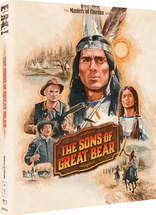
Die Söhne der großen Bärin | Masters of Cinema | Limited EditionEureka Entertainment | 1966 | 92 min | Rated BBFC: 15 | Jul 21, 2025

Movie rating
6.4 | / 10 |
Blu-ray rating
| Users |  | 0.0 |
| Reviewer |  | 3.0 |
| Overall | | 3.0 |
Overview
The Sons of Great Bear (1966)
Starring: Gojko Mitic, Jirí Vrstála, Rolf Römer, Hans Hardt-Hardtloff, Gerhard RacholdDirector: Josef Mach
| Western | 100% |
Specifications
Video
Video codec: MPEG-4 AVC
Video resolution: 1080p
Aspect ratio: 2.35:1
Original aspect ratio: 2.35:1
Audio
German: LPCM 2.0
Subtitles
English
Discs
Blu-ray Disc
Single disc (1 BD)
Playback
Region B (locked)
Review
Rating summary
| Movie | | 3.0 |
| Video | | 3.0 |
| Audio |  | 4.0 |
| Extras | | 3.0 |
| Overall | | 3.0 |
The Sons of Great Bear Blu-ray Movie Review
Reviewed by Dr. Svet Atanasov October 1, 2025Josef Mach's "The Sons of Great Bear" (1966) arrives on Blu-ray courtesy of Eureka Entertainment. The supplemental features on the release include new audio commentary by critic Jenny Barrett; new program with critic Lee Broughton; new program with critic Austin Fisher; vintage trailer; and more. In German, with optional English subtitles for the main feature. Region-B "locked".
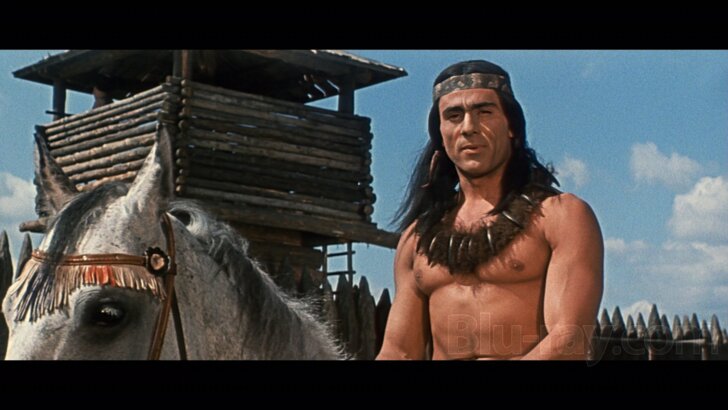
Tokei-Ihto
During the Cold War era, the former Yugoslavia was for Eastern European directors what Spain, and specifically the Tabernas Desert of Almeria, was for many Western European, primarily Italian, directors. Yugoslavia offered seemingly countless beautiful mountainous terrains that could pass for the same famous American locations that John Ford and Howard Hawks visited with their iconic westerns. (The Tabernas Desert is where the likes of Sergio Leone and Sergio Corbucci went to shoot Mexican locations that were thousands of miles away from Mexico). Yugoslavia offered something else, too. It was run by Josip Bros Tito, a communist dictator who, despite having a very friendly relationship with the Kremlin, did not adopt the Stalinist model of governing. Tito kept Yugoslavia open to the rest of the world and allowed its citizens to exit and reenter it virtually without restrictions, and made it possible for private companies to do ‘some’ business there. (Large and very large private businesses were not allowed to operate. Only small businesses were typically issued permits to operate, in many cases under strict conditions, with foreign businesses having to meet additional requirements). Because of this significantly more liberal communist regime, Eastern European directors enthusiastically travelled to Yugoslavia to do ambitious projects that often gathered Eastern European and some Western European and even American talent.
The biggest and most successful hybrid project of that era was undoubtedly the Winnetou trilogy, a co-production between Yugoslavia and West Germany, which influenced many spaghetti westerns that are now considered cult films. The Winnetou trilogy was such a big hit in Eastern Europe that it was only a matter of time before DEFA, the famous communist film studio in East Germany, and Mosfilm’s closest and most prominent relative, began developing its first western. It was Josef Mach’s The Sons of Great Bear.
While visually pretty similar -- The Sons of Great Bear was not shot at the famous locations in Yugoslavia, but in East Germany -- the Winnetou trilogy and The Sons of Great Bear are very different projects. The Winnetou trilogy is a large-scale spectacle that recreates the drama from Karl May’s famous novels quite well. In other words, it was conceived to earn the admiration of its audience in much the same way Hollywood westerns did. The Sons of Great Bear is a communist propaganda film disguised as a western. In fact, it is the first of many such films DEFA produced that became famous as “red westerns”, precisely because they were carefully scripted to channel messages that the Party wanted popularized amongst the masses. (The “red westerns” were distributed throughout the Soviet Bloc by the same government agencies that allowed and rejected entry of foreign films after their content was carefully examined).
Gojko Mitic, a Serbian-born actor with a tiny part in the first film in the Winnetou trilogy, was cast to be the star of The Sons of Great Bear. Mitic exceeded expectations and appeared in various other films, not all “red westerns”, that transformed him into one of the biggest stars to emerge from Eastern Europe during the Cold War era. In The Sons of Great Bear, Mitic plays Tokei-Ihto, a fearless Indian warrior who, after losing his father, a famous chief, must lead his tribe to Canada, the last safe haven. However, before crossing into Canada, Tokei-Ihto also intends to take out his father’s killer, Red Fox (Jiri Vrastala), a vicious scout with an itchy trigger finger.
*The version of The Sons of Great Bear presented on this release is cut. The BBFC has censored three shots depicting horse falls.
The Sons of Great Bear Blu-ray Movie, Video Quality
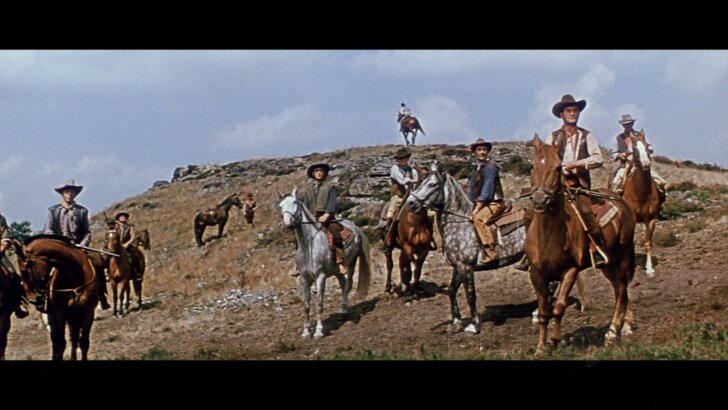
Presented in its original aspect ratio of 2.35:1, encoded with MPEG-4 AVC and granted a 1080p transfer, The Sons of Great Bear arrives on Blu-ray courtesy of Eureka Entertainment.
It is pretty easy to tell that The Sons of Great Bear has been remastered. (Press materials provided with this release clarify that it was restored in 2K). However, the overall appearance of The Sons of Great Bear is a something of a mixed bag. Why? I have a copy of the film on DVD, and while the high-definition presentation is the healthiest and most pleasing I have seen to date, it is very, very inconsistent. Sharpness, delineation, and depth are routinely underwhelming, and grain appears to have been managed in some way with digital tools. There is minor color instability as well, though this is the least concerning aspect of the presentation. To be honest, on a large screen, a lot of the visuals quite simply do not have a proper organic appearance, and while density levels are better than those of the standard definition presentation, the overall improvement that should be very noticeable in a high-definition presentation is not there. I noticed a few small blemishes, but there are no large cuts, warped or torn frames to report. (Note: This is a Region-B "locked" Blu-ray release. Therefore, you must have a native Region-B or Region-Free player in order to access its content).
The Sons of Great Bear Blu-ray Movie, Audio Quality
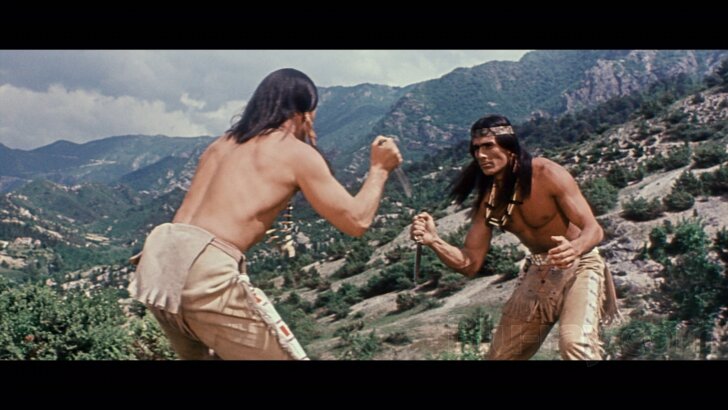
There is only one standard audio track on this Blu-ray release: German LPCM 2.0. Optional English subtitles are provided for the main feature. When turned on, they appear inside the image frame.
All exchanges are easy to follow. However, in a few places, the audio can sound a bit muffled. I am fairly certain that this is a source limitation, but it could be that during the restoration some digital filtering was applied to rebalance shakier spots. Regardless, you will not be distracted. Dynamic intensity is pretty decent, occasionally even good, or at least for a film completed during the 1960s.
The Sons of Great Bear Blu-ray Movie, Special Features and Extras
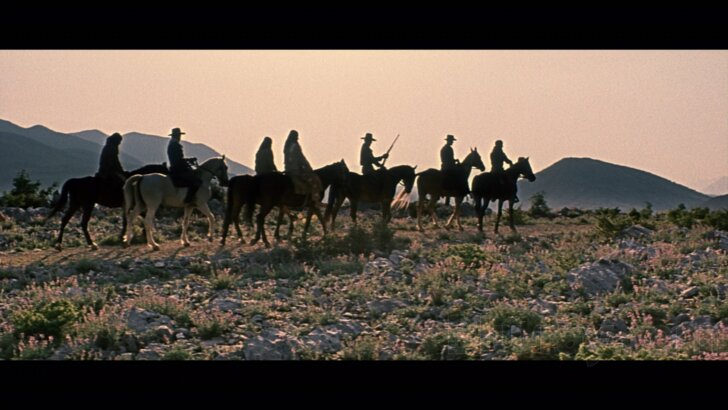
- Commentary - this exclusive new audio commentary was recorded by critic Jenny Barrett.
- World Wide West - in this new program, critic Austin Fisher discusses The Sons of Great Bear. In English, not subtitled. (17 min).
- Homeland - in this new program, critic Lee Broughton discusses some of the prevalent themes in the German westerns from the Cold War era and The Sons of Great Bear. In English, not subtitled. (27 min).
- The Eyewitness 42/1965 - presented here is an installment of an archival newsreel, part of a communist propaganda series, produced by DEFA to accompany its theatrical presentations of films like The Sons of Great Bear. In German, with English subtitles. (11 min).
- Trailer One - presented here is an original German trailer for Sons of the Great Bear. In German, with English subtitles. (4 min).
- Trailer Two - presented here is a new UK trailer for the recent 2K restoration of Sons of the Great Bear. In German, with English subtitles. (2 min).
- Booklet - a collector's booklet featuring new writing on The Sons of Great Bear and DEFA's approach to the western by Mariana Ivanova, Academic Director of the DEFA Film Library.
The Sons of Great Bear Blu-ray Movie, Overall Score and Recommendation
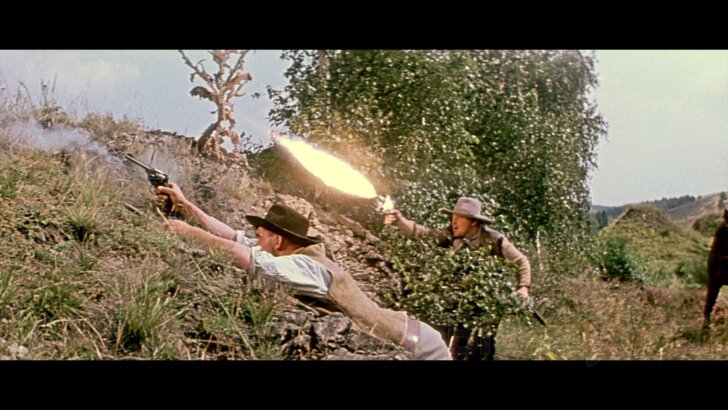
Without Winnetou, the "red westerns" would not have become a cultural and political phenomenon. While the Cold War lasted, they offered a much-needed, safe and cheap temporary escape from reality to people living on the other side of the Iron Curtain, and delivered plenty of propaganda material for the people who approved and funded them on behalf of the Party. However, perhaps unsurprisingly, none of the "red westerns" turned out as good as Winnetou. They are one-dimensional, very transparent, and often oddly shot films without proper stars. The Sons of Great Bear was the first "red western" that DEFA produced in East Germany. It is worth seeing for this very reason, and because it permanently transformed the career of its lead, Serbian-born actor Gojko Mitic, who, despite playing various Indian characters, became famous as the Clint Eastwood of the Balkans.
Similar titles
Similar titles you might also like

Canyon Passage
1946

A Reason to Live, a Reason to Die
Una ragione per vivere e una per morire / Massacre at Fort Holman
1972

Death of a Gunfighter
Indicator Series | Limited Edition
1969

The Sisters Brothers 4K
Limited Edition
2018

Two Rode Together
Masters of Cinema
1961

Navajo Joe
Un dollaro a testa / The Italian Collection #41
1966

The Tall T
Indicator Series
1957

Kill Them All and Come Back Alone
Ammazzali tutti e torna solo / Cult Classics
1968

The Culpepper Cattle Co.
1972

The Man from Laramie
Masters of Cinema
1955

The Grand Duel
Il grande duello
1972

Sabata
Ehi amico...c'è Sabata. Hai chiuso! / Eureka Classics
1969

Destry Rides Again
1939

The Naked Spur
Warner Archive Collection
1953

The Gunfighter
1950

Apache
Masters of Cinema | Limited Edition
1954

Man Without a Star
Masters of Cinema
1955

A Time for Dying
Indicator Series | Standard Edition
1969

The Mercenary
Il mercenario / A Professional Gun | The Italian Collection #40
1968

Day of Anger
Gunlaw / I giorni dell'ira
1967