The Samurai Trilogy Blu-ray Movie
HomeThe Samurai Trilogy Blu-ray Movie 
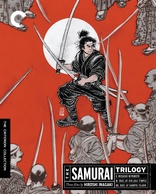
Criterion | 1954-1956 | 3 Movies | 303 min | Not rated | Jun 26, 2012

Movie rating
Movie has not been rated yetBlu-ray rating
| Users |  | 4.0 |
| Reviewer | | 4.0 |
| Overall | | 4.0 |
Overview
The Samurai Trilogy (1954-1956)
See individual titles for their synopses.
| Foreign | 100% |
| Drama | 73% |
| Martial arts | 28% |
| Period | 17% |
| History | 13% |
| Biography | 7% |
| Adventure | Insignificant |
| Action | Insignificant |
Specifications
Video
Video codec: TBA
Video resolution: 1080p
Audio
See individual releases
Subtitles
None
Discs
50GB Blu-ray Disc
Two-disc set (2 BDs)
Playback
Region A (locked)
Review
Rating summary
| Movie |  | 4.5 |
| Video | | 4.0 |
| Audio |  | 3.5 |
| Extras | | 3.5 |
| Overall | | 4.0 |
The Samurai Trilogy Blu-ray Movie Review
Reviewed by Dr. Svet Atanasov July 1, 2012Japanese director Hiroshi Inagaki's "Samurai I: Musashi Miyamoto" (1954), "Samurai II: Duel at Ichijoji Temple" (1955), and "Samurai III: Duel at Ganryu Island" (1956) arrive on Blu-ray courtesy of Criteiron. The supplemental features included with the three films are three original theatrical trailers and three exclusive new video interviews with translator and historian William Scott Wilson. The release also arrives with a 24-page illustrated booklet featuring Stephen Prince's essay "Musashi Mifune" and William Scott Wilson's "The Book of Five Rings". In Japanese, with optional English subtitles for each film. Region-A "locked".

After the battle
Samurai I: Musashi Miyamoto
The young and feisty Takezo (Toshiro Mifune) and his best friend Matahachi (Rentaro Mikuni) go to war, hoping that after it ends they could become samurai. But their side is quickly defeated and the two men become fugitives.
Takezo and Matahachi find shelter in a small village. There, Matahachi is seduced by the widow Oko (Mitsuko Mito), who lives together with her beautiful daughter Akemi (Mariko Okada). Soon after, the three leave the village and head to Kyoto, while Takezo returns home. When he informs Matahachi’s family that his friend has decided to start a new life, despite the fact that he has promised to marry the beautiful Otsu (Kaoru Yachigusa), Takezo is accused of abandoning Matahachi and then promptly arrested for treason.
The wise monk Takuan (Kuroemon Onoe) saves Takezo from almost certain death - and proceeds to teach him an important lesson. In the process Takezo falls madly in love with Otsu and becomes Musashi Miyamoto, a future hero who would challenge some of the greatest swordsmen of his time.
Samurai II: Duel at Ichijoji Temple
Musashi has become a skillful swordsman, but he is yet to gain the reputation he desires. He arrives in Kyoto and immediately challenges the leader of the Yoshioka School, the most prestigious fencing institution in the area. As he kills its members one after another, Musashi is quietly observed by another young and fearless swordsman, Kojiro Sasaki (Koji Tsuruta), who dreams of becoming a great samurai.
Meanwhile, Otsu vows to wait for Musashi, hoping that one day the two could start a family together. Things become complicated when Akemi also reveals that she has fallen in love with him.
Eventually, Musashi kills the leader of the Yoshioka School and proceeds to confess his love for Otsu. But his eagerness dishonors her and she rejects him. The two part ways even though both are still madly in love with each other.
Samurai III: Duel at Ganryu Island
Musashi is now an unbeatable swordsman and various clans seek his services and expertise. Kojiro has also earned a reputation as a great swordsman. When the Shogun expresses interest in Musashi, the jealous Kojiro decides that the time to determine who the best swordsman is has finally come. He promptly challenges Musashi to a duel.
Musashi agrees to fight Kojiro but a year later. He, then, relocates to a small village to enjoy life, followed by Otsu, and eventually Akemi. There, he assists the villagers in their fight against a group of merciless bandits.
The trilogy ends with Musashi and Kojiro’s legendary duel on Ganryu Island.
Based on the novel by Eiji Yoshikawa, Hiroshi Inagaki’s trilogy chronicles the life and legacy of arguably Japan’s greatest hero. In 1954, the first film in the trilogy won the honorary Academy Award for Best Foreign Language Film.
Though ambitious and certainly very entertaining, the three films paint a fairly inaccurate portrait of the legendary Musashi. For example, the two women who follow the swordsman throughout the trilogy and inspire him to reevaluate his life never existed. Also, there are various key events, such as Takuan’s punishment of Musashi early into the first film, which were basically invented by Inagaki and the script writers.
What the trilogy does well is capture the essence of a very unique culture. Musashi undergoes a profound character transformation and gains a new appreciation of life, one that is very much in sync with classic Japanese ideals of living in harmony with nature. His maturation as a swordsman is also accompanied by an impressive spiritual maturation, which provides him with the mental strength great swordsmen must possess.
Despite some rather intense fight sequences, the three films are not as grandiose in scope as many of Akira Kurosawa’s films are. They often feel subdued and sustain an intimate atmosphere that allows the viewer to focus on Musashi’s transformation. More importantly, there is plenty of attention given to the secondary characters, and especially some of Musashi’s opponents as they debate his strengths and expose his weaknesses.
The first and second films were lensed by Jun Yasumoto, who late in his career often collaborated with the great Mikio Naruse. The third film was lensed by Kazuo Yamada, who worked with Masaki Kobayashi on the excellent Samurai Rebellion, again with Mifune playing a brave man on a mission. The third film has some truly spectacular panoramic vistas from the island where Musashi and Kojiro clash.
The Samurai Trilogy Blu-ray Movie, Video Quality
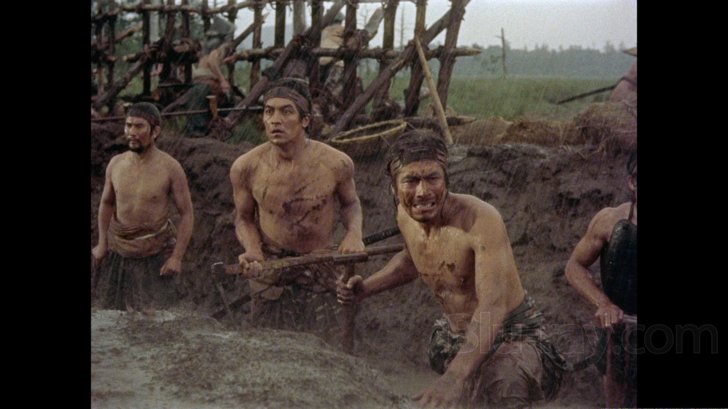
Presented in an aspect ratio of 1.33:1, encoded with MPEG-4 AVC and granted 1080p transfers, Hiroshi Inagaki's Samurai I: Musashi Miyamoto, Samurai II: Duel at Ichijoji Temple, and Samurai III: Duel at Ganryu Island arrive on Blu-ray courtesy of Criterion.
The screencaptures included with our review appear in the following order:
1. Samurai I: Musashi Miyamoto: 1-14.
2. Samurai II: Duel at Ichijoji Temple: 15-27.
3. Samurai III: Duel at Ganryu Island: 28-39.
The following text appears inside the booklet provided with The Samurai Trilogy:
"These new high-definition digital transfers (for the three films) were created on a Spirit Datacine from 35mm low-contrast prints struck from the original camera negatives. Wherever possible, we have corrected the occasional color fluctuations inherent in the now decades-old Eastmancolor stock on which these films were originally shot. In addition, thousands of instances of dirt, debris, scratches, splices, and warps were manually removed using MTI's DRS and Pixel Farm's PFClean, while Image Systems' Phoenix and PFClean were used for small dirt, grain, noise reduction, jitter, and flicker.
Telecine supervisor: Lee Kline.
Colorist: Allan Rogers/Post Logic, New York."
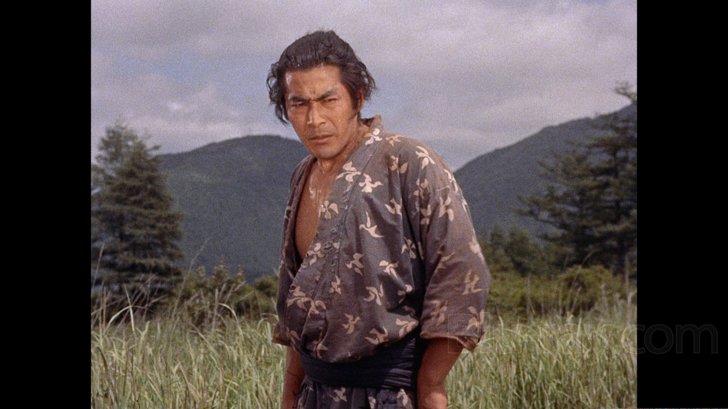
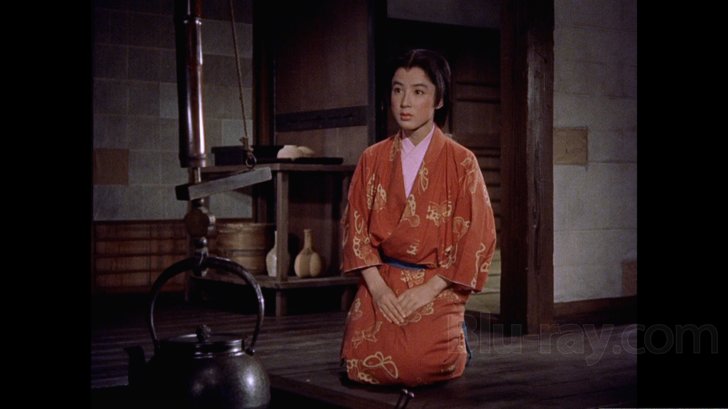
The upgrades in quality are quite impressive. Every single area we typically address in these reviews, from detail to clarity to color reproduction, reveals substantial improvements which essentially give the films an entirely new look. In fact, there are large sections of the films that look very different because of the dramatic detail and clarity improvements.
Certain limitations, however, remain. For example, grain isn't always evenly distributed, and extremely light edge flicker occasionally pops up. There are some light color pulsations as well. Virtually all of these noticeable limitations, however, are inherited. The best news is that there are no traces of problematic sharpening corrections, contrast boosting, or other lab tinkering that could have degraded the image quality. Naturally, the three films have solid organic looks. Lastly, there are no large cuts, damage marks, stains, or debris to report in this review. To sum it all up, despite some age-related limitations the three films in the collection have benefited enormously from the transition to Blu-ray and undoubtedly look the best they ever have. (Note: The two Blu-ray discs in the collection are Region-A "locked". Therefore, you must have a native Region-A or Region-Free PS3 or SA in order to access their content).
The Samurai Trilogy Blu-ray Movie, Audio Quality
Each of the three films in The Samurai Trilogy arrives with a Japanese LPCM 1.0 audio track. For the record, Criterion have provided optional white English subtitles for each film.
The following text appears inside the booklet provided with this release:
"The original monaural soundtracks were remastered at 24-bit from the 35mm optical positives. Clicks, thumps, hiss, and hum were manually removed using Pro Tools HD. Crackle was attenuated using AudioCube's integrated workstation."
The lossless tracks for the first and third films are very good. Generally speaking, the dialog is clean, stable, and free of distortions. Ikuma Dan's music score has also benefited from the lossless treatment, particularly when some of the traditional string instruments have important solos. In the second film, however, I noticed some light to moderate mid-range hiss that plagues the dialog from time to time. It is not overly distracting, but it is fairly easy to hear. There are no audio dropouts.
The Samurai Trilogy Blu-ray Movie, Special Features and Extras
Disc 1
- On Musashi Miyamoto, Part I - in this interview, translator and historian William Scott Wilson (The Lone Samurai) discusses the legacy of the real Musashi and some of the key events chronicled in the first film in the trilogy. The interview was conducted by Criterion in 2012. In English, not subtitled. (9 min, 1080p).
- Trailer - original trailer for Samurai I: Musashi Miyamoto. In Japanese, with optional English subtitles (3 min, 1080i).
- On Musashi Miyamoto, Part II - in this interview, translator and historian William Scott Wilson discusses Musashi's challenge of the leader of the prestigious Yoshioka School and the type of life the legendary swordsman led (which was unlike the one many samurai desired at the time). The interview was conducted by Criterion in 2012. In English, not subtitled. (8 min, 1080p).
- Trailer - original trailer for Samurai II: Duel at Ichijoji Temple. In Japanese, with optional English subtitles (4 min, 1080i).
- On Musashi Miyamoto, Part III - in this interview, translator and historian William Scott Wilson discusses the legendary duel between Musashi and Kojiro and the profound effect the event had on the legendary swordsman. The interview was conducted by Criterion in 2012. In English, not subtitled. (10 min, 1080p).
- Trailer - original trailer for Samurai III: Duel at Ganryu Island. In Japanese, with optional English subtitles (4 min, 1080i).
- Booklet - 24-page illustrated booklet featuring Stephen Prince's essay "Musashi Mifune" and William Scott Wilson's "The Book of Five Rings".
The Samurai Trilogy Blu-ray Movie, Overall Score and Recommendation
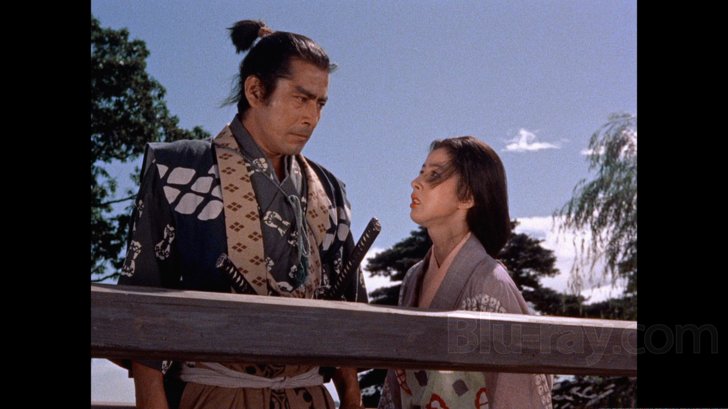
Anyone who has previously seen Criterion's DVD releases of Hiroshi Inagaki's classic films will be enormously impressed with the films' transition to Blu-ray. Frankly, now there are entire sections of the films that look quite different because of the dramatic improvements in quality. Criterion have also included three new very informative interviews for each film with translator and historian William Scott Wilson. HIGHLY RECOMMENDED.