The Quatermass Xperiment 4K Blu-ray Movie
HomeThe Quatermass Xperiment 4K Blu-ray Movie 
The Creeping Unknown | Limited Edition / 4K Ultra HD + Blu-rayHammer Films | 1955 | 1 Movie, 2 Cuts | 82 min | Rated BBFC: PG | Jun 09, 2025

Movie rating
7.1 | / 10 |
Blu-ray rating
| Users |  | 0.0 |
| Reviewer |  | 5.0 |
| Overall | | 5.0 |
Overview
The Quatermass Xperiment 4K (1955)
At the dawn of the space age the British Rocket Group launches three astronauts on an experimental mission. Their ship, Quatermass 1, loses radio contact with Earth and later crash-lands. Professor Bernard Quatermass is one of the first on the scene, and is intrigued to discover that two of the crew are no longer aboard. It soon becomes clear that the mission's sole survivor, Victor Carroon (Richard Wordsworth), is desperately ill - he is rapidly consumed by the parasitic alien organism that killed his fellow astronauts.
Starring: Brian Donlevy, Jack Warner (I), Margia Dean, Thora Hird, Gordon JacksonDirector: Val Guest
| Horror | Uncertain |
| Sci-Fi | Uncertain |
Specifications
Video
Video codec: HEVC / H.265
Video resolution: 4K (2160p)
Aspect ratio: 1.85:1, 1.66:1, 1.37:1
Original aspect ratio: 1.66:1
Audio
English: LPCM 2.0 Mono
English: DTS-HD Master Audio 5.1
Italian: DTS 2.0
German: DTS 2.0
Subtitles
English SDH, French SDH, German SDH, Italian SDH, Spanish SDH
Discs
Blu-ray Disc
Five-disc set (5 BDs)
4K Ultra HD
Playback
Region B (A, C untested)
Review
Rating summary
| Movie |  | 4.5 |
| Video |  | 4.0 |
| Audio | | 4.0 |
| Extras | | 5.0 |
| Overall | | 5.0 |
The Quatermass Xperiment 4K Blu-ray Movie Review
Reviewed by Justin Dekker June 12, 2026Hammer's landmark project that brought the BBC television sensation to the big screen in 1954 arrives on 4k UHD disc in 'The Quatermass Xperiment: Collector's Edition 4K' courtesy of Hammer Films. The sprawling five disc set (two 4K UHD discs and three Blu-ray discs) are loaded with a wealth of on-disc and printed supplemental material, including presentations of with the film in multiple aspect ratios with multiple commentaries, two cuts of the film, a graphic novel, a perfect-bound book with extensive writing on the film, and a Blu-ray presentation (in SD) of the surviving episodes of the original television serial. Discs #1-4 (which include the 4K and Blu-ray presentations of the film along with many extras) are Region-free, but the fifth disc, the Blu-ray housing the television episodes of 'The Quatermass Experiment' is Region B "locked", so viewers outside that territory wishing to enjoy that content will need a Region-free Blu-ray player to do so.
British cinematic science fiction was in a strange state in the early 1950s. Hammer, for their part, had put forth three serious and solid offerings early in the decade, each of which were helmed by Terence Fisher. 1952 would see his Stolen Face with its far-flung surgical solution to crime which also served as a means for the film's Dr. Philip Ritter to exert his control over women and craft a receptacle for his lustful urges. Space wasn't on the menu, but science, however questionable, was certainly in the mix. 1953's Four Sided Triangle would again see terrestrial science take center stage as another man sought to solve his romantic woes through a process that is essentially cloning, but somehow he's strangely shocked when the copy of his ideal woman has similar tastes in men to the original, which is to say not him. It's no small wonder that science was ill-matched in serving as the basis for such vaguely disturbing affairs of the heart. The science here was beyond the grasp of actual practitioners in 1950s, and remains so even seventy years later. But, none of the characters in either of these films ever had their sights set on distant planets with lands and beings different from our own.
Fisher's Spaceways from 1953 would change that to a degree. While most of the events in the film are concerned with getting a ship into space and an Earth-bound mystery having to do with the era-appropriate threat of spying, the film does take viewers into space for a few minutes near the film's end, as smoke and danger abound and threaten the success of both the flight and the lives of the two crew members. It's serious stuff, but true science fiction isn't its main focus - it's a mystery that is found at the film's core. Love, or a version of it, would come back to the fore in a pair of more spacey pictures from the middle of the decade, 1954's Devil Girl From Mars and 1956's Fire Maidens from Outer Space. In both of these films, it's the women who are in pursuit of love, with a war between men and women resulting in the need for new male breeding stock in Devil Girl, and no men of a suitable age being left in a population on the verge of extinction in Fire Maidens. Of the two, Fire Maidens spends more time in space, however much of what we see of that film's "alien world" looks like some pretty standard countryside on our own planet. Amazingly, the women here are no more sensitive or emotionally intelligent than the questionable men in Stolen Face or Four Sided Triangle.
Knowing a good thing when they saw it, Hammer was keen to leverage the success of the original Quatermass six-part television series from 1953, with director Val Guest famously being given a treatment of the project to take with him on vacation to get the ball rolling as quickly as possible. Challenges arose, not only with condensing the television serial down to approximately 80 minutes, but also with regard to casting. The involvement of producer Robert Lippert meant the injection of American actors into what was previously a very British affair, a move which ruffled a few feathers. However, all these years later, it is hard to imagine the film without Brian Donlevy's brusque and bullying performance as Professor Quatermass, as he takes charge of situations about which he has no definitive knowledge, and is willing to gamble with the lives of others to forward his own goals.
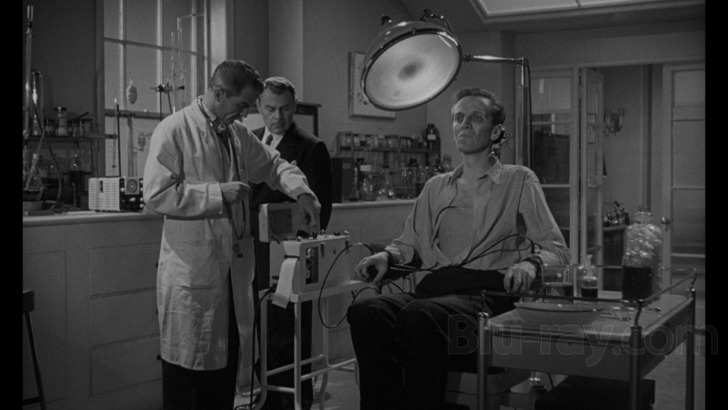
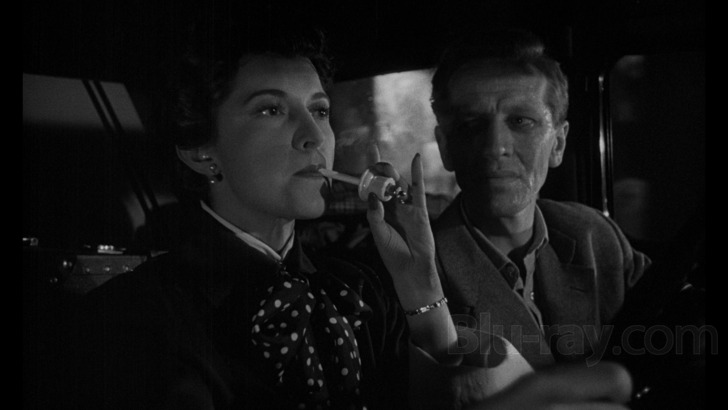
As engaging and unusual (given the role) as Donlevy's performance is, it's Richard Wordsworth's portrayal of the doomed astronaut Victor Carroon that the most integral to the film's success. It also bears some resemblance to Karloff's in the Universal classic Frankenstein. Like Karloff, Wordsworth was 5'11", though here, based on the angles from which he's shot, he frequently looks much taller. His body is lanky, his features are gaunt, and his eyes are sunken and haunted, much as Karloff's were. His gait, while not quite as halting as Karloff's Monster, is no more certain or brisk. Both films also feature a slow, tense moment as their monsters meet a young girl at the water's edge. Both of the creatures are alone at this point in their stories; they're frightened, aware of their "otherness", and on the run. But while Karloff's Monster was a simpler creature which all but assured a tragic outcome of his chance encounter, Carroon's creature could still muster enough of his previous self to flee before he harmed the youngster, although there was, in point of fact, already blood on his hands. As he sits in his hospital bed, Victor looks almost as lifeless as The Monster did before lightning gave him the spark he needed. In Victor's case, it's an alien entity that worked its magic in the depths of space that is the cause of this "new life" instead of an ambitious scientist. But it's likely no coincidence that, in an interesting inversion of the Frankenstein film, it's electricity that would spell this otherworldly monster's ultimate doom. The "X" certificate film offered a thoughtful and deft mix of science fiction for adults with a dose of horror, and it's title, The Quatermass Xperiment (underline for emphasis), would remind audiences of that fact. A classic in its own right, Quatermass's box office success against a budget that was just north of £40,000 laid the groundwork for the studio's most famous horror output which was just over the horizon and a host of "X" certificates to come along with them.
The Quatermass Xperiment 4K Blu-ray Movie, Video Quality
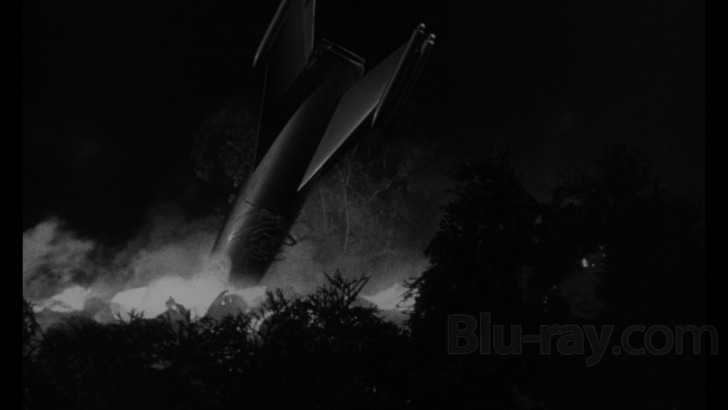
Though the original camera negative has been lost and was therefore not an available source for the basis of Hammer's restoration, they were able to
obtain elements that are one generation removed from it to serve as the work's foundation. Those elements are a 35mm fine grain master that was
held by the BFI. After scanning and extensive restoration where once again density fluctuations were the cause of rampant flickering, the film received
and HDR grade with Dolby Vision, with three different aspect ratios and two distinct cuts. The results are as impressive as any fan of the film could
hope. Fine grain is present and well managed for the duration. Detail levels are impressively high, with viewers able to appreciate the finish and
grillwork of the van in which the team arrives to the landing site, the components of the radio used while they're in the field, the equipment in the labs,
and, of course, in the make-up effects that chart the doomed astronaut's transformation and in the creature effects shots at the film's climax.
Stonework is rough, wood grains are visible, and the creature is pleasingly gooey and slimy. Facial particulars are also open for inspection, with fine
lines, wrinkles, and make-up details readily apparent. Image depth and dimensionality are excellent and invite the viewer into the film's world. Blacks
are deep and inky with whites being more than acceptable. I did not detect and dirt, damage, judder, or any other defect. It's a beautiful transfer.
Screenshots 1 - 10 1.66:1 are taken from the UK Theatrical version.
Screenshots 11 - 20 1.37:1 are taken from the As-Filmed version.
Screenshots 21 - 30 1.85:1 are taken from the US Theatrical version.
Screenshots are sourced from the 4K UHD discs and downscaled to 1080 and are in SDR.
The Quatermass Xperiment 4K Blu-ray Movie, Audio Quality
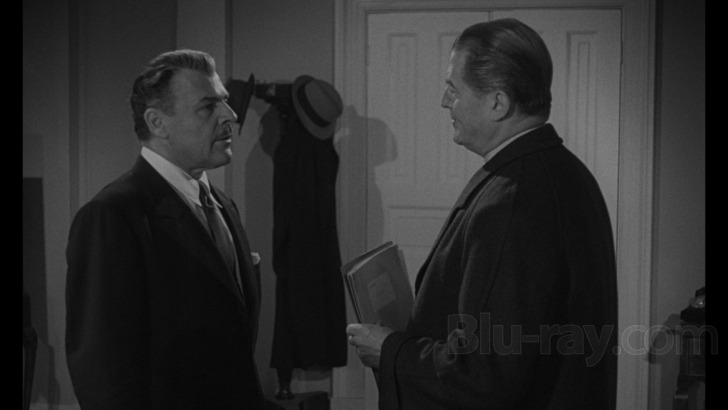
Hammer's release of The Quatermass Xperiment has been outfitted with two English audio options, a modern and newly minted 5.1 DTS-HD
Master Audio track crafted by using AI to strip the dialogue from the mono mixed soundtrack, and pushing music and effects into the surrounds, and a
more vintage 2.0 track. After watching the film with the new 5.1 track, I found it to be one of Hammer's best efforts among all of their recent releases
for which they have performed this work. The presentation is still rather front-heavy, all things considered, though there are moments, such as the in
the field where the craft lands at the film's start, where sounds from the area, such as voices, water from the hoses, and the like, place the viewer in
the mix of the bustling action. Music also emerges from the surrounds, and builds and fades nicely, smoothly entering and leaving without being jarring
or intrusive. Sound effects, such as knocks at doors, are well placed in the field as well. Viewers are able to easily track objects such as characters and
vehicles though the space. It's a well-done track.
The 2.0 track provides a more authentic viewing experience. While the 5.1 track offers a degree of finesse, the 2.0 track is more straightforward and
assertive. Voices are properly prioritized and well-rendered, with only the slightest sibilance issue popping up in Donlevy's aggressive performance.
Sound effects are credibly reproduced, and though it is a science fiction film, most of the sound effects required are of a more terrestrial and mundane
nature, with fire trucks providing some of the most "exotic" sounds. The pensive strings that populate the track are delicate and precise, as are the
various other instruments used for Bernard's score and sound era-appropriate. While my default is to opt for the original audio track, and while both are
well done, in this instance, I would be inclined to select the new 5.1 DTS-HD MA track for subsequent viewings of the landmark film.
The Quatermass Xperiment 4K Blu-ray Movie, Special Features and Extras
Hammer's The Quatermass Xperiment: Limited Collector's Edition 4K is massive, with much of its footprint being driven by an enormous
amount of printed and on-disc supplemental material as detailed below.
Disc One
Widescreen 1.66:1 Theatrical Version Viewing Options
- Play as 1955 Premier with The Eric Winstone Bandshow - An option to recreate the original viewing experience, the film plays after this segment. Produced and directed by Michael Carerras, the band works through several musical numbers, some instrumental, and others featuring guest artists Alma Cogan, and The George Mitchell Singers, and Kenny Baker. The source material shows its age but is in good shape.
- 2024 Commentary featuring Toby Hadoke, Andy Murray, and Wayne Kinsey - The trio begins with Andy Murray and Wayne Kinsey discussing the origins of the project, and director Val Guest's approach to the material. Hadoke serves as a moderator, but also adds a fair amount of information himself. Locations used in various shots are discussed, as are the matte paintings of contributed by Les Bowie, and the sets, many of which are reused and redressed from other Hammer films. Star Brian Donlevy's casting and performance is discussed at length, and the differences between the Quatermass character and other characters as well in the television series and the film. Neale himself becomes a focus, as does the impact the film had on Hammer and how its success leads indirectly to the studio's future horror output. James Bernard's score, the first of several he would write for Hammer, eventually comes into focus. The track is both entertaining and richly informative.
- 2024 Commentary Featuring Stephen Bissette - Bissette begins by quoting from Wayne Kinsey's work to provide a very thorough background on Robert Lippert, tracing his career from his early days working in, and then owning a number of cinemas before he got into production, and his relationship with exclusive/Hammer. It's original theatrical screening dates are discussed, as is the film's television debut in the US and the UK. He moves on to reviews published at the time of its theatrical release, including a a scathing assessment from François Truffaut, which comes of as sexist and dismissive of the whole of British cinema. While the author makes the text noteworthy, his words reveal more about the man the film that is his focus, and his contempt comes off as bordering on the comedic. Bissette's comments covers other subjects as well, and are based on his research, with an assist from several colleagues.
- 2003 Commentary Featuring Val Guest and Marcus Hearn - This commentary track previously appeared on Kino's release of the title back in 2014.
- The Legend of Nigel Kneale: Part One (42.32) - Hosted by Toby Hadoke, he explores Quatermass, the terror- inspiring qualities of the story, and it's author, Nigel Kneale. Writer Andy Murray joins him to discuss his memoires of watching Quatermass and the Pit and its impact on him. Murray shares some audio recordings of a conversation with him, and provides a profile of the Nigel Kneale he knew and documented in a his biography of the author. Murray traces Kneale's life from his sickly boyhood to his first jobs writing for television, and how he came to write The Quatermass Experiment. The audio recordings also cover some information about his experience with the work being turned into a Hammer film. He also discusses Kneale's television adaptation of Orwell's Nineteen Eighty-Four and the popularity it brought to him and its star, Peter Cushing. Later, he's joined by writer and researcher Brontë Schlitz, author and cultural theorist Dr. Tom Attah, and tv and film writer Joel Morris as they share their thoughts on the writer and his work. Jane Asher, an eight-year-old actor in the original film recounts her experiences working on the project, and her time with Kneale while she worked with him on The Stone Tape.
- The Eric Winstone Bandshow (29.22) - Produced and directed by Michael Carerras, the band works through several musical numbers, some instrumental, and others featuring guest artists Alma Cogan, and The George Mitchell Singers, and Kenny Baker. The source material shows its age but is in good shape. This feature allows viewers to enjoy this feature by itself without flowing directly into the film.
- The Eric Winstone Bandshow Trailer (1.08) - A vintage trailer for the above content.
- The Eric Winstone Bandshow Censor Card (0.14)
- Monstrous (5.53) - Stepehn Bissette weighs in on Hammer make-up artist Phil Leakey, and this segment features information that would not fit into his commentary due to time considerations. He reveals that much of the material used for the more human transformation effects were made from items and materials found in Leakey's home.
- Super 8 Cutdown 1 (26.48) - This unrestored vintage material provides views with a look at how the films would have been enjoyed at home.
- Super 8 Cutdown 2 (mute) (14.01) - This is a shorter and soundless cut of the film.
- Germain Titles: Shock! (1.10) - The opening credits sequence in German and bearing the title "Shock!".
- UK Censor Card (0.10) - The censor card confirms that this film is rated "X" and that no one under 16 will be admitted.
- 2025 Commentary Featuring Constantine Nasr and Dr. Steve Haberman - Only partly beholden to the on-screen action, the script receives focus in the early goings here, especially the differences between the film and the television series, as does Val Guest's shooting style. Anthony Hinds and Robert Lippert become a topic of discussion, and the pair spend a great deal of time addressing the "found footage" elements shot aboard the doomed space ship, and its innovative and reasonably inexpensive rotating set. They discuss the film's popular reception, its double-feature pairing with The Black Sleep, its far-reaching impact on science fiction, and various critical reviews. The creature effects are discussed, as is Donlevy's performance and, in particular, his final moments on the screen here. It's a very informative track.
- Unstoppable (37.01) - Nigel Kneale biographer Andy Murray, Toby Hadoke, Stephen Volk, and others discuss the man, his work, and the "X certificate". Hammer's studios and the shooting locations used are also a focus, as is the shooting schedule, the score, and the impact the film had on the studio.
- The Creeping Unknown Trailer (2.10)
- The Creeping Unknown Widescreen Trailer (2.10)
- The Creeping Unknown Textless Trailer (2.10)
- Alternative US Titles: Shock! (1.10)
- Val Guest 2000 Interview (1:05.15) - Stephen Gallagher interviews director Val Guest at the Festival of Fantastic Films, and begins with questions about Guest's childhood and his earliest cinema heroes and experiences, with Guest mentioning an early encounter with Valentino. His entry into the film industry is discussed before the pair move on to Guest's films. The audience in attendance is eventually given the chance to ask their own questions of the director.
- Val Guest 2003 Interview (7.52) - Guest covers how he began work on The Quatermass Xperiment, his work prior to the film, the film's rating, and his approach to filming the feature. The differences between the series and the film are also quickly discussed.
- Patient Zero (19.47) - James Swanton shares his thoughts on the film's star, Richard Wordsworth, his career, and his own more contemporary interpretation of Wordsworth's role.
- Image Gallery (8.33) - Images auto-advance accompanied by the film's score.
- Exhuming 'The Quatermass Xperiment' (4.09) - Hammer's Mark Stanborough discusses the quest for the best available film elements and its aspect ratios, before Silver Salt's Anthony Badger shares the approach to massive task of restoring the film. The differences between the US and UK versions, and the included audio tracks are also discussed. Silver Salt Colorist Ray King briefly discusses the color grade.
Discs 3 and 4: Blu-rays that repeat the programming of discs 1 and 2.
Extras Disc 5: Blu-ray with standard definition content): The Quatermass Experiment Surviving BBC Episodes
- Episode One: Contact has Been Established
- Episode Two: Persons Reported Missing
- Time Shift: The Kneale Tapes (39.54) - In this segment, Jeremy Dyson, Mark Gatiss, Kim Newman, and Neale himself look back at Neale's impactful career that included television adaptations of works like George Orwell's Nineteen Eighty-Fourand, of course, The Quatermass Experiment.
- Cartier & Kneale in Conversation (11.02) - Producer/Director Rudolph Cartier and writer Nigel Kneale discuss The Quatermass Experiment and the the ways in which the project defied convention.
- Making Demons (7.08) - Visual Effects Supervisors Jack Kine and Bernard Wilkie talk about the projects they worked on together, beginning with Nineteen Eighty-Four and showcase some of their creations.
- 'Quatermass and the Pit' Omnibus Titles (2.11) - The title sequence for "an Omnibus Edition in two parts of the serial by Nigel Kneale".
- Photo Gallery (3.14) - Stills and other material from the television series auto-advance in silence.
- PDF Material (via PC or Mac) - Scripts from the missing episodes are available by placing the Blu-ray disc into a compatible drive.
- Lobby Card Reproductions - A collection of eight lobby cards.
- Double-Sided Poster - One side features a reproduction of the original artwork for The Quatermass Xperiment while other captures the American iteration, The Creeping Unknown.
- 'The Quatermass Xperiment' Graphic Novel - Reprinted from the pages of The House of Hammer magazine, this 51-page perfect-bound book allow fans to experience the tale another way.
- The Quatermass Papers Volume One - This 176-page perfect bound book features extensive writing on the film, its origins, and the studio that brought the influential science fiction movie to the big screen
The Quatermass Xperiment 4K Blu-ray Movie, Overall Score and Recommendation
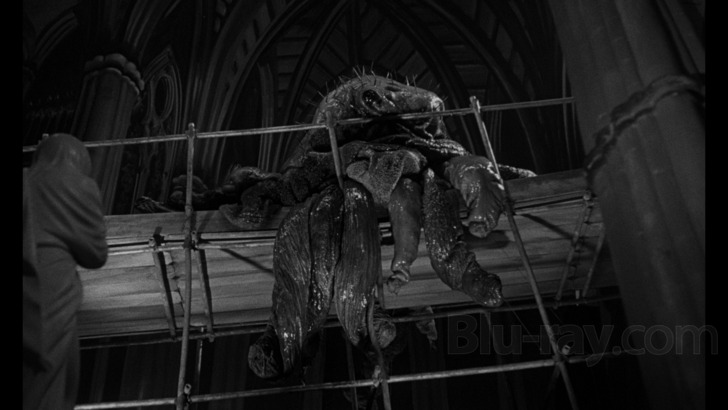
Moody and tense, The Quatermass Xperiment offered space-based thrills without ever really leaving our planet's surface, though a bit of "found footage" does technically check that box. The familiar is made eerily foreign with the reinsertion into our world of astronaut Victor Carroon, a man who looks like us but increasingly isn't us. We're as terrified as he is at his transformation, and our reaction to him mirrors that of his wife and ultimately of Quatermass as he seeks to destroy him. Donlevy's performance as the surly Professor Quatermass is certainly memorable, but it is Richard Wordsworth's almost wordless portrayal of Victor Carroon that provides the film with its essential heart, as he crafts a monster that is every bit as sympathetic as Karloff's from decades before. Hammer's work on the film is simply splendid, and it looks and sounds its absolute best. With hours upon hours of supplemental material, both on-disc and in print, The Quatermass Xperiment: Limited Collector's Edition 4K is the film's definitive release and it earns my highest possible commendation.
Similar titles
Similar titles you might also like

Quatermass 2 4K
Enemy From Space | Limited Edition
1957

It Came from Outer Space
1953

The Thing from Another World!
1951

It! The Terror from Beyond Space
1958

Quatermass and the Pit
Five Million Years to Earth
1967

20 Million Miles to Earth
Indicator Series
1957

Night of the Creeps
Eureka Classics
1986

The Blob
1958

Invaders from Mars
1953
The Monolith Monsters
Eureka Classics
1957

Creature from the Black Lagoon 3D
60th Anniversary Edition
1954
The Giant Claw
1957

The Cloverfield Paradox
2018

Invasion of the Body Snatchers
1956

X the Unknown 4K
Collector's Edition
1956

Galaxy of Terror
1981

The Incredible Melting Man
1977

Creature
Titan Find
1985

Attack of the 50 Ft. Woman
Warner Archive Collection
1958

Inseminoid
Indicator Series
1981