The Phantom of the Opera 4K Blu-ray Movie
HomeThe Phantom of the Opera 4K Blu-ray Movie 
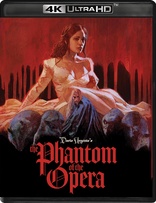
Il fantasma dell'opera / Slipcover in Original Pressing / 4K Ultra HD + Blu-rayVinegar Syndrome | 1998 | 104 min | Not rated | Feb 24, 2026

Movie rating
5.2 | / 10 |
Blu-ray rating
| Users |  | 0.0 |
| Reviewer |  | 4.5 |
| Overall | | 4.5 |
Overview
The Phantom of the Opera 4K (1998)
In Paris 1877, rats save a baby from death and raise him in the underground of the Opera de Paris. This child becomes The Phantom of the Opera, a half-human half-animal breed, who falls in love with Christine Daaé, an opera singer just beginning her career. He fights for her love against the aristocratic Baron Raoul De Chagny, though Christine loves them both equally...
Starring: Julian Sands, Asia Argento, Andrea Di Stefano, Nadia Rinaldi, Coralina Cataldi-TassoniDirector: Dario Argento
| Horror | 100% |
Specifications
Video
Video codec: HEVC / H.265
Video resolution: 4K (2160p)
Aspect ratio: 1.85:1
Original aspect ratio: 1.85:1
Audio
Italian: DTS-HD Master Audio 5.1 (48kHz, 24-bit)
English: DTS-HD Master Audio 5.1 (48kHz, 24-bit)
2.0 = 5.1 (correction)
Subtitles
English, English SDH
Discs
Blu-ray Disc
Two-disc set (2 BDs)
4K Ultra HD
Packaging
Slipcover in original pressing
Playback
Region A (B, C untested)
Review
Rating summary
| Movie |  | 2.0 |
| Video |  | 5.0 |
| Audio | | 4.5 |
| Extras | | 4.5 |
| Overall | | 4.5 |
The Phantom of the Opera 4K Blu-ray Movie Review
Reviewed by Brian Orndorf February 15, 2026For 1998’s “The Phantom of the Opera,” director Dario Argento sets out to find the horror and dark romance of the story, also co-scripting the endeavor, putting his own spin on Gaston Leroux’s 1910 tale of obsession. What Argento actually ends up with is something of a mess, with a clear line between creative intent and budgetary reality. “The Phantom of the Opera” means to be erotic and sincere, but the production often veers into extreme horror and slapstick comedy shake up the viewing experience, and Argento shows very little control over the frightfully uneven, unpolished movie. The helmer hopes to deliver an overwhelming viewing experience of sight and sound, only to end up with one of his most disappointing films.
For additional information and analysis, please read the 2022 Blu-ray review.
The Phantom of the Opera 4K Blu-ray Movie, Video Quality
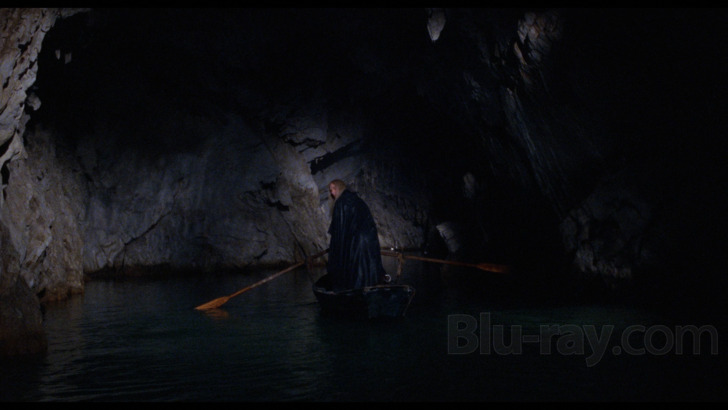
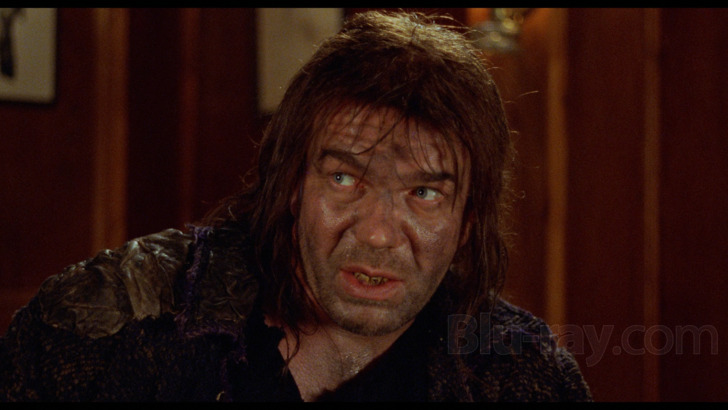
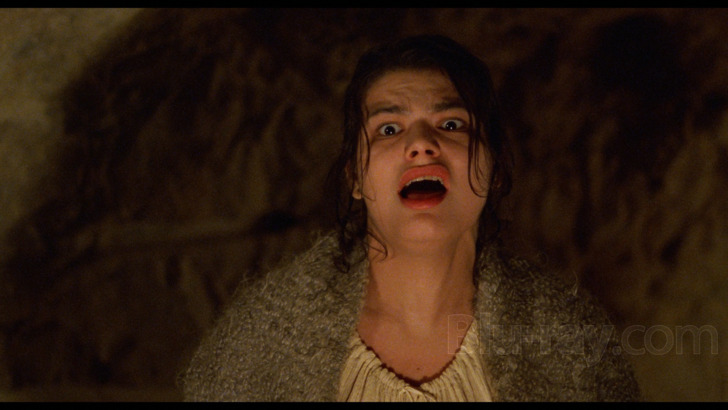
Screencaps are taken from the Blu-ray.
"The Phantom of the Opera" was last issued on Blu-ray in 2022 from Scorpion Releasing. Vinegar Syndrome returns to the title with a new UHD release,
listed as "presented in Dolby Vision HDR and newly scanned and restored from its 35mm original camera negative." Scorpion did fairly well with its
image presentation, but Vinegar Syndrome sweetens the viewing experience, delivering a more colorful picture. Hues are richer throughout, offering
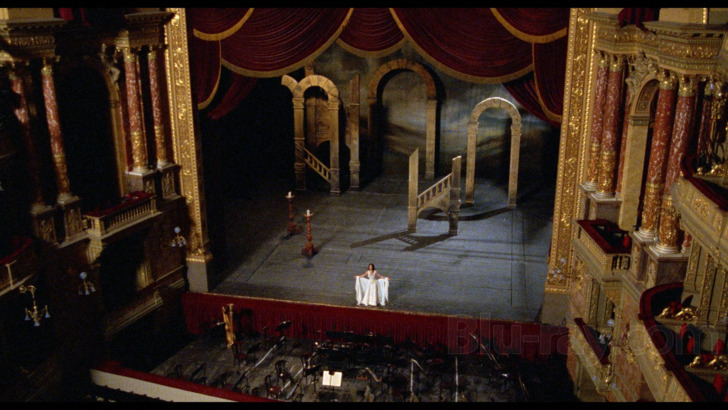
wonderfully gold views of opera house architecture. Primary power is found with costuming choices, and red blood remains vivid. Skin tones are natural,
along with rodent appearances. Trips into darker locations and moodier scenes maintain deep blacks. Highlights are tasteful. Detail is excellent,
capturing fresh skin particulars, which are plentiful in the movie. Clothing retains fibrousness and intended sheerness at times. Cave tours and opera
house rooms deliver strong dimension, handling decorative and naturalistic additions. Grain is fine and film-like. Source is a good
The Phantom of the Opera 4K Blu-ray Movie, Audio Quality
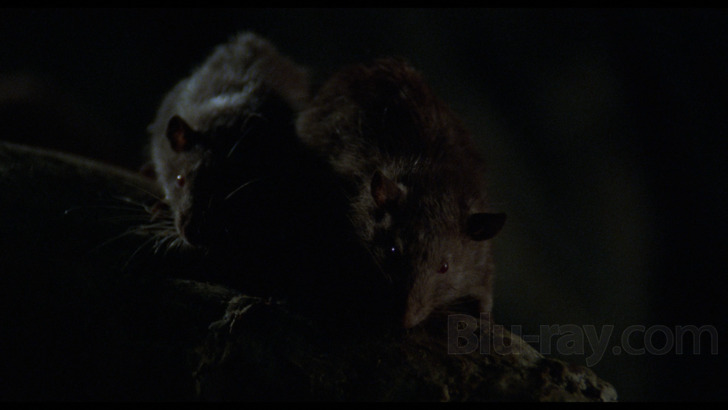
English and Italian 5.1 DTS-HD MA mixes are offered, and both are basically the same, securing clear dialogue exchanges from a wide variety of actors and accents. Differences arrive with environments, as most English dialogue was recorded on-set, creating a natural sound that's more appealing than the Italian dub. Scoring selections provides sharp instrumentation and dramatic emphasis, with warm strings throughout the listening event. Opera offerings also carry defined vocals. Surrounds explore musical moods, creating some immersive moments, and atmospherics show life with cave experiences and rodent movement. Sound effects are distinct. Low-end isn't challenged, but some elements of violence offer weight.
The Phantom of the Opera 4K Blu-ray Movie, Special Features and Extras
- Commentary features film historians Troy Howarth and Nathaniel Thompson.
- "Opera of Wounds" (19:47, HD) is an interview with special FX artist Sergio Stivaletti, who jumped into "The Phantom of the Opera" after his directorial effort on 1997's "Wax Mask," with director Dario Argento looking to cash in on interest in period horror films. The interviewee dissects technical challenges, including the creation of various rodents due to the limitations of CGI at the time. Also highlighted is the manufacturing of the rat-killing machine, which the interviewee openly admits is a bit too silly for the feature. Stivaletti walks viewers through various digital enhancements to gory events, working beyond what practical effects would allow, also examining an aborted attempt to create a "rat-man" visual that didn't quite work for Argento.
- "Like a Thunder" (20:34, HD) is an interview with film editor Anna Napoli, who tracks the development of her career, working her way into more important production roles during the 1960s and '70s. She also explains job duties and female roles in the industry, especially when dealing with the delicate ways of splicing and assembling footage. Originally connecting to Claudio Argento, Napoli was introduced to director Dario Argento, and she discusses her fandom of the director and his ability to create rowdy screenings with his movies. Moved to Budapest to edit "The Phantom of the Opera," the interviewee was in the middle of transitioning to working with computers, dealing with Argento's cinematic imagination, which took some labor to shape into horror. Napoli discusses her relationship with actress Asia Argento, earning her trust for future gigs, and she speaks candidly about the helmer's icy ways, learning to interpret his creative process.
- "Of Screams and Arias" (22:32, HD) is an interview with actress Nadia Rinaldi, who was hired for "The Phantom of the Opera" right after admitting on a television show that she can't stomach horror movies. Tasked with learning opera parts for the role, Rinaldi dived into the work, also dealing with director Dario Argento's insistence that some elements of violence were acted out for real to achieve the proper fear factor. The interviewee recalls her time in Budapest and its opera house, also offering her memories of heavy costumes and practical effects, which helped to inform her characterization. She also shares praise for Argento and his style, though she admits visual effects work in "The Phantom of the Opera" is far from perfect.
- "Behind the Red Curtain" (18:08, HD) is an interview with director Dario Argento, who shares a childhood memory of seeing a version of "The Phantom of the Opera" as a child, completely charmed by the experience. Setting out to study the novel and create a screenplay, Argento was joined by co-writer Gerard Brach, who suffered from agoraphobia, creating pages at home while the helmer visited the Paris opera for research. Originally looking to set the story during the Russian Revolution, Argento changed the setting to Paris, also detailing additional deviations from the source material. Casting is highlighted, with Asia Argento dealing with a nude scene photographed by her father, and Julian Sands needed work to overcome his extreme rat phobia. Locations are highlighted, along with work from cinematographer Ronnie Taylor, with Argento looking to Caravaggio paintings for inspiration. The interviewee also explores his hunt for the musical mood of "The Phantom of the Opera."
- "Into the Phantom Cave" (18:13, HD) is an interview with set designer Antonello Geleng, who tracks his working relationship with director Dario Argento, having originally met him while making "The Sect" and "The Church." Working mostly in Budapest, Geleng oversaw a major effort to use a theater space during non-performance hours, constantly building and dismantling sets. The interviewee discusses the rats, which he claims were painted guinea pigs, and he highlights several technical achievements, including the creation of a rat killing machine. The production used real caves for the shoot, and Geleng recalls his time in a vast network of tunnels found in Budapest, requiring a map to navigate.
- "Welcome to the Opera" (18:08, HD) is an interview with producer Giuseppe Columbo, and he recalls his first introduction to director Dario Argento, first learning of his interest in turning "The Stendhal Syndrome" into a movie. Partnering with the helmer, the pair were working to remake "Rififi" when the opportunity to have their way with "The Phantom of the Opera" arrived, changing career plans. Casting is the highlight of this conversation, as Columbo admits Julian Sands refused to play his Phantom as disfigured, and Julie Delpy was the first choice for Christine. Anthony Hopkins was also considered for a part, along with Roberto Benigni. The interviewee shares his memories of using real caves for the shoot, and goes into his eventual fallout with Argento, as a project involving the men ending their relationship, resulting in numerous lawsuits.
- "Behind the Camera" (12:28, HD) is an interview with camera operator Marco Pieroni, who admits that his "memories aren't super accurate," but he built on his achievements with the Steadicam to earn a larger role in "The Phantom of the Opera." The interviewee reflects on his time with director Dario Argento, exploring his on-set attitude and unique look, resembling a "heroin-addicted orchestra conductor." Reverence is also shared for cinematographer Ronnie Taylor, and Pieroni provides a few memories from the shoot.
- "Acts of Fear" (10:59, HD) is an interview with actor Gianni Franco, who moved from work on "Wax Mask" into "The Phantom of the Opera," delighted to be considered for a job by director Dario Argento. Praise for technical achievements are provided, and the interviewee celebrates other areas of the production, including the cast and the locations.
- Alternate English Titles (7:38, HD) are offered.
- A Trailer has not been included on this release.
The Phantom of the Opera 4K Blu-ray Movie, Overall Score and Recommendation
While one has to have some admiration for a take on "The Phantom of the Opera" that's absolutely obsessed with rat action and mutilation, but Argento can't fight the reality of the production, which is brought down by some terrible performances, unpleasantly crazy tonality, and painfully crude digital effects (some the practical ones aren't so hot either). Argento hopes to work in his usual idiosyncrasies and aggression, but he's clearly overwhelmed by the material, often struggling to sell his ideas on all-consuming fixation and manipulation. "The Phantom of the Opera" is bizarre, but not interestingly so, missing cohesiveness and stylishness as Argento attempts to generate an epic take on passion, only to stumble through the endeavor.
Other editions
The Phantom of the Opera: Other Editions

The Phantom of the Opera
Il fantasma dell'opera
1998

The Phantom of the Opera
Il fantasma dell'opera
1998