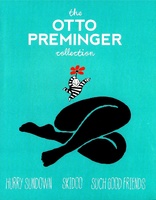
The Otto Preminger Collection Blu-ray Movie
HomeThe Otto Preminger Collection Blu-ray Movie 
Hurry Sundown / Skidoo / Such Good FriendsOlive Films | 1967-1971 | 3 Movies | 344 min | Rated R | Nov 13, 2012

Price
List price:Amazon: $38.97 (Save 44%)
Third party: $38.97 (Save 44%)
Only 2 left in stock - order soon.

Movie rating
Movie has not been rated yetBlu-ray rating
| Users |  | 0.0 |
| Reviewer |  | 3.0 |
| Overall | | 3.0 |
Overview
The Otto Preminger Collection (1967-1971)
| Drama | 100% |
| Comedy | Insignificant |
Specifications
Video
Video codec: MPEG-4 AVC
Video resolution: 1080p
Aspect ratio: 1.78:1, 2.35:1
Original aspect ratio: 2.35:1, 1.85:1
Audio
English: DTS-HD Master Audio Mono
Subtitles
None
Discs
25GB Blu-ray Disc
Three-disc set (3 BDs)
Playback
Region A (B, C untested)
Review
Rating summary
| Movie |  | 2.5 |
| Video |  | 3.5 |
| Audio |  | 4.0 |
| Extras | | 0.0 |
| Overall | | 3.0 |
The Otto Preminger Collection Blu-ray Movie Review
Summer (and Fall, Winter and Spring) Camp
Reviewed by Jeffrey Kauffman October 25, 2012Note: the scores above are averages of the three films together. See below for individual scores.
Otto Preminger loved pushing the envelope, and a number of his films, while seeming fairly passé today, were the
subject of major controversies when they were released. As incredible as it may sound, Preminger’s film version of
The Moon is Blue was the focus of a major cause célèbre due to its perceived sanguine approach toward
sex, something that will strike anyone seeing the film nowadays as positively weird. Preminger, ever the master
showman, played the controversy for all it was worth, releasing the film without the vaunted Breen office Seal of
Approval, and made the film into one of the blockbusters of the early fifties. Several more films in the fifties and sixties
caused various ruckuses. Carmen Jones featured a largely African American cast and once again toyed with
illicit seduction. A couple of years later Preminger caused headlines again when he tackled the subject of drug addiction
in The Man With the Golden Arm. 1959 saw the release of both Preminger’s film of Porgy and Bess, a
well meaning if flawed adaptation that has been tied up in rights issues with the Gershwin Estate (which hated the film)
and has rarely if ever been seen in the intervening years since its theatrical release, and what has become probably
Preminger’s most critically lauded film of this era, Anatomy of a Murder. That film created a sensation due to its then remarkably candid
discussions involving sex and rape.
While Preminger’s 1960 film of Leon Uris’ Exodus wasn’t as patently
controversial as some of his previous works, it continued Preminger’s tendency of being an agent provocateur,
at least behind the scenes, when the director started pounding the nails in the coffin of the blacklist by hiring Dalton
Trumbo under his own name to write the screenplay. Two years later Preminger offered Advise and Consent, a
film which wasn’t circumspect about portraying homosexuality in the highest levels of government. Sandwiched before,
after and in between this mere handful of films mentioned above are several other Preminger pieces, many of which are
undisputed classics in their own right (Laura) or at least highly regarded if acknowledged as being somewhat
flawed (The Cardinal). But the sixties saw a perhaps predictable decline in Preminger’s directorial fortunes, and
few would accord his later films the same accolades that were regularly bestowed on his earlier works. That said,
there’s virtually no Preminger film that doesn’t have something to recommend it, even if that something is
nothing other than camp value. The three films in this new box set may well be in that category, but they each also are
distinctive in at least a couple of other elements as well, not the least of which is the window they offer into Preminger’s
late sixties and early seventies mindset.
Hurry, Sundown
Film: 2.0 stars
Video: 4.0 stars
Audio: 4.0 stars
Camp Value: 4.0 stars
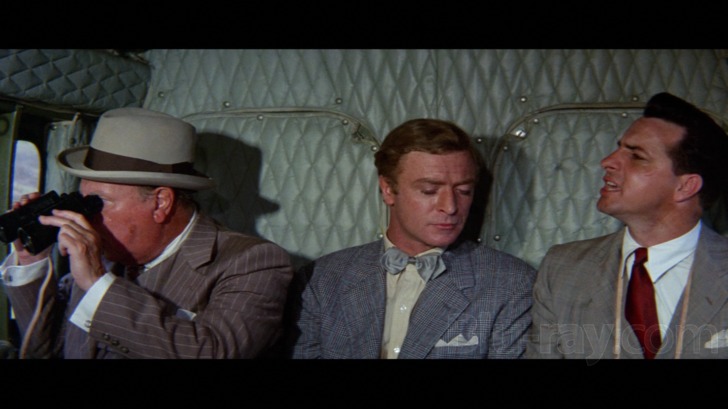
Preminger evidently optioned the novel of Hurry, Sundown before it was ever published, expecting it to be some sort of latter day Gone With the Wind. He couldn’t have been more wrong. The film, which is basically a convoluted tale of land rights woven around several family stories, both black and white, is just a patently odd combination of melodrama and outright camp. How else to properly explain Michael Caine as a greedy southern investor (and amateur saxophone player, no less) married to a coquettish Jane Fonda, whose “mammy” (the incredible Beah Richards) owns some land that Caine’s character needs to get a hold of. There’s another parcel at stake owned by John Phillip Law and his wife, hard working mother of four Faye Dunaway (in one of her first starring roles). Also on hand are Robert Hooks as Richards’ grandson, Diahann Carroll as a local teacher and Hooks’ kind of love interest, and Frank Converse as Fonda’s cousin, a newly consecrated Priest who has the temerity to serve communion to the town’s blacks right alongside the whites, angering the local judge (Burgess Meredith). (Interestingly, Hooks and Converse would go right into co-starring roles on N.Y.P.D., a great old cop show which was a brief but substantial hit for ABC in the late sixties).
The film is obviously a well intentioned attempt to illumine the horrible discrimination that blacks suffered at the hands of bigoted whites, but placing the film in the immediate post-World War II era distances it from what could have been its own era’s (1967) obviously visceral dealings with race relations. There are a number of just downright weird moments in this film, none more so than when Caine and Fonda’s afflicted child (described by Dunaway in a semi- hilarious scene as “peculiar”) just starts screaming, apparently for no reason (something that happens repeatedly throughout the film).
Hurry, Sundown made headlines of its own during production, but not for any substantial reasons. The cast evidently was near mutiny due to Preminger’s autocratic ways (Dunaway later sued to be let out of a five film deal she had signed with the director, something that evidently cost her a small fortune to settle, but which she more or less happily paid in order to never have to work with him again). Preminger also had some unavoidable issues of his own to deal with, including local Georgia racism (which to his credit, he stood up against) and a late in the shoot replacement of his cinematographer due to an injury. There's some especially haphazard editing on display throughout this outing, something that's really quite odd for a Preminger film, with some scenes just coming to an abrupt halt almost in mid- sentence as if either the director or editor wanted to get away from something really ridiculous happening. Easy listening maestro Hugo Montenegro contributes one of his very few film scores to the project, working a kind of quasi-Copland territory that is too contemporary sounding for the movie's supposed forties setting. The film can therefore only be charitably described as something of a mess.
Skidoo
Film: 3.0 stars
Video: 4.0 stars
Audio: 4.0 stars
Camp Value: 5.0 stars
To paraphrase a certain famous commercial featuring an egg frying in a pan, “This is Otto Preminger.” (Pause). “This is Otto Preminger on drugs.” Perhaps it was understandable after the disaster of Hurry, Sundown that Preminger would need to turn to mind altering drugs like LSD to recover (I jest, but only slightly), but evidently that’s exactly what happened with regard to Skidoo. And according to rumors which still fly around about the shoot of this extremely (as in extremely) odd 1968 feature, the director wasn’t alone in the sugar cube swallowing business. (Some reports indicate it may have only been Groucho Marx who consumed the drug in preparation for the film, but anyone watching Skidoo would be hard pressed not to think that Preminger was under the sway of some mind altering substance during the film.)
It’s possible to give a plot summary of Skidoo but that hardly even comes close to capturing the complete anarchy that runs rampant throughout this film. Jackie Gleason plays a retired hitman who is married to a frenetic Carol Channing. Their daughter (Alexandra Hay) has fallen in love with a hippie (John Phillip Law, evidently not having learned his lesson about working with the director). Gleason is ordered by another crime family (played by Cesar Romero and Frankie Avalon) that the city’s mob boss (Groucho Marx) has ordered Gleason to kill another mobster (Mickey Rooney) who’s being kept in a kind of high tech version of Alcatraz. That’s the basic plot of Skidoo but that’s a bit like saying War and Peace is about Russia.
There are no doubt some looking at the 3.0 star rating above and thinking this reviewer must be on some mind altering drug, but there’s a certain joyous cacophony to Skidoo that I personally find irresistible. The film is quite simply like nothing you’ve ever seen. That doesn’t necessarily make it good, mind you, and it’s frequently quite noisy and busy to absolutely no avail, but it is just so patently odd that I can’t help but like it, despite my awareness of its complete inanity. When you have Jackie Gleason dropping acid in a prison and hallucinating Mickey Rooney doing a song and dance with bags of money, you really are forced to cut the film a little slack, at least in my way of looking at things.
Skidoo has some charming songs by Harry Nilsson, and it also has two bookending elements that are quite remarkable in their own way. The opening has a pretty funny trip through late sixties television with faux advertisements (including Fat Cola), along with what is supposed to be a broadcast of Preminger’s own bloated war epic In Harm’s Way. The ending on the other hand has the credits sung by Nilsson, probably one of the few times (if not the only time) that’s happened in a major feature film.
Such Good Friends
Film: 3.0 stars
Video: 2.5 stars
Audio: 4.0 stars
Camp Value: 2.0 stars
There must be tons of people out there with a deep, burning desire to see Burgess Meredith dancing naked, and for that vast population Such Good Friends is your film! I’ll just go out on a limb and state that for the rest of us, this is a decidedly mixed bag, although whether or not you end up in the “pro” or “con” camp probably will depend on how black your sense of humor is. Much as with Hurry, Sundown, Preminger optioned the book on which Such Good Friends was based before it was published. In this particular case, his prescience paid off as the book became a bestseller and the film version was a hotly anticipated property. It still got bogged down in development hell, however, with several screenwriters attached at one point or another and eventual lead scenarist Elaine May so disappointed with the final version that she only allowed her contributions to be included under a pseudonym, which of course didn’t prevent Preminger from widely advertising the fact that May was involved anyway.
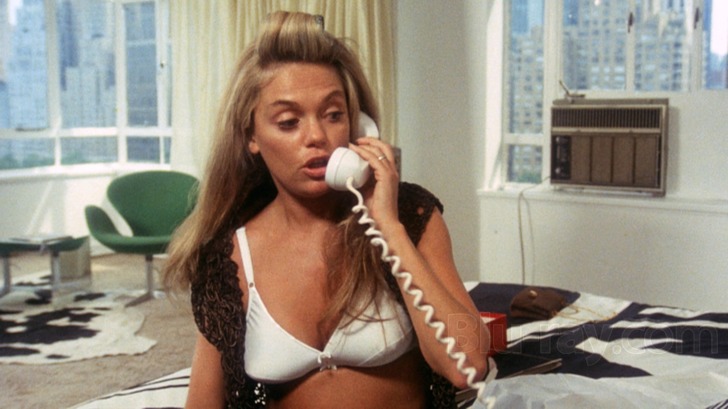
Such Good Friends concerns a harried housewife and mother played by Dyan Cannon whose husband (Laurence Luckinbill) is a best selling children’s author. He goes in for a minor medical procedure (having a mole removed), and through a series of catastrophes, ends up in a coma and on life support. That may sound like a drama, but Such Good Friends is really a very (as in very) black comedy, and if you’re properly jaded, it is quite funny a lot of the time. Cannon’s main liaison at the hospital is a kind of manic doctor played by James Coco, and he repeatedly brings in all sorts of specialists to consult who put the screws to the Cannon character in terms of signing releases and other bureaucratic nonsense while never being able to treat the problem at hand. There are a couple of viciously humorous scenes, including one fantastic one at the hospital commissary where one of the specialists “assures” Cannon that now that her husband is near death (due to so many foul ups at the hospital), he’ll finally receive decent care. It’s a stunning and rather prescient indictment of the American medical system, one that in its own way is reminiscent of Paddy Chayefsky’s vastly underrated The Hospital.
Simultaneously unfolding with the medical drama is the fact that Cannon becomes aware that her husband had been having an affair with one of her best friends (played by the incredibly lovely Jennifer O’Neill). That of course puts the once devoted wife into an emotional tailspin, which she attempts to get out of by attempting to bed O’Neill’s lover (a rather hirsute Ken Howard) and, later, the doctor played by Coco. She ultimately discovers that her husband was in fact a serial cheater and had a not very cleverly coded “little black book” that detailed his conquests, romantic assignations that include just about every bit player seen earlier in the film.
Such Good Friends probably would have been a much better film had it completely jettisoned its supposedly dramatic (some would say melodramatic) content and played everything resolutely for laughs (albeit squirm worthy laughs). The film is tonally at odds with itself, not really having the requisite daring it needs to completely exploit this blacker and black humor. As with the two previous films in this collection, this film has a rather unusual composer, at least for you Broadway fans who like to read credits. If any of you have original cast recordings from the past several decades (including several high profile pieces by Stephen Sondheim), you may recognize the name of Thomas Z. Shepard, one of the two or three leading Broadway musical recording producers of the past half century or more. This was Shepard’s only feature film work as a composer (he did one television piece as well). Really astute lovers of Broadway trivia will also recognize the film’s production designer, Rouben Ter-Arutunian, who contributed to many Broadway plays and musicals, including a couple of legendary flops like I’m Solomon.
The Otto Preminger Collection Blu-ray Movie, Video Quality
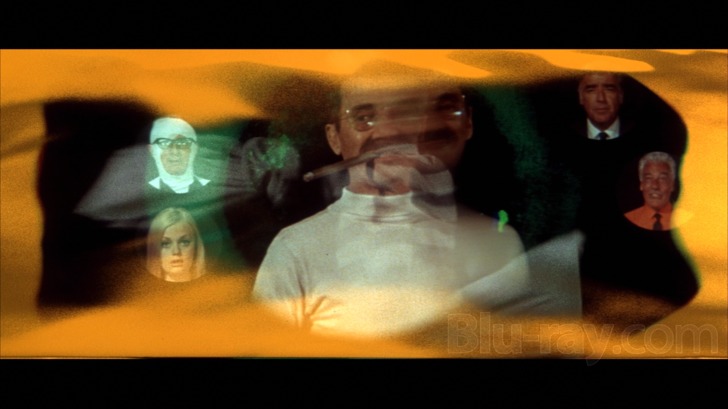
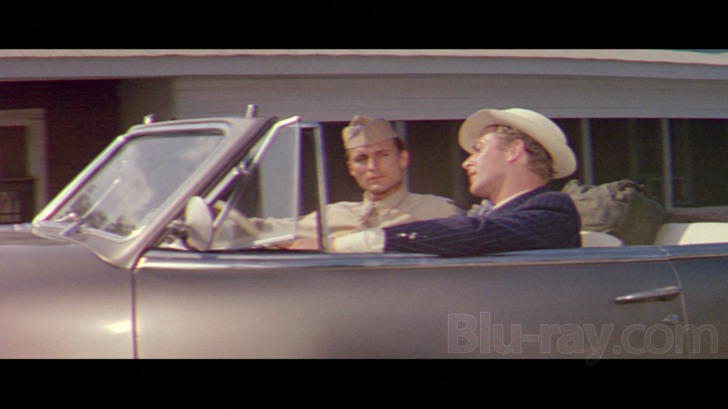
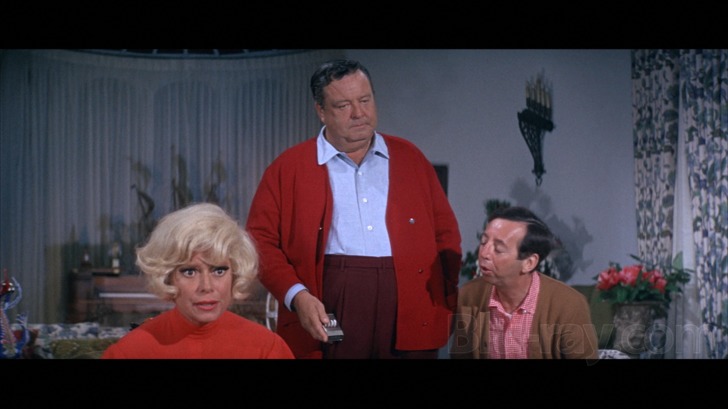
Note: screencaps 1, 4, 7, 10, 13, and 16 are from Hurry, Sundown; 2, 5, 8, 11, 14, and 17 are from
Skidoo; and 3, 6, 9, 12, 15 and 18 are from Such Good Friends.
All three of the films are delivered via AVC encoded 1080p transfers. Hurry, Sundown and Skidoo offer a
2.35:1 aspect ratio, while Such Good Friends is presented in 1.78:1. Both Hurry, Sundown and
Skidoo look very sharp and naturally filmic, for the most part, while rather strangely Such Good Friends, the
most recent of the three films, is far softer and less robustly saturated than the first two. Both Hurry, Sundown and
Such Good Friends have some really weird anomalies, where brief sequences seem to have been culled from a
second generation (at least) element. In these sequences, things suddenly get much softer and less detailed and
color is also nowhere near as saturated as the bulk of the films (see screencap 4 of Caine and Law in the car for a great
example of this phenomenon, something that also happens late in Such Good Friends in a scene featuring Elaine
Joyce in an apartment). All three films boast elements in very good to excellent shape, within certain limitations.
The Otto Preminger Collection Blu-ray Movie, Audio Quality
All three of the films feature lossless DTS-HD Master Audio Mono tracks that more than adequately recreate the rather modest sonic charms of these outings. Dialogue is very cleanly presented in all three of these films, and the music (which includes some sung elements in all three films, most notably in Hurry, Sundown and Skidoo) sounds just fine. Fidelity is very strong in all three of these tracks, though dynamic range is somewhat limited. Hurry, Sundown does have several boisterous explosions dotting its sonic landscape and Skidoo is so relentlessly frenetic it may give the impression of having dynamic range, but it's just an auditory hallucination.
The Otto Preminger Collection Blu-ray Movie, Special Features and Extras
No supplements of any kind are included on any of the three discs in this package.
The Otto Preminger Collection Blu-ray Movie, Overall Score and Recommendation
There's no denying that these three films are not exactly prime Preminger, but that doesn't mean they're worthless. Preminger's quality was frankly pretty spotty overall after his Anatomy of a Murder high, but there are glimmers of the director's innate brilliance, as well as his very pointed social justice attitudes, in all three of these films. The best of these is probably Such Good Friends, though those with an outré sense of the bizarre may well place Skidoo at the top of this particular pile for reasons only tangentially related to the film's actual instrinsic quality. I can't outright recommend this package on objective quality criteria, but I will say for certain fans, this collection is absolutely indispensable.