The Other Side of Madness Blu-ray Movie
HomeThe Other Side of Madness Blu-ray Movie 
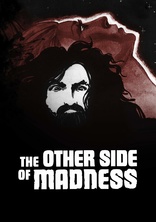
Blu-ray + CDThe Film Detective | 1971 | 81 min | Rated R | Nov 24, 2020
Price
List price:Amazon: $23.17 (Save 23%)
Third party: $23.17 (Save 23%)
Only 3 left in stock (more on the way).

Movie rating
6.7 | / 10 |
Blu-ray rating
| Users |  | 0.0 |
| Reviewer |  | 3.5 |
| Overall | | 3.5 |
Overview
The Other Side of Madness (1971)
A mixture of documentary footage and re-enactment scenes, some filmed on the action locations, of the infamous Tate-LaBianca murders committed by the gang known as the Manson Family.
Starring: Brian Klinknett, Erica Bigelow, Paula Shannon, Linda Van Compernolle, Debbie DuffDirector: Frank Howard (VII)
| Crime | Insignificant |
| Drama | Insignificant |
Specifications
Video
Video codec: MPEG-2
Video resolution: 1080p
Aspect ratio: 1.37:1
Original aspect ratio: 1.37:1
Audio
English: DTS-HD Master Audio 2.0
Subtitles
English SDH, Spanish
Discs
Blu-ray Disc
Two-disc set (1 BD, 1 CD)
Playback
Region A (B, C untested)
Review
Rating summary
| Movie |  | 2.5 |
| Video |  | 3.0 |
| Audio | | 3.5 |
| Extras | | 3.5 |
| Overall | | 3.5 |
The Other Side of Madness Blu-ray Movie Review
Reviewed by Brian Orndorf November 23, 2020There have been many movies and television programs devoted to the exploits of the Manson Family. Just last year, for the 50th anniversary of the Tate-LaBianca Murders, the film industry issued three pictures about the event, with two compelling overviews (“Once Upon a Time in Hollywood” and “Charlie Says”) and one that was compete garbage (“The Haunting of Sharon Tate”). The particulars of cult power and ghastly crimes has been catnip to the storytellers for decades, but 1971’s “The Other Side of Madness” is unique due to its timing. Director Frank Howard and producer Wade Williams jumped at the chance to explore the grim ways of the Manson Family before trials were even completed for the killers, giving them a shot to capitalize on a gruesome story, giving the gods of exploitation cinema an offering of in-the-moment horror. Of course, Howard and Williams forgot to create a screenplay for their endeavor, making “The Other Side of Madness” more of a curiosity than a compelling sit, with the feature mostly wandering around the era, going procedural without getting too specific about anything.
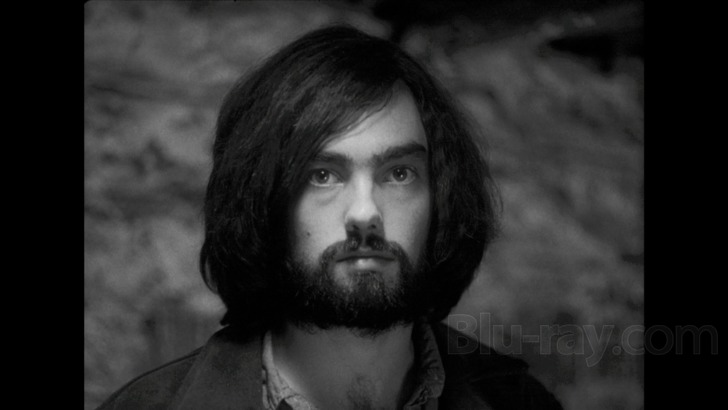
“The Other Side of Madness” doesn’t provide an overall explanation of Charles Manson and his followers, with the “photoplay” electing to sniff around numerous ideas connected to the Tate-LaBianca murders. We meet members of the “family” as they prepare to storm Sharon Tate’s home on Celio Drive, but Howard doesn’t use introductions to fuel a story about growing darkness. He tries to keep the movie in the realm of journalism, with the opening of the effort declaring that all information was taken from news reports and trial information. He also visits the courtroom to provide some type of structure, using testimony to fuel flashbacks to the development of hippie hysteria, highlighting how broken minds were pulled into Manson’s orbit. “The Other Side of Madness” initially promises a study of brainwashing and evil, but Howard and Williams seem more interested in the sellable aspects of hippie culture. There’s no examination of behavior, just the highlights of free living, including the distribution of drugs, musical performances, and nudity. It’s hard to take anything this picture offers seriously when it includes a two-minute-long sequence of hippies bathing in a lake. It’s here where the true intent of the endeavor is exposed.
The exploitation interests of “The Other Side of Madness” are pronounced, especially when the moviemakers are terrified of getting too close to the case, refusing to use any real names to avoid lawsuits. The details of Manson’s reign are clouded as well, served up with vague visuals of follower submission and voiceover from Manson and his rambling ways. The picture becomes a study of secretive movement, tracking the Family as they make their way up Celio Drive and execute those residing at Tate’s residence. And that’s pretty much it for content in “The Other Side of Madness,” save for some race war embellishment and a study of Tate’s development as a model and film actress, with Howard breaking the black and white look of the feature with use of color to showcase Tate’s glamour and beauty. Her actual life is of no use to the production.
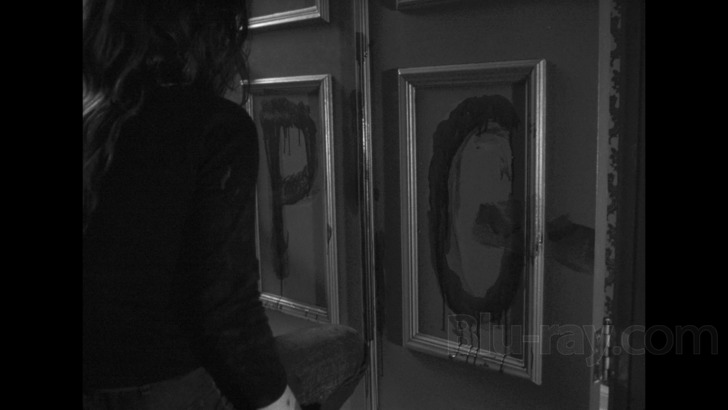
The rest of “The Other Side of Madness” recreates the Tate-LaBianca Murders, though without much of a budget to do anything besides rehash horrors best left to the imagination. The movie becomes amateur actors threatening other amateur actors, without necessary dimension to grab viewers with something more than staring contests. “The Other Side of Madness” is the first production out of the gate to examine the Tate- LaBianca Murders, but it only provides flat summation of death, showing little respect for lives taken as it quests to be nothing more than a drive-in diversion (the use of Manson’s real music on the soundtrack only adds ickiness to the endeavor).
The Other Side of Madness Blu-ray Movie, Video Quality
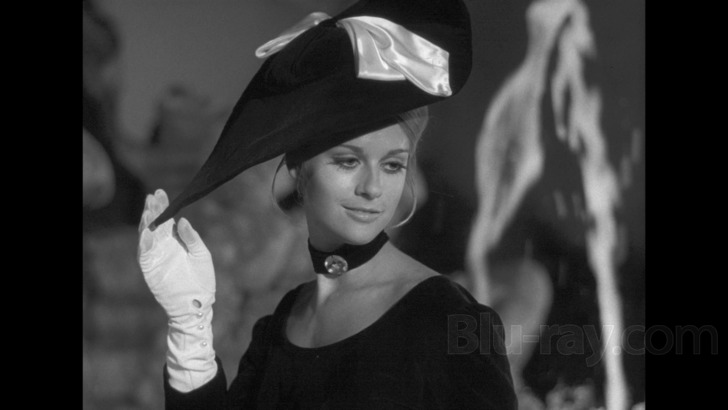
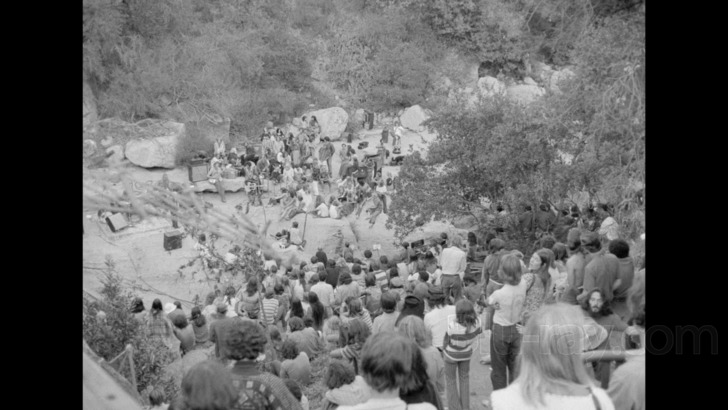
"The Other Side of Madness" comes to Blu-ray via a rare MPEG-2 encoded image (1.37:1 aspect ratio) presentation, which can't always handle the visual experience the production aims to offer. Detail comes through satisfactorily, highlighting scruffy facial particulars and full body displays. Exteriors retain dimension, and depth is found in courtroom sequences. Textures remain with decorative additions and costuming. Black and white cinematography delivers acceptable balance, while color additions come through with brightness and some level of age-related fade. Grain is fine and film-like. Compression issues are common throughout, delivering varying levels of banding and posterization. Source has surges of wear and tear, with speckling, scratches, and rough reel changes detected.
The Other Side of Madness Blu-ray Movie, Audio Quality
The 2.0 DTS-HD MA mix for "The Other Side of Madness" is a basic overview of the feature's sloppy sound assembly. Dialogue exchanges are simple and intelligible, and inherent sync issues are easily spotted. Music offers a bit more force with some fuzziness, with rock songs hitting harder, providing deeper percussion and buzzsaw guitars. Hiss is present throughout the listening event, and loud popping is periodic.
The Other Side of Madness Blu-ray Movie, Special Features and Extras
- Booklet (10 pages) contains an essay from Alexander Tuschinski.
- CD Soundtrack contains two songs from Charles Manson: "Mechanical Man" and "Garbage Dump."
- "The Other Side of Manson" (15:50, HD) is an audio interview with producer Wade Williams, who recalls the origins of "The Other Side of Madness," making friends with director Frank Howard, with the pair taking their love of film collecting to an actual production. With the Manson Murders still fresh in the news, the men decided to create a quickie offering to capitalize on the horror, finding ways around legal entanglements to stay out of trouble. Casting highlights are shared, with some of the amateur performers pulled directly from hippie compounds. While the bulk of the picture was shot in Kansas City, Howard and Williams made the trek to L.A. to collect some sights, making their way up Cielo Drive and spending time at the Spahn Ranch, capturing the last days of the infamous movie set. Running out of money, Williams worked to sell the endeavor in a hurry, finding a buyer for markets overseas, while the U.S. release wasn't successful, partially due to efforts from Roman Polanski to block the distribution of "The Other Side of Madness."
- "The Mechanical Man: Wade Williams Meets Manson" (4:30, HD) is a second audio interview with the producer, who details his efforts to acquire the rights to two of Charles Manson's songs for "The Other Side of Madness." Armed with $1,500 and two hours inside Manson's prison, Williams recalls his meeting with the criminal, enduring his ramblings without getting into the specifics of the murder scene.
- And Theatrical Trailers (HD) for "The Other Side of Madness" (1:48) and "The Helter Skelter Murders" (1:55) are included.
The Other Side of Madness Blu-ray Movie, Overall Score and Recommendation
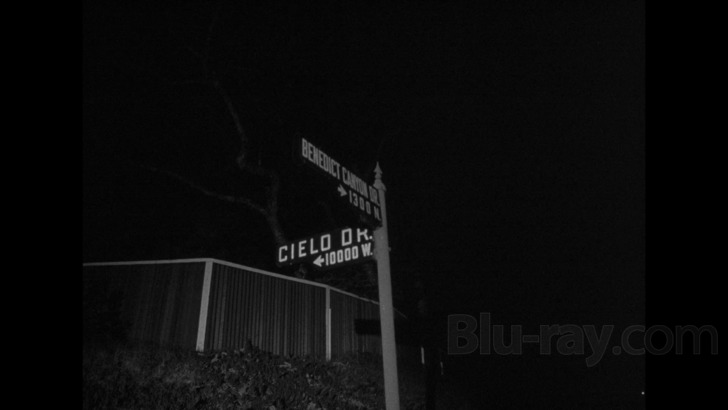
"The Other Side of Madness" doesn't provide authenticity or filmmaking style. But it does have timing, with touring sequences that visit Celio Drive and the Spahn Ranch during the time of their nationwide exposure. There's a time capsule aspect to the endeavor that's interesting, and possibly worth a look, especially for those curious about the case before it was pounded into place by decades of reporting and dramatization. "The Other Side of Madness" also closes with a condemnation of drug culture, suddenly assigning a level of importance to the feature as a way to justify the entire creation, which is insulting to the audience but gives Howard and Williams a "Get Out of Jail Free" card, helping to transform their exploitative, no- budget enterprise into call for justice. Against drugs. Murders? Not really.
Similar titles
Similar titles you might also like
(Still not reliable for this title)

Too Much Too Often!
1968
Moon
Man of Violence
1970

Cop-Out
Stranger in the House
1967

Blutiger Freitag
Bloody Friday | Limited Collector's Edition
1972

Willie Dynamite
1974

The Dirty Dolls
1973
Satan's Bed
1965

The Hooked Generation
1968

Marihuana
Marihuana, the Devil's Weed(Marihuana, the Weed with Roots in Hell!
1936

The Farmer 4K
1977
The Girl from Pussycat
1969
Lady Cocoa
Pop Goes the Weasel
1975
Boots and the Preacher
1972
Just for the Hell of It
1968

Kids
1995

Who Fears the Devil
The Legend of Hillbilly John
1972
Passion Fever
1969

Suspect
1960

Death Ride to Osaka
Girls of the White Orchid
1983

The Pick-Up
Standard Edition
1968