The Modern Jazz Quartet: The Last Concert Blu-ray Movie
HomeThe Modern Jazz Quartet: The Last Concert Blu-ray Movie 
Quadio Blu-ray AudioRhino Music | 1974 | 91 min | Not rated | Feb 06, 2026

Movie rating
Movie has not been rated yetBlu-ray rating
| Users |  | 0.0 |
| Reviewer |  | 4.0 |
| Overall | | 4.0 |
Overview
The Modern Jazz Quartet: The Last Concert (1974)
Starring: Milt Jackson| Music | 100% |
Specifications
Video
Video codec: MPEG-4 AVC
Video resolution: 1080p
Aspect ratio: 1.78:1
Original aspect ratio: 1.78:1
Audio
Music: DTS-HD Master Audio 4.0 (192 kHz, 24-bit)
Music: DTS-HD Master Audio 2.0 (192kHz, 24-bit)
Subtitles
None
Discs
Blu-ray Disc
Single disc (1 BD)
Playback
Region A (B, C untested)
Review
Rating summary
| Movie | | 4.0 |
| Video | | 0.0 |
| Audio |  | 5.0 |
| Extras | | 0.0 |
| Overall | | 4.0 |
The Modern Jazz Quartet: The Last Concert Blu-ray Movie Review
Reviewed by Jeffrey Kauffman March 9, 2026Rhino’s latest aggregation of Quadio Blu-ray releases includes four artists who have all had previous Quadio releases. Curtis Mayfield: Roots, Spinners: Spinners and The Spinners: Pick of the Litter, Graham Central Station: Graham Central Station and The Modern Jazz Quartet: Blues on Bach have already seen the lossless four channel light of day, and kind of interestingly if tangentially, several of the above linked efforts were released almost exactly a year ago in that particular bundle of Quadio offerings. This 1974 recording is kind of interesting in that it differed from the stereo two LP set in terms of track listings, but fans should be pleased that this Quadio disc reproduces the two LP quad release as it came out, even if it does not always offer the same material as the stereo release (or the later "sequel" album).
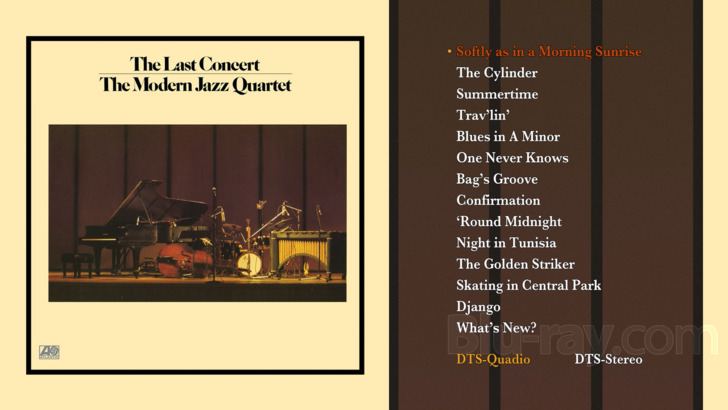
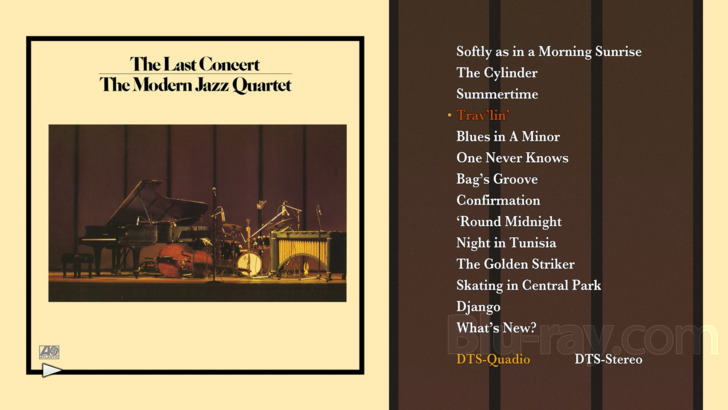
The album's track list can be seen in the screenshots of the (static) disc menu I've uploaded to accompany this review.
The Modern Jazz Quartet: The Last Concert Blu-ray Movie, Video Quality
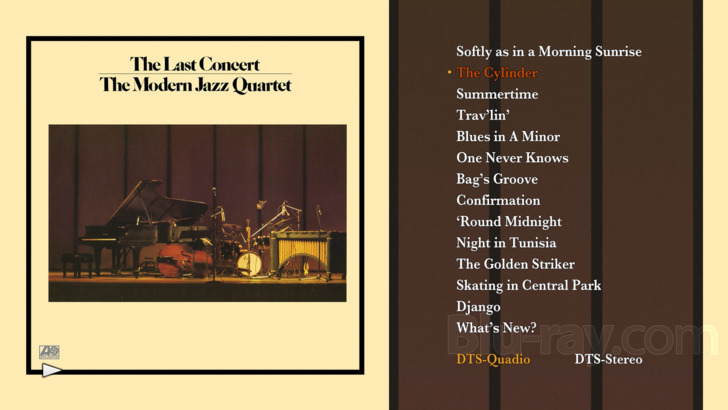
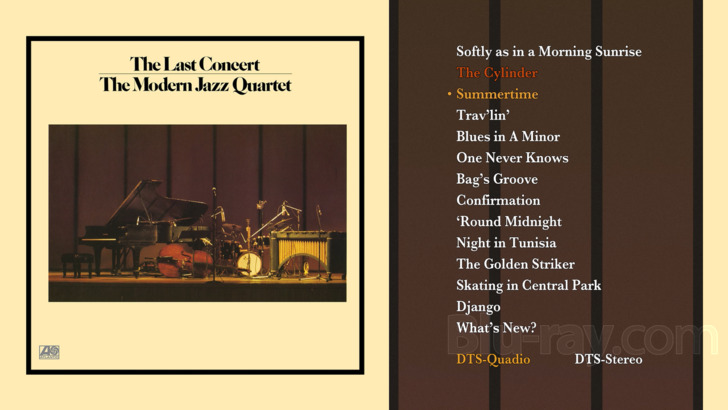
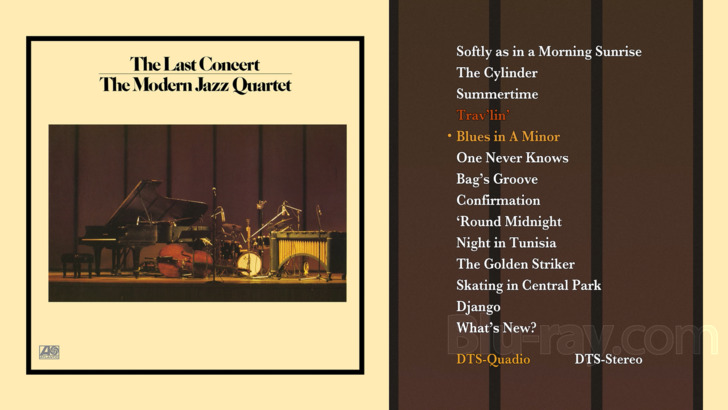
As mentioned above, while there is video content here, like most of Rhino's Quadio line of audio Blu-rays, it's simply a static menu. Longtime readers of my reviews know one of the bugaboos that tends to bother me is inconsistent authoring of these discs in terms of toggling between audio codecs, and in this particular instance, you can not use the color buttons on your remote to choose which audio codec to utilize. Just as unfortunately, navigating to the links on the main menu then starts the song over if a different codec is chosen. If you parse through the screenshots, you can see how the font colors change depending on whether your use the chapter skip or toggle down buttons on your remote to navigate from track to track.
The Modern Jazz Quartet: The Last Concert Blu-ray Movie, Audio Quality
The Modern Jazz Quartet: The Last Concert features DTS-HD Master Audio 4.0 and DTS-HD Master Audio 2.0 options. It's maybe a little ironic that by the time this album came out "modern jazz" certainly meant something far different than when the MJQ began in the early fifties, and as such the simultaneous use of all four channels to deliver the quartet's music can make this more of a "wall of sound" listening experience than a showcase for discrete channelization. That said, there are what I might term subtle weightings in terms of directionality, with, for example, grand piano tending to emanate rearward (even if spill can quite easily be heard in the front channels), and with vibes coming from the front (though with spill in the rear channels). There are some really nice thrusts of low frequency from the bass throughout the recording, even if, again, the actual sound tends to come from all directions at once rather than one individual speaker. The interplay between the instruments can be alternately delicate and athletic, and the spacious quality of the recording allows some good breathing room, especially between piano and vibes. This is another Quadio offering where just a bit of lead in hiss can be quite audible at the beginnings of some tracks before the actual music kicks in.
The Modern Jazz Quartet: The Last Concert Blu-ray Movie, Special Features and Extras
As usual with Rhino's Quadio line, there are no on disc supplements. The insert booklet reproduces cover images and also includes credits and the typical verbiage on "bass management" along with the traditional photos of master tape boxes.
The Modern Jazz Quartet: The Last Concert Blu-ray Movie, Overall Score and Recommendation
The Modern Jazz Quartet didn't quite say goodbye with this recording, and in fact Atlantic continued to mine content from the concert for years after the initial stereo and quad releases. Still, this is an elegy of sorts, both for the esteemed foursome, but also arguably for this type of elegant, nuanced jazz, something pretty far removed for what had already become in the mid-seventies more of a jazz rock fusion sound coming from that era's biggest groups. The quad recording is quite spacious, but it does tend to offer more of a wall of sound approach rather than amazing directionality. One way or the other, fidelity is great. Recommended.