The Mizoguchi Collection Blu-ray Movie
HomeThe Mizoguchi Collection Blu-ray Movie 
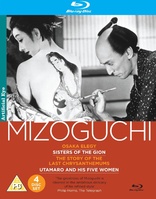
Osaka Elegy / Sisters of the Gion / The Story of the Last Chrysanthemum / Utamaro and His Five WomenArtificial Eye | 1936-1946 | 4 Movies | 406 min | Rated BBFC: 15 | Mar 12, 2012
Price
List price:Listed on Amazon marketplace

Movie rating
Movie has not been rated yetBlu-ray rating
| Users |  | 0.0 |
| Reviewer |  | 4.0 |
| Overall | | 4.0 |
Overview
The Mizoguchi Collection (1936-1946)
A collection of four films from the celebrated Japanese director Kenji Mizoguchi. Included are 'Osaka Elegy' (浪華悲歌), 'The Story of the Last Chrysanthemum' (残菊物語), 'Sisters of the Gion' (祇園の姉妹) and 'Utamaro and His Five Women' (歌麿をめぐる五人の女).
| Foreign | 100% |
| Drama | 70% |
| Romance | 15% |
Specifications
Video
Video codec: MPEG-4 AVC
Video resolution: 1080p
Aspect ratio: 1.34:1
Original aspect ratio: 1.37:1
Audio
Japanese: LPCM 2.0
Japanese: Dolby Digital 2.0
Subtitles
English
Discs
25GB Blu-ray Disc
Four-disc set (4 BDs)
Playback
Region B (locked)
Review
Rating summary
| Movie |  | 4.5 |
| Video |  | 3.5 |
| Audio |  | 3.0 |
| Extras | | 0.0 |
| Overall | | 4.0 |
The Mizoguchi Collection Blu-ray Movie Review
Reviewed by Dr. Svet Atanasov May 23, 2012Japanese director Kenji Mizoguchi's "Sisters of the Gion" (1936), "Osaka Elegy" (1936), "The Story of the Last Chrysanthemum" (1939), and "Utamaro and His Five Women" (1946) arrive on Blu-ray courtesy of British distributors Artificial Eye. There are no supplemental features offered with these films. In Japanese, with optional English subtitles for each film. Region-B "locked".
You can't do that to him...
The Story of the Last Chrysanthemum
Kikunosuke (Shôtarô Hanayagi) dreams of becoming a great actor, like his father, who is well-known all over Tokyo. Because of him, Kikunosuke has been able to land excellent roles and perform in some of the city's most prestigious theaters.
But Kikunosuke senses that he isn't as good as most of the people around him insist. Deep inside his heart he knows that the flattering words after each play come only because of his father. The only person who eventually tells him the truth is Otoku (Kakuko Mori), his brother's nurse. Her honesty immediately wins his heart, and for that she is promptly fired by Kikunosuke's mother. Kikunosuke begs his father to allow him to marry Otoku but is told that a man of his stature cannot marry a servant. Determined to spend the rest of his life with the only person who has been honest with him, Kikunosuke leaves his family.
Based on Shôfû Muramatsu's novel, The Story of the Last Chrysanthemum is a beautiful romantic film with excellent observations about the division between men and women in pre-war Japan. Because of his social stature, Kikunosuke is faced with an impossible dilemma -- to be the person he wants to be, he must go against his heart, and confront his own family.
Mizoguchi carefully balances the light melodrama with the serious critique. The film's address of the social injustice the Japanese society tolerated at the time is very clear but never too direct. Naturally, the progression of the relationship between Kikunosuke and Otoku is never compromised.
Utamaro and His Five Women
The great artist Utamaro (Minosuke Bandô) is challenged to a duel by Seinosuke (Kôtarô Bandô), a young and feisty samurai. But Utamaro proposes that they paint portraits, over the course of a single day. Seinosuke loses the contest.
Soon after, Utamaro meets a beautiful woman and asks her for a permission to paint her body. After the woman is told by some of Utamaro’s most trusted men that he is going to paint his masterpiece, she agrees. While Utamaro works, Seinosuke, who has become one of his biggest admirers, falls in love with the woman.
Utamaro is so pleased with his work that begins searching for beautiful geishas to inspire him. His lifestyle changes and eventually he is sanctioned. Seinosuke tries to follow Utamaro’s steps, but goes too far, and his life spins out of control.
Mizoguchi’s film is based on the life of a famous 18th century artist who had a complex relationship with the women who inspired him. The focus of attention here is on the struggle of the artist to freely create, while at the same time follow the rules and regulations of an oppressive and unjust society.
Mizoguchi remains surprisingly cold towards Utamaro and Seinosuke. While the latter’s behavior clearly deserves the Japanese director’s lack of sympathy, the former is a man who could be seen in an unfavorable light only because he never becomes romantically involved with the women who sacrifice their bodies for his art. Regarded as one of Mizoguchi’s most autobiographical films, Utamaro and His Five Women is indeed a fascinating film to behold.
Osaka Elegy
Young and beautiful switchboard operator Ayako (Isuku Yamada) becomes her older boss’ mistress – to help her father (Seiichi Takegawa) pay off his debts and her brother (Chiyoko Okura) finish his degree work at a prestigious university. The man Ayako truly loves is Nishimura (Kensaku Hara), a young a handsome professional who works closely with her boss.
In the beginning Ayako’s plan works fine, but then her father discovers one of her payments and immediately confronts her. The family’s reputation has been seriously damaged and Ayako’s is the only one to blame.
Eventually, the boss tires of Ayako and she is promptly fired from her job. Then her family rejects her and she becomes a prostitute. Ayako quickly makes more than she ever did as a switchboard operator and approaches Nishimura, hoping that she could start a new life with him. But things turn disastrous when one of her clients complains to the police.
Osaka Elegy is the most direct and most angry film in this excellent collection of early Mizoguchi films. Ayako is a woman who is essentially rejected by her family and society because she has compromised herself. Yet the people who truly are compromised here are her discriminating boss and conservative father, both representing the strong and 'flawless' side, the Japanese men.
The conversations between Ayako and her patron and family are fascinating. The viewer gets a real sense of the incredibly discriminating environment she is forced to endure. Immediately after her boss approaches her, her life becomes a never-ending roller-coaster of disappointing and humiliating experiences. Slowly but surely, Ayako realizes that for women like her there are no second chances in life.
Sisters of the Gion
The film tells the story of two sisters, both geishas in a district of Kyoto. Umekichi (Yoko Umemura), the more conservative of the two, vows to stay with her lover Furusawa (Benkei Shiganoya) after his business collapses and he leaves his wife. Her decision infuriates the bolder Omocha (Isuzu Yamada), who believes that men like Furusawa must not be helped.
Determined to save her sister from Furusawa, Omocha begins looking for healthy and responsible patrons that would make life easier for her and Umekichi. She meets different men and forces Umekichi into relationships that ultimately have tragic consequences on their relationship.
Considered one of Mizoguchi’s pre-war masterpieces, Sisters of the Gion again exposes a society in which women are often treated like objects. Umekichi’s dealings with the prospective patrons are both hilarious and at the same time enormously sad; the system of values and principles which the men and women respect while they arrange their relationships is, to say the least, amusing.
The film has plenty of Mizoguchi’s beautiful long-take scenes. Especially during the second half of the film, there are terrific panoramic vistas from Kyoto.
The Mizoguchi Collection Blu-ray Movie, Video Quality
Encoded with MPEG-4 AVC and granted 1080p transfers, the four films in The Mizoguchi Collection arrive on Blu-ray courtesy of British distributors Artificial Eye.
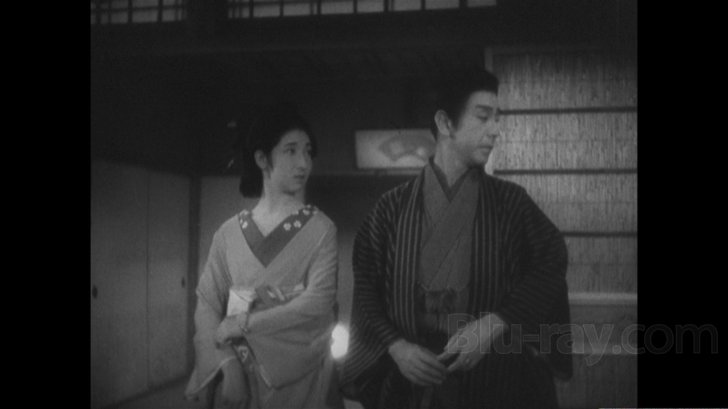
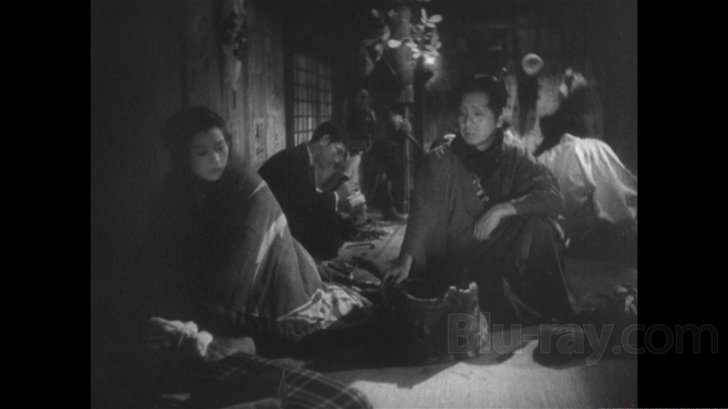
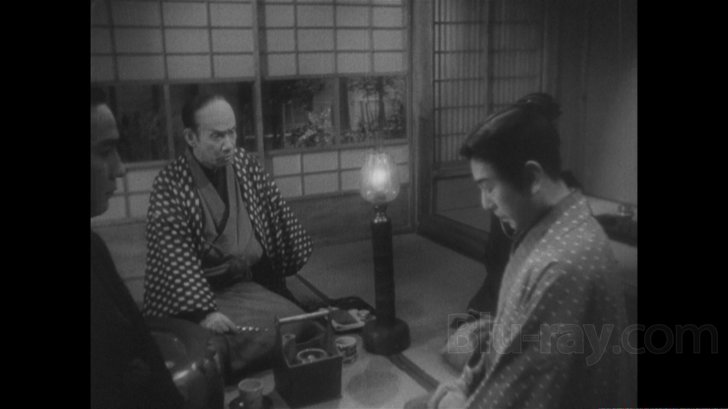
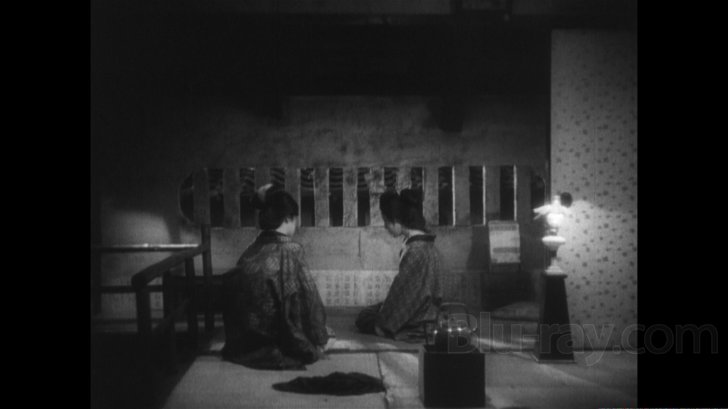
The screencaptures included with our review appear in the following order:
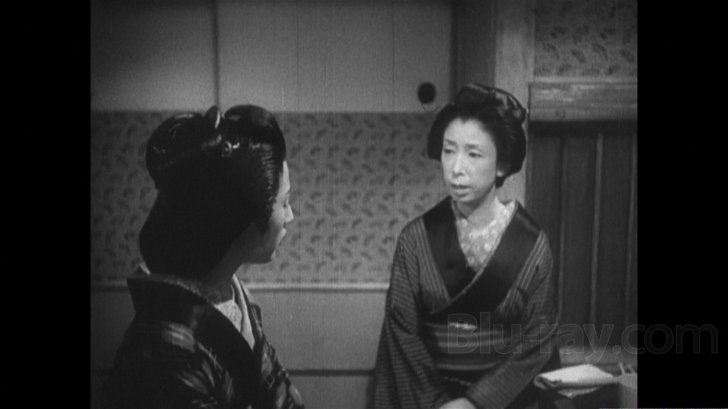
1. The Story of the Last Chrysanthemum: 1-10.
2. Utamaro and His Five Women: 11-20.
3. Osaka Elegy: 21-30.
4. Sisters of the Gion: 21-39.
The Story of the Last Chrysanthemum - there are various inherited limitations, such as minor warps, frame skips, and contrast fluctuations. This isn't surprising considering the fact that there are no strong elements for many of Kenji Mizoguchi's early films. In fact, I believe that this was one of the key reasons why Criterion chose to release some of them via their Eclipse series. Still, there are plenty of benefits here - during selected close-ups depth is improved, while during darker sequences macroblocking patterns are eliminated. Light grain is also retained, though it is obviously not evenly distributed and well resolved. The best news, however, is the fact that there are no traces of problematic lab tinkering. In other words, the limitations on display are very obviously retained from the master used to produce the high-definition transfer.
Utamaro and His Five Women - from the four films in the collection, this one has some of the most prominent warps that I noticed. Damage marks, light scratches, and flecks are also easy to spot. However, clarity and contrast are rather pleasing, with quite a few close-ups looking very good. Very light grain is visible, but here the grain is also occasionally mixed with light noise. The color scheme is relatively stable, though neither the blacks nor the whites look particularly healthy. Lastly, there are no traces of sharpening corrections.
Osaka Elegy - image depth is the key issue here. Some of the indoor scenes are too dark, though detail is still relatively good (or at least in comparison to the other three films in the collection). Contrast levels also fluctuate, but colors are surprisingly stable. But this isn't to say that they look healthy; clearly, time has left its mark on the film and it is easy to see that there are areas of it that have deteriorated more than others. The grain structure is also the weakest from the four films in the collection. This said, the film does look like a dated film from its era would look.
Sisters of the Gion - detail and clarity are relatively good. However, both fluctuate, particularly during the second half of the film. There is no serious surface damage, but there is some edge instability. There are small warps and frame skips as well. Again, the best news is that there are no traces of problematic sharpening. Contrast levels also have not been manipulated. This being said, light noise is interspersed throughout the film, often overwhelming the uneven grain. Unless one projects the film, however, one isn't likely to spot its presence. Finally, the color-scheme is relatively stable, with the blacks occasionally looking too faded.
Despite the various limitations, the four films in The Mizoguchi Collection have clearly benefited from their transition to Blu-ray. Yes, there are stability issues, contrast and clarity fluctuations, and plenty of damage marks, debris and warps, but the overwhelming majority of these limitations are inherited from very weak elements. Naturally, while some improvements could be made in the future, none of these early films can look as good as Kenji Mizoguchi's masterpieces Ugetsu Monogatari and Sanshô Dayû.
Note: All four Blu-ray discs in The Mizoguchi Collection are Region-B "locked". Therefore, you must have a native Region-B or Region-Free PS3 or SA in order to access their content.
The Mizoguchi Collection Blu-ray Movie, Audio Quality
Each of the four films in The Mizoguchi Collection arrives with two audio tracks: Japanese LPCM 2.0 and Japanese Dolby Digital 2.0. Optional English subtitles are included for each film.
The four lossless audio tracks are very similar. Generally speaking, the dialog is clear and easy to follow, but often there is background hiss that interferes with it, as well as random pops and cracks. Depth is adequate, but the range of dynamics each track has is very limited. On Utamaro and His Five Women there are also a couple of light distortions that appear early in the film (the effect is like static noise trying to push through the dialog). However, there are no audio dropouts to report in this review. All in all, it is obvious that no efforts have been made to eliminate hiss and crackle or digitally stabilize the audio. Naturally, the lossless tracks are serviceable but guaranteed not to impress audiophiles.
The Mizoguchi Collection Blu-ray Movie, Special Features and Extras
There are no supplemental features offered with the four films in the box set.
The Mizoguchi Collection Blu-ray Movie, Overall Score and Recommendation
Even though the four films in The Mizoguchi Collection do not look as impressive as the recent Blu-ray releases of the Japanese director's masterpieces Ugetsu Monogatari and Sanshô Dayû, I think that they belong in the collection of any serious film aficionado. The truth is, these are very early films that have not aged particularly well. I do believe that they could look a little bit better, but I seriously doubt we would see big-budget restorations and consequently stronger English-friendly releases. Kudos to Artificial Eye for giving the films a new life. RECOMMENDED.