The Millionaires' Unit Blu-ray Movie
HomeThe Millionaires' Unit Blu-ray Movie 
Humanus Documentary Film Foundation | 2015 | 121 min | Unrated | Dec 19, 2017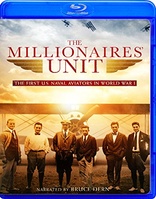

Movie rating
6.7 | / 10 |
Blu-ray rating
| Users |  | 0.0 |
| Reviewer |  | 4.5 |
| Overall | | 4.5 |
Overview
The Millionaires' Unit (2015)
Narrator: Bruce DernDirector: Darroch Greer, Ron King
| Documentary | 100% |
Specifications
Video
Video codec: MPEG-4 AVC
Video resolution: 1080p
Aspect ratio: 1.78:1
Original aspect ratio: 1.85:1
Audio
English: DTS-HD Master Audio 5.1
English: DTS-HD Master Audio 2.0
Subtitles
English SDH
Discs
Blu-ray Disc
Single disc (1 BD)
Playback
Region A (B, C untested)
Review
Rating summary
| Movie | | 4.5 |
| Video | | 4.5 |
| Audio |  | 4.0 |
| Extras |  | 3.0 |
| Overall | | 4.5 |
The Millionaires' Unit Blu-ray Movie Review
The red, white and blue max.
Reviewed by Jeffrey Kauffman December 25, 2017Those with an interest in military history may think they know that the United States Air Force was officially founded as an independent branch of the armed services in 1947, after having been part of the Army for several decades (and indeed known under a variety of names, including the United States Army Air Service, United States Army Air Corps and then in the World War II era, as the United States Army Air Forces). It might therefore come as a surprise to some to hear that there was a separate and unrelated naval antecedent to what might generally be thought of as America’s air forces (if not the Air Force itself), one known as the Naval Reserve Flying Corps, which itself was linked almost inextricably to a “civilian” group called the First Yale Unit which was founded in the build up to the United States’ entry into World War I. This in and of itself may be a fascinating little tidbit of history, since even military types tend to think of the armed services as having existed in perpetuity from time immemorial. But of course there were no (functioning) airplanes before Wilbur and Orville Wright took that short but epochal flight in 1903 a little bit south of Kitty Hawk, North Carolina. Planes were still something of a novelty by the time the world erupted into battle in 1914, but one of the hallmarks of the so-called “Great War” was its emphasis on “new, improved” technology, and that of course included air power in the form of planes (military historians will most likely know there were previous attempts to get up “above the fray” in prior wars, utilizing outmoded methods like hot air balloons). A Yale student named F. Trubee Davison, a guy who would go on to become at various times Assistant Secretary of War, Director of Personnel for the Central Intelligence Agency, and President of the American Museum of Natural History, became convinced that, despite then President Wilson’s campaign promises to keep the United States “neutral” in the burgeoning calamity, there was probably no way for America to stay out of the war. Davison was a bit of a visionary, and became convinced that the United States needed some kind of contingent of pilots to help build that aspect of our nation’s defenses.

Our current political climate is rife with what has been termed class envy, but one of the most fascinating things that The Millionaires’ Unit makes clear is that all of the extremely privileged young men who formed the First Yale Unit lived by the maxim “to whom much is given, much is expected.” While it probably can’t be denied that there was a bit of rabble rousing that informed these men’s psyches, there was also an undeniable commitment to civic responsibility, something that puts their exploits in a fascinating and commendable light.
With some pretty spry and even animated sounding narration from Bruce Dern (who is related to one of the airmen), The Millionaires' Unit takes a straightforward but often incredibly interesting and scenic tour through this little known and/or remembered piece of the United States' history with aviation. Several of Davison's colleagues are profiled, and there emerges a real sense that these young men were all patriots in the best sense of the word, willing to stand up and potentially die for their country, especially considering the inherent dangers in the then still nascent technology of flight. Lovers of historic airplanes will delight in some of the stills and films included in the documentary, and there are a number of "POV" shots sprinkled throughout the film that may give armchair pilots at least some semblance of what it's like to pilot one of these historic craft.
The Millionaires’ Unit serves as almost a microcosm of American greatness in the early days of the 20th century, and the documentary covers some of the outstanding contributions several of the young men made not just in terms of their war experiences, but for decades afterwards. Some historians have pointed to the almost incredible confluence of great minds who gathered together to become what has become known as our Founding Fathers, and while perhaps not quite at that level of achievement, the guys who found themselves together in Yale as World War I began to subsume the planet also were a unique and quite remarkable aggregation of extremely smart, dependable and forceful types who helped to shape history perhaps more than they ever realized.
The Millionaires' Unit Blu-ray Movie, Video Quality

The Millionaires' Unit is presented on Blu-ray courtesy of Humanus Documentary Film Foundation with an AVC encoded 1080p transfer in 1.78:1. As is usually the case with these historically themed documentaries, there's a fairly wide variance in image quality courtesy of the stock and/or archival footage that is utilized. Some of the older video, some of which dates to the early days of the 20th century, is understandably pretty ragged looking, with abundant damage and highly variable clarity. The contemporary footage, though, is all impeccably sharp and often quite arresting, especially some of the aerial footage which recreates the flying (and fighting) experience of some of the pilots. The contemporary footage boasts excellent detail levels and a natural looking palette. There are no compression issues or problems with image instability.
The Millionaires' Unit Blu-ray Movie, Audio Quality

The Millionaires' Unit features DTS-HD Master Audio mixes in both 2.0 and 5.1. The surround mix derives some considerable if intermittent immersion courtesy of some of the recreations of battles, or with regard to sound effects added to some of the older archival video. Otherwise, though, the two mixes are really not that substantially different, since the bulk of this piece is either talking head interview segments or Bruce Dern's enjoyable voiceover. Fidelity is fine throughout, and there are no problems to report.
The Millionaires' Unit Blu-ray Movie, Special Features and Extras
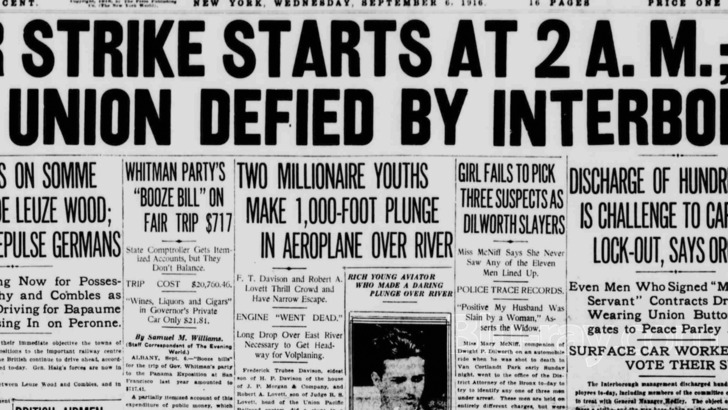
- The Making of The Millionaires' Unit (1080p; 27:43) is a nicely done featurette, with some interesting interviews featuring family members of some of the men depicted in the documentary.
- From Sea Legs to Navy Wings (1080p; 21:04) is another interesting piece providing background on the "evolution" of thought from Navy defenses to those involving air support.
- Killingholme (1080p; 16:08) focuses on the hunt for a German U Boat.
- Flying the Sopwith Camel (1080p; 15:48) is a fun piece paying tribute to the iconic airplane, with interviews with two pilots who have flown one.
- Official Trailer (1080p; 2:26) of course will lead some to wonder if there's an Unofficial Trailer (yes, that's a joke).
The Millionaires' Unit Blu-ray Movie, Overall Score and Recommendation

If you're a fan of old films like The Blue Max, you may well want to check out The Millionaires' Unit, even if you've never previously heard of the First Yale Unit. This is a really interesting "little" sidebar to United States aviation history which in fact ends up having huge consequences not just for our nation, but for the world as a whole. Nicely researched and often beautifully filmed, The Millionaires' Unit offers solid technical merits and comes Highly recommended.