The Men of Sherwood Forest 4K Blu-ray Movie
HomeThe Men of Sherwood Forest 4K Blu-ray Movie 
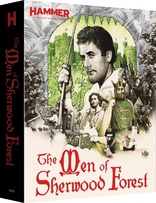
4K Ultra HD + Blu-rayHammer Films | 1954 | 77 min | Rated BBFC: PG | Nov 24, 2025

Movie rating
7.3 | / 10 |
Blu-ray rating
| Users |  | 0.0 |
| Reviewer |  | 4.0 |
| Overall | | 4.0 |
Overview
The Men of Sherwood Forest 4K (1954)
In 1194, on his return from the Third Crusade, Richard the Lionheart is taken prisoner in Germany. Disguised as a troubadour, Robin Hood formulates a plan to rescue Richard but he is captured himself.
Starring: Don Taylor (I), Reginald Beckwith, Eileen Moore (I), David King-Wood, Douglas WilmerDirector: Val Guest
| Period | Uncertain |
| Adventure | Uncertain |
| Action | Uncertain |
Specifications
Video
Video codec: HEVC / H.265
Video resolution: 4K (2160p)
Aspect ratio: 1.37:1
Original aspect ratio: 1.37:1
Audio
English: LPCM 2.0 Mono
English: DTS-HD Master Audio 5.1
Subtitles
English, French, German, Italian, Spanish
Discs
Blu-ray Disc
Three-disc set (3 BDs)
4K Ultra HD
Playback
Region B, A (C untested)
Review
Rating summary
| Movie |  | 3.5 |
| Video | | 4.0 |
| Audio | | 4.0 |
| Extras |  | 5.0 |
| Overall | | 4.0 |
The Men of Sherwood Forest 4K Blu-ray Movie Review
Reviewed by Justin Dekker January 6, 2026Hammer's very first color film, 'The Men of Sherwood Forest' comes to 4K UHD disc in this new release. Directed by Val Guest ('The Quatermass
Xperiment (1955)', 'Quatermass 2 (1957)'), the film stars American Don Taylor ('Love Slaves of the Amazons', Dir. of 'Escape From the Planet of the
Apes') as Robin Hood, alongside Reginald Beckwith ('Thunderball') as Friar Tuck, and Eileen Moore ('An Inspector Calls') as Lady Alys. The film has
been lovingly restored and given a Dolby Vision color grade. It features a two different audio tracks, and is accompanied by a rich assortment of on-
disc and printed supplemental material. All of the contents for this three-disc (a 4K UHD disc and two Blu-ray discs) set are housed in an attractive
slipbox. This release is region-free.
Robin Hood and his merry men are firmly established in Sherwood Forest by the time the action of the film finds them. Heroes to all, it seems, save
for those loyal to the man who currently sits on king's throne, Robin is contacted by men who believe the rightful king, King Richard, is in danger.
Sir Nigel Saltire (Douglas Wilmer) and Count of Morain (John Stuart) urge Robin to take action and find a toy lost by a fallen squire in which was
hidden a secret message with specific details about the King's return to England. Should the message fall into the wrong hands, it could spell the
rightful King's doom and secure the throne for the villainous Prince John. It's up to Robin Hood, Friar Tuck, and the rest of his merry men to engage in
their particular brand of espionage and swashbuckling derring-do to save the King, the kingdom, and themselves.
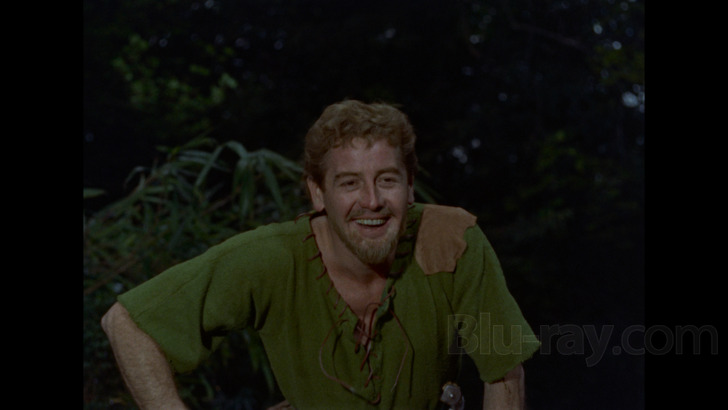
Director Val Guest described The Men of Sherwood Forest as "a merry romp", and it's hard to argue with that assessment. While not an outright comedic farce in the fashion of Mel Brooks' Robin Hood: Men in Tights, there is a certain lightness in the the film's events. The danger is never quite dangerous, arrows find their marks without spilling a drop of blood, and the mischievous smiles rarely leave Robin Hood or Friar Tuck's faces for long. The Sheriff of Nottingham is suitably villainous, and the escalating price on Robin's head helps to increase the personal stakes for our hero, but as in most family-friendly fare, the villain's role is not to win. Instead, the villain must simply provide obstacles with a suitable enough degree of difficulty for the protagonist to appear gleamingly heroic when he overcomes them and saves the day. And that's definitely what happens here. But in between all of the sword fights and flying arrows, Robin still has a moment to sing a bawdy song or two and make an impression on the lovely Lady Alys, while the affable Friar Tuck leads a crooked game of chance at every opportunity.
The film would be a first for Hammer in a number of regards. In 1954, it was the studio's first tale of the English folk hero Robin Hood. In much the same spirit as The Adventures of Robin Hood (1938) which was headlined by screen legends Errol Flynn, Olivia de Havilland, and Basil Rathbone, Don Taylor's Robin Hood is just as dashing, honorable, and unbeatable. The film would ultimately lead to several other swashbuckling efforts over the following decade. Terence Fisher's Sword of Sherwood Forest would eventually follow in 1960 and was perhaps most notable for featuring Peter Cushing's more understated take as the Sheriff of Nottingham, and attentive viewers will spot Oliver Reed. Tonally quite different from the Robin Hood films, Christopher Lee would star in The Pirates of Blood River, a more serious endeavor even if the high adventure of the open seas is absent. Captain Clegg (aka 'Night Creatures') would follow in 1962 and reunited Peter Cushing and Oliver Reed in a tale of smuggling with a supernatural bend. Oliver Reed would next face off against a Robin Hood-like character in 1963's The Scarlet Blade, before Christopher Lee would pick up another sword in 1964's The Devil-Ship Pirates. 1967's A Challenge for Robin Hood would close the book on Robin Hood and similar films for Hammer, as the studio spent more of their energy and resources on the science fiction and horror-related fare for which they are best known.
Of perhaps even greater importance, The Men of Sherwood Forest was Hammer's first color film. Technicolor had been around for quite some time by the mid-1950s, but Eastmancolor offered a more cost-effective option for Hammer. It's hard to argue with the results here, as the film is simply alive with color, as reds, yellows, blues, and greens delight and bring additional vitality to Guest's film. The use of color enabled this film and those that followed to be more competitive with films produced in America, as an increasing number of features were being shot in color. Ultimately, though, it would be lessons learned and familiarity with color filming that would make the horror films that would soon follow as impactful and shocking (for the time, at least) as they were. 1959's The Man who Could Cheat Death would quite simply not be as eerie and memorable were it not for the shots of star Anton Diffring's face bathed in an ominous green light, the unnatural shift in his eyes as the end of the all too short six-hour window drew near, and Hazel Court's vibrant and beautiful costumes and make-up. Likewise, the mangled visage of Christopher Lee's Creature in 1957's The Curse of Frankenstein, Hammer's first color horror outing, would not have been nearly as terrifying were viewers not able to appreciate the cadaverous hue of his flesh, the roadmap of his red scars, and the milkiness of his dead eye. Though their first Dracula film, also in color, was essentially bloodless, eventually Hammer's horror films would be awash in the crimson stuff as Lee's Dracula would attack his victims, and other villains and monsters would do the same. The visceral impact of color was as important as the studio's stable of actors, and the caliber of people in the director's chair and behind the camera.
The Men of Sherwood Forest 4K Blu-ray Movie, Video Quality
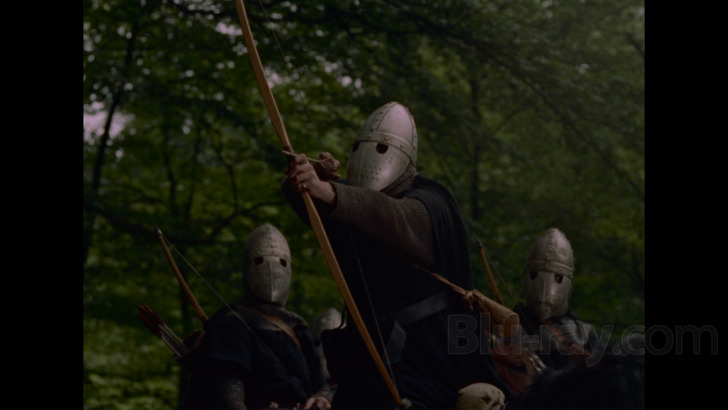
The video presentation of The Men of Sherwood Forest is very much the tale of two halves. Per the enclosed notes on the restoration, the film
was originally shot on 35mm Eastmancolor film stock. But when the materials were retrieved from the Hammer vault for scanning, it was discovered
that much, but not all, of the first two reels of the feature had degraded past the point of usefulness. As a result, Hammer was forced to utilize a
35mm internegative as the source for this "lost" material. That material required a good deal more work to bring it up to snuff, and in general, color
density, image stability, and flickering were the most substantive issues to overcome. Much work was done to make the final quality of what was
sourced from the internegative material match that sourced from the original elements. While the work done to that end is quite admirable, there is
still a detectable difference which attentive viewers will no doubt spot.
In the early goings, the material sourced from the internegative typically seems to sport heavier grain, a slight softness, less vibrant and well-
saturated colors, and less convincing skin tones. That said, the film is still perfectly watchable; it's just that once the source material switches to the
original negative, the improvement is substantial and very positive, and this is much more consistently the case once the film unspools past the first
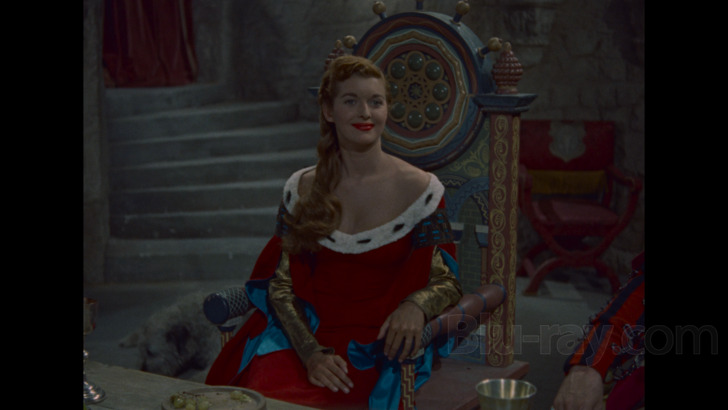
two reels. Colors are immediately more vibrant, especially reds, which present with an impressive pop, especially the unexpectedly dazzling fire-
engine red lipstick worn by Lady Alys. In fairness, though, blues impress as well. As we spend a fair amount of time in the forest, greens are rich and
leafy elements are well-defined. Film grain is still present, but it resolves more naturally without any noticeable issues. Blacks are deeper and inkier,
though at times they can consume more environmental and character detail than I would like. Fine detail is generally pleasing, with costuming
presenting with tactile realism, especially the more rough-spun garments worn by Robin Hood's men. Fine lines, winkles, and make-up particulars are
all appreciable as well. And wooden set elements such as tavern furniture and feast tables show realistic wear and grain. Depth and dimensionality
are solid. Presented in its original 1.37:1 theatrical aspect ratio, Hammer's first color film looks very pleasing in 4K.
Screenshots are sourced from the 4K UHD discs and downscaled to 1080 and are in SDR.
The Men of Sherwood Forest 4K Blu-ray Movie, Audio Quality
When preparing for this review, I watched the film several times; once with the 2.0 track, another time with the newly crafted 5.1 (as is Hammer's
method), and twice switching back and forth between the two. After these viewings, if found the 2.0 LPCM Stereo track provides a suitably authentic-
sounding accompaniment for the 1954 feature, though to modern ears the track does feel a bit cramped. Dialogue is clean, clear, and absent any
defect. Clanging swords ring out with metallic weight, and arrows thump convincingly into their marks, though the depth of sound effects, such as
thundering horse hooves, isn't as deep as what would be found on more modern tracks.
The DTS-HD Master Audio 5.1 track is a different listening experience. As per Hammer's MO, the track was created by using AI to strip the dialogue out
of the original mono mix and pushing music and effects into the surrounds. It's a more modern listening experience, but not jarringly so, and instead,
the impact is enjoyable and tastefully done. Directionality is a welcome addition, with viewers able to track actors and objects through the stage, and as
they enter or leave the frame. Viewers can track the arrows his men fire while Robin and Friar Tuck hide in Hugo of Nottingham's shop, which whiz
through the field before sticking in their target with a convincing thud. Voices possess a pleasant, realistic echo in larger rooms, audibly informing the
viewer of the size of the space. Not overwhelmingly immersive, there are moments where surrounds are leveraged to place the viewer in the middle of
a
crowded town square, a tavern, or Robin Hood's forest hideout through the subtle use of atmospheric and environmental sounds. Doreen Carwithen's
wonderful score is a treat on both tracks, but I found it more enjoyable here. Horns have more room to breathe, strings are more precise, and
percussion has better low-end support, but the score has lost none of its vintage feel and charm. Overall, the sound stage feels gently and
unobtrusively expanded here, and after four back-to-back viewings, I found the newly minted 5.1 track to be my preferred accompaniment.
The Men of Sherwood Forest 4K Blu-ray Movie, Special Features and Extras
Disc One: 4K UHD Disc
- 'The Men of Sherwood Forest' 2025 Commentary Featuring David Huckvale - After connecting the various members of the cast and crew to other Hammer films, Huckvale moves on to the film itself, and begins by drawing attention to the score which was composed by Doreen Carwithen. She was one of the few female composers working at the time, and he shares a fair amount of information about her career. He eventually turns his attention to the cast, their previous roles, later careers, various anecdotes, and other bits of trivia. Likely working from well- prepared notes or a script, he occasionally pauses to appreciate the work of the actors before getting back to his thoughts. It's a casual but informative track.
- UK Trailer (2.01) - A vintage film trailer.
- UK Textless Trailer (2.01) - The same trailer without the text elements.
- UK Censor Card (0.09) - This certifies that the film has been rated "U" and has been passed for general exhibition.
- French Titles and Inserts (2.39) - These elements are unrestored and display a variety of age-related damage and defects.
- French Trailer (2.04) - A film trailer in French.
- German Titles and Inserts (2.30) - As with the French elements, these elements are similarly unrestored and display a variety of age-related damage and defects.
- Wolfshead: The Legend of Robin Hood (56.37) - Directed by John Hough, this pilot was intended to be the start of television series that was meant to be a more realistic depiction of the noble Robin Hood. Shot in 1969, the series was not ultimately not to be, and Hammer ending up using it as a supporting feature in 1974 and it continued to found in British cinemas until 1978. It finally made its way to television in 1988, and is wonderfully restored here in it its 1.33:1 aspect ratio. The grim and gritty pilot features several standout performances, excellent production values, and a production team largely populated by crew members who had just finished working on The Avengers television series. Minor damage and debris is visible from time to time, but on the whole, it looks quite good. The leads are well-cast, but the biggest surprise is Pamela Roland, making the absolute most of her small role as Adele. The hour-long tale is a great companion to The Men of Sherwood Forest.
- 'Wolfshead: The Legend of Robin Hood' 2025 Commentary Featuring Tim Worthington - The loquacious Tim Worthington seems to be working from either a prepared script or notes, as his thoughts are well-organized and richly informative. After discussing how difficult it was to find or see Wolfshead after the 1970s, he provides historical context to the feature's production and the social and political barriers that impeded its success at becoming a series. Never at a loss for words, it's an informative and entertaining track.
- 'Wolfshead' VHS Version (56.21) - A rough-looking presentation of the pilot episode.
- Sherwood's Secret Weapon (22.47) - Filmed in the Cambridge University Library, this informative piece on composer Doreen Carwithen's career is driven by input from Neil Brand (composer and author), Margaret Jones (of Cambridge University Library), and Andrew Knowles (from the William Alwyn Foundation). The trio share a wealth of information and documents including handwritten pages of Carwithen's original score.
- Swashbuckler (30.59) - Film historians Barry Forshaw, Bruce G. Hallenbeck, and Richard Hollis, along with Allan Bryce (Editor, The Darkside Magazine), discuss Hammer's swashbuckling adventures which began with The Men of Sherwood Forest. They provide a brief history of the genre before zeroing in this film and the rest of the studio's genre output.
- A Welcome Guest (19.20) - Film historian and writer Neil Sinyard shares his thoughts on the film, its status as Hammer's first color film, and director Val Guest.
- And Then There Was Colour! (28.25) - Filmed at London's The Cinema Museum, film historian Melanie William and writer Keith M. Johnstone discuss the significance of the rise of color films in the US and how the British film industry and Hammer responded, and the impact of Eastmancolor. Particular attention is paid to The Men of Sherwood Forest and what was to come next.
- John Hough Interview (27.31) - Interviewed by Darrol Blake in December of 2007 for the British Entertainment History Project, this segment of a longer piece finds Hough seated in his office as he discusses his entry into the film industry and working on The Avengers television series, before eventually moving on to Wolfshead.
- Image Gallery (17.42) - Posters, stills, and publicity shots and related material automatically advances as music from the film's score plays. Images are in color and black-and-white.
Printed Material
- The Tales of Robin Hood - This 116-page perfect-bound book includes eight essays, numerous black-and-white and color images, document reproductions, and restoration notes. I found the profile of star and future director Don Taylor, and the piece on Michael Carreras to be of particular interest.
- Poster - Measuring approximately 13.5" x 20", a double-sided poster of vintage poster art is included.
The Men of Sherwood Forest 4K Blu-ray Movie, Overall Score and Recommendation
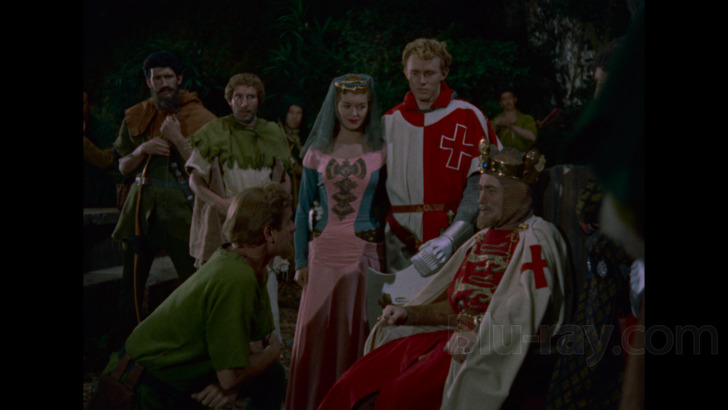
Though not the first or the last time an American would bring Robin Hood to life on screen, Don Taylor's version is certainly among the most charming. Possessed of a strong moral compass, he's self-assured without being arrogant, and is never above injecting a bit of fun into his work. Val Guest's film is consistently entertaining and carefully paced, with scenes that are allowed to breathe and delight, without leaving viewers breathless or bewildered. This type of family-friendly swashbuckling fare may not be what most associate with Hammer, but like their more well-known horror (and related) films, it is populated with a lively cast, and features a remarkable score and top-notch production values. When screened in conjunction with the unearthed and reinvigorated Wolfshead: The Legend of Robin Hood, viewers are treated to an expanded and more adult view of the character of Robin Hood, and I'm glad for it's inclusion here. The Men of Sherwood Forest 4K comes highly recommended.