The Memphis Belle: A Story of A Flying Fortress Blu-ray Movie
HomeThe Memphis Belle: A Story of A Flying Fortress Blu-ray Movie 
Periscope Film | 1944 | 90 min | Not rated | Sep 14, 2010

Movie rating
6.6 | / 10 |
Blu-ray rating
| Users |  | 0.0 |
| Reviewer |  | 4.0 |
| Overall | | 4.0 |
Overview
The Memphis Belle: A Story of A Flying Fortress (1944)
The most famous documentary to emerge from WWII, directed by William Wyler.
Director: William Wyler| Documentary | Uncertain |
| War | Uncertain |
| History | Uncertain |
Specifications
Video
Video codec: MPEG-4 AVC
Video resolution: 1080p
Aspect ratio: 1.37:1
Original aspect ratio: 1.37:1
Audio
English: Dolby Digital 2.0
Subtitles
None
Discs
25GB Blu-ray Disc
Single disc (1 BD)
Playback
Region A (B, C untested)
Review
Rating summary
| Movie | | 4.0 |
| Video |  | 3.0 |
| Audio |  | 3.5 |
| Extras | | 3.0 |
| Overall | | 4.0 |
The Memphis Belle: A Story of A Flying Fortress Blu-ray Movie Review
William Wyler's iconic World War II documentary comes to Blu-ray.
Reviewed by Jeffrey Kauffman September 16, 2010Propaganda is usually disparaged as the refuge of “them,” the evil enemy whose nefarious aims need a little PR boost to help win hearts and minds. Of course, “they” would no doubt see our morale boosting efforts in the same light. World War II saw a bevy of top notch Hollywood artists, both actors and behind the camera personnel, take part in some fantastic documentaries and features which helped to whip up support among the American populace and our allies. While glossy entertainments like Stage Door Canteen brought a typical Hollywood sheen to the war effort, grittier productions often filled the documentary side of the aisle. Vaunted directors like Frank Capra and George Stevens contributed major pieces during the war, as did a perhaps more unlikely source, William Wyler. While Wyler contributed perhaps the most beloved film about World War II’s aftermath, 1946’s The Best Years of Their Lives, somehow his often mannered approach seems, on the face of it at least, less in tune with propagandistic needs than Capra’s “aw, shucks” Americana or Stevens’ “go get ‘em” machismo.
Wyler, by the time of World War II, had already amassed a considerable reputation, helming high minded product for Samuel Goldwyn and having brought home an Oscar for 1942’s British morale booster Mrs. Miniver. In one of my favorite stories from Wyler’s Goldwyn years, he was called in to replace Howard Hawks toward the end of filming Edna Ferber’s Come and Get It. Hawks had personally hired actress Frances Farmer for the coveted dual role in the film, and considered the young star the best actress with whom he had ever worked, lavishing care and attention on the young woman which the persnickety Wyler certainly wasn’t about to once he took the reins. Wyler considered Farmer “unbearable,” in his own words, and the two mixed like oil and water, if even that well. There are unsubstantiated rumors that Farmer once chased him around the set with a flyswatter, an image I find absolutely delectable. Perhaps that incident helped give Wyler the intestinal fortitude to tag along on a series of high risk aerial missions in 1943. Perhaps surprisingly, Wyler, along with his cinematographer Harold J. Tannenbaum, managed to capture some viscerally exciting combat footage while piecing together a (somewhat fictionalized) story about the supposed last mission of the film’s title plane, Memphis Belle. According to, well, the propaganda at the time, the Belle was the first “flying fortress” to complete 25 missions over the European continent, and Wyler’s film was an ostensible document of its last mission. If the actual facts have turned out to be ever so slightly different, it ultimately doesn’t diminish the historical significance and impact of this documentary, long considered one of the classics of the World War II era.
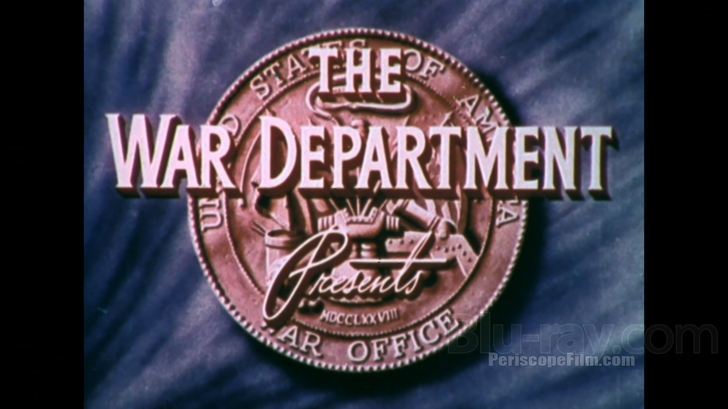
This little remembered "studio" was one of the majors circa 1944.
Memphis Belle: A Story of a Flying Fortress may strike contemporary audiences as incredibly quaint, the relic of a bygone age. But put yourself in the shoes of a 1944 audience member. The United States was seen as the last, best hope for freedom to overcome the forces of tyranny, and our fighting men had a level of support probably never to be seen again. Memphis Belle unapologetically celebrated these dashing heroes’ exploits, framed within the context of one group of guys making it through the gauntlet scores of time to reap their ultimate reward—the chance to return home. The documentary introduces us to the crew of the Belle (actually somewhat assembled for the purposes of the film itself). What the film doesn’t make clear is that Wyler and cinematographer Tannenbaum actually were up there with the crew, facing flak with the rest of the guys. (Tannenbaum perished in one of the missions, and Wyler’s hearing was severely damaged in one of the raids). That brings a viscerally exciting element to a lot of the scenes, which are up close and personal in every sense of the phrase.
As staged as some of the framing segments may be, there is a literally frightening reality to the long battle segment which takes place high in the air over Germany. In fact these intrepid pilots climb to literally stratospheric heights, donning oxygen masks as they witness ice crystals forming on their Plexiglas windows, but still unable to completely evade flak shot up from anti-aircraft guns, or to evade incoming fighter planes once their mission is accomplished. Memphis Belle documents, sadly, the demise of one plane (though its members evidently parachuted out), as well as giving the viewer some really incredible footage of the damage suffered by several other bombers which were nonetheless able to hobble back to England to fly another day. In fact some of the most emotional footage is seeing the ground crews erupt into cheers when the American planes start returning. Later, the King and Queen of England drop by for a congratulatory celebration.
As unsensationalized and matter of fact as Memphis Belle may be, especially to audiences accustomed to more in your face entertainments, there is a startlingly compelling aspect to this documentary which speaks across the decades since it was filmed, helping to not only illuminate the efforts of one fighter squadron, but indeed the zeitgeist of the wartime era.
The Memphis Belle: A Story of A Flying Fortress Blu-ray Movie, Video Quality
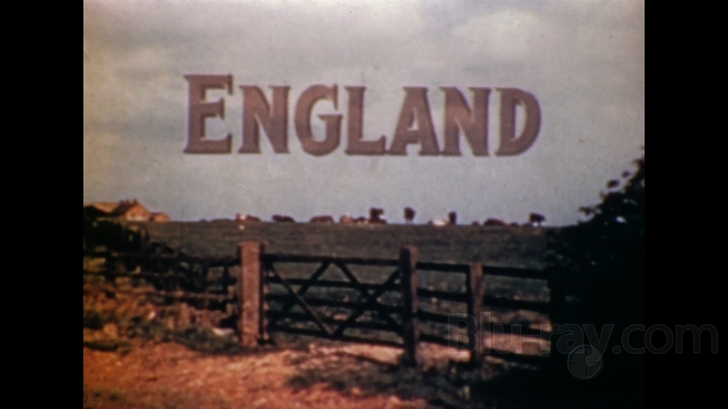
Are you a half glass full or half glass empty sort of viewer? A few things need to be taken into consideration when evaluating the image quality of Memphis Belle. First and foremost, this feature was originally shot in 16mm in combat conditions. That means no amount of restoration or digital fine tuning is ever going to completely ameliorate inherent qualities of the 16mm image, notably an overall softness and an abundance of grain. The film was also the victim of its non-preservationist era, meaning even the first prints suffered from a lot of scratches, debris, and light leakage to the negative. So what are we left with? The "half glass full"-ers will notice a considerable uptick in clarity and especially color saturation from previous home video releases. Greater detail can be seen in everything from the scribbled artwork on the sides of planes (and bombs) to some of the close-ups of the military personnel. The "glass half empty"-ers will still probably be aghast at the shape of the source elements. There are a lot of vertical blue scratches throughout the film which appear either singly down the left side of the image, or often in pairs toward the center. Flecks, scratches and other debris often mar the film's image. And there's simply no denying it's soft, with milky blacks and inconsistent contrast, all of which can be traced to the source elements. The Blu-ray upgrade does exhibit some noticeable haloing a time or two. One minor qualm I have with this release is the ubiquitous use of "bugs" (icons and logos) in the bottom right of the image. Periscope Films no doubt did this for copyright reasons, but it's a little bit annoying to have a nonstop periscope icon or, even worse, "PeriscopeFilms.com" plastered (however lightly) across the bottom right of the image.
It should also be noted for the obsessive compulsive viewers out there that the original film included short images that were optically flipped (you'll notice tail numbers are backwards on some planes). Why this was done is something of a mystery, but it's the way the film was originally released and is not an "error" with this release. Objectively, graded by contemporary standards of Blu-ray imagery, Memphis Belle probably rates only a 2.5. Given a rating relative to its previous home video incarnations, it might rate in the 3.5-4.0 range. I've therefore split the difference to give a reasonably balanced score.
The Memphis Belle: A Story of A Flying Fortress Blu-ray Movie, Audio Quality
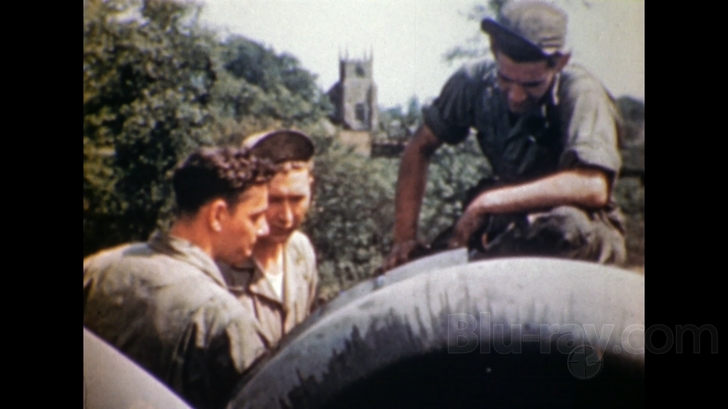
Memphis Belle's original mono track sounds surprisingly spry in this admittedly lossy Dolby Digital 2.0 presentation. The documentary was filmed silently and the soundtrack was added back in Hollywood, featuring narrator Eugene Kern and the occasional, but excellent, underscore of Gail Kubik. Late in the film a few moments of supposed flight crew voices spill into the mix, but overall this is quite simply a narrated documentary, with a few sound effects thrown in for good measure. Fidelity is quite good, considering the age of the stems. While there's obvious compression and a bit of boxiness in the sound, there's no overwhelming hiss or dropouts or other damage to report. Dynamic range is still acceptably strong here, with some of the explosions and reports from the machine guns providing some decent LFE. It's certainly not up to modern day standards by any stretch, but as is so often the case with these older films, the soundtrack has weathered the ages much better than the image.
The Memphis Belle: A Story of A Flying Fortress Blu-ray Movie, Special Features and Extras
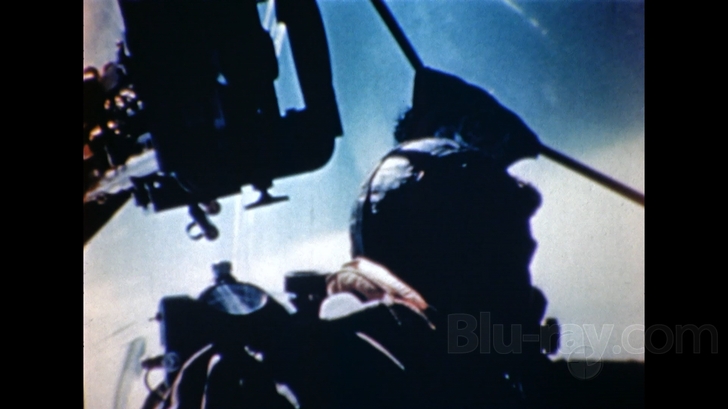
Three interesting wartime black and white featurettes are included on the Blu-ray, all in HD. Mission Accomplished (10:51) documents the first B-17 American raids into Europe and gives a very real account of what going into battle was like for these often extremely young men. Operation Clarion (11:34) was a once confidential account of a raid to disrupt the flow of German supplies to the frontline. 8th Air Force Report (8:36) offers some insight into the efforts of the Royal Air Force and concludes with a fun appeal by Gen. Eisenhower to buy war bonds. Also included on the Blu-ray for those with PC or Mac Blu-ray drives is a PDF file, 25 Missions, an original War Department pamphlet about the Memphis Belle and her crew.
The Memphis Belle: A Story of A Flying Fortress Blu-ray Movie, Overall Score and Recommendation
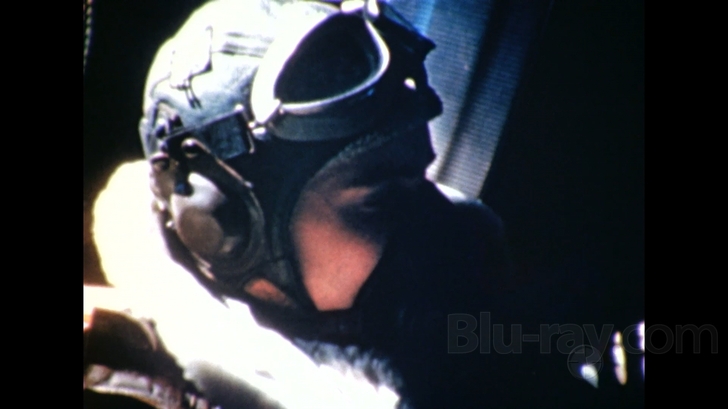
Wyler was evidently drawn to this particular plane and its crew for no other reason than that he found the name Memphis Belle evocative. It was a fortuitous decision, because Wyler was able to film a dedicated and heroic bunch of guys on what may not have exactly been their last mission, but which nonetheless was filled with danger and risk. This is a slow and deliberate film which manages to pry open the lid on what amounts to a time capsule, catapulting the viewer back to that epochal era when the lines between good and evil seemed much more clearly drawn than they are today. This Blu-ray offers a significant upgrade to the image, though truth be told videophiles expecting something digitally pristine will be sorely disappointed. Ultimately, the historical significance of this film outweighs any problems the source elements may contain, and Memphis Belle comes very highly recommended.
Similar titles
Similar titles you might also like
(Still not reliable for this title)

The War
2007

WWII in HD
World War II in HD
2009

They Shall Not Grow Old
2018

The Cold Blue
2018

Last Days in Vietnam
American Experience: Last Days in Vietnam
2014

The Vietnam War
2017

Korengal
2014

Vietnam in HD
2011

The World at War
1973

D-Day: Normandy 1944 4K
75th Anniversary Edition
2014

WWII From Space
2012

Apocalypse: World War II
2010
Report from the Aleutians
1943

Cease Fire 3D
1953

Restrepo
2010

Victory at Sea
Deluxe Edition
1952-1953

The World Wars
2014

Ken Burns: The Civil War
1990

Bombshell: The Hedy Lamarr Story
2017

Gettysburg
2011