The Marx Brothers Silver Screen Collection Blu-ray Movie
HomeThe Marx Brothers Silver Screen Collection Blu-ray Movie 
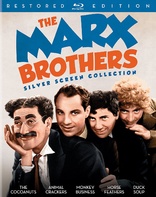
Restored EditionUniversal Studios | 1929-1933 | 5 Movies | 406 min | Not rated | Oct 18, 2016

Movie rating
Movie has not been rated yetBlu-ray rating
| Users |  | 0.0 |
| Reviewer |  | 4.0 |
| Overall | | 4.0 |
Overview
The Marx Brothers Silver Screen Collection (1929-1933)
See individual titles for their synopses.
| Romance | 100% |
| Comedy | 84% |
| Musical | 82% |
Specifications
Video
Video codec: MPEG-4 AVC
Video resolution: 1080p
Aspect ratio: 1.37:1
Original aspect ratio: 1.37:1
Audio
English: DTS-HD Master Audio 2.0
Subtitles
English SDH, French
Discs
Blu-ray Disc
Three-disc set (3 BDs)
Playback
Region free
Review
Rating summary
| Movie |  | 4.5 |
| Video | | 4.0 |
| Audio |  | 3.5 |
| Extras |  | 3.0 |
| Overall | | 4.0 |
The Marx Brothers Silver Screen Collection Blu-ray Movie Review
Reviewed by Jeffrey Kauffman October 16, 2016The Marx Brothers remain one of the most iconic comedy teams in the entire history of show business, including of course their film work. Years of
vaudeville experience and then Broadway stardom meant the siblings came to cinema with personas largely set and with a huge “catalog” of bits they
could utilize for their film work. That said, the movie going public had never really seen anything like the manic proclivities of this familial troupe, and
countless commentators from 1929 (when The Cocoanuts debuted on celluloid) on have attempted to analyze various elements of the
team’s completely unique comedy. While perhaps not especially “meaningful” in any overarching way, I had an unusual response to watching these
new transfers of the first five Marx Brothers feature films (all reportedly sourced from new 4K restorations done by Universal), one probably sparked
by my recent reviewing duties.
Arrow Video’s UK branch recently released
Woody Allen: Six Films 1971-1978, and in doing some background reading in preparation for my reviews of the movies in that set,
more than once I read in various articles comments along the lines of “Allen helped to define Jewish humor” or “Jewish humor simply wouldn’t be
the
same without Allen.” Allen’s patented brand of neurosis, sexual obsession and verbal acuity may indeed be at least a trifecta of Jewish
humor if not the trifecta, but one only need look a bit further back in time to the Marx Brothers for another potent example of the
“mainstreaming” of elements that could well be considered Jewish humor. I'm not suggesting this is the only way to look at the Marx Brothers'
efforts, or even that it's an "important" way, just that it struck me as "being there" for me after having just watched a bunch of Allen films.
In a way, though, the Marx Brothers’ perceived “Jewishness” is a little
more subliminal than Allen’s is in his own films, though for those with the eyes to see, the siblings represent their generation of Jews rather
iconically.
Not only is their verbal humor full of puns and other formalistic hijinks, the very subject matter of many of their jokes tends to focus on social,
political and even economic elements. The very fact that the act is comprised of family is important, with a “me and you against the world”
ambience
that speaks to outcasts (obviously including Jews) to this day. But there’s a “subtext” to many of the early Marx Brothers films, where the
brothers
are the outsiders, virtual interlopers attempting to make sense of a calamitous “new” world, whether that be a hotel, high society, a passenger
ship,
college sports or even a supposed nation in the throes of financial ruin.
What’s fascinating about the early Marx Brothers efforts is how they very
subtly display signs of the assimilative fervor that many first or second generation Jews of that time period experienced, where it became
paramount
(no pun intended, considering the studio which released the early Marx Brothers efforts) to “blend in”. That may seem positively non-intuitive,
given
the Marx Brothers’ predilection toward anarchic behavior and just outright silliness, but when seen through the prism of an early to mid 20th
century
“Jewish identity,” the first five Marx Brothers feature films offer not just laughs galore, but a rather interesting example of so-called “ethnics”
rather
brilliantly invading the American consciousness in an almost subversive way. In this respect, the Marx Brothers become one of the most potent
examples
of what might be termed cultural immigration, where their Jewishness may have been slightly cloaked but no less ingratiating in the long run.
That
“cloaking” may be nowhere more obvious than in the persona of Chico, a Marx who spoke with a faux Italian accent and who seemed to be
something of a grifter at times. Cloaked in another way but perhaps arguably more ostensibly Jewish, at least on one interpretive level, was
Harpo,
the weirdly childlike mute who seemed
to
often be the hapless scapegoat in many of the films, the outsider whose very powerlessness (as evidenced by his inability or unwillingness to
speak)
created “problems,” albeit often in a comedic way. The most obvious paradigm of Jewishness is of course Groucho, with his hyperarticulate
verbal
humor and a probably more than slightly lecherous mien which may in fact be a precursor for some of Woody Allen’s more sexually charged
material.
Zeppo, the kind of “forgotten” Marx Brother, and the one whose film persona is probably the blandest, may therefore somewhat ironically be
seen as
the best symbol of those
aforementioned assimilative tendences—Zeppo had “learned” how to be an American first, blending in as the troupe’s straight man and therefore
almost seeming like an outsider himself, at least within the insular world of the siblings’ relationships.
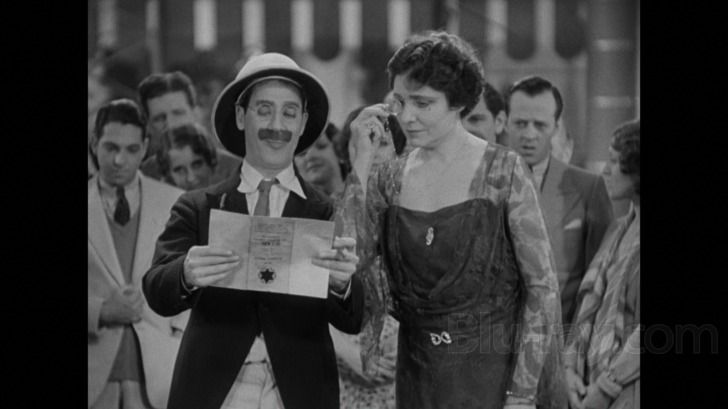
For reviews of the five films in this set, please click on the following reviews:
The Cocoanuts Blu-ray review
Animal Crackers Blu-ray review
Monkey Business Blu-ray review
Horse Feathers Blu-ray review
Duck Soup Blu-ray review
The Marx Brothers Silver Screen Collection Blu-ray Movie, Video Quality
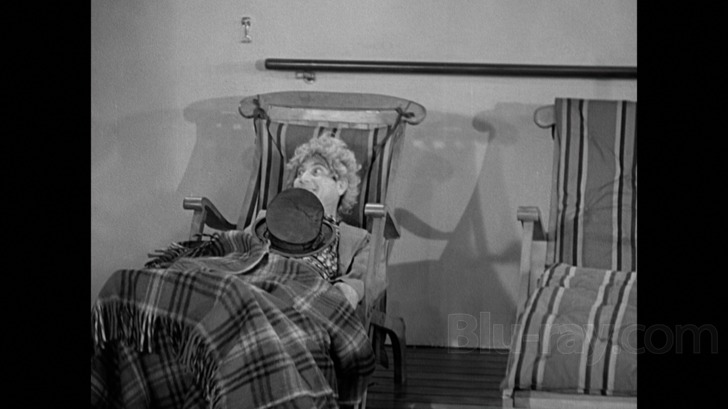
Video quality of each release is assessed in the above linked reviews.
The Marx Brothers Silver Screen Collection Blu-ray Movie, Audio Quality
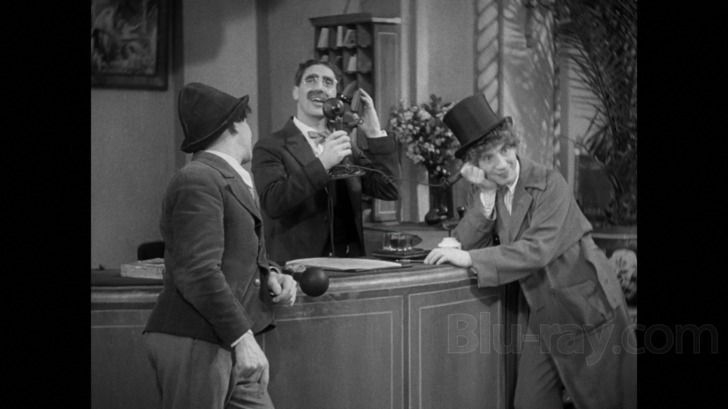
Audio quality of each release is assessed in the above linked reviews.
The Marx Brothers Silver Screen Collection Blu-ray Movie, Special Features and Extras
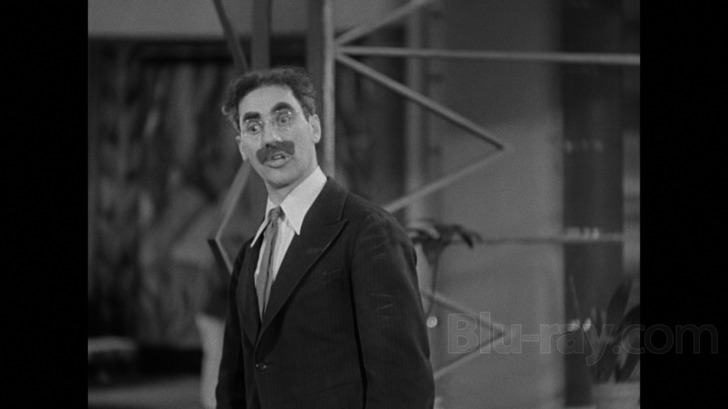
For the record, Universal has packaged these five films on three BD-50s, with The Cocoanuts and Animal Crackers sharing a disc, Monkey Business and Horse Feathers sharing another, and with Duck Soup on its own disc. Supplements exclusive to any individual film (which boils down to commentary tracks in all cases) are detailed on the appropriate review pages (linked above). The Duck Soup disc also has a commentary (detailed on its review page), as well as the following "general" supplements:
- The Marx Brothers: Hollywood's Kings of Chaos (1080p; 1:19:57). This is a decent if hardly exhaustive overview which gets into a few biographical tidbits (most having to do with Minnie, the boys' agent mom) while detailing the brothers' early film career. Lest some readers think I'm completely out of my mind with regard to my "Jewish thesis" above, the documentary actually briefly gets into how the boys' Jewish upbringing affected at the very least their musical proclivities. Some of the most interesting information actually comes toward the end, when Groucho started to experience the renaissance of interest in the Marx Brothers and their films that began in the late sixties.
- Inside The Today Show Vault: The Interviews (480i; 16:45) offers Harpo from 1961, Groucho from 1963 and Bill (Harpo's son) from 1985.
The Marx Brothers Silver Screen Collection Blu-ray Movie, Overall Score and Recommendation
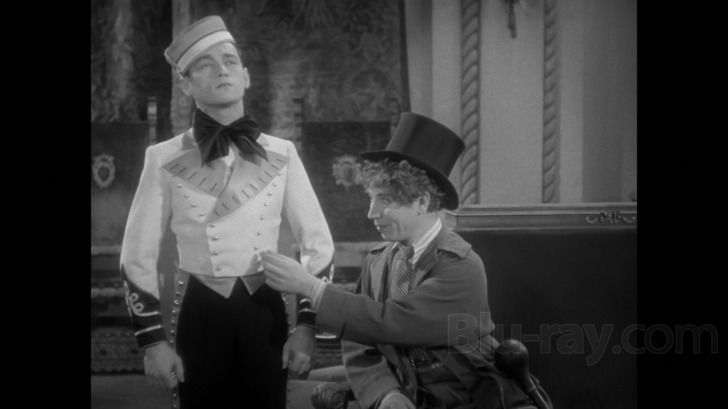
I was a little amazed a few years ago when I reviewed Citizen Kane when both people messaging me and members on our forum posted that they had never seen the film before and were looking forward to watching it for the first time. So with that in mind, I'll simply say if you've never seen the Marx Brothers (or even any/all of the films in this set), you're in for one of the prime viewing treats of your life. Even those who have seen (and loved) the Marx Brothers for years will find a lot to love in this new collection, including a reconstituted Animal Crackers, great commentaries, and generally improved (sometimes markedly) video and audio. Highly recommended.