The Man with No Name Trilogy Blu-ray Movie
HomeThe Man with No Name Trilogy Blu-ray Movie 
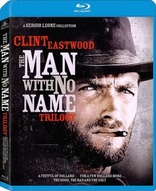
A Fistful of Dollars / For a Few Dollars More / The Good, The Bad and The Ugly [Remastered]Metro-Goldwyn-Mayer | 1964-1966 | 3 Movies | 407 min | Rated R | Jun 03, 2014

Movie rating
Movie has not been rated yetBlu-ray rating
| Users |  | 4.0 |
| Reviewer |  | 4.5 |
| Overall | | 4.0 |
Overview
The Man with No Name Trilogy (1964-1966)
Contains all three films in The Man with No Name Trilogy: 'A Fistful of Dollars', 'For a Few Dollars More' and 'The Good, The Bad and The Ugly'. See individual titles for their synopses.
| Drama | 100% |
| Period | 58% |
| Western | 50% |
| Epic | 38% |
| Adventure | Insignificant |
| Action | Insignificant |
Specifications
Video
Video codec: MPEG-4 AVC
Video resolution: 1080p
Aspect ratio: 2.35:1
Original aspect ratio: 2.35:1
Audio
See individual releases
Subtitles
None
Discs
50GB Blu-ray Disc
Three-disc set (3 BDs)
Playback
Region A, B (locked)
Review
Rating summary
| Movie | | 4.0 |
| Video | | 4.5 |
| Audio | | 4.0 |
| Extras | | 4.0 |
| Overall | | 4.5 |
The Man with No Name Trilogy Blu-ray Movie Review
"Blondie" Returns (Though Still Not Blond)
Reviewed by Michael Reuben June 15, 2014The latest remaster from MGM in celebration of its 90th anniversary is the Sergio Leone-directed The Man with No Name Trilogy that launched Clint Eastwood into international stardom. The release comes almost exactly four years to the day after MGM's previous release of the same set, and the first two films—A Fistful of Dollars and For a Few Dollars More—are identical to the earlier discs. The third film, however, The Good, the Bad and the Ugly, first seen on Blu-ray in 2009, has received a long-hoped-for restoration under the auspices of the Cineteca di Bologna. Although the audio options remain unchanged from the 2009 release (a subject that has prompted protests from some corners), the upgrade in image quality is dramatic. Everyone has their personal favorite among Leone's spaghetti Westerns, but for many The Good, the Bad and the Ugly is the pinnacle of his achievement, both as cinema and as a reinvention of this classic American genre. Beginning with A Fistful of Dollars in 1964, Leone transformed the Western from its origins as a morality play into an operatic celebration of masculinity. His cowboy heroes were tougher, more reserved, faster on the draw, able to endure greater suffering and achieve more remarkable feats. They inhabited larger landscapes than John Ford's, and their visages filled the frame in what is still known today as "the Leone closeup". His villains grew in stature until they became almost superhuman (of which probably the best known is Henry Fonda's Frank in Once Upon a Time in the West). By the time Leone made The Good, the Bad and the Ugly, his third film with Eastwood, he had so thoroughly mastered these stylistic elements that he needed only the barest bones of a story on which to hang them. Most of the film's plot is contained in its title: three giant archetypes on a collision course that, appropriately enough, ends in a cemetery. Around them, battles rage and hundreds die, but these three always survive, because they have an appointment they are destined to keep. Along the way, mini-dramas proliferate, often courtesy of Eli Wallach's incorrigible Tuco ("The Ugly"), a whirling dervish whose buffoonery effectively masks his ruthless nature.
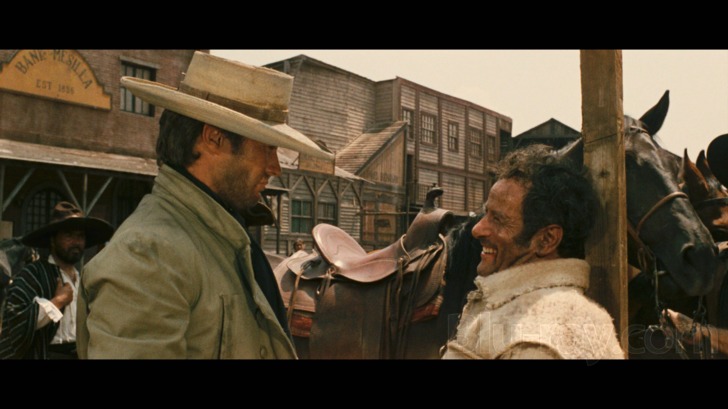
The following excellent summary of The Good, the Bad and the Ugly is reproduced from Casey Broadwater's review of the 2009 Blu- ray:
The Good, the Bad and the Ugly presents Leone at the height of his creative and directorial powers, not to mention blessed with the biggest budget he'd had yet. The scope of the film is immense, as Leone takes us from tiny towns to embroiled Civil War battles, and from the craggy canyons of the characters' faces to sand-filled vistas that stretch from one horizon to the next. Even time itself seems subject to the film's enormity. At a hefty 179 minutes, The Good, the Bad and the Ugly should seem drawn-out and overlong. Instead, we're drawn into the tense and protracted stares between characters, waiting anxiously for that split-second moment of violence. A lesser film would've left whole spools on the cutting room floor, but each spare detail here builds up the world that the narrative inhabits. Set in Texas on the outskirts of the Civil War, The Good, the Bad and the Ugly is the story of three men vying to find $200,000 in Confederate gold. Blondie (Clint Eastwood) is the Good, an itinerant gunslinger who's running a scam with Tuco (Eli Wallach)—the Ugly—a conniving bandit well practiced in the art of backstabbing, and the two have a tenuous alliance based on mutual gain. Also after the coinage is Angel Eyes (Lee Van Cleef)—the Bad—a cold-blooded killer with an icy stare that's like looking down the dual barrels of a shotgun. Tuco knows the cemetery where the money is buried, but not the exact location. Blondie knows the spot, but not the name of the cemetery. And Angel Eyes tracks them both, hoping to get his hands on the glittering payday. Allegiances flip-flop and niceties are quickly dispensed with as the three men get nearer and nearer to the treasure. That our hero (or is it anti-hero?) Blondie is after money-not justice-is indicative of the new, cynical direction that Leone was taking with his westerns. Decency and integrity were no longer adequate rewards, in and of themselves, and though Blondie is the Good in the film, he's rarely "good" in the conventional sense. Tuco is the most blatantly rapacious-when he gets to the cemetery he's basically running around with dollar signs in his eyes-but Blondie is also driven inherently by greed. This materialistic hunt is set against a backdrop of war's absurdities— thousands of soldiers die to take an inconsequential bridge—and Leone seems to be saying that both war and greed are surefire routes to senseless violence. And there's plenty of fun, senseless violence. More than just an upheaval of its genre, The Good, the Bad and the Ugly is an ultra-cool exercise in style, from the cleverly cut gun battles to Clint Eastwood in his knee-length duster, squinting into the sun with a half-smoked stogie wedged in his grimacing teeth. The three principle actors are simply a pleasure to watch. Lee Van Cleef simmers with a dastardly suaveness, Eastwood brings his wry smile, and Eli Wallach stomps through the narrative, often stealing the show from Clint himself. There's a reason why people still watch The Good, the Bad and the Ugly, and it's not because the film is influential or game-changing, but simply because it's so damn entertaining and watch-able.
The Man with No Name Trilogy Blu-ray Movie, Video Quality
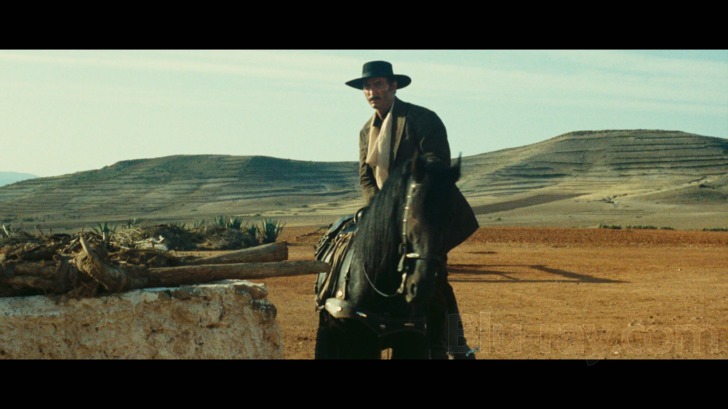
Tonino Delli Colli's Techniscope cinematography for The Good, the Bad and the Ugly has been restored from the original camera negative (or "OCN") by L'Immagine Ritrovata, the imaging specialty facility created by the Cineteca di Bologna for precisely such projects. Delli Colli died in 2005, but the restoration team consulted with Sergio Salvati, assistant cameraman on the film. They also used Italian Technicolor prints as a color reference. (Far too many internet discussions of classic films complain about the colors on Blu-ray without any basis other than personal preference.) The results, in direct comparison to the 2009 Blu-ray from MGM, reveal a number of significant changes, all of which I consider improvements. First of all, the framing is noticeably expanded, revealing additional image at top and bottom and especially at the right. While the added image isn't crucial to any particular scene, Leone was a visual stylist noted for his meticulous compositions. Preserving the integrity of his frame is crucial. Second, the densities and detail are substantially improved, the former more than the latter. The Techniscope process, which is discussed in the "Restoration" featurette in the extras, was economical, but it did not create as large a negative as anamorphic processes such as Cinemascope. Still, by scanning the OCN at 4K, the restoration team was able to extract previously unseen fine detail in faces, shadows and smaller objects. Everything in the frame also has a greater sense of solidity and presence than in any previous video version of the film I have seen, an essential quality in the many wide shots crowded with soldiers, townspeople and, in the final sequence, graves marked by crosses. Third, the color balance has changed dramatically, a point that has already engendered much comment, primarily from viewers who have seen screen captures but not the disc itself. Yellow has been prominently accentuated throughout, although not (as some have claimed) to the exclusion of all other colors. Screenshot 3 accompanying this review shows an example of a frame bisected by a contrast between a yellowish-brown foreground and the bluish cast of the distant hills, as Lee Van Cleef's "Angel Eyes" dismounts his horse in his first appearance. Deep blues recur repeatedly, both in night scenes and whenever the Union Army appears. The yellow cast has been confirmed as Leone's intent, which was not reflected in the prior Blu-ray, just as the framing was wrong. If one stares at screen captures, then it seems to jump out, but if one sits down to watch the film straight through, the eye quickly adjusts, as other colors vary and balance the image. By the end of a three-hour viewing, you are no longer aware that anything has changed (until, that is, you put on an older copy). Some minor video noise can be observed in long shots, probably a result of the limitations of Techniscope as it confronts modern high-resolution video. The good news is that the restoration team hasn't tried to smooth away the noise, thereby introducing other unwanted results. The overall impact of this visual restoration is to make an already memorable film even more vibrant, vital and compelling. Whatever issues one might have with the audio tracks (about which more below), there is no reason to hesitate over the remastered video. (Note: For the sake of comparison, I have provided a few screenshots from the 2009 Blu-ray, with their counterparts from the remastered disc. These occur at screenshots 15-26, and the remastered version is always first. The frame matches are not necessarily exact, because the capture equipment we use at Blu-ray.com does not provide the ability to select an exact frame.) (Additional Note: The video score is for the entire trilogy, with an upward adjustment for the remastered third disc.)
The Man with No Name Trilogy Blu-ray Movie, Audio Quality
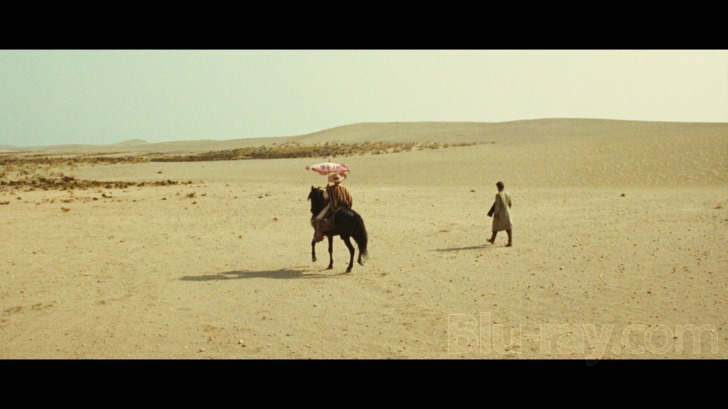
Although this remastered edition of The Good, the Bad and the Ugly offers fewer audio options than the 2009 release (omitting Thai and Italian tracks), it does provide the same two English tracks as its predecessor. The first is a remastered 5.1 mix presented in lossless DTS-HD MA; the other is a mono track in Dolby Digital, which is a "mixdown" of the remastered 5.1 track. The reasons for presenting the mixdown are explained in the Restoration featurette in the extras (although one must apply some deduction). The 179-minute version of the film presented here and in 2009 was never released theatrically in America in 1964, so that an English-language version of the additional scenes had to be created from scratch in 2003, when the restoration project was undertaken by MGM. Eastwood and Wallach, among others, redubbed their lines, and substantial audio manipulation had to be applied to minimize synch issues. For the 2009 release, a mixdown was the only existing version of a mono track for those wishing to replicate the original theatrical experience. In connection with this restoration, however, the Cineteca di Bologna has reportedly prepared a new mono track that uses the original English language mix for those portions of the film seen in the U.S. in 1964, inserting the "mixdown" only for the newly recorded scenes. For whatever reason, that newly created mono track was not used by MGM on this disc. Audio purists and cinemaphiles interested in experiencing films in as close to their original form as possible have objected and requested that MGM reissue the disc. In the meantime, the pros and cons of the 5.1 remix remain much as they were when the 2009 edition was first reviewed. The audio score is for the trilogy as a whole.
The Man with No Name Trilogy Blu-ray Movie, Special Features and Extras

The extras are identical to those previously included with the 2009 release. Please see the previous review for details.
The Man with No Name Trilogy Blu-ray Movie, Overall Score and Recommendation
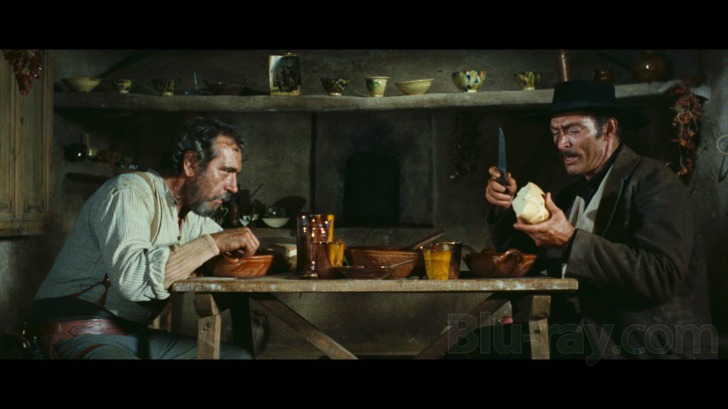
The combination of Leone's visual poetry, the cast's iconic performances and Ennio Morricone's unforgettable score produced a Western classic unlike any other, which has now received the visual restoration it deserves. At the moment, the restored version of The Good, the Bad and the Ugly can only be acquired as part of the three-disc The Man with No Name Trilogy, but look for a separate release at some date in the near future. (We already have an entry for it.) Indeed, right now the Trilogy itself is hard enough to find as a result of production delays. Fans who are able to find it shouldn't hesitate to acquire it, especially if they don't already own the previous set.