The Man with No Name Trilogy Blu-ray Movie
HomeThe Man with No Name Trilogy Blu-ray Movie 
A Fistful of Dollars / For a Few Dollars More / The Good, the Bad and the UglyMetro-Goldwyn-Mayer | 1964-1966 | 3 Movies | 407 min | Rated R | Jun 01, 2010


Movie rating
Movie has not been rated yetBlu-ray rating
| Users |  | 4.7 |
| Reviewer |  | 4.0 |
| Overall | | 4.4 |
Overview
The Man with No Name Trilogy (1964-1966)
Contains all three films in the Man with No Name Trilogy: 'A Fistful of Dollars', 'For a Few Dollars More' and 'The Good, the Bad and the Ugly'.
| Drama | 100% |
| Period | 58% |
| Western | 50% |
| Epic | 38% |
| Adventure | Insignificant |
| Action | Insignificant |
Specifications
Video
Video codec: MPEG-4 AVC
Video resolution: 1080p
Aspect ratio: 2.35:1
Original aspect ratio: 2.35:1
Audio
See individual releases
Subtitles
None
Discs
50GB Blu-ray Disc
Three-disc set (3 BDs)
Playback
Region A, B (C untested)
Review
Rating summary
| Movie | | 4.0 |
| Video |  | 3.5 |
| Audio | | 4.0 |
| Extras | | 4.0 |
| Overall | | 4.0 |
The Man with No Name Trilogy Blu-ray Movie Review
Eastwood. Leone. Morricone. Pretty much all you need to know.
Reviewed by Casey Broadwater June 8, 2010When John Wayne rode the plains, life was pretty simple for a gunslinger. Heroes wore white hats and treated their women kindly, while villains sauntered into town in ten-gallons worth of black, their upper lips hardened into permanent sneers. The Law of the West was a balancing act between freedom and justice. Good was good, bad was bad, and moral ambiguity just plain hadn’t been invented yet. The reality of westward expansion, however, was a great deal less grounded in ethical certainties, and I’ve always thought the myth of the noble West was a ploy to help us feel better about how we treated the Native Americans. Hollywood embraced the western for its easy-to-script, good vs. evil, let’s get out there and show ‘em how Americans get ‘r done ethos, but after churning out title after title, the formula began to lose its potency. In the meantime, Europeans—most of whom had never even been to the wild, wild West—were putting new spins on the genre and paying close attention to what might as well be called the “eastern.” Yes, the samurai movie. Inspired by Akira Kurasawa’s Yojimbo, a film about a masterless swordsmen plying his steel-edged trade for cold hard cash, Italian director Sergio Leone would create a different, cynical kind of western, where good was relative and bad was more than just an attitude. For the traditional Hollywood cowpoke tale, things were about to get ugly.

The Man With No Name
A Fistful of Dollars (3.5/5)
While not the first so-called “spaghetti western,” A Fistful of Dollars certainly announced the presence of this new European take on a distinctly American idiom. Director Sergio Leone, whose only previous credited film was the under-the-radar Colossus of Rhodes, saw in Kurasawa’s Yojimbo an opportunity to reinvent the flagging western genre, which had grown predictable and stale. The irony, of course, is that Kurasawa was immensely influenced by the earlier westerns of John Ford, and borrowed the plot of Yojimbo from Dashiell Hammett’s noir- ish novel Red Harvest. When Leone set about remaking Yojimbo as a western— unauthorized and unbeknownst to Kurasawa—he was essentially bringing the story full circle and around the globe, telling an American tale, processed through a Japanese aesthetic and moral filter, with a European cinematic sensibility. Somehow, it works. While Leone’s soon-to-be- characteristic style is still in its nascent stages here—the two sequels grow progressively more assured—A Fistful of Dollars is, in several ways, a genre game-changer, effectively overturning many long-held tenets of the “classic” western cinematic mythology established by John Ford and others.
This has everything—and, at the same time, nothing—to do with the film’s threadbare plot. By which I mean that the story is exceptionally simple, but the crux of it—moral ambiguity and greed —is something entirely new to the genre. A stranger—a perfectly stoic Clint Eastwood, in the role that would launch him to stardom—rides into the barren Mexican border town of San Miguel. We know nothing about his past, but like the nameless, masterless swordsman of Yojimbo— played by the almost equally taciturn Toshiro Mifune—he’s a drifter, looking to put his gun slinging skills to use for the highest bidder. Vying for control of the town are two warring factions, the gunrunning Baxter clan, led by a crooked sheriff (Wolfgang Lukschy), and the liquor-smuggling Rojos brothers, Don Miguel (Antonio Prieto), Esteban (Sieghart Rupp), and Gian Maria Volontè as the rifle-toting Rámon. (In the same way that the villain in Yojimbo uses a firearm against a swordsman, Rámon uses a more powerful weapon—a rifle—against the pistol-carrying protagonist.) The stranger—nicknamed “Joe” by the local undertaker—sees in this territorial stalemate a chance to earn some serious cash. He plays the two gangs against one another, flipping allegiances whenever there’s a buck to be made.
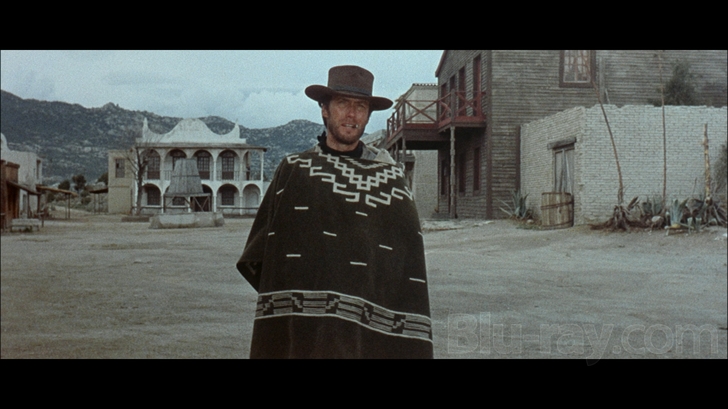
And herein lies the film’s cynicism. In previous westerns, the good guys were out for justice; they did what was right precisely because it was right, with no expectation of reward. The Man With No Name, going after money, and money only, is one of the western genre’s first true anti- heroes. He dresses the part, with a dirty hat, a bandit’s poncho, and a week’s growth of stubble. Gnawing on his cigarillo and grimacing into the southwestern sun, he’s the total antithesis of a clean-shaven John Wayne-type with a pressed shirt and white hat. The violence he doles out with his trusty .45 has no moral justification whatsoever, and helping the innocent is definitely secondary to his greed-driven cause. And yet, he’s a likeable, sympathetic character, and Eastwood plays him with a subtle wink in his eye. This is the genesis of the onscreen persona that Eastwood would cultivate for the rest of his career—a tough, world-wearied sort with an in-the-know smirk— and it’s also ground zero for Sergio Leone’s immediately recognizable directorial style, from the ultra-tight close-ups and deep compositions—utilizing a looming foreground object while some kind of action takes place in the background—to the tense, protracted Mexican standoffs that end in sudden bursts of bullet-strewn violence. Though A Fistful of Dollars isn’t the best of the Man With No Name saga—it owes too much of a debt to Kurasawa—it is a terrific starting point for the trilogy, launching the careers of Eastwood, Leone, and composer Ennio Morricone, and introducing the world to westerns of the morally relativistic, hard-boiled spaghetti variety.
For A Few Dollars More (4/5)
In Japan, Yojimbo was followed almost immediately by Sanjuro, but after getting sued by Akira Kurasawa for A Fistful of Dollars’ uncanny resemblance to the first film, Sergio Leone wasn’t about to remake its sequel. Instead, he wisely followed up Fistful with a story of his own creation. For A Few Dollars More finds the director expanding on the themes and visual touchstones established in his previous film, and the result is a production that’s much more mature, narratively complex, and polished, even if content-wise it’s just as raw and gritty. Clint Eastwood returns as The Man With No Name—a marketing gimmick dreamed up at MGM—only this time, we learn he’s “said to go by the name of ‘Manco,’” which roughly translates to “lame in one hand.” And while he’s not actually lame, he does do just about everything left- handed, if only to keep his right hand—his gun hand—always at the ready. The character is still a complete enigma, a man without a past. Is he supposed to be “Joe” from Fistful? The matching poncho, black jeans, and cigarillos say yes, but we can’t be sure. The mystery broadens the character; he’s no longer just a man, he’s an entire archetype unto himself—the nameless wanderer, the itinerant gunslinger, hellfire on a horse.
The film begins with a title card that reads, “Where life had no value, death, sometimes, had its price. That is why the bounty killers appeared.” Straight off we’re introduced to Colonel Douglas Mortimer (Lee Van Cleef), an inveterate vigilante who smokes an enormous yellow pipe and carries his own personal arsenal of firearms—the right gun for every situation. This is a man accustomed to dealing out death for money, and we see a calm, almost bemused reserve on his face as he assembles his extended-stock pistol while the bandit he’s hunting fires at him from out of range. He’s a specialist, a thinker, who has somehow survived in this trade until “almost fifty years of age.” Manco’s approach to bounty killing is more reckless, ballsy even. We see him initiate a shootout in a saloon with nary a flinch; when the last bandit standing—or rather, crawling— reaches for a pistol on the ground, Manco kills him without even looking. Badass. Eventually, these two bounty hunters meet face to face and, after sizing each other up in a pistol-shooting game of one-upmanship—Mortimer wins, keeping Manco’s hat in the air with several shots—form a shaky partnership, based on mutual distrust. Both men, for separate reasons, are looking for El Indio (Gian Maria Volontè), a heartless, reefer-smoking criminal—everyone smokes something in these films, be it a cigarillo, a pipe, or a joint—who plans on robbing the heaviest guarded bank in El Paso. Manco infiltrates Indio’s gang while Mortimer keeps watch from the outside, but when their scheme is discovered, it’ll take a whole lot of trickery and gunplay to get them their reward—a $27,000 bounty.
The violence is more intense, the themes are more pronounced, and For A Few Dollars More is bigger and more accomplished—in just about every way—than its predecessor. You can practically see everyone involved settling into a kind of swagger, Eastwood most of all, as he seems completely at home in the character here, allowing himself more leeway for comedic moments. Like Steve McQueen, a rising star after The Magnificent Seven, Eastwood exudes effortless cool. Unlike McQueen, though, who basically tried to steal the show from Yul Brynner in Magnificent—waving his hat around and doing anything he could to attract onscreen attention—Eastwood’s performance is economically pared down to the essentials, minimal expression, minimal movement, minimal dialogue. (Leone once joked that Clint had two expressions, with the hat, and without the hat.) And this makes him a commanding presence. Lee Van Cleef is just as good. After playing second-fiddle in numerous 1950’s westerns, he makes the most here out of his first sizeable starring role. Watching his motivations unravel is one of the film’s greatest subtleties—it’s ultimately satisfying to learn why he’s really after Indio—and his nearly father/son-style repartee with Eastwood gives the movie unexpected depth. Since Leone made For A Few Dollars More for more than just a few more dollars than its predecessor— $600,000, compared to $200,000—his directorial performance also seems more confident. His frame are filled with movement, the town seems more alive than Fistful’s San Miguel, and the gunfights are more tensely choreographed. Far from just a warm-up for his masterpiece, The Good, the Bad, and the Ugly—though it is that, as well—For A Few Dollars More is a piece of audacious filmmaking that continues to evolve Leone’s conception of the ignoble west.
The Good, the Bad, and the Ugly (4.5/5)
The culmination of this new breed of western is undoubtedly The Good, the Bad and the Ugly. As the third film in the “Dollars” trilogy, The Good, the Bad and the Ugly presents Leone at the height of his creative and directorial powers, not to mention blessed with the biggest budget he’d had yet. The scope of the film is immense, as Leone takes us from tiny towns to embroiled Civil War battles, and from the craggy canyons of the characters’ faces to sand-filled vistas that stretch from one horizon to the next. Even time itself seems subject to the film’s enormity. At a hefty 179 minutes, The Good, the Bad and the Ugly should seem drawn- out and overlong. Instead, we’re drawn into the tense and protracted stares between characters, waiting anxiously for that split-second moment of violence. A lesser film would’ve left whole spools on the cutting room floor, but each spare detail here builds up the world that the narrative inhabits.
Set in Texas on the outskirts of the Civil War, The Good, the Bad and the Ugly is the story of three men vying to find $200,000 in Confederate gold. Blondie (Clint Eastwood) is the Good, an itinerant gunslinger who’s running a scam with Tuco (Eli Wallach)—the Ugly—a conniving bandit well practiced in the art of backstabbing, and the two have a tenuous alliance based on mutual gain. Also after the coinage is Angel Eyes (Lee Van Cleef, in another iconic role)—the Bad—a cold- blooded killer with an icy stare that’s like looking down the dual barrels of a shotgun. Tuco knows the cemetery where the money is buried, but not the exact location. Blondie knows the spot, but not the name of the cemetery. And Angel Eyes tracks them both, hoping to get his hands on the glittering payday. Allegiances flip-flop and niceties are quickly dispensed with as the three men get nearer and nearer to the treasure.
That our anti-hero Blondie is after money—not justice—is once again indicative of the new, cynical direction that Leone was taking with the western. Decency and integrity were no longer adequate rewards, in and of themselves, and though Blondie is the Good in the film, he’s rarely “good” in the conventional sense. Tuco is the most blatantly rapacious—when he gets to the cemetery he’s basically running around with dollar signs in his eyes—but Blondie is also driven inherently by greed. This materialistic hunt is set against a backdrop of war’s absurdities—thousands of soldiers die, for instance, to take a wholly inconsequential bridge—and Leone seems to be saying that both war and greed are surefire routes to senseless violence.
And there’s plenty of fun, senseless violence. More than just a continued upheaval of its genre, The Good, the Bad and the Ugly is an ultra-cool exercise in style, from the cleverly cut gun battles to Clint Eastwood in his knee-length duster, squinting into the sun with a half-smoked stogie wedged in his grimacing teeth. The three principle actors are simply a pleasure to watch. Lee Van Cleef simmers with a dastardly suaveness, Eastwood brings his wry smile, and Eli Wallach stomps through the narrative, often stealing the show from Clint himself. There’s a reason why people still watch the films in the Man With No Name trilogy, and it’s not because they’re influential or game-changing—though they certainly are, serving as predecessors to the “acid westerns” of Sam Peckinpah and Alejandro Jodorowsky—but simply because they’re so infinitely entertaining.
The Man with No Name Trilogy Blu-ray Movie, Video Quality
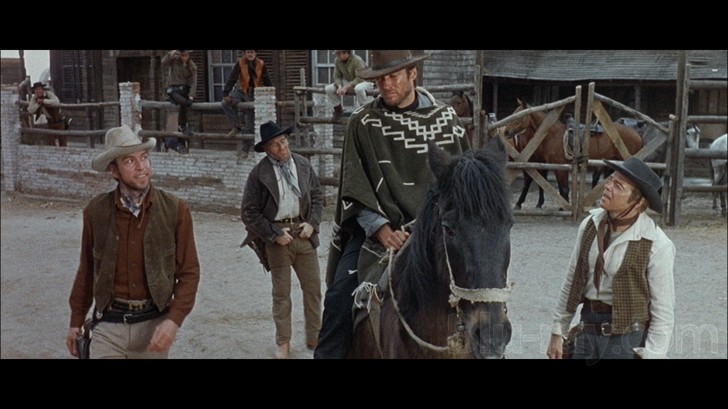
Okay, so there's some good news and some bad news (but, thankfully, no outright ugly news). First,
the bad. While some were hoping for a new re-master of The Good, the Bad, and the Ugly,
MGM has—not unexpectedly—stuck with the same transfer that was used on the 2009 stand-alone
Blu-ray release of the film. And this transfer didn't exactly win over the hearts of videophiles. Based
on a 2002 restoration and originally engineered for a subsequent DVD release, the transfer exhibits
issues that wouldn't be as apparent in standard definition, but definitely show up in 1080p. Edge
enhancement is frequently noticeable—forming sometimes white, sometimes black haloes around
hard lines—and the overuse of digital noise reduction often results in waxy facial textures and an
artificial diminishing of the film's grain structure. So, no, the transfer isn't ideal, but it is an
improvement in terms of color and depth, with dusty Technicolor hues and solid black
levels.
The good news is that both A Fistful of Dollars and A Few Dollars More look much
better. There are still some small issues—Fistful appears to be slightly cropped, and some
lines and textures do seem unnaturally edgy—but both films look less obviously tampered with and
more naturally filmic. Visually, Fistful is the weaker of the two, with a softer image, but this
seems due to the film's low-budget origins and slightly off focus pulling rather than a defect in the
transfer process. Still, the upgrade in picture quality is definitely appreciable. The real gem here,
image-wise, is For A Few Dollars More, which looks quite nice in high definition, with strong
color and a more refined sense of clarity. There are white specks and some minor print damage
present in all three films, but nothing too off-putting. Likewise, the films sit comfortably on three
BD-50 GB discs, and there really aren't any overly apparent compression-related distractions. Could
The Man With No Name trilogy look better? Absolutely. Will it? Probably not for some time
to come. I, for one, am definitely retiring my DVD copies.
For those keeping score, I'd give A Fistful of Dollars a 3.5/5, For A Few Dollars More
a solid 4/5, and The Good, the Bad, and the Ugly a 3/5.
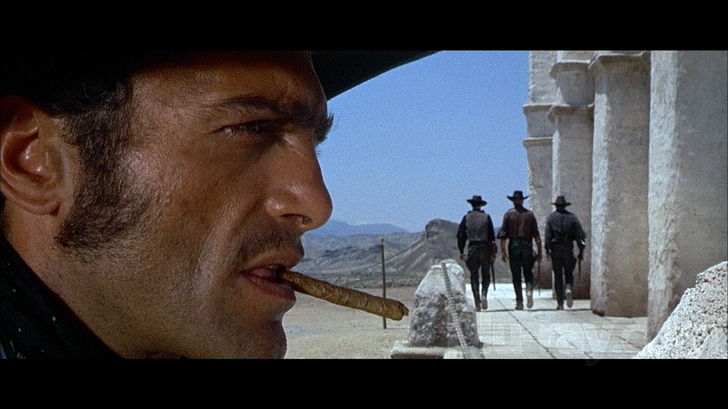
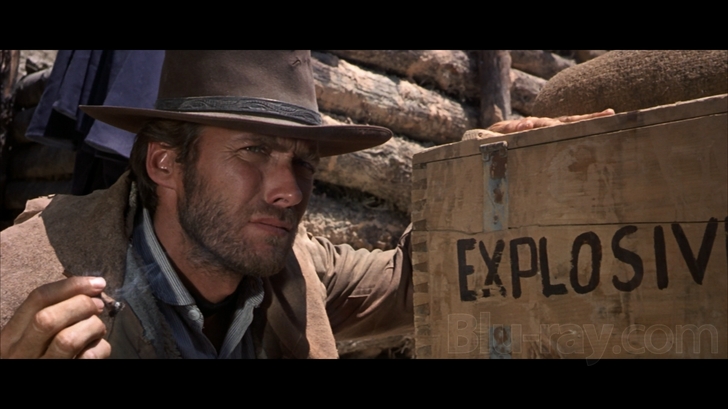
Also note that screenshots 2 and 5-10 are from Fistful, 1,3, and 11-15 are from A Few
Dollars More, and 4 and 16-20 are from The Good, the Bad, and the Ugly.
The Man with No Name Trilogy Blu-ray Movie, Audio Quality
The original mono stems for each film have been expanded here into capable DTS-HD Master Audio 5.1 surround mixes. Personally, I'd be fine with lossless versions of the mono tracks, but I can understand the insistence on wanting to fill out the soundfield. You'll hear horses galloping between channels, gunfire ricocheting from all sides, and the occasional bleeding of place-establishing ambience, like saloon chatter and various outdoorsy noises. That said, this attempt to make the films more immersive isn't always successful. There are times when the effects panned into the rear speakers sound clumsy, directionally inaccurate, or simply out of place (i.e., voices coming from the left when, visually, it seems they should be heard from the right). Thankfully, this doesn't happen too frequently. Overall, I'm happy with all of these tracks, which, surround sound aside, seem like accurate representations of the original audio, warts and all. All three films were completely dubbed in post- production, and the ADR work from many of the bit players is often laughably bad. Still, dialogue is balanced well and is usually easy to understand, even if it doesn't always lip-sync perfectly. The biggest benefit in the upgrade to lossless audio can be heard in Ennio Morricone's iconic scores, which were radical departures from the orchestral arrangements of most westerns. If you're cool with the tinny quality of the high-end, the music sounds fantastic, a mix of bright Stratocaster guitar tones, mouth harp, whistling, clip-clop percussion, and unintelligible chanting. The audio gets strong 4/5's across the board.
The Man with No Name Trilogy Blu-ray Movie, Special Features and Extras
A Fistful of Dollars
Commentary with Film Historian Christopher Frayling
Frayling, Sergio Leone's biographer and author of Spaghetti Westerns: Cowboys and Europeans
from Karl May to Sergio Leone, offers up an immensely informative commentary, a non-stop
parade of facts, anecdotes, and trivia.
The Christopher Frayling Archives: Fistful of Dollars (1080p, 18:40)
An all-new featurette featuring film historian Christopher Frayling, who shows off pieces from his
sizeable collection of Fistful of Dollars-related movie memorabilia, from posters and
pressbooks to lobby cards, 7" singles, and the original script.
A New Kind of Hero (SD, 22:54)
Frayling talks about the plot is similar to Yojimbo, but how the dialogue, the action, and the
experience of watching it—the particulars—are quite different. There's some overlap here with his
commentary, but it's definitely worth a watch.
A Few Weeks in Spain: Clint Eastwood on the Experience of Making the Film (SD,
8:33)
In August 2003, Eastwood sat down to discuss his memories of Fistful, with an emphasis
on the cobbled together costuming and the difficulties of dubbing for the American
release.
Tre Voci: Fistful of Dollars (SD, 11:12)
Producer Alberto Grimaldi, screenwriter Sergio Donati, and American actor Mickey Knox offer up
their memories of Sergio Leone.
Not Ready for Primetime: Renowned Filmmaker Monte Hellman Disscusses the Television
Broadcast of A Fistful of Dollars (SD, 6:20)
Ah, TV censorship. Because none of the violence in the film is given any moral justification, and
because Clint's character goes unpunished for the murders that he commits, network TV censors
had filmmaker Monte Hellman film a prologue that explained why Clint was going into the town of
San Miguel. Hellman is obviously kind of embarrassed to have this on his resume, but he's good-
natured about it.
The Network Prologue with Harry Dean Stanton (SD, 7:44)
Here, we get to see the prologue, which features Harry Dean Stanton as a federal marshall who
grants Eastwood's character a pardon if he agrees to "clean up" the town of San Miguel.
Location Comparisons: Then to Now (SD, 5:22)
In this featurette, we see clips from the film, and then still photos of the locations as they appear
today.
10 Radio Spots (1080p, 6:00)
Ten radio spots play over production stills.
Double Bill Trailer (SD, 2:03)
Fistful of Dollars Trailer (1080p, 2:26)
For A Few Dollars More
Commentary with Film Historian Christopher Frayling
Another listenable, informative track from Frayling, who has a seemingly inexhaustible supply of
Sergio Leone-related knowledge.
The Christopher Frayling Archives: For A Few Dollars More (1080p, 19:02)
Once again, Frayling shows off posters, documents, and scripts—the "greatest hits" from his
collection of Leone-related materials—and tells the story of each.
A New Standard: Frayling on For A Few Dollars More (SD, 20:14)
Frayling discusses Leone's developing style and emerging confidence as a filmmaker. He also gets
into the casting and themes of the film, but you won't learn much that you didn't already hear in
the commentary.
Back For More: Clint Eastwood Remembers For A Few Dollars More (SD, 7:08)
Another featurette with Eastwood reminiscing about his work with Sergio Leone.
Tre Voci: For A Few Dollars More (SD, 11:05)
Alberto Grimaldi, Sergio Donati, and Mickey Knox return to talk about their contributions to the
film.
For A Few Dollars More: The Original American Release Version (SD, 5:18)
For the film's 1965 U.S. relase, United Artists trimmed three scenes slightly, removing references to
"Manco" as Eastwood's character's name, so as to conform with their "Man With No Name"
marketing.
Location Comparisons (SD, 12:16)
More comparisons between the locations as they appeared in 1965 and how they look
today.
12 Radio Spots (1080i, 7:36)
Audio from vintage radio spots playing over production stills.
Theatrical Trailer 1 (1080p, 2:29)
Theatrical Trailer 2 (1080p, 3:44)
The Good, The Bad, and The Ugly
Commentary Tracks
Two commentaries are included on the disc, the first by film historian Richard Schickel, which
appeared on the DVD release, and the second by Christopher Frayling. Both men are veritable Leone
experts, and each track is laden with insights, critical dissections, and anecdotes, with some
expected overlap. Frayling's is the livelier track, but both commentaries will prove invaluable to
spaghetti western fans.
Leone's West (SD, 19:55)
This retrospective look at Leone's westerns, specifically the Man With No Name trilogy, features Clint
Eastwood, Eli Wallach, producer Alberto Grimaldi, dubbing expert Mickey Knox, and film historian
Richard Schickel. A lot of the material discussed is also covered in the more extensive commentary
tracks, but those looking for a concentrated, less time consuming dose will find this featurette highly
informing. I was particularly amused by the fact that Clint Eastwood brought most of his own
costume to the set, including his black Levi jeans, gun belt, and that distinctive sheepskin
jacket.
The Leone Style (SD, 23:48)
Featuring the same cast of interviewees as the previous feature, "The Leone Style" is basically a
way to break the bonus materials into more digestible chunks. This morsel is naturally focused on
the look of Leone's films and how, with an almost child-like view of the world, he drew inspiration
from painting and opera.
The Man Who Lost the Civil War (SD, 14:24)
Many viewers might assume the Civil War skirmishes that surround the film's narrative are fictional,
but they were based on some actual battles fought on the far western front of the war. This brief
documentary is focused on Brigadier General Henry Hopkins Sibly, who had a grand scheme to give
the Confederacy an open route to California, and win the acknowledgement of France and
England.
Restructuring The Good, the Bad and the Ugly (SD, 11:09)
In 2002, MGM Technical Services and Triage Labs, a company that focuses on photo-chemical
restoration and obscure formats, set about restoring the extended version of the film, a daunting
task that was done almost completely by hand. This segment gives some insight into that
process.
Il Maestro: Ennio Morricone and The Good, the Bad and the Ugly (SD, 7:48 and
12:00)
This segment is broken into two parts. The first is an interview with film music historian Jon
Burlingame, who discusses Morricone's avante-guard influences and the unique score of the film.
Part two is an audio-only dissection by Jon Burlingame of Morricone's themes from The Good,
the Bad and the Ugly.
Deleted Scenes (SD, 10:19)
Included are the extended Tuco torture sequence and the Socorro sequence, which is pieced
together from still photography and shots from the French trailer for the film.
Trailers (SD, 3:21)
Includes the original theatrical trailer and the French trailer.
The Man with No Name Trilogy Blu-ray Movie, Overall Score and Recommendation
It goes without saying that The Man With No Name trilogy belongs in every western fan's collection. These three films cataclysmically altered the course of the genre, and launched steely-eyed Clint Eastwood into super-stardom. For some reason, though, the trilogy has never really received the home video treatment it deserves, imperfectly reproduced through pan-and-scanned VHS copies and non-anamorphic DVDs. This Blu-ray release of the collection is a remarkable improvement—newfound detail, consistent color, stronger depth—but videophiles will still find cause to complain. I empathize to some extent—I too want the best possible versions in my collection—but I'm not about to let some minor edge enhancement and imprudently applied DNR ruin my enjoyment of the films. Even with their flaws, the transfers look drastically better than anything that has come before. Barring new re- masters and frame-by-frame restorations from MGM—which, let's face it, given the studio's financial state, aren't going to happen anytime soon, if ever—this is likely the best that The Man With No Name trilogy is going to look for some time to come. Recommended.