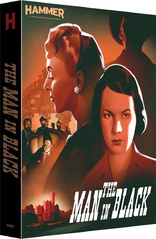
The Man in Black 4K Blu-ray Movie
HomeThe Man in Black 4K Blu-ray Movie 
Collector's Edition / 4K Ultra HD + Blu-rayHammer Films | 1950 | 70 min | Rated BBFC: PG | Sep 08, 2025

Movie rating
6.9 | / 10 |
Blu-ray rating
| Users |  | 0.0 |
| Reviewer |  | 4.5 |
| Overall | | 4.5 |
Overview
The Man in Black 4K (1950)
A yogi seemingly dies while simulating death and his evil second wife, and her daughter, try to force his daughter into insanity for control of his estate.
Starring: Betty Ann Davies, Sheila Burrell, Sidney James, Anthony Forwood, Hazel PenwardenDirector: Francis Searle
| Thriller | 100% |
Specifications
Video
Video codec: HEVC / H.265
Video resolution: 4K (2160p)
Aspect ratio: 1.37:1
Original aspect ratio: 1.37:1
Audio
English: LPCM 2.0 Mono
English: DTS-HD 5.1
Subtitles
English, French, German, Italian, Spanish
Discs
Blu-ray Disc
Two-disc set (2 BDs)
4K Ultra HD
Playback
Region B, A (C untested)
Review
Rating summary
| Movie |  | 3.5 |
| Video |  | 4.0 |
| Audio | | 4.0 |
| Extras |  | 5.0 |
| Overall | | 4.5 |
The Man in Black 4K Blu-ray Movie Review
"This is your storyteller, The Man in Black. You are going to hear a story of intrigue, and jealousy, and murder."
Reviewed by Justin Dekker September 10, 2025Making the leap from radio to the big screen, 'The Man in Black 4K Collector's Edition' is the latest release from Hammer Films. Adding a
mystical flair to madness and murder, the film stars Betty Anne Davies ('It Always Rains on the Road'), Sheila Burrell ('Paranoiac'), Sidney James
(from the 'Carry On' series of films), and Hazel Penwarden in her first screen role. The release boasts a beautiful 2160p transfer, an enjoyable 5.1
DTS-HD Master Audio track, and Hammer's usual impressive assortment of on-disc and printed supplemental material. A Blu-ray disc with identical
content to the 4K UHD disc, a 116-page perfect-bound book, and a reproduction of a publicity one-sheet are all included and are housed in an
attractive slipbox.
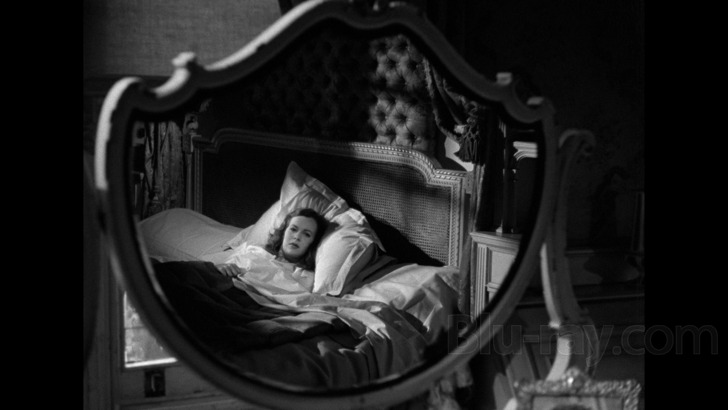
After his death during a yoga demonstration, young Joan (Penwarden) is set to inherit the vast majority of her deceased father's (James) estate. But
her grasping stepmother (Davies) and conniving step-sister (Burrell) aren't about to be cut out of what they feel is rightfully theirs. The pair hastily
enact a cunning plan to swindle Joan out of the money, and aren't about to let anyone or anything stand in their way. Joan is in for a battle if she's
going to retain her fortune and her sanity.
One morning at breakfast, Henry Clavering (Sidney James) passionately retorts, "Yoga is not a subject for cheap jibes!" against his stepdaughter's snide remark about whether or not he'll be swallowing swords at the yoga demonstration later that evening. While what he's doing is dangerous, even deadly, so he claims, he earnestly defends it against something as trivial and trite as sword swallowing. As is evidenced by the synopsis above, and the script, the filmmakers either don't have a grasp of what yoga is about or simply don't want facts to get in the way of a good story. And while "cheap jibes" may not be allowed, misrepresentation certainly is. For them, "yoga" is evidently something of a catch-all term meant to include any sort of mysticism, practice, or thought process that lies outside of the then-conventional Western philosophy and way of life. It was meant to sound mysterious, ominous, magical, almost otherworldly. After all, the yoga move Henry is due to demonstrate that night is so dangerous that any break in concentration could result in his immediate death. While I'm not deep into yoga, I was never warned that death could result from an improper downward-facing dog, tree, or child's pose. And any one of those moves seems more challenging than what Henry does - he's just sitting in a comfortable chair. But joking aside, and however misused the concept of yoga may be, an element of the supernatural was required to drive the plot, and if one is able to forgive the storytellers this sin, the rest of the picture will more than make up for it.
Those who are unfamiliar with the radio show from which the film is adapted and are therefore expecting to see The Man in Black for any appreciable amount of screen time in The Man in Black are in for something of a letdown. Valentine Dyall (The Man in Black) simply serves as the host or narrator, if you will, in much the same fashion as the Crypt Keeper would in the more modern Tales From the Crypt. He sets the stage for the events we are about to see and then returns for the resolution. So while he doesn't have much screen time, the sonorous tones of Dyall's voice ground the viewer in the film, introduce the major characters, and ensure we know that Henry Clavering is doomed. From there, the rest of the cast takes center stage, and his evil wife and step-daughter enact their scheme against the grieving Joan.
The Man in Black, by virtue of its structure and setup, doesn't leave many mysteries to unravel or surprises up its sleeves. It's the journey here that's important, and the cast doesn't disappoint. Unusual for the day, women outnumber the men in terms of the prominent cast members. It's Davies' Bertha who constructs the plan to secure Joan's new fortune, and Burrell's Janice, who is her only co-conspirator. While Janice's husband-to-be arrives in the form of the drunken and loutish Victor (Anthony Forwood), he's never part of their plot, and his self-centered actions only serve to frustrate and complicate matters. No, the women are in charge here. Their roles are meaningful, layered, complex, and devilishly fun. Joan, as our heroine, one could argue, receives some small assistance from the men in the film from time to time, but such moments are rare and limited. Joan is the one who is clearly in danger and taking risks. She is the one squaring off with Bertha and Janice, and she is largely on her own.
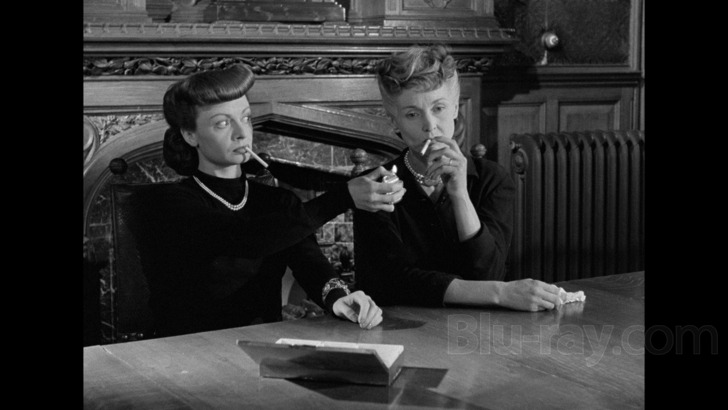
It should be noted that the location used for filming, Oakley Court, is a star in its own right. The structure is grand and gothic, rich with the former wealth of its owner. The interior is lavishly appointed. Elaborate woodworking lines halls, rooms, and stairs, as do paintings and curios from around the world. Its twisting interiors create a sense of claustrophobia and serve to effectively trap Joan - she can't possibly leave until she wins her human battle. All of this is, of course, to say that the house lends itself spectacularly well to some incredibly carefully constructed, moody, and atmospheric shots that will linger with the viewer long after the credits have rolled. That, and Bertha's nearly incessant smoking.
The Man in Black 4K Blu-ray Movie, Video Quality
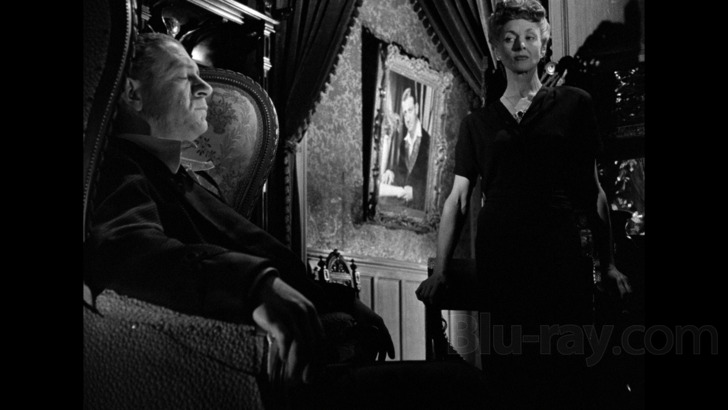
Per the included notes, to create this release, Hammer obtained the 35mm nitrate original negative from the British Film Institute and it was scanned in 4K resolution using an ARRI scanner. Dirt and debris were removed, and instability and density fluctuations were resolved, before it was given a Dolby Vision grade. The end result is truly quite impressive. Eagle-eyed viewers will still notice the odd bit of hair or the instance where damage was not completely mitigated, and there is the occasional missing frame. Transitions can also still look a bit shaky. But on the whole, the film looks extremely good. Viewers will immediately notice the excellent depth and dimensionality present as the camera tracks through the home of the late Henry Cavering, taking stock of his eclectic mix of possessions from various corners of the world that fill the massive rooms and hallways. Fine detail is likewise high. Fabrics present with appealing texture and tactile presence, from robust tweeds to fine laces to silky dressing gowns. Environmental particulars fare very well, also. The exterior stonework visible when Henry joins his wife and stepdaughter for breakfast is rough, with the mortar showing its age. Lines and wrinkles are visible on the older members of the cast's faces, and a surprising number of flyaway hairs are discernible in the meticulously coifed hairstyles of women. Blacks are deep and inky, with enough subtle gradations in shadowy areas to permit viewers to observe what lies in their depths. Fine grain is present and resolves naturally. It's a beautifully filmic transfer.
The Man in Black 4K Blu-ray Movie, Audio Quality
The original sound master positive for the film was also obtained from the BFI. In line with their other releases, AI was used to strip dialogue out of the
final mono soundtrack, and by pushing sound effects and music to the surrounds, a 5.1 mix was created. I first viewed the feature with the LPCM
2.0 mono mix. Valentine Dyall's opening narration sounds appropriately lush and ominous as his voice glides from the speakers. As with other films
from the era, the opening theme music sounds a bit thin, but otherwise is reproduced without issue. Dialogue is clear and center-focused, but not quite
as precise as I would like, and some slight distortion and clipping are present. Voices that hover around the midrange or lower sound the most pleasing
to my ear here. Sound effects such as car engines, crunching gravel, slamming doors, and shattering glass are rendered well enough for the vintage of
the film. The backing score is reproduced well, with precise strings that aid in the manipulation of the audience. The only remaining damage I detected
is a few pops that are faintly audible as Joan helps Hodson paint the boat. It's a fine accompaniment to the film.
Next, I viewed the film with the 5.1 DTS-HD Master Audio track. Surrounds add a bit of extra oomph to the opening music and the underscore as The
Man in Black begins his narration. Dyall's rich voice is still front and center. The most immediate change (and improvement) I noticed is that dialogue
sounds better here, cleaner and more precise, than what is found on the 2.0 track. It remains consistently so throughout the film. While this is billed as
a 5.1 track, it's not quite what modern viewers would expect when seeing that option. Sound is most certainly separated, and that complement of
speakers is used, but not in the traditional manner. Objects don't really move through the sound field, and the track keeps ambient sounds such as bird
song and murmuring voices of those who turned up for the yoga demonstration in the front rather than the surrounds. One specific instance where a
voice does move through the field, almost startlingly so, is when Janet joins her fiancé on the stairs as he arrives at the home at around the 22-minute
mark. As she enters, her voice erupts from the left surround before hastily moving to the front as she goes to meet him. Because moments like that are
rare, it was a bit surprising when it occurred. In fairness, I actually jumped. Still, it's a most satisfying listening experience, and for the improvement in
the quality of dialogue reproduction, it's the 5.1 track that I'll be choosing when I next revisit The Man in Black.
The Man in Black 4K Blu-ray Movie, Special Features and Extras
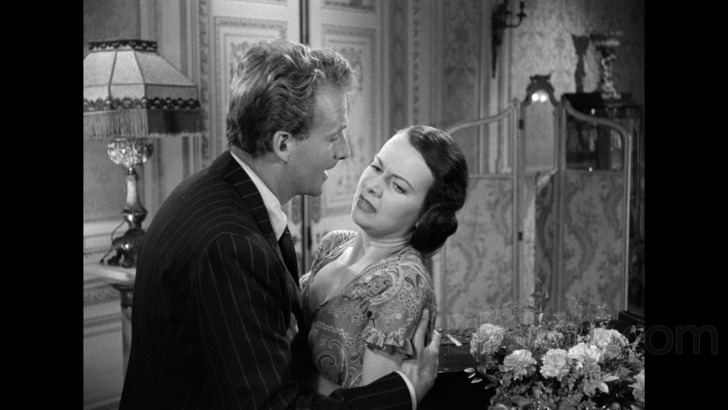
As is their standard, Hammer has included a considerable amount of on-disc and printed supplemental material.
- Commentary with writers Lisbeth Myles and Paul Cornell, creators of the 'Hammer House of Podcast' - The pair begin by focusing on Dyall's voice, with Myles stating she primarily knows the actor from his role in Doctor Who. They marvel at the quality of the transfer, the level of detail revealed, and the items on display in the house. It's an interesting experience as while they do have a fair amount of knowledge of Hammer films, it doesn't seem that either has seen this particular film before starting work on this project. The two are very entertaining and have a wonderful time pointing out various bits of trivia, the film's complete lack of understanding of yoga, and the virtually non- stop smoking in the film. The overall feel of the track lies somewhere between watching the film with friends and an MST3K episode.
- Commentary Featuring Will Fowler (writer and co-creator of bfi's 'Flipside' series) and Melanie Williams (professor of film and television studies) - The tandem state that this is the first commentary they've done, and they waste little time getting into detail about the this film's place as a supporting feature, its radio origins, and needed changes to bring a radio play to the big screen. They spend a fair amount of time discussing the film's casting, particularly as it pertains to Sidney James, and they obviously enjoy him in a more serious role here. They also discuss director Searle's career and the volume of opportunities available at the time, as there was a dedicated push to rebuild the British film industry. Narrator Valentine Dyall is also a focus. They have an obvious rapport, and the back-and-forth between them ensures there's never a quiet moment. It's an informative and entertaining track.
- Men in Black (28.41) - Filmed in January of 2025, authors Andrew Taylor and Martin Edwards begin by discussusing what drew them to the crime fiction genre, and their love for it before turning their attention to John Dickson Carr, one of the co-writers of the script. Much time is given to the Detection Club, a group of crime writers that gathered on a regular basis, with Carr being not only its first American member, but also its youngest. They then move on to the appeal of the genre, the various forms, as well as the ambiguity of, and different types of justice. The conversation eventually moves on to the renewed interest in Carr's work, it's influence on modern works, and the original radio series. The pair close with recommendations for those interested in reading Carr's novels.
- Panic Stations (25.36) - Professor and historian Richard Hand begins his discussion of post-war genre radio by covering the adaptations of classics that were created in the immediate wake of the war. He sees John Dickson Carr, with his penchant for "locked room" mysteries, as someone who was very adept at writing for American radio, and his early series, "Suspense". In support of the war effort, Carr provided scripts to the BBC. Once he establishes the origin of American horror radio, Hand spends time discussing how the format and content was implemented in the UK, and how it was received by listeners. He is careful to emphasize that in the early days of radio shows, the scripts were performed live, and that the radio shows had much more in common with theater. He eventually makes his way to "Appointment with Fear", for which few recordings remain, and then moves on to The Man in Black and its various incarnations.
- This is Your Storyteller (22.34) - Narrator Valentine Dyall is the focus of this segment that features insight from author Vic Pratt, and he begins by discussing his memorable and powerful voice, before author Jonathan Rigby provides a brief biography. After quickly covering Dyall's stage career, they transition to his radio work and his iconic role of "The Man in Black," and his film work. A falling out with studio leadership, however, prevented him from being cast when the studio shifted its focus to horror and made stars out of Christopher Lee and Peter Cushing. They continue on with his career, which transitioned back to radio, various movies, and playing the role of The Black Guardian during Peter Davison's run on Doctor Who.
- Francis Searle Interview (19.59) - Conducted by Roy Fowler in 1988 and taken from a much longer interview for the British Entertainment History Project, the audio interview picks up with his arrival at Exclusive Films. Searle recalls the push to take radio properties and use them as the basis of a film. He also shares how he would need to modify scripts due to the locations used/available. He recalls his time at Oakley, and shares quite a few insights into the practices and personalities at Hammer. The interview plays out against a slide show of stills and behind-the-scenes shots.
- Yoga and You (26.04) - Something of a curiosity, this vintage short seeks to provide the history of yoga, though it is much more melodramatic and sensationalistic than truly informative or accurate.
- Suspense: The Devil's Saint (29.52) - This classic episode of the radio show "Suspense" was originally aired on January 19, 1943, and starred Peter Lorre and featured Ted Osborne as "The Man in Black". Written by John Dickson Carr, the audio quality is quite good, but there isn't a video component beyond the title card.
- Suspense: The Customers Like Murder (28.47) - Originally airing on March 23, 1943, Carr's story is brought to life by Roland Young, Peggy Conklin, and Ted Osborne. The audio here shows its age, but it's perfectly listenable.
- Suspense: Cabin B-13 (29.39) - Joe Kearns performs the duties of "The Man in Black" in Carr's tale, which was first aired on September 11, 1943. The episode stars Anne Brewster and Philip Dorn. It's my favorite story of the three.
- UK Censor Card
- Image Gallery (8.03) - A mix of color and black-and-white publicity, promotional material, and stills advances automatically to the film's soundtrack, including the voice of "The Man in Black" himself.
- The Hammer Crime Files: The Man in Black () - The 116-page perfect-bound book includes numerous stills and other images, with articles covering the project's radio origins, the psychology of gaslighting, and a biography of Tony Hinds. Each is an excellent read, and I was particularly interested in the piece about Oakley Court, which also includes floor plans and photos of the house that serves as the film's setting.
- Publicity One Sheet Reproduction
The Man in Black 4K Blu-ray Movie, Overall Score and Recommendation
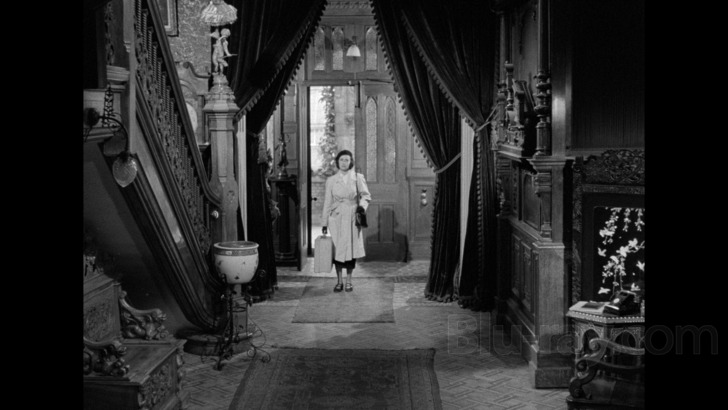
More cozy than diabolical, due to a combination of oversharing in the opening narration and the film's structure, savvy viewers will have no difficulty sorting out where the mystery in The Man in Black is going to go. All of the fun in this tale is the journey, thanks to the performances of the three female leads - Penwarden, Burrell, and Davies, who is a deviously entertaining villain and deservedly receives top billing here. Oakley Court further elevates the production and proves to be the perfect location for a slightly mystically inclined story of jealousy and murder, and the film seems to be something of a harbinger of Hammer's impending shift into horror, making the films for which, in the eyes of most film fans, the studio is infamous. Given a lovely 4K presentation and a surprising 5.1 DTS-HD Master Audio track, Hammer's The Man in Black 4K Collector's Edition comes highly recommended.
Similar titles
Similar titles you might also like

Voice Over
Repeater / BFI Flipside
1983

The Concorde: Airport '79
1979

The Pleasure Girls
BFI Flipside
1965

Topaz
1969

The Mystic
1925

Mothers' Instinct
2024

Babygirl
2024

Hunted
Indicator Series
1972

Suture
1993

A Most Wanted Man
2014
Drone
Incursion
2017

Secret Ceremony
Indicator Series
1968

Gummo
1997

Pig
2021

Wake in Fright
Masters of Cinema
1971

Southland Tales
2006

Gaslight
1940
Untamed Mistress
Indicator Series
1956

First Reformed
2017

Tinker Tailor Soldier Spy
1979