The Man Who Could Cheat Death / The Skull Blu-ray Movie
HomeThe Man Who Could Cheat Death / The Skull Blu-ray Movie 
Legend | 1959-1965 | 2 Movies | 165 min | Not rated | May 03, 2011
Price
List price:Listed on Amazon marketplace

Movie rating
Movie has not been rated yetBlu-ray rating
| Users |  | 4.2 |
| Reviewer |  | 3.0 |
| Overall |  | 3.3 |
Overview
The Man Who Could Cheat Death / The Skull (1959-1965)
A collector of esoterica, Dr. Maitland (Peter Cushing), buys an unusual skull from his ordinary source of artifacts. The skull is what remains of marquis De Sade. Much too soon he discovers how the skull affects him: by turning him into a frenzied killer...
| Horror | 100% |
| Thriller | Insignificant |
| Sci-Fi | Insignificant |
| Drama | Insignificant |
Specifications
Video
Video codec: MPEG-4 AVC
Video resolution: 1080p
Aspect ratio: 2.35:1, 1.66:1
Original aspect ratio: 2.35:1
Audio
English: Dolby Digital 2.0
Subtitles
None
Discs
25GB Blu-ray Disc
Two-disc set (2 BDs)
Playback
Region A, B (C untested)
Review
Rating summary
| Movie | | 3.0 |
| Video | | 3.5 |
| Audio | | 3.0 |
| Extras |  | 0.0 |
| Overall | | 3.0 |
The Man Who Could Cheat Death / The Skull Blu-ray Movie Review
A sort-of Christopher Lee double feature comes to Blu-ray.
Reviewed by Jeffrey Kauffman May 4, 2011Note: The scores above are averages of the two films together. Please see individual listings for more detailed individual scores.
If Universal Studios was the undisputed master of the horror genre in the 1930s and at least part of the 1940s, the 1950s and beyond saw the mantle
of shriekdom pass from the spinning planet studio’s grasp. While the late 1940s and early 1950s saw Universal stumble with increasingly sad knockoff
fare like a number of Abbott and Costello monster flicks, even their more putative serious attempts, like the 1962 Herbert Lom Phantom
of the Opera, failed to really connect with either critics or audiences. Tastes had changed, and Hammer Films had taken over the lead in providing
chills, albeit chills decidedly more lurid and decidedly less chaste than Universal ever offered up. In fact you’d have to go back to early two-strip
Technicolor Grand Guignol-athons like Doctor X to really see anything approaching the Hammer Films ethos of sex and violence
intermingled in moody, Gothic ambience. While lovers of Universal’s iconic horror trifecta of Frankenstein, Dracula and The Mummy often point to the
undeniable fact that Hammer built a lot of its mid-1950s reputations on florid remakes involving those three characters, the truth is Hammer always
had a surprisingly large and relatively varied amount of horror fare which it churned out with rather alarming regularity for over two decades. Often
mistaken for Hammer Films, Amicus productions came along a bit later but pursued much the same content, albeit often with more of a science fiction
edge than the Hammer Films oeuvre. This new double feature from Legend may not exactly present the absolute best either studio has to
offer, but it’s an interesting slice of decidedly weird cinema that may at least fitfully entertain horror aficionados.
The Man Who Could Cheat Death
Film: 2.5
Video: 3.5
Audio: 2.5
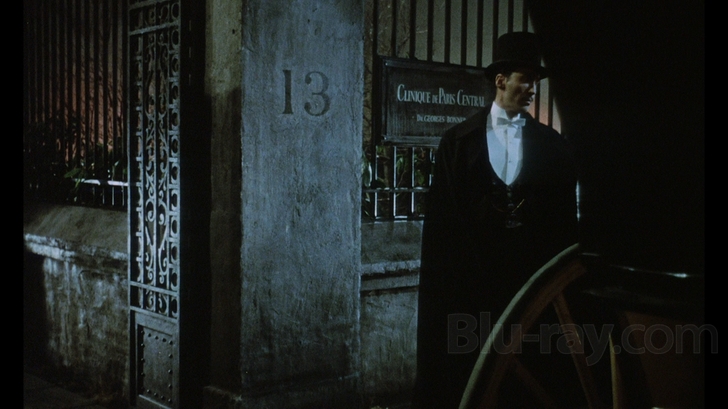
A fog shrouded landscape in the late 19th century. A mysterious caped figure moves through the mist and accosts a helpless victim, evidently slicing and dicing the poor soul with surgical precision. Jack the Ripper? No, but the parallels are there, at least in the opening sequence of The Man Who Could Cheat Death, a fairly turgid 1959 Hammer Film based on a 1945 Paramount chiller called The Man in Half Moon Street, which had then been adapted for a 1957 British television version with two of this film’s stars, Anton Diffring and Arnold Marlé. The Man Who Could Cheat Death actually takes place in Paris, not in the fetid corridors of Whitechapel, and its storyline might be more aptly compared to a Bizarro-world combination of Dr. Jekyll and Mr. Hyde crossed with The Picture of Dorian Gray than with any of the many films about the infamous Ripper.
Diffring portrays Dr. Georges Bonnet, an odd man who, in Diffring’s characterization at least, doesn’t exactly possess a charming bedside manner. Bonnet’s actual medical practice is only hinted at in the film (does he deal with mental patients?), and his avocation as a sculptor is instead the focus of the film’s opening gambit. Bonnet is revealing his latest bust of a beautiful young woman named Margo (Delphi Lawrence) when an old paramour named Janine (Hazel Court) just “happens” to drop by and is more than a tad jealous that the talented doctor hasn’t finished his sculpture of her. Meanwhile Bonnet is evidently growing desperate to meet someone for something perhaps related to the glowing green flask of bubbling liquid he keeps locked away in a quite impressive safe in his office.
The Man Who Could Cheat Death, despite a rather impressive pedigree that includes stars Diffring, Marlé and a quasi-cameo by Christopher Lee, as well as Hammer standby director Terence Fisher, is one of the least successful Hammer productions of this era, an overly static and way too talky feature that offers few thrills other than a couple of shock cuts of Bonnet’s hideous transformations, replete with attendant ghastly light cues. One of the problems with the film, aside from its narrative lethargy, is the fact that the audience knows virtually from the get-go that Bonnet is indeed cheating death, and that both the liquid and the unfortunate imprisonment of a hapless female have something to do with his evident eternal semi-youth. Instead of building on this promising premise with a series of more Hammer-worthy shock and sensuality, we instead get a lot of philosophical posturing by several main characters that is stifling and deadening. The Man Who Could Cheat Death doesn't just show its stagebound origins (the original source material was a play), it seems to follow what was probably the television adaptation, with minimal sets and a small cast.
This film may have been at least potentially more effective by having switched the actors in two of the featured roles. Diffring is so completely and oddly hyperbolic in this film that it’s a distraction, while Lee is uncharacteristically muted and stoic. Giving Lee the chance to tear through the role of Bonnet may have invested this film with a little bit of the energy it so desperately needs, and would have relegated the peculiar Diffring to the sidelines. Marlé and Court are both excellent in their supporting roles, though they really aren’t given very much to do in Jimmy Sangster’s moribund screenplay.
The Skull
Film: 3.5
Video: 3.5
Audio: 3.0
Did Guillermo del Toro have The Skull in mind when he made his early effort Cronos? There are some striking parallels. The Skull, a 1965 Amicus film starring Hammer regulars Christopher Lee and Peter Cushing, tells the tale of an ancient artifact which bestows certain sinister effects on whoever comes in contact with it. If Cronos flirted with promises of eternal life, The Skull turns that on its head (no pun intended) with deathly results. Freddie Francis, the Academy Award winning cinematographer of high profile releases like Room at the Top, The Innocents and Glory, evidently had a rather dark streak as a director, preferring the decidedly less august horror genre in which to make his mark. Like a number of other Francis chillers for Hammer, The Skull is one of the more visually inventive films of this ilk and it provides a rare chance for Cushing to take the lead while Lee remains a supporting “guest star.”
In some ways The Skull is just as talky as The Man Who Could Cheat Death, but here, unlike in Cheat, there’s a decidedly macabre ambience which helps to alleviate any tedium the long stretches of dialogue may promote. The film starts with an evocative prologue, where the skull of the Marquis de Sade is disinterred and then cleaned for examination by a phrenologist who soon meets his demise at the hands (do skulls have hands?) of the nefarious “creature.” From then we segue to “present day” (read 1965) Britain where collector Christopher Maitland (Peter Cushing) is offered the piece by seedy dealer Marco (Patrick Wymark). Maitland isn’t prone to believe Marco that the skull is actually de Sade’s, despite almost immediately falling under the thing’s hideous spell, until his friend Sir Matthew Phillips (Christopher Lee) informs him that not only is it, yes, de Sade’s skull, it actually belonged to Phillips previously until Phillips realized what a devastating effect it had on the psyche of anyone who came into contact with it.
The rest of The Skull plays out in a semi-predictable fashion, as Maitland falls further and further under the influence of the malevolent cranium. While the skull’s motives (can skulls have motives?) are never really fully explained, the film does a good job of portraying Maitland’s descent into madness as he experiences a series of frightening hallucinations and soon loses the ability to discern what’s real and what isn’t. Francis highlighs all of this internal mayhem with a series of radically skewed shots that may have some viewers reaching for the Dramamine.
Francis stages several scenes with a fair amount of ingenuity. The graverobbing scene gives us a digging perspective from the coffin’s point of view, and Francis does similar point of view work repeatedly from the skull’s vantage point. The entire production has a nice relatively sumptuous look, especially considering what was probably a very small budget, and if some of the special effects are Grade Z Ed Wood worthy (it’s not too hard to spot the black wires making the skull “float”), they don’t seriously detract or distract from the film’s overall menacing feel.
The Man Who Could Cheat Death / The Skull Blu-ray Movie, Video Quality
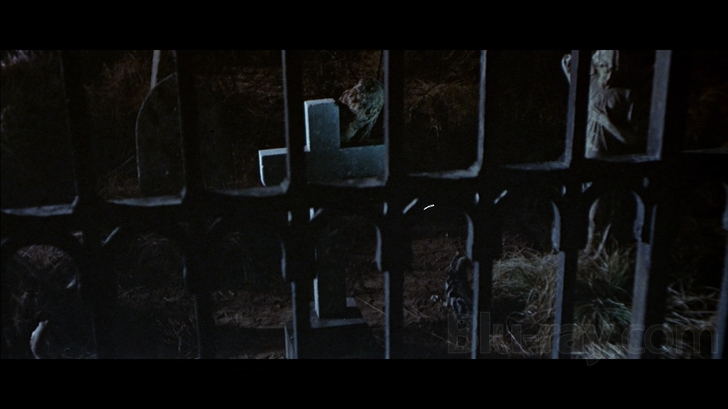
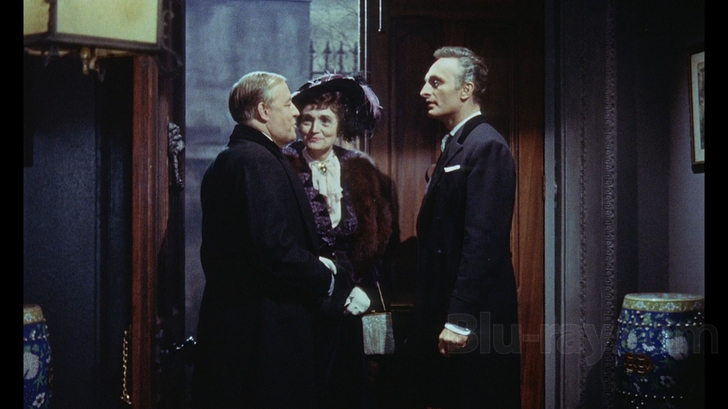
If you can overlook a fair amount of flecks and specks which dot both of these releases, The Man Who Could Cheat Death and The Skull look at the very least decent in these AVC encoded 1080p transfers. The Man Who Could Cheat Death is offered in a 1.66:1 aspect ratio, while The Skull appears in 2.35:1. Cheat has arguably the better, more saturated color, something highlighted by Hammer's proclivity for lurid lighting schemes. There's a slight green cast to a lot of this film, but that simply adds to the ghoulish nature of Bonnet's dissolution. The opening sequence looks like the fog was added optically, and for that reason it is by far the murkiest, hardest to make out sequence in the film. Otherwise the image is decently sharp and certainly robustly saturated. The Skull offers a considerably more subdued palette, and one which seems just slightly pallid at times, especially with regard to fleshtones. Black levels are incredibly full on this film, however, and with excellent contrast help to make the shadowy interiors of Maitland's home very sinister feeling indeed. The image on both of these films is certainly acceptable in terms of sharpness though neither really rises to spectacular levels. As with Legend's other two-pack released this week, Houdini/Those Daring Young Men in Their Jaunty Jalopies, there appears to have been absolutely no restoration or digital tweaking done on these releases, so DNR-phobes should have no issue with either of these transfers.
The Man Who Could Cheat Death / The Skull Blu-ray Movie, Audio Quality
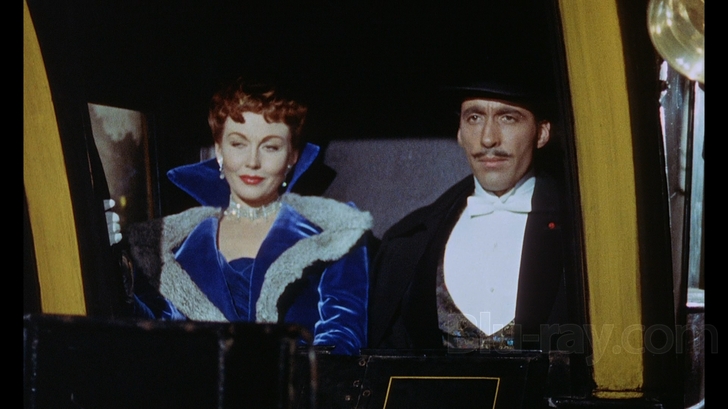
As with Houdini/Those Daring Young Men in Their Jaunty Jalopies, Legend has transferred these two films to Blu-ray with standard Dolby 2.0 tracks. The results are okay, nothing more, nothing less, and will probably suffice for most listeners. The Man Who Could Cheat Death suffers from quite a bit of soundtrack damage, with abundant hiss and several loud (and unexpected) pops and cracks which may startle some viewers. The dialogue is fairly crisp, though the film suffers from an overall narrowness that a lossless track could have potentially opened up a little bit. The Skull, while certainly not reference quality audio by any means, is a good deal better, with less damage and slightly less hiss. This is a film that really could have benefited from a lossless audio offering if only to enjoy avant garde composer Elisabeth Luytens' intriguing score with more robust sonics. It's fairly apparent throughout The Skull that several lines were post-looped, but otherwise, while narrow and compressed, this is a consistent sounding track that doesn't present too many issues.
The Man Who Could Cheat Death / The Skull Blu-ray Movie, Special Features and Extras
No supplements are offered on this two-disc release. That's at least a little odd with regard to The Skull, whose Legend DVD release at least contained the original theatrical trailer.
The Man Who Could Cheat Death / The Skull Blu-ray Movie, Overall Score and Recommendation
Legend Films is to be commended for releasing some of these great (if musty) old catalog titles on Blu-ray. The good news is they aren't tweaking these releases with over aggressive DNR. The bad news is the films so far exhibit a fair amount of damage, with ubiquitous flecks, specks and other dirt. It's also a shame that we're not getting lossless audio on any of these releases. All of that said, at least one film in each two-pack so far is a keeper. In this instance, it's The Skull, an odd but effective thriller that offers Cushing in one of his strongest roles. The Man Who Could Cheat Death is largely a misfire, but it's good for a camp-tastic laugh or two along the way. Taken as a whole package, this two-pack is Recommended.