The Making of the Mob: New York Blu-ray Movie
HomeThe Making of the Mob: New York Blu-ray Movie 
Starz / Anchor Bay | 2015 | 343 min | Rated TV-14 | Oct 20, 2015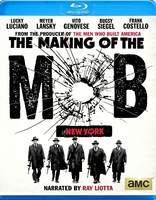

Movie rating
7.1 | / 10 |
Blu-ray rating
| Users |  | 0.0 |
| Reviewer |  | 3.5 |
| Overall | | 3.5 |
Overview
The Making of the Mob: New York (2015)
An eight-part series tracing the rise of the New York Mafia from their beginnings as a neighborhood gang of teenagers to murderous entrepreneurs and bootleggers who organized the criminal underworld into an American institution.
Starring: Rich Graff, Richie Acevedo, Ian Bell (X), Evan Boymel, Anthony DiCarloNarrator: Ray Liotta
Director: John Ealer
| Documentary | 100% |
| Crime | Insignificant |
| Drama | Insignificant |
| History | Insignificant |
Specifications
Video
Video codec: MPEG-4 AVC
Video resolution: 1080p
Aspect ratio: 1.78:1
Original aspect ratio: 1.78:1
Audio
English: Dolby TrueHD 5.1 (48kHz, 24-bit)
Subtitles
English SDH, Spanish
Discs
50GB Blu-ray Disc
Two-disc set (2 BDs)
Packaging
Slipcover in original pressing
Playback
Region A (B, C untested)
Review
Rating summary
| Movie |  | 3.0 |
| Video |  | 4.0 |
| Audio | | 4.0 |
| Extras |  | 2.5 |
| Overall | | 3.5 |
The Making of the Mob: New York Blu-ray Movie Review
To Dream the American Dream
Reviewed by Michael Reuben November 25, 2015One would think that the history of the American Mafia has been so thoroughly mined by
popular culture that the vein is exhausted. After the Godfather trilogy, The Sopranos, Boardwalk
Empire, Goodfellas, Casino, Bugsy, The
Untouchables and many lesser works, what could
possibly remain? Producer Stephen David (The
Men Who Built America) and AMC have staked
their claim with an eight-part miniseries that ran from June 15 through August 3, 2015—and so
far they've only covered the organization that arose from the five boroughs of New York. A
second season is currently in production focusing on the Chicago organization built by Al
Capone.
David's company usually produces programs for The History Channel, and The Making of the
Mob: New York (or "Mob:NY") presents itself as a re-enacted factual account. The stamp of
authenticity is supplied by commentary from journalists, historians, biographers and, in a few
instances, descendants of key participants. Somewhat less authoritative sources are those who
studied the early mob for specialized purposes, either as prosecutors fighting its present-day
incarnation (e.g. Rudolph Guiliani and Edward McDonald), or as actors attempting to portray
"made men" (notably, Vincent Pastore, "Big Pussy" on The Sopranos, and Chazz Palminteri,
who wrote and starred in A Bronx Tale).
What is notable about Mob:NY is how different the Mafia's story looks from a historical
overview, separated from individual tales spun by master storytellers like Coppola, Scorsese and
David Chase. While these well-known works serve as essential background to Mob:NY's larger
story (and fans of gangster classics will recognize the sources for many of their favorite
characters and subplots), Mob:NY assembles the pieces in a way that most viewers haven't
experienced before. Gone is the thrilling allure of the wise guy lifestyle, which Martin Scorsese
rendered so viscerally in Goodfellas, or the emotional turmoil of family loyalty that was central
(in different ways) to both the Godfather films and The Sopranos. In its place is a sense of the
historic magnitude of the American Mafia's achievement: how a group of penniless immigrants
built one of America's largest, most powerful and most profitable conglomerates entirely outside
the law. During World War II, even the U.S. government had to avail itself of their services to
secure the port of New York from enemy sabotage.
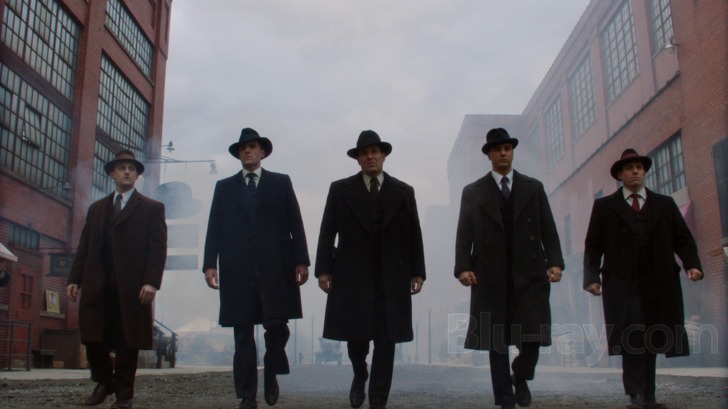
Mob:NY could just as accurately be called "The Rise and Fall of Lucky Luciano", because the central figure in the story is the nine-year-old Sicilian immigrant who arrived in this country with his family in 1906. Within a few years, the teenaged Luciano, whose given name was Charles (played as an adult by Rich Graff), had formed a gang with Russian Jew Meyer Lansky (Ian Bell) and another Jewish kid named Ben Siegel (Jonathan C. Stewart), who acquired the nickname "Bugsy" because of his crazy temper. They would eventually be joined by two more partners: Vito Genovese (Craig Thomas Rivela) and Frank Costello (Anthony DiCarlo), the pair that, in years to come, vied for control of the nationwide organization that the five of them built together.
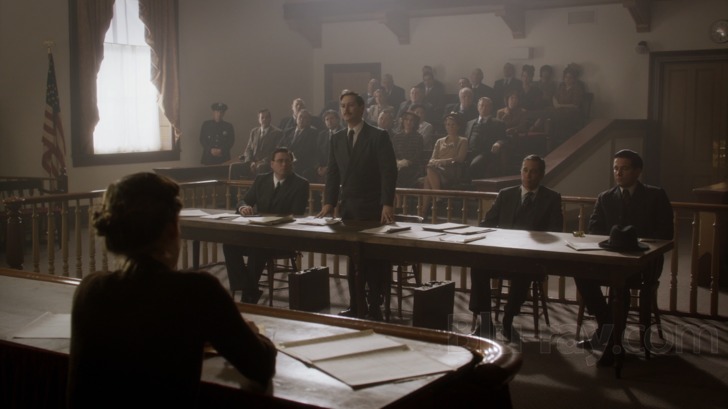
Series director John Ealer and a writers' room of eight contributors cleverly open with the 1931 Chicago gathering at which Luciano persuaded mob leaders from around the country to answer to a ruling body that came to be known as "the Commission". This bold transformation ushered in a long period of relative stability for the mob, allowing its businesses to flourish. The story then winds back to Luciano's early days to show how he came to be in a position to impose such discipline on a group of criminals, including the notoriously unruly Al Capone (Umberto Felisano). It's a tale of cunning, strategy, violence and an education in business at the feet of the legendary gambler, Arnold Rothstein (Hugh Scully). The portrait of Luciano that emerges is that of a man who combined two equally rare qualities: extreme intelligence and ruthless brutality. Members of his immediate crew excelled at one or the other—Lansky and Costello were both cagey strategists, while Genovese and Siegel were exceptionally violent—but Luciano alone had both qualities in equal measure.
Just as Mob:NY traces the multi-layered conglomerate that Luciano developed, amassing millions from drugs, gambling, prostitution and, above all, bootlegging during Prohibition, it also explores the crusading prosecutor who finally brought Luciano to justice: Thomas Dewey (Adam Jonas Segaller). Luciano's personal dealings with prostitutes and madams and his handling of the criminal trial that arose from that business were rare miscalculations in an otherwise brilliant career. Those mistakes would eventually lead to his imprisonment and deportation. Dewey rode his success as an anti-crime crusader into the New York governor's mansion and almost into the White House. But even from abroad, Luciano continued to direct the organization he had conceived and helped build. Not until the 1950s did he fully surrender his power to a successor. By then, he had so effectively diversified the American mob that, in the words of Godfather II 's Hyman Roth, they were bigger than U.S. Steel.
Many famous names weave in and out of this story, and one of the pleasures of Mob:NY is discovering how they fit in. The rise and fall of Dutch Schulz (Cory Boughton) is chronicled. So are the architects of the hit squad that came to be known as Murder, Inc., including Bugsy Siegel, Louis "Lepke" Buchhalter (Evan Boymel), Abe Reles (Sam Little) and Albert Anastasia (Gus Zucco). Italian fascist dicator Benito Mussolini (Jonathan Hartman) appears at several points, first as an enemy of the Sicilian Mafia, which he regarded as a rival for power, and then as a friend of American mob leaders exiled to Italy, whom he found useful. Bugsy Siegel's bumpy road to founding Las Vegas is recounted, as is the mob's lengthy involvement in Cuba, with the blessing of its leader, General Batista (Plinio Villablanca), whom Meyer Lansky described as so greedy that you couldn't pay him too much money. (An abbreviated account of the mob's Cuba venture is a crucial element in The Godfather: Part II.)
Mob:NY doesn't rely on dramatic scenes to hold the viewer's attention; many of the scenes play like shorthand versions of familiar equivalents in existing gangster dramas, and the dialogue is often buried beneath the musical score and the intense narration by Ray Liotta, whose intonation can't help but recall his voiceover as Henry Hill in Goodfellas. Instead, Mob:NY gains its propulsive momentum from the skillful editing (a team of eleven editors is listed) that rapidly shifts among dramatic recreations, historical photographs and newspaper headlines, graphical representations of maps and statistics, and the contemporary interviews. The cutting is rapid without losing focus on the story being told. Even the recaps that originally followed each commercial break have been sufficiently varied, both in the shots selected and in the text of Liotta's narration, so that watching them now without interruption doesn't feel like repetition. If more history were told so creatively, the subject would be more popular.
Lucky Luciano died in Naples in 1962 of a heart attack. By that point, control of the American Mafia had passed to Carlo Gambino. Several decades of remarkable history remain to be told, as the unique organization built by Luciano and his cohorts struggled to adapt to changing times. As late as 1985, a mob boss could still be the target of a brazen public assassination, like the infamous shooting of Paul Castellano at Sparks Steakhouse in Midtown Manhattan, which led to the ascension of John Gotti as head of the Commission. Maybe some future installment of The Making of the Mob will take the story to the present day.
The Making of the Mob: New York Blu-ray Movie, Video Quality
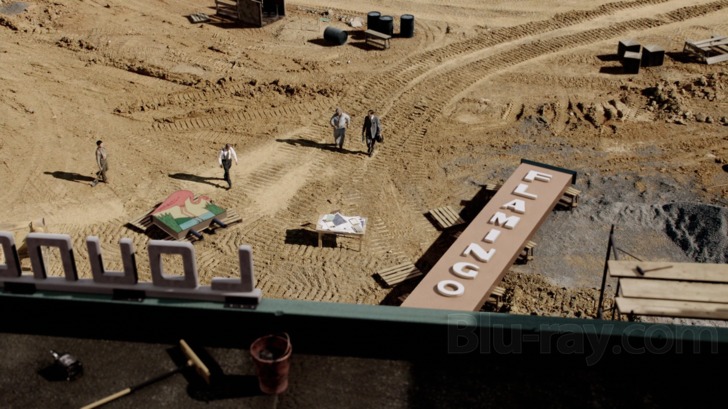
The Making of the Mob: New York was shot digitally by Andrew Huebscher, whose many TV
credits include the series Tosh.O. The historical re-
creations were filmed on soundstages and
backlots in West Virginia, and the interviews were filmed in various studios. Both the lighting
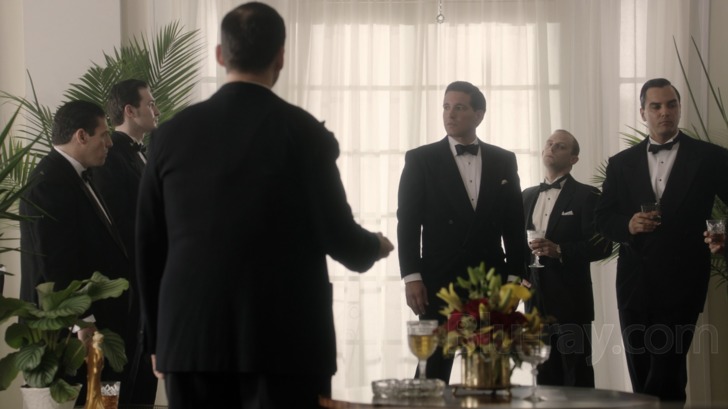
and the digital coloring in post-production were obviously designed to create the kind of dark,
period look designed by Gordon Willis for The Godfather
. Even the direction and staging
repeatedly invoke scenes from Francis Ford Coppola's masterpiece. Starz/Anchor Bay has
divided the eight episodes of the series between two 1080p, AVC-encoded BD-50s, both of
which feature an elegantly atmospheric presentation of the series' photography, with good blacks
and excellent shadows. Even the modern-day interview subjects are surrounded by black, the
better to blend them with the historical re-creations. Detail is good enough to pick up the
production design of old New York streets, speakeasies, warehouses and secret gathering places,
as well as locations in Italy, Cuba, Los Angeles and Las Vegas. Colors tend to be desaturated,
consistent with the historical style, especially the red of blood (which may be a defensive move
for AMC's benefit, since it is a basic cable network and can't be as graphic as pay cable). Every
so often, however, a bright color breaks through, e.g., a bouquet of red roses displayed
prominently at a graveside.
Anchor Bay has mastered Mob:NY at an average bitrate of 30.96 Mbps, which may be generous
for digitally originated material but provides a good margin of safety for a program where the
camera is almost always moving and the cutting is rapid.
The Making of the Mob: New York Blu-ray Movie, Audio Quality
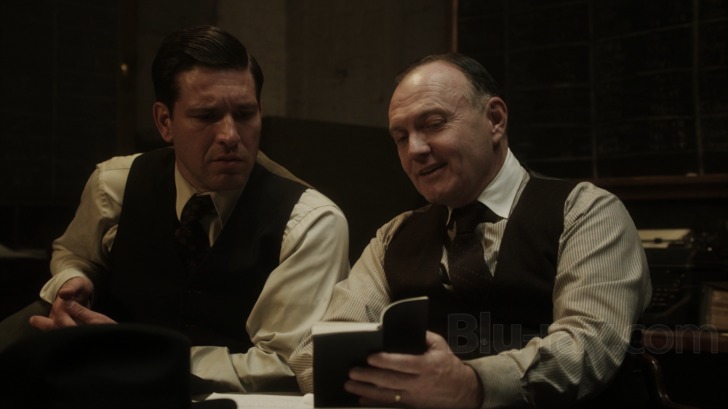
Mob:NY's 5.1 sound mix, encoded in lossless Dolby TrueHD, mostly stays true to its docudrama origins by remaining front-oriented and keeping its focus on Ray Liotta's narration and the exchanges of dialogue among the players that are allowed to rise to the front of the mix and be heard without interference. Sound effects such as gunfire, fists on flesh, glass breaking or tires screeching are usually relegated to the background. The urgent theme music, which plays continuously in repeated variations, is credited to Matthew Pavolaitis.
The Making of the Mob: New York Blu-ray Movie, Special Features and Extras
All of the extras are on disc 2, other than introductory trailers for The Walking Dead, Into the
Badlands, Comic Book Men and
Better Call Saul, which
play when disc 1 initially loads. Except
for the "Additional Scenes", the extras have voiceover, scoring and finalized editing that indicate
they were either initially contemplated for inclusion in the series or were completed in the same
style as adjuncts.
- Additional Scenes (1080p; 1.78:1; 9:27): The seven extra scenes are not individually listed or selectable. The color timing and sound mix have not been finalized, and there is no voiceover. One of the most notable shows Lucky Luciano and Al Capone meeting for the first time.
- The Real Arnold Rothstein (1080p; 1.78:1; 1:53): Further detail about gambler Rothstein's alleged involvement in fixing the 1919 World Series.
- The Secret Life of a Mob Wife (1080p; 1.78:1; 1:44): The unlikely history of the mob's involvement in the business of gay bars, including Club 82 in New York City, owned by Vito Genovese and operated by his second wife, Anna.
- The Mob & Mussolini (1080p; 1.78:1; 2:10): A further examination of Mussolini's shifting loyalties where the mob was concerned. His business dealings with Vito Genovese are covered in the main feature, but this brief featurette adds an additional story involving Bugsy Siegel.
- Style (1080p; 1.78:1; 2:03): The history of mob "dressing to impress".
- Mob Innovations (1080p; 1.78:1; 1:25): The "double-decker" coffin; the icepick murder that looked like a cerebral hemorrhage; and the 21 Club's "disappearing bar".
- The Mob Shrink (1080p; 1.78:1; 2:14): Further detail on the real event described in the main feature, which has inspired both The Sopranos and Analyze This/Analyze That.
The Making of the Mob: New York Blu-ray Movie, Overall Score and Recommendation
The Godfather films gave a special meaning to phrases like "we're businessmen" and "let's do
business". Mob:NY gives substance to those phrases. For all its colorful figures, outrageous tales
and terrifying threats, the Mafia succeeded because it was a business: organized, systematic and
profitable—"totally brilliant", as acknowledged by one of its most dogged foes, former New
York Mayor (and federal prosecutor) Rudolph Guiliani. Mob:NY focuses on those elements of
the Mafia like no other film or TV treatment to date. Recommended.
Similar titles
Similar titles you might also like
(Still not reliable for this title)

Studio 54: The Documentary
2018

Drunk Stoned Brilliant Dead: The Story of the National Lampoon
2015

Whitey: United States of America V. James J. Bulger
2014

Fahrenheit 11/9
2018

Prohibition
2011

The Roosevelts: An Intimate History
2014

Inside Job
2010

Dawson City: Frozen Time
2016

West of Memphis
2012

Cocaine Cowboys: Reloaded
2006

RBG
2018

King Cohen: The Wild World of Filmmaker Larry Cohen
2017

I Am Not Your Negro
2016

ESPN Films 30 for 30: O.J. - Made in America
Collector's Edition
2016

Where to Invade Next
2015

The Wolfpack
2015

The Dog
2013

The Central Park Five
2011

This Is Cinerama
Deluxe Edition
1952

Waiting for "Superman"
2010