The Magnificent Seven Collection Blu-ray Movie
HomeThe Magnificent Seven Collection Blu-ray Movie 
The Magnificent Seven / Return of the Seven / Guns of the Magnificent Seven / The Magnificent Seven Ride!Metro-Goldwyn-Mayer | 1960-1972 | 4 Movies | 430 min | May 11, 2010


Movie rating
Movie has not been rated yetBlu-ray rating
| Users |  | 4.3 |
| Reviewer |  | 3.5 |
| Overall |  | 3.9 |
Overview
The Magnificent Seven Collection (1960-1972)
See individual titles for their synopses. The Magnificent Seven (1960) is an American western movie that spawned three sequels: Return of the Seven (1966), Guns of the Magnificent Seven (1969) and The Magnificent Seven Ride! (1972). This box set contains all 4 movies from the series and they all somewhat share a similar plot: an oppressed Mexican village that is being vandalized by vile "bandoleros" assembles seven gunfighters to help them defend their homes and land.
| Western | 100% |
| Drama | 85% |
| Action | 55% |
| Thriller | 25% |
| Adventure | 17% |
Specifications
Video
Video codec: MPEG-4 AVC
Video resolution: 1080p
Aspect ratio: 1.85:1, 2.34:1
Original aspect ratio: 2.35:1, 1.85:1
Audio
See individual releases
Subtitles
English SDH, French, Spanish
Discs
50GB Blu-ray Disc
Four-disc set (4 BDs)
Playback
Region A, B (C untested)
Review
Rating summary
| Movie | | 3.5 |
| Video | | 3.5 |
| Audio | | 4.0 |
| Extras |  | 2.5 |
| Overall | | 3.5 |
The Magnificent Seven Collection Blu-ray Movie Review
One magnificent film, three mediocre sequels.
Reviewed by Casey Broadwater May 20, 2010The western has been around since the very beginnings of cinema, starting with 1903’s The Great Train Robbery, and like all genres, it has shifted through various fads, phases, and permutations. Cowboy tales were massively popular during the silent era—though few from this period exist today—but with the advent of “talkies,” studio execs began deriding the genre as pulpy, b-movie fodder, relegating westerns to independent, low-budget, so-called “Poverty Row” production companies. This all changed with John Ford’s Stagecoach (1939), a critical and commercial success that revitalized the genre and set the moral and narrative template for countless westerns to come. Oddly enough, the next zeitgeist in the western would come from the far East. Akira Kurasawa, arguably the most "Western" filmmaker to emerge from post-war Japan, was tremendously influenced by John Ford, and realizing that itinerant gunslingers were really no different from ronin—roaming masterless swordsmen—he merged the cinematic idioms of East and West for Seven Samurai (1954). By the 1960s, Kurasawa’s films had become a partial inspiration for American and European “revisionist westerns,” which questioned the white hat/black hat morality of traditional John Ford-style films, and introduced progressive social themes, anti-heroes, and harder edged violence. While director John Sturges’ The Magnificent Seven—an inferior but entertaining remake of Seven Samurai—isn’t as exemplary of revisionist westerns as later films by Sergio Leone and Sam Peckinpah, it does mark a turning of the page in the western playbook. It’s also as cool as cold steel, led by an all-star cast that couldn’t be any more badass if they tried.

2/7 of the Magnificent Seven...
Considering the films are set roughly 300 years apart, The Magnificent Seven hews remarkably closely to Seven Samurai’s plot. As the film opens, we learn that ruthless bandit Calvera (Eli Wallach) perennially raids a poor Mexican village, stealing crops, raping, and pillaging. Three lowly farmers consult the village elder, who sends them across the border into Texas to buy guns. Here we’re introduced to Chris (Yul Brynner) and Vin (Steve McQueen), two wandering gunslingers who join up while helping a dead Native American get a proper burial in a town filled with white racists. The farmers see quite clearly that Chris is the guy they need to talk to, and they beseech him to help them buy guns. (As an aside, in the original script, the farmers go into town to buy gunmen, but the censors didn’t want Mexicans to be portrayed as cowardly or completely defenseless—a revisionist western revision in action.) “Nowadays, men are cheaper than guns,” explains Chris, who agrees to round up a posse and defend the village—for the paltry fee of $20 per man. Nearly all of the first half of the film is spent on setting up the premise and finding/auditioning gunmen to fill out Chris’ seven-man crew. The pacing here is somewhat slow—it’s all about the buildup to the inevitable battle with Calvera’s forces—but The Magnificent Seven’s charm is that it’s really one of the first “men on a mission” films made in Hollywood, and the time spent introducing the characters pays off in the end.
Like many westerns, the film is populated with stock characters, but William Robert’s script gives each role a dramatic arc of its own. Lee (Robert Vaughn) is a dandy outlaw on the lam and out of cash. Britt (James Cobern) is the group’s switchblade master. Harry Luck (Brad Dexter) has his eye out for buried treasure. Bernardo O’Reilly (Charles Bronson), a half-Irish/half-Mexican gunfighter, forms a bond with the village kids and learns to embrace the Hispanic side of his heritage. Impetuous show-off Chico (Horst Buchholz) has to choose between a career as a hired gun or life with Petra, the pretty senorita he’s fallen for. Though there’s not much meat to each character’s individual plot, it’s enough to keep us engaged. The real thrill is in the interactions between Yul Brynner’s somber leader Chris, and Steve McQueen’s laid-back Vin, not so much because of what the story has them do, but because of how both actors play off of one another. If you’re a fan of westerns, you’re probably already familiar with the stories of on-set competitiveness between the two, and the film is all the better for their testosterone-charged one-upmanship. Brenner has top billing, but you can see McQueen—in his breakthrough role—trying to upstage his co-star in nearly every scene. If Brenner is talking, McQueen is adjusting his hat, shaking rifle shells, and doing just about anything to draw attention to himself. For a lesser screen presence, this could come off as arrogant or self-possessed, but McQueen, the so-called “King of Cool,” makes it look entirely natural.
Director John Sturges never matches Kurasawa for artistry, depth, or intent—Sergio Leone comes closer with A Fistful of Dollars, an unofficial remake of Yojimbo—but he crafts a memorable western that really takes off once “the seven” arrive at the village and begin to train and interact with the farmers. Even as it becomes apparent that Calvera will stop at nothing to raid the village again—“If God did not want them sheared, he would not have made them sheep,” he says—the external “seven vs. the bandits” conflict is superceded by an internal struggle of motivation. The film asks why these hired gunslingers would risk death for $20, contrasting the lonely nomadic lives of Chris and his crew with the poor in wealth/rich in spirit existence of the villagers, who eek a hard living out of their barren patch of earth, but will fight to the end to protect it. Existential quandaries aside, The Magnificent Seven explodes with old west action in its final act, which adds a few good narrative twists to all the expected gunplay and heroics. There’s nothing particularly innovative or remarkable about the staging, style or cinematography, but it’s all solidly constructed, better than workmanlike but far shy of visionary.
Unfortunately, The Magnificent Seven—no unqualified classic, but good fun—was followed by three largely forgettable sequels, which did little to expand upon the “make a posse, protect the village” pattern established by the first film. Return of the Seven (1966) is somewhat mis-titled, as Yul Brynner is really the only returning actor, with Steve McQueen’s Vin role assumed by the notably less charismatic Robert Fuller. Once again, a group of farmers is in dire need of protection—this time from a bandit named Lorca (Emilio Fernandez) who’s out to avenge the death of his two sons—and though the stakes are higher and the odds steeper this time around, Return is an often tedious repeat with no real heart of its own. The best—and most varied—of the sequels is Guns of the Magnificent Seven, which finds an all-new trigger-happy septet on a mission to rescue a Mexican revolutionary leader (Fernando Rey). Not much has changed—the villagers have been replaced by guerillas and the bandits by an oppressive military regime—but the heightened action and violence makes this entry a modest standout. George Kennedy takes over for Yul Brynner as Chris, and he’s not half bad, actually, making the character his own, albeit a bit more typical, replacing Brynner’s Vladivostok-ian brogue with your run of the mill American cowboy accent. As a villain, Colonel Diego (Michael Ansara) is the most sadistic of the series—he orders his cavalry to stampede prisoners buried up to their necks in sand —and the surrounding characters, including a one-armed gunman and a black demolitions expert, are much better than the cardboard cut-outs from the second film.
The final movie in the series, The Magnificent Seven Ride, goes for a trick that’s been used by many a flagging franchise—it brings in a bunch of female characters to up the sex appeal. Here, The Good, the Bad, and the Ugly’s Lee Van Cleef plays an aging version of Chris, now married and holding down a respectable job as a federal marshal. Yet again, he’s approached to save a village in peril, but he lacks the motivation until his wife is brutally raped and murdered. Together with a kind of proto-embedded journalist (Michael Callan) and a group of five ex-cons, Chris protects a town full of beautiful women whose husbands have all been killed by—you guessed it—a heartless bandit. I appreciate the film’s attempt to evolve the character of Chris, but aside from the new pretty faces, there’s nothing in Ride that we haven’t seen in the previous films. As a whole, the series fails to innovate, relying on recycled plot devices that seemed fresh when The Magnificent Seven debuted in 1960, but were complete clichés by the time Ride came out in ’72. Still, none of the sequels is outright unwatchable—the third film is solid Saturday afternoon entertainment—and it’s good to have the entire series available on Blu-ray, though it’s understandable that many fans will want to hold out for an individual release of The Magnificent Seven.
For those keeping score:
The Magnificent Seven - 4/5
Return of the Seven - 2.5/5
Guns of the Magnificent Seven - 3.5/5
The Magnificent Seven Ride! – 3/5
The Magnificent Seven Collection Blu-ray Movie, Video Quality
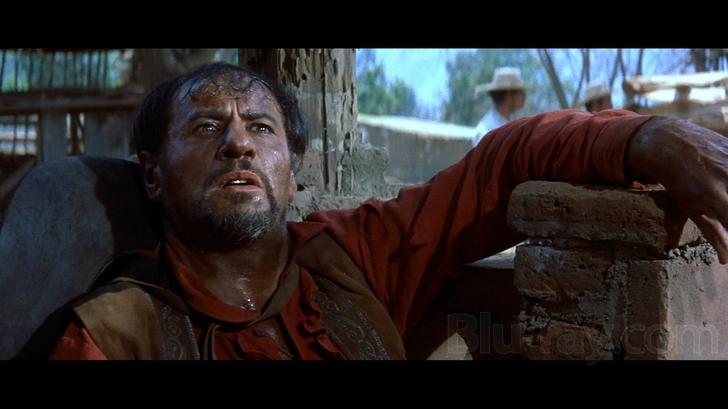
In 2006, MGM earned the ire of western fans and videophiles with their over-processed transfer of
Sergio Leone's The Good, the Bad, and the Ugly. The charges were serious: heavy DNR,
resulting in smeary, waxy textures. Since then, genre aficionados have been holding their collective
breath, waiting to see what the studio would do with other westerns, like Hang 'Em High
and The Magnificent Seven. Well, you can stop clenching your fists now and heave a sigh of
relief. By and large, MGM's treatment of The Magnificent Seven Collection is, well,
magnificent, mostly, proving to be a worthy upgrade from prior DVD iterations. Granted, it doesn't
appear that these four films have been given immaculate frame-by-frame restorations—I don't
think anyone expects that given MGM's current financial crisis—but to my eyes there's no evidence
of unneeded tampering, no overzealous noise reduction, no unwieldy edge enhancement or other
post-telecine blunders. And really, I think that's the best that fans could ask for. The quality varies
a bit from one film to another—oddly enough, the first and third movies are the most impressive—
but each looks naturally filmic, and all are presented in their original aspect ratios.
If you're like me, you're probably most concerned with The Magnificent Seven. Fans will be
glad to see that the print used here is relatively clean, with only a few scattered white flecks
throughout the duration. Clarity is as strong as could be expected, and though there are definitely
some soft shots—a product of the original film elements, not this transfer—most of the time you'll
notice a fairly impressive level of fine detail. Horses' coats have a discernable texture, and so does
suede, the cloth weft of the village elder's poncho, and the weathered, sun-beaten faces of our
heroes. There are some minor color fluctuations, but the film's dusty palette has been reproduced
nicely, with rich neutrals, creamy sky blues, and vivid reds. Black levels are perfectly tuned, and
strong contrast carves out an image with a palpable dimensional presence. The film's grain
structure is intact, and you will see some spikes in analog noisiness during longer establishing shots
and lap dissolves between scenes. Compression artifacts and other issues are almost entirely
absent, and the only oddity I noticed was some occasional telecine wobble—when the film shakes
subtly back and forth as it runs through the telecine machine. This is most apparent near the
beginning of the film, but it lets up quickly.
Though all of the sequels—with the exception of the fourth film—share a similar visual aesthetic
with the original, there are some variations in quality, clarity, and general cleanliness. Return of
the Magnificent Seven has the dirtiest print, with salt and pepper flecks and specks dotting the
image throughout. The picture is also slightly softer here, though there are some terrifically sharp
close-ups. Guns of the Magnificent Seven stands toe to toe with the first film, picture
quality-wise, with an image that's bright, colorful, and resolved. Filmed in 1.85:1, The
Magnificent Seven Ride is the odd man out—the others are all in 2.35:1—and it's also the
softest, blurriest film of the bunch, with a severe dearth of fine detail. If I had to score each film
based on our 5-star system, The Magnificent Seven would net a solid 4/5, Return
would garner a 3.5/5, Guns would get a 4/5, and Ride would be stuck with a
2.5/5. Overall, I'm really pleased with the quality of this collection, and western fans who blacklisted
MGM after their release of The Good, the Bad, and the Ugly should definitely give the studio
a second chance.
Screenshots 1-5 are from The Magnificent Seven, 6-10 are from Return of the
Seven, 11-15 are from Guns of the Magnificent Seven, and 16-20 are
from The Magnificent Seven Ride!
The Magnificent Seven Collection Blu-ray Movie, Audio Quality

While there's quite a bit of variance in the picture quality of the four films, the audio is surprisingly similar. Each film features a solid DTS-HD Master Audio 5.1 surround track. As with Hang 'Em High, which MGM also released last week, the expansion from mono/stereo stems to a full 5.1 presentation is subtle but effective, and should please even the most ardent audio purists. As you'd expect, the most obvious uses for the rear speakers are for zippy, cross-channel gunfire and composer Elmer Bernstein's now-iconic main theme. The sound effects get slightly better over the course of the four films, sounding fuller and more dynamic as the technology from 1960 to 1972 improved. Gunfire in The Magnificent Seven sounds thin and tinny, but by the time we get to the final film, bullets from pistols careen and ping through the rears, dynamite explodes with potent low-end rumble, and gattling guns spew louder-than-loud streams of hot lead. Other than that though, these four tracks really aren't that different. The constant is Elmer Bernstein's galloping Americana score, which sounds bigger, clearer, and more detailed than ever, sometimes clip-clopping along on slow cowpoke rhythms but most often bursting with a wide-open grandeur befitting of the southwest. There are a few moments of slightly muffled dialogue, but overall, voices are perfectly balanced in the mix. English SDH, Spanish, and French sub-titles are available for all four films in easy to read white lettering. The Magnificent Seven also includes an English Dolby Digital mono track and a Spanish Dolby Digital 5.1 mix. For sound, I'm giving the collection a straight 4/5 across the board.
The Magnificent Seven Collection Blu-ray Movie, Special Features and Extras

The Magnificent Seven
Commentary by Producer Walter Mirisch, Assistant Director Robert Relyea, and Actors James
Coburn and Eli Wallach
Owners of prior DVD releases will be familiar with this excellent, if spotty track, which finds the
participants divulging filmmaking details, yes, but mostly reminiscing and feeling nostalgic. Missing
in action is the separate commentary with film historian Sir Christopher Frayling, which graced the
2006 Collector's Edition DVD.
Guns for Hire: The Making of The Magnificent Seven (SD, 46:54)
Everything you'd ever want to know about The Magnificent Seven, from the process of
adapting Kurasawa's Seven Samurai to refit a distinctly American idiom, to the on-set
competitiveness between Yul Brynner, Steve McQueen, and the rest of the testosterone-soaked
cast. Features interviews with Eli Wallach, executive producer Walter Mirisch, and many
others.
The Linen Book: Lost Images from The Magnificent Seven (SD, 14:47)
Maggie Adams, head of MGM's photo archive, shows off an enormous photo book that was
discovered in storage in a salt mine in Kansas.
Elmer Bernstein and the Magnificent Seven (SD, 14:48)
Jon Burlingame, film music historian, guides us through each of composer Elmer Bernstein's
themes for the film.
Trailer A (1080p, 2:46)
Trailer B (1080p, 3:03)
Stills Gallery (1080p, 4:05)
Return of the Magnificent Seven
Trailer (1080p, 2:31)
Guns of the Magnificent Seven
Trailer (1080p, 2:09)
The Magnificent Seven Ride!
Trailer (1080p, 2:33)
The Magnificent Seven Collection Blu-ray Movie, Overall Score and Recommendation

For a remake of one of the most widely acclaimed films of all time, The Magnificent Seven stands up surprisingly well, even today. The same, however, can't quite be said for the film's merely mediocre sequels, which suffer under a lack of cast continuity and a general been there, done that feeling that creeps into every recycled storyline. Still, this is a decent collection of westerns, and under the circumstances, MGM has done a commendable job with the high definition transfers and lossless audio tracks. A standalone release of The Magnificent Seven seems inevitable, a matter of when not if, so more casual fans might want to wait it out. Otherwise, this set is worth a recommendation and would make a great Father's Day gift.