The Killer 4K Blu-ray Movie
HomeThe Killer 4K Blu-ray Movie 
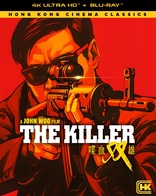
Dip huet seung hung / Die xue shuang xiong / 喋血雙雄 / Hong Kong Cinema Classics #18 / 4K Ultra HD + Blu-rayShout Factory | 1989 | 111 min | Not rated | Dec 02, 2025

Movie rating
8.2 | / 10 |
Blu-ray rating
| Users |  | 4.8 |
| Reviewer | | 5.0 |
| Overall | | 4.8 |
Overview
The Killer 4K (1989)
Chow Yun-Fat stars as an assassin with a code of honor, who agrees to one last job before quitting for good. When his bosses double-cross him, he must confront the mob in one of the most explosive showdowns in film history.
Starring: Chow Yun-Fat, Danny Lee, Sally Yeh, Kong Chu, Kenneth TsangDirector: John Woo
| Foreign | Uncertain |
| Crime | Uncertain |
| Melodrama | Uncertain |
| Thriller | Uncertain |
| Action | Uncertain |
Specifications
Video
Video codec: HEVC / H.265
Video resolution: 4K (2160p)
Aspect ratio: 1.85:1
Original aspect ratio: 1.85:1
Audio
Cantonese: DTS-HD Master Audio Mono
English: DTS-HD Master Audio Mono
Subtitles
English
Discs
Blu-ray Disc
Three-disc set (3 BDs)
4K Ultra HD
Playback
Region A (B, C untested)
Review
Rating summary
| Movie | | 5.0 |
| Video | | 5.0 |
| Audio |  | 4.5 |
| Extras | | 5.0 |
| Overall | | 5.0 |
The Killer 4K Blu-ray Movie Review
Reviewed by Dr. Stephen Larson December 18, 2025John Woo's eighteenth feature The Killer (1989) was reviewed by my colleague Jeff Kauffman fifteen years ago. Jeff wrote about Vivendi Visual Entertainment's BD-25. To read Jeff's thoughts on the film and his critical assessment of Vivendi's a/v transfers and extras, please refer to the link above.
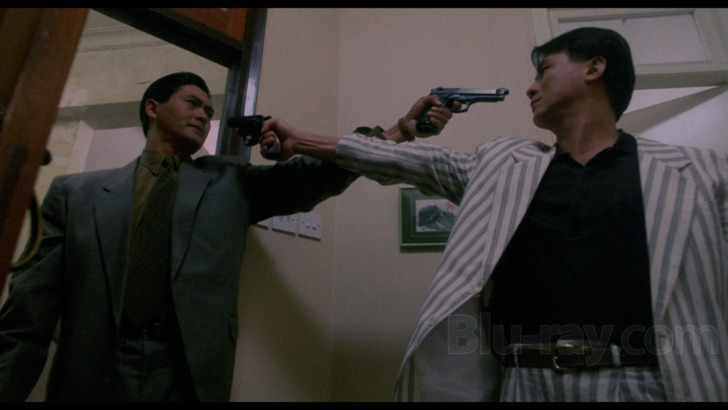
Gun play time.
The Killer 4K Blu-ray Movie, Video Quality
For spine #18 in its Hong Kong Cinema Classics line, Shout! Studios has released a three-disc set of The Killer that comes with a sturdy slipbox and collector's booklet. Shout! has put the feature on a triple-layered 4K Ultra HD disc and a BD-50. The artwork inside the front of the 4K UHD case, which was originally designed by Ellison/Goodreau, is the same as what appears on the front of The Criterion Collection's gatefold jacket for its 1993 LaserDisc set. All of the non-commentary extras have been placed on a separate BD-50. The film recently received a 4K restoration from the original camera negative, which is the basis for the transfers of Discs One and Two. The picture appears in Dolby Vision (HDR10 compatible) in its original theatrical exhibition ratio of 1.85:1.
The Killer has received a lot of DVD releases the world over along with several Blu-ray editions. I own Criterion's 1995 LD, which is sourced from the same transfer that was used for the two discs in '93. The only difference is that the inaugural LD is encoded in CAV while the second release is presented in CLV. The following text is printed on the rear of the LD cover and inside the trifold:
This new digital transfer was made from a 35mm color composite optical release print. This print was provided by the original distributor in Hong Kong. While this material has some flaws, we believe it to be the best available at the time of transfer.The following text appears in Shout!'s booklet:
Film-to-Tape Transfer Supervision: Maria Palazzolo
Film-to-Tape Transfer Operator: Roger Skip Kimball, Pacific Ocean Post
Transfer approved by director John Woo
Film Restoration by DuplitechIt is very important to note that when Criterion first worked on its LD transfer in the early '90s, it probably was not aware of the OCN's existence (or where it was). And the circumstances were far from ideal. It's quite different working from a color composite print than an OCN. While it is cool that Criterion brought Woo in to sign off on the final transfer, he and the participants in the LD release likely didn't have access to other and better materials. I am sure that at the time, they were glad to present Woo's final director's cut in a letterboxed presentation that would offer a superior alternative to Fox Lorber's VHS. The LD transfer probably served as the basis for Criterion's non-anamorphic DVD in '98. Note: I have created a graphical comparison between many screen captures from the LD transfer and Shout's transfers on the UHD and BD. (Most, if not all, are identical frame matches.) Prior to capturing, I performed an inverse telecine of the image on the LD by converting the frame rate from 29.97 to 23.976. I resized the picture to 720p using the NNEDI3 filter before upsampling the final images to 1080.
Color Correction: Kevin Schneider
Conformation: Dominic Marino, Stephen Hardy
Film Restoration Supervised by: Henry Weintraub of Shout! Studios
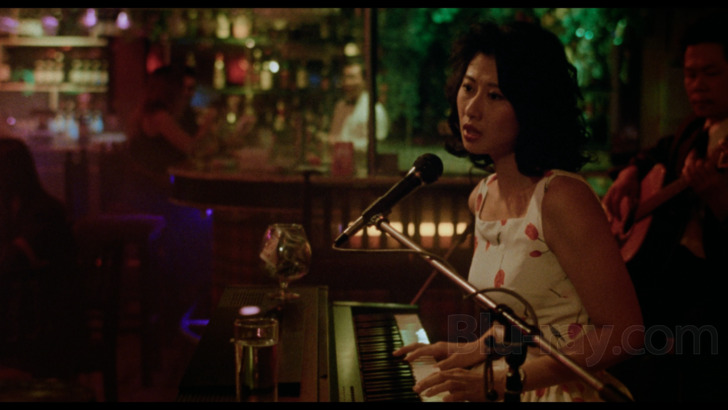
The image on the Criterion discs sports numerous speckles and blotches as well as several video artifacts and some scratches. I also noticed some chroma/luminance noise, aliasing, and rainbow patterns due to the analog source. The image also exhibited some telecine wobble. Shout!'s frame-by-frame restoration doesn't share any of these issues. The only conspicuous age-related mark is an ultra-thin vertical tramline seen in an exterior shot of the nightclub where Jennie (Sally Yeh) sings and performs on keyboard. On the Shouts, grain and texture are clearly apparent without obscuring any of the finer hues or color shadings. One visual aspect that Woo probably wanted is for the different color flags shown during the Dragon Boat Festival to be bright and finely saturated. You can see this in the frame grabs I retrieved from the LD. When you watch this elongated sequence in either Dolby Vision or HDR10 on the 4K, they should really "pop"! Please note that the color of the water does shift during this section of the film.
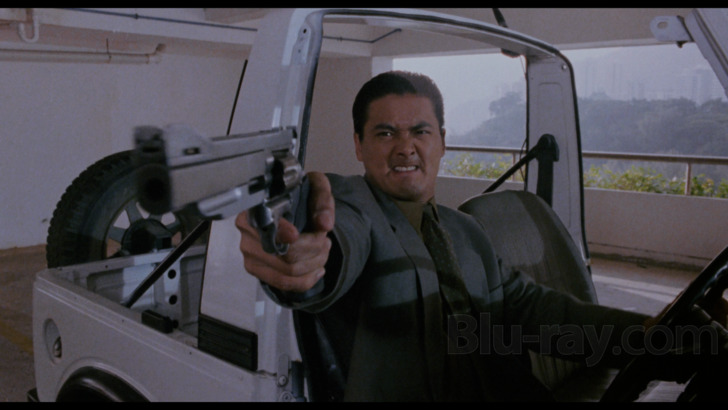
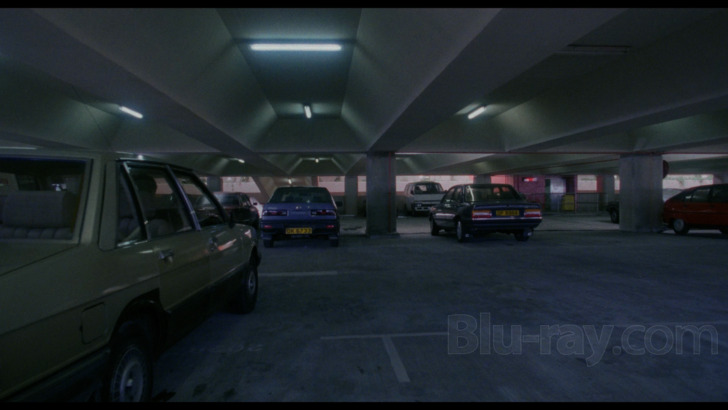
The new transfer also exhibits excellent spatial depth. Check out the parking garage in Screenshot #5. Digital colorist Kevin Schneider has made several significant improvements to not only give the image a superior depth, but also reveal background details not seen before. For example, look at how an interior scene is drenched in evening blue in #16. Then compare it to #17 which has cold and gray tones. The restored shot sports a lot more detail through the windows which you can't pick out well on the LD.
Skin complexions on the LD are warm but sometimes too sun-baked. Look at how the Shout! restores faces to more neutral fleshtones: compare #7 to #6, #11 to #10, and especially, #s 27 and 28 to #26.
The UHD delivers a mean video bitrate of 88.2 Mbps for the feature and a whopping overall bitrate of 104 Mbps for the BD-100. The MPEG-4 AVC-encoded BD-50 boasts a rough average video bitrate of 32000 kbps.
Screenshot #s 1-5, 7, 9, 11, 13, 15, 17, 19, 21, 23, 25, 28, 31, 34, 37, & 40 = Shout! Studios 2025 4K Ultra HD (downscaled to 1080p)
Screenshot #s 6, 8, 10, 12, 14, 16, 18, 20, 22, 24, 26, 29, 32, 35, & 38 = The Criterion Collection 1993 LaserDisc transfer (resized to 720p)
Screenshot #s 27, 30, 33, 36, & 39 = Shout! Studios 2025 Blu-ray BD-50 (from a 4K restoration)
Shout! has encoded the 111-minute feature with seven chapter stops, which are only accessible via remote control.
The Killer 4K Blu-ray Movie, Audio Quality
Shout! has supplied two sound-track options: a DTS-HD Master Audio Dual Mono mix (1587 kbps, 24-bit), which is in the native Cantonese (along with some Japanese dialogue), and an English dub encoded in DTS-HD MA 2.0 Mono (1618 kbps, 24-bit). I compared the original Cantonese mix on the Shout! discs with the PCM 16-bit digital track (in the same language) on the Criterion LD. Both the Criterion and Shout! mixes have some static and garble that can be heard over the main titles. So this must have been present in the original magnetic master. The mix on the Shout! demonstrates its age at times but thankfully, it hasn't been sweetened with overt NR. The Criterion has amplification distortion and strong noise in an apartment scene where Inspector Lee Ying (Danny Lee) investigates a homicide. On side two of my CLV copy, I heard pops and crackles in a couple scenes. Pops and crackles are absent on Shout!'s remastered audio, which was overseen by Brandon Bentley.
Shout!'s Cantonese track also boasts terrific fidelity and excellent dynamic range coming out of the center channel. Dialogue is clear, audible, and crisp. Gunshots are sometimes loud and explosions emit pretty big kabooms.
Composer Lowell Lo's original score is firmly rooted in '80s action cinema. There's a gong-like synth sound that's right out of Harold Faltermeyer's repertoire. One synth chord reminded me of Fred Mollin's scoring work during this same period. For several scenes, the non-diegetic track excerpts the cue "Russian Streets" from James Horner's score to Red Heat (1988). Some of the preexisting musical extracts, as well as original compositions, also strongly resemble Horner's music for Commando (1985). In addition, Lowell Lo's score sometimes employs the shakuhachi, one of Horner's preferred instruments. It's no wonder that Woo wanted to work with the maestro on Windtalkers (2002)!
Many of our readers have a close interest in the subtitles Shout! uses for its HKCC titles. For this release, Tim Wong made the translations. The translations, as well as their timing and placement over the image, are quite different compared to the subs on the Criterion LD, as you can see from several frame grabs I have retrieved. The subs track on the Shout! is definitely more formal. There are some comical differences in the nicknames Insp. Lee and Ah Jong
(Chow Yun Fat) give each other.
The Killer 4K Blu-ray Movie, Special Features and Extras
Shout! has recorded two recent commentary tracks, produced a retrospective doc, filmed three new interviews, and included an author's featurette. It has ported over a vintage LaserDisc commentary and a reel of omitted footage. Absent from this set is a commentary track with John Woo that was originally recorded for Fox Lorber's 2000 DVD, a feature-length commentary with Asian cinema expert Bey Logan on the R2 UK Hong Kong Legends DVD as well as interviews with actors Kenneth Tsang, Sally Yeh, and co-DP Peter Pau. In addition, an interview with Woo, programs about The Killer and Hard Boiled, and a featurette about The Killer's locations have not been carried over from the Dragon Dynasty DVD/Vivendi Blu-ray.
DISC ONE: 4K ULTRA HD — FEATURE FILM
- NEW Audio Commentary with Director John Woo and Film Journalist Drew Taylor (2025) - this track features a very chatty Woo discussing The Killer and various aspects of its production. It is moderated by Taylor, who wisely lets Woo do much of the talking. There are a few occasions in which Woo doesn't fully comprehend what Taylor is asking him. Taylor largely lets Woo speak about what he wants on the track. But there are some gaps. Taylor could have filled these moments of dead air had he prepared additional questions. Woo covers some of the same material he has in interviews and other commentaries but he brings in lots of retrospective reflections. Woo and Taylor stop talking around the start of the end titles. Woo's voice is raspy but I still could understand him in full. In English, not subtitled.
- NEW Audio Commentary by Critic and Author David West (2025) - this feature-length track is sociocultural and HK film-industry centric. West envisages some of The Killer's story events as either cinematic manifestations of or commentary on incidents that occurred at the Tiananmen Square massacre. He also spends chunks of his track examining the influence Le Samouraï (1967) has had on Woo. West additionally analyzes the aesthetic differences between the Melville picture and The Killer. Moreover, he discusses characteristics of the Yakuza and wuxia he sees in The Killer and Woo's oeuvre. In English, not subtitled.
- Audio Commentary by Director John Woo and Producer Terence Chang (1993) - this running commentary was recorded by The Criterion Collection for its initial LaserDisc edition. It is hosted by an unnamed moderator, who introduces and reintroduces the two filmmakers prior to their remarks. Woo's thoughts and his presentation of topics are more clearly articulated and better organized than the track he recorded this year. He acknowledges the influence that various Scorsese films has had on his work. He demonstrates this by specifying particular movies and then describing how shot composition, scene construction, et al. shaped how he photographed and edited The Killer. Woo is also very open about his filmmaking ideas and how he executed them. Terence Chang addresses various logistical challenges he and the crew faced while making the picture. He also broaches the locations and their filming conditions. This track has some gaps but is very informative. In English, not subtitled.
DISC TWO: BLU-RAY — FEATURE FILM
- NEW Audio Commentary with Director John Woo and Film Journalist Drew Taylor (2025) - this track features a very chatty Woo discussing The Killer and various aspects of its production. It is moderated by Taylor, who wisely lets Woo do much of the talking. There are a few occasions in which Woo doesn't fully comprehend what Taylor is asking him. Taylor largely lets Woo speak about what he wants on the track. But there are some gaps. Taylor could have filled these moments of dead air had he prepared additional questions. Woo covers some of the same material he has in interviews and other commentaries but he brings in lots of retrospective reflections. Woo and Taylor stop talking around the start of the end titles. Woo's voice is raspy but I still could understand him in full. In English, not subtitled.
- NEW Audio Commentary by Critic and Author David West (2025) - this feature-length track is sociocultural and HK film-industry centric. West envisages some of The Killer's story events as either cinematic manifestations of or commentary on incidents that occurred at the Tiananmen Square massacre. He also spends chunks of his track examining the influence Le Samouraï (1967) has had on Woo. West additionally analyzes the aesthetic differences between the Melville picture and The Killer. Moreover, he discusses characteristics of the Yakuza and wuxia he sees in The Killer and Woo's oeuvre. In English, not subtitled.
- Audio Commentary by Director John Woo and Producer Terence Chang (1993) - this running commentary was recorded by The Criterion Collection for its initial LaserDisc edition. It is hosted by an unnamed moderator, who introduces and reintroduces the two filmmakers prior to their remarks. Woo's thoughts and his presentation of topics are more clearly articulated and better organized than the track he recorded this year. He acknowledges the influence that various Scorsese films has had on his work. He demonstrates this by specifying particular movies and then describing how shot composition, scene construction, et al. shaped how he photographed and edited The Killer. Woo is also very open about his filmmaking ideas and how he executed them. Terence Chang addresses various logistical challenges he and the crew faced while making the picture. He also broaches the locations and their filming conditions. This track has some gaps but is very informative. In English, not subtitled.
DISC THREE: BLU-RAY — SPECIAL FEATURES
- NEW The Hero of Heroic Bloodshed: A John Woo Documentary (2025) (1:14:19, 1080p) - this feature-length documentary directed by Naomi Holwill primarily concentrates on A Better Tomorrow, A Better Tomorrow II, The Killer, and Hard Boiled. The doc's last section touches on Woo's Hollywood films in the '90s and early 2000s as well as his later productions in the 2010s and early 2020s. The program features new interviews with academic Luke White, film critic James Mudge, Woo himself, film historian Kim Newman, producer Lori Tilkin de Felice, academic Chen Yu-Lin, stuntman Bruce Law, academic Victor Fan, producer Michael Colleary, writer Mike Werb, and director Roel Reiné. Bruce Law speaks in Cantonese, which is accompanied by English subtitles. All other participants speak in English.
- NEW A Bullet Ballet – An Interview with Director John Woo (2025) (44:45, 1080p) - this recent sit-down with Woo finds the filmmaker musing about the preliminary ideas he had for The Killer and how he developed the relationship between the title character and HK police inspector. Woo also talks about his working relationship with Chow Yan Fat. He discusses how action scenes were designed and how the actors pulled them off. Woo additionally speaks about the contributions of his assistants on set, composer Lowell Lo, and other actors that appeared in The Killer. In English, not subtitled.
- NEW My Kind of Hero – An Interview with Producer Terence Chang (2025) (6:06, 1080p) - Chang briefly goes over The Killer's budget, the filming period, the movie's locales, and Chow Yan Fat's performance. It's particularly interesting to hear him tell of the 20-minute sequence he used to pitch the film to investors at the Cannes Film Festival. Chang describes the differences between A Better Tomorrow and The Killer that he sees. He explains where the latter fits in Woo's career. In English, not subtitled.
- NEW Editing THE KILLER – An Interview with Editor David Wu (2025) (11:58, 1080p) - Wu clarifies that he served as music editor on The Killer (and was not involved in the creation of the musical cues). He explains how he edited the main theme for use in the film. Wu discusses a Taiwanese folk song featured in one scene and how he employed musical counterpoint. He also covers the musical selection process and changes he made. In English, not subtitled.
- NEW Hong Kong Confidential – An Inside Look at The Killer with Grady Hendrix (2025) (11:32, 1080p) - Hendrix speaks about the character inspiration Woo used for the basis of The Killer. He also presents on Woo's initial acting considerations and the roles eventually delivered by Chow Yan Fat, Danny Lee, Sally Yeh, and other actors. He discusses some of the crew members, too. Hendrix describes Woo's filmmaking inspirations, which he paid homage to in the film. In addition, editing alterations that Woo made. He also devotes some airtime to character portrayals and themes of the picture. Especially illuminating in this program are the perceptions of Hong Kong police at the time the film was made. In English, not subtitled.
- Deleted and Extended Scenes (11:40, 1080p) - this diverse compilation of excised footage is preceded by a prefatory note about general scenes missing from the Hong Kong cut of the film. The footage is of varying quality. Scenes are presented in either 1.33:1 or 1:78:1 anamorphic widescreen. The former AR is VHS quality. The scenes come with either dual Mandarin/English subtitles or just English subs. There is static, pops, and crackles on the audio track. Footage is interesting to see. Some is extra snippets that were dropped from the HK version.
- Trailers (6:02 altogether, 1080p) - a reel comprised of two trailers. First is a HK trailer presented in about 1.85:1 (16x9 enhanced) and accompanied by native Cantonese with English subs. The second is a US trailer that carries the Circle Films logo. It is of lesser quality. This contains critics' quotes which a narrator reads.
- Image Gallery (6:30, 1080p) - a moving slide show of about 78 high-res images from various ad campaigns that promoted The Killer in mainly European and Asian markets. A majority of the stills consist of lobby cards. There are some poster reproductions (including one-sheets for the American theatrical run) towards the end of the show.
ADDITIONAL CONTENT
- Booklet - an illustrated 52-page booklet with new essays on The Killer and Woo's work by Grady Hendrix, Victor Fan, Calum Waddell, and Brandon Bentley. Each is worth reading. Waddell's piece is annotated with bibliographic entries.
The Killer 4K Blu-ray Movie, Overall Score and Recommendation
The Killer is exemplar for heroic bloodshed cinema par excellence. John Woo sometimes employs parallel editing with quick cross-cutting that generates taut suspense through a ticking clock-like effect. Action scenes are masterfully mounted and staged. Most importantly, the script creates two great characters. Shout! Studios' 4K scan of the OCN looks almost immaculate on the UHD. The OG audio has been thoroughly restored. Extras are bountiful. It remains to be seen if Arrow produces any new extras but in any case, the booklet Shout! has included is very good. MY HIGHEST RECOMMENDATION.

Similar titles
Similar titles you might also like
Hard Boiled 4K
Lat sau san taam / La shou shen tan / 辣手神探 / Hong Kong Cinema Classics #17 / Includes Bonus BD
1992

A Better Tomorrow 4K
Ying hung boon sik / Ying xiong ben se / 英雄本色 / Hong Kong Cinema Classics #19
1986

A Better Tomorrow II 4K
Ying hung boon sik II / Ying xiong ben se II / 英雄本色II / Hong Kong Cinema Classics #20
1987
The Connection
La French
2014

The Raid 2
The Raid 2: Berandal
2014

The Man from Nowhere 4K
아저씨
2010

Exiled
Fong juk / 放‧逐
2006

Three
Saam yan hang / 三人行
2016

Drug War
毒戰
2012

Dead or Alive 2
2000

Le Doulos 4K
1962

22 Bullets
2010

New World
신세계
2013

A Bittersweet Life
2005

Syndicate Sadists
Il giustiziere sfida la città
1975

Kill Zone
殺破狼 | SPL: Kill Zone | Saat po long | Ultimate Edition
2005

Dead or Alive
1999

The Raid: Redemption 4K
Serbuan Maut
2011

Violent Cop
その男、凶暴につき
1989

Hiroshima Death Match
Battles Without Honor and Humanity - Deadly Fight in Hiroshima
1973