The Jayhawkers Blu-ray Movie
HomeThe Jayhawkers Blu-ray Movie 
Olive Films | 1959 | 100 min | Unrated | Apr 24, 2012
Price
List price:Amazon: $21.04 (Save 30%)
Third party: $21.04 (Save 30%)
Available to ship in 1-2 days

Movie rating
7.2 | / 10 |
Blu-ray rating
| Users |  | 3.7 |
| Reviewer | | 3.5 |
| Overall | | 3.5 |
Overview
The Jayhawkers (1959)
In the maelstrom of Pre-Civil War Kansas, a government agent infiltrates the vigilante group called the Jayhawks.
Starring: Jeff Chandler, Fess Parker, Nicole Maurey, Henry Silva, Herbert RudleyDirector: Melvin Frank
| Western | 100% |
Specifications
Video
Video codec: MPEG-4 AVC
Video resolution: 1080p
Aspect ratio: 1.78:1
Original aspect ratio: 1.85:1
Audio
English: DTS-HD Master Audio Mono
Subtitles
None
Discs
25GB Blu-ray Disc
Single disc (1 BD)
Playback
Region A, B (C untested)
Review
Rating summary
| Movie |  | 3.0 |
| Video |  | 4.0 |
| Audio | | 3.5 |
| Extras |  | 0.0 |
| Overall | | 3.5 |
The Jayhawkers Blu-ray Movie Review
The slightly less big country.
Reviewed by Jeffrey Kauffman April 15, 2012Jerome Moross is one of those names which is instantly recognizable to a certain class of film fan but which probably is
more or less unknown to a vast majority of the general public, despite the fact that there’s little doubt most of these
people—despite not recognizing his name—would instantly recognize one or two of Moross’ crowning achievements, if
not exactly where they came from. Moross was a wunderkind who graduated from high school when he was
barely a teenager, and who went on to a successful, albeit largely (and rather strangely) anonymous, career as a
composer, conductor and orchestrator. Moross originally made his name in concert music, where he eschewed the then
trendy twelve tone serial technique in favor of a more idiomatic American sound that was part Copland, part Bernstein,
and very much Moross. Moross first attracted something approaching mainstream success with his short-lived
Broadway musical The Golden Apple, which despite its official “flop” status, won the prestigious New York Drama
Critics’ Circle Award for Best Musical. Despite outright rave reviews, and a transfer from Off-Broadway to a legitimate
Broadway house, the show closed relatively quickly, but it granted Moross his first taste of real popularity with one of
the songs from the score, “Lazy Afternoon”.
Moross had already been working steadily in Hollywood, mostly as an
orchestrator (including such high profile projects as the film version of Our Town with its Copland score and
The Best Years of Our Lives, one of the best remembered projects by and an Academy Award winner for Hugo
Friedhofer), but occasionally as a
composer as well (1948’s Close-Up and Robert Wise’s 1952 opus Captive City). But Moross
really exploded into the general public consciousness with two scores that would come to define his career. In
1958 he scored the William Wyler epic The Big Country, working in a quasi-Coplandesque vocabulary and
creating a theme that has become one of the most recognizable in the western idiom, arguably second only to Elmer
Bernstein’s iconic The Magnificent Seven. (I was frankly surprised to find that neither the soundtrack album nor
the theme to The Big Country ever charted on any Billboard chart according to the reliable Joel
Whitburn). A year later Moross scored a much less well remembered western, The Jayhawkers, but he was also
hired to retool the theme for what was then a Top 10 television hit, Wagon Train. Wagon Train had
done very well in the ratings, but it had had a miserable time developing a memorable theme song, with several
lamentable attempts coming and going through the series’ first couple of seasons. Moross lifted a theme from his
Jayhawkers score, retooled it, and created (as with The Big Country) one of the most memorable and
long-lived themes in the history of late fifties and early sixties television, one which, when heard, instantly brings back
memories for Baby Boomers who spent their childhoods glued to the weekly adventures of the western bound gaggle
of pioneers. (The cue that became the Wagon Train theme occurs at around the 36 minute mark in The
Jayhawkers, during the burial scene.)
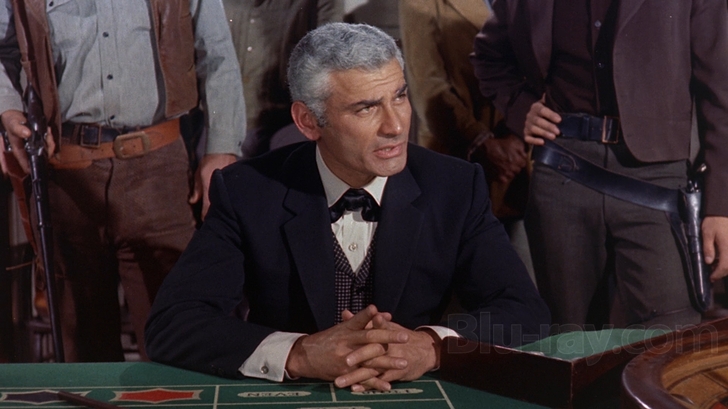
It may strike some as odd that a film review would begin with a (somewhat abbreviated) career recap of its composer, but in the case of The Jayhawkers, it’s for a good reason: Moross’ score is probably ultimately the most memorable thing about this western potboiler, a film which takes a once well-known term for its title, a term which referred to free state advocates who fought pro-slavery forces in around what was then Kansas Territory in the years leading up to the Civil War, but a film which never once even attempts to really address issues of slavery, either from a states’ right perspective or from an Abolitionist one. Instead the term is used as a sort of "gang name" (for want of a better term) for a bunch of quasi-vigilantes run by a power mad character named Luke Darcy (Jeff Chandler), a man whose goal is to take over Kansas. Darcy has his own men dress up as "invading" Missourians (presumably pro-slavery folks, though this is never mentioned), then has his "Jayhawkers" swoop in and "rescue" towns, with the townspeople so grateful that they basically just hand the keys to the kingdom right over to Darcy. Rather than take on weighty issues like slavery, The Jayhawkers is at its core a simple good vs. evil, hero vs. villain outing that is long on mood and even occasionally character but awfully short on riveting plot or epic sweep.
Darcy’s nemesis in The Jayhawkers is an escaped Kansas prisoner named Cam Bleeker (Fess Parker), a man who, having been shot as he attemps to break out of the joint, then stumbles, half dead, into a prairie farmhouse where he accosts a young French woman (Nicole Maurey), whom in his delirium he mistakes for his wife. The woman nurses him back to health whereupon he finds out his wife is dead, buried on the property which in fact had once belonged to Bleeker. When Union forces show up to arrest Bleeker, he finds out even more. Kansas’ military Governor (played by Herbert Rudley, an actor Baby Boomers will recognize from his stint playing Eve Arden’s husband in The Mothers In Law) informs him that his wife was more or less taken by Darcy, who “used her up and threw her away”, leading to her life of alcoholism and eventual death from pneumonia. That gives Bleeker an added motivation beyond the freedom the Governor promises him if he will track down and kill Darcy.
For all of the rote, quasi-B movie ethos of The Jayhawkers, there’s a surprising amount of nuance with regard to the lead characters. The supposed “good guy”, Bleeker, is an escaped prisoner who, just like Darcy, had had his own personal brigade with which he took the law into his own hands. Darcy, besides being a megalomaniac (note the charming bust of Napoleon in his "secret lair”), actually seems to be a man of principal despite his means not quite justifying his ends, so to speak. This was a fairly unusual film for the partnership of Melvin Frank and Norman Panama, better known for their lighter fare like the Danny Kaye comedy The Court Jester and the musical version of Li'l Abner than for more ostensibly serious films like The Jayhawkers. While the film never really rises above its almost television-like ambience (note the flaming credits sequence which is of course instantly reminiscent of Bonanza), it does offer some really good characterizations from Chandler and Parker, and it of course has the supremely effective music of Jerome Moross.
The Jayhawkers Blu-ray Movie, Video Quality
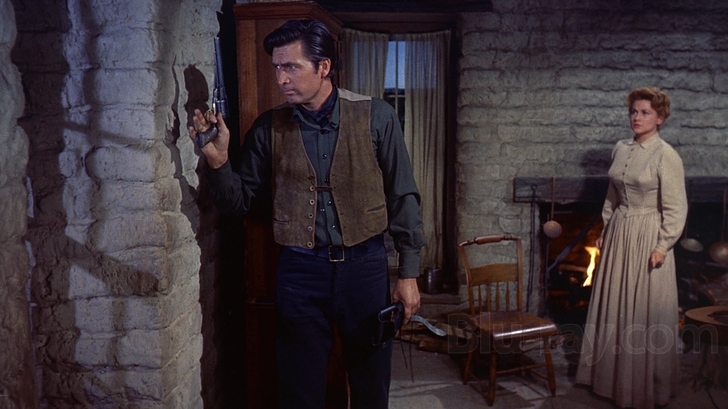
The Jayhawkers is presented on Blu-ray courtesy of Olive Films with an AVC encoded 1080p transfer in 1.78:1. This is yet another really solid looking high definition presentation of a Paramount catalog title, with accurate looking and well saturated looking color for the most part, and pleasing sharpness and clarity. Some elements seem just ever so slightly faded, with wan flesh tones at times, but overall the transfer offers some nicely bold and vivid hues and pops quite well, generally speaking. There is some age related wear and tear, as should be expected, mostly white specks which show up with fair regularity, but there is also one really bad set of scratches right where Chandler's character is introduced and he loses it in a little mini-rant (I have to wonder if maybe this tiny scene was excised from some prints). Depth of field is very good in the outdoor location shots, though some of the process photography shows its age, and opticals present much greater grain than the bulk of the film, again as should be expected.
The Jayhawkers Blu-ray Movie, Audio Quality
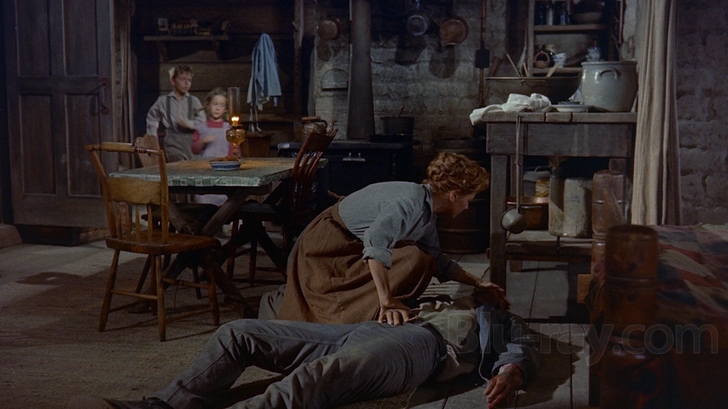
The Jayhawkers features a lossless DTS-HD Master Audio Mono mix that for the most part serves the film quite well, if obviously incredibly narrowly. Midrange is nicely full throughout the film, and Moross' score sounds fantastic (though one wonders what stereo stems might have sounded like on an Isolated Score). Dialogue is presented cleanly and clearly for the most part, but at least one or two post-looped moments are clearly discernable (pay attention to Nicole Maurey when she turns toward the sink in an early scene with Fess Parker and talks about the bounty on his head—volume ticks up appreciably and the reverb of that line is distinctly different from the bulk of her dialogue). Dynamic range is decent, if not overwhelming, and fidelity is very good to excellent throughout the track.
The Jayhawkers Blu-ray Movie, Special Features and Extras
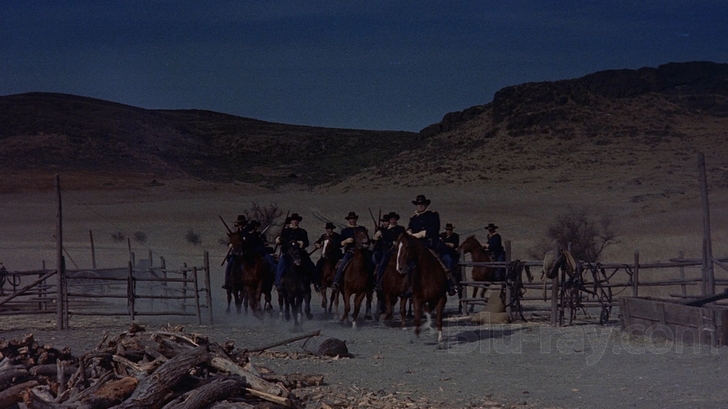
As is usual with these Olive Films releases, there are no supplements of any kind included on the Blu-ray. It's times like these, with a film with a glorious score, that one begins to appreciate the efforts of another niche label, Twilight Time, which always includes Isolated Scores as supplements. Twilight Time is sometimes taken to task for its premium price point on its offerings, but for film score lovers (and I count myself among them), Isolated Scores (especially when they're presented in lossless audio, as several recent Twilight Time releases have been) are an incalculably appreciated extra.
The Jayhawkers Blu-ray Movie, Overall Score and Recommendation
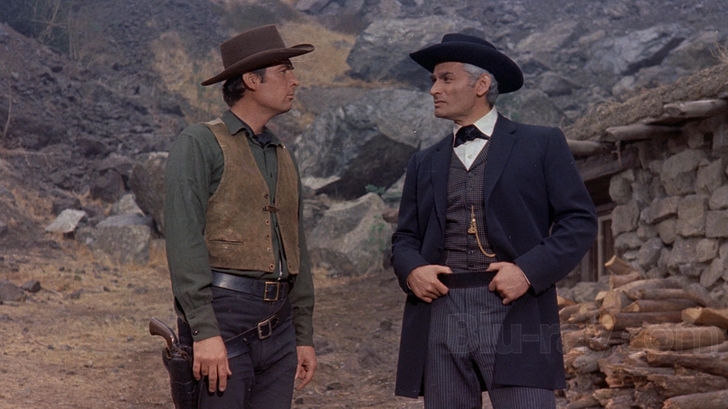
The Jayhawkers never really addresses the central issue it should be about with that title, namely the burgeoning War Between the States and the various conflicts of pro-slavery vs. anti-slavery forces. Instead, the film is kind of a turgid potboiler pitting Chandler against Parker, with little regard for historical context or nuance. Thankfully, there is some nuance with regard to the two main characters, and Chandler and Parker both deliver fine, authentic performances. The scenery is nice, if not exactly spectacular (there's a reason Dorothy wanted out of Kansas, though of course this wasn't filmed in Kansas), and the Jerome Moross score is superb. This Olive Films release is once again bare bones, but it features solid video and audio, and it comes Recommended.
Similar titles
Similar titles you might also like

Major Dundee
1965

A Reason to Live, A Reason to Die
1972

The Nevadan
1950

The Cimarron Kid
1952

The Indian Fighter
1955

Apache
1954

The Train Robbers
1973

Dodge City
1939

Fort Yuma Gold
For a Few Extra Dollars / Die Now, Pay Later / Per pochi dollari ancora
1966

One More Train to Rob
H. Fleet, Robber
1971

Springfield Rifle
Warner Archive Collection
1952

The Paleface
1948

Union Pacific
1939

Only the Valiant
1951

Rio Grande
1950

Justice
2017

The Hills Run Red
Un fiume di dollari
1966

Macho Callahan
1970

The Grey Fox
1982
Rio Conchos
1964