The Hourglass Sanatorium 4K Blu-ray Movie
HomeThe Hourglass Sanatorium 4K Blu-ray Movie 
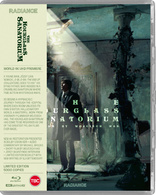
Sanatorium pod klepsydrą | Limited Edition / 4K Ultra HD + Blu-rayRadiance Films | 1973 | 124 min | Rated BBFC: 15 | Aug 03, 2026

Movie rating
7.2 | / 10 |
Blu-ray rating
| Users |  | 0.0 |
| Reviewer |  | 5.0 |
| Overall | | 5.0 |
Overview
The Hourglass Sanatorium 4K (1973)
A visionary reflection on the nature of time and the irreversibility of death. A young man embarks on a journey to see his dying father and succumbs to a procession of hallucinatory encounters on the grounds of a mystical, dilapidated hospice. The film’s screenplay draws from more than 20 stories by Jewish author Bruno Schulz, one of the most renowned Polish prose stylists of the 20th century. The resulting film is a tour de force of atmospherics and otherworldly set design. Reading Schulz’s works through the prism of his death during World War II, Has adds reflections on the Holocaust.
Starring: Jan Nowicki, Tadeusz Kondrat, Irena Orska, Bozena Adamek, Mieczyslaw VoitDirector: Wojciech Has
| Foreign | Uncertain |
| Drama | Uncertain |
| Surreal | Uncertain |
| Fantasy | Uncertain |
Specifications
Video
Video codec: HEVC / H.265
Video resolution: 4K (2160p)
Aspect ratio: 1.85:1
Original aspect ratio: 1.85:1
Audio
Polish: DTS-HD Master Audio Mono
Subtitles
English
Discs
Blu-ray Disc
Two-disc set (2 BDs)
4K Ultra HD
Playback
Region B, A (C untested)
Review
Rating summary
| Movie | | 5.0 |
| Video | | 5.0 |
| Audio |  | 4.0 |
| Extras |  | 2.5 |
| Overall | | 5.0 |
The Hourglass Sanatorium 4K Blu-ray Movie Review
Reviewed by Jeffrey Kauffman July 9, 2026For adventurous viewers who may have just snapped back to "reality" after having made it through Radiance's release of Malpertuis*, have I got a follow up idea for you! Both that Harry
Kümel film and this one helmed by Wojciech Jerzy Has were
based on provocative literary causes célèbres originally written within ten years of each other in the thirties and forties, and both film
adaptations came out within just a
couple of years of each other circa 1971 to 1973. Each of the stories offers a focal male in a patently surreal environment where he may or may not
be a Prisoner (to cite a cult television property with its own decidedly surreal ambience), either
"geographically" or temporally, as the case may be. Both films are also undeniably
staggering visual
achievements, though in that regard, The Hourglass Sanatorium may in fact take the cake (from a terrarium, and those who have seen the
film will get the reference).
*The link points to Radiance's Region A release since that's the one I reviewed, but there are Region B releases from Radiance also available.
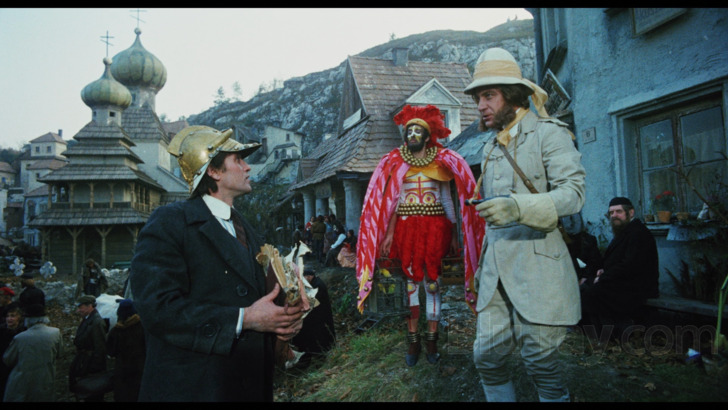
Malpertuis' (anti?) hero arrives at his labyrinthine location by ship, but here Joseph (Jan Nowicki) is introduced on a train that seems to be traveling through a background (seen through windows) that defies the laws of physics. Laws of physics, not to mention logic and "traditional" chronology, are regularly defied throughout this tale, which, much like Malpertuis, tends to exist in a liminal world more akin to dreaming than wakefulness, although considering what occurs in both films it might be better to liken things to nightmares. Joseph arrives at the dilapidated title facility, where it is soon disclosed his father Jakub (Tadeusz Kondrat) is a resident. It's also soon disclosed that Jakub is dead, or at least kind of dead, in a potential flip side to the famous "I'm not dead yet! I feel fine!" moment from Monty Python and the Holy Grail.
That weird "kind of" asterisk above is a foundational premise of the narrative, in that the sanatorium is divorced from the usual perception of time, and in fact offers time that can be "saved" or "rewound" to start over from a certain moment with new results (a la multiverses) springing from that reignition, kind of like getting your malfunctioning computer back to a safe point with a system restore. Bizarre? Yes, but that hardly begins to come close to describing the sheer visual (and at least occasional aural) onslaught the film delivers as Joseph wanders in and out of various "time pockets" which themselves are often loop like and which feature a variety of completely eccentric characters (one of the other potential tethers to Malpertuis).
If some of the subtext of Malpertuis tended to evoke Greek myth (I compared it in passing to American Gods), The Hourglass Sanatorium is decidedly more Jewish, and perhaps arguably almost Hasidic, at least in terms of a mystical component suffusing everything, and even intermittently in its presentational style offering "old world" Jews with peyot (sidelocks), kipot (yarmulkes) and topcoats, especially in the opening train sequence which of course has undeniable subtext of its own. Unsurprisingly, then, it turns out that original novelist Bruno Schulz wrote the book in 1937 before he himself perished in the Holocaust (evidently a Nazi simply shot him on his way home from a store one day, though the story is even more horrifying than that, for those who want to do a little internet sleuthing), and the film is rife with what might be thought of as Schulz's prescient premonitions about an impending apocalypse.
Without belaboring this piece's obvious connections to Jewish lore and legend, it has to be mentioned in passing that we have a father - son duo here named Jakub and Joseph, and I might jokingly suggest that this Joseph actually kind of walks through whatever the experiential equivalent of wearing an Amazing Technicolor Dreamcoat might be. But that's really just the barest surface of a film that gets into all sorts of fascinating and way too arcane to explain in a mere Blu-ray review assortment of "tidbits" from the Jewish mystical tradition, though it must be immediately added that the film itself is so arcane on any number of levels that knowledge of those traditions isn't strictly necessary to "understand" what's going on. Quotes are definitely necessary around understand in this instance, because The Hourglass Sanatorium is one of those films that seems to be able to bypass the conscious brain and communicate directly with (sorry for this one) What Lies Beneath.
The Hourglass Sanatorium 4K Blu-ray Movie, Video Quality
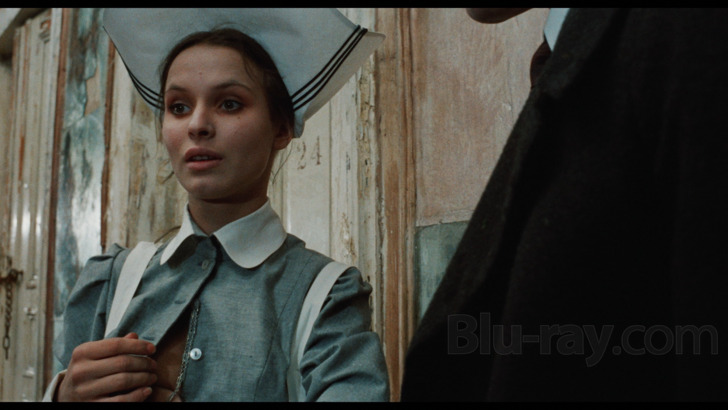
Note: Screenshots are sourced from the 1080 disc in this package.
The Hourglass Sanatorium is presented in 4K UHD courtesy of Radiance Films with an HEVC / H.265 encoded 2160p transfer in 1.85:1. This
package also includes an AVC encoded 1080p presentation in the same aspect ratio. Radiance sent check discs for the purposes of this review, and so
I'm not privy to any verbiage in their insert booklet, but their website mentions this is a "new 4K restoration from the original camera negative,
presented in Dolby Vision HDR". If the 1080 presentation here is already gobsmacking enough, the 4K presentation delivers even more palette nuance
and better detailing, within certain contexts. The film has its fair share of opticals including the odd bird and trees in the opening, as well as some
composited effects, and Has also likes to skew things even further with occasional fisheye lenses and the like. The opening few minutes are arguably
the least amazing from a "pop" perspective, even if the pure imagery on tap is almost hypnotic. Comparing the 1080 and 4K UHD versions, though,
can show some improvements courtesy of the HDR / Dolby Vision grades in, for example, the almost monochromatic sequence where Joseph gets to
the sanatorium, where the 4K's whites are more refined and varied. On the flip side, those same few opening moments provide one slight deficit in
even the HDR grades, some very minor crush that pervades the darkest areas in certain frames (like the very rear of the train car seen in the opening,
or some later material with Joseph and his mother). Once Joseph enters the building, HDR starts adding some noticeable highlights throughout, starting
with "little" items like green glass in a door. Once Joseph gets to a supposed "restaurant", some really evocative blues and purples enter the
fray and become a recurrent motif. While the production design often offers shadow laden interior environments, some of the lighting is absolutely
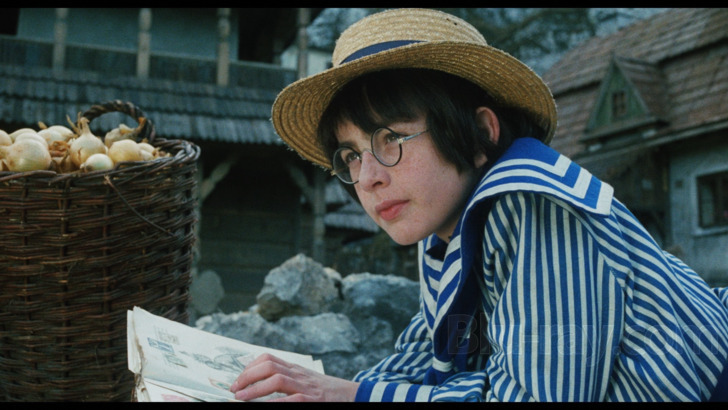
Bava-esque, with (again) purples, teals and in one very memorable quasi-Hasidic prayer sequence, orange. While minor color temperature variances
can be spotted, probably especially in 4K's HDR, the overall look here is organic and especially impressive in the palette department.
The Hourglass Sanatorium 4K Blu-ray Movie, Audio Quality
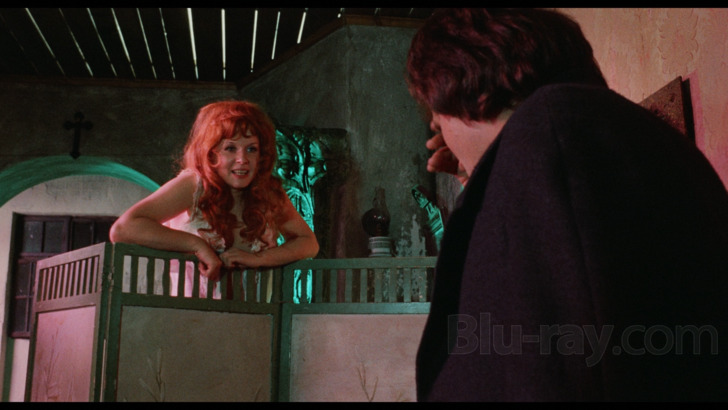
The Hourglass Sanatorium features a DTS-HD Master Audio Mono track in Polish, though what will probably catch most audiophiles' ears from the get go is the incredible score by Jerzy Maksymiuk, which varies from almost musique concrète to Klezmer, and which is often combined with weird, almost sci fi adjacent, sound effects. It all delivers an undeniably hallucinatory experience, so that when actual good old fashioned dialogue intrudes, it can be a bit of a shock. Some of the track can sound a bit wet (as in the aforementioned prayer sequence), but all elements including dialogue are delivered without any issues. Optional English subtitles are available.
The Hourglass Sanatorium 4K Blu-ray Movie, Special Features and Extras
4K Disc
- Audio Commentary by Michael Brooke
- Audio Commentary by Michael Brooke
- Accordion (HD; 12:08) is a bittersweet 1947 short that was Has' first.
- Jerzy Skarzynski (HD*; 15:01) is an archival interview with Production Designer Jerzy Skarzynski. Subtitled in English.
Note: Hebrew speakers will note one repeated mispronunciation in an otherwise very informative commentary. In that regard, there was a recent Jeopardy episode where a contestant mispronounced kibbutz as kibbitz, and I joked with my wife it's a kind of commune where you just sit around and watch people.
The Hourglass Sanatorium 4K Blu-ray Movie, Overall Score and Recommendation
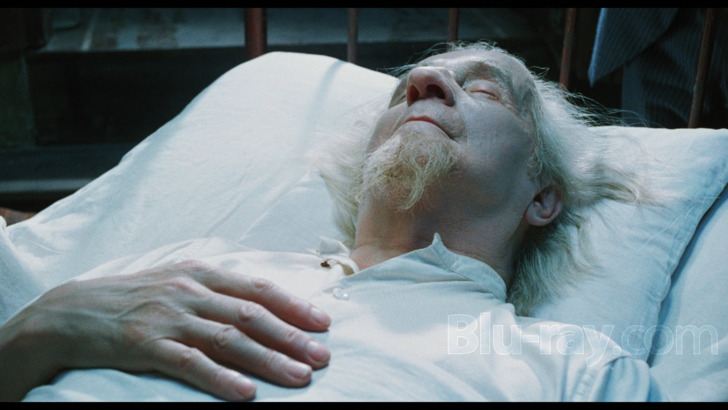
In my cheeky younger days I led a jazz rock fusion ensemble called Qabala Deluxe, which may indicate that I am more of a "target audience" so to speak than the general public for this film which offers both a subtle examination and an over the top depiction of Jewish mysticism, albeit wrapped up in such a bizarre "package" that (to quote a certain Tevye) "tradition" becomes virtually irrelevant. I had only ever seen The Saragossa Manuscript (the link points to an imminent release from Radiance which I'll be reviewing) from Has' filmography, and while that maybe prepared me slightly for this film, I have to say I think this one knocked me out even more, and I am absolutely sure I'm going to be revisiting it. Technical merits are solid and the supplements appealing. Highly recommended.
Other editions
The Hourglass Sanatorium: Other Editions

Similar titles
Similar titles you might also like

The Saragossa Manuscript
Rekopis znaleziony w Saragossie
1965

Julieta
2016

The Hero
Nayak
1966

Wrong Move
Falsche Bewegung
1975

Pather Panchali
পথের পাঁচালী / Song of the Little Road
1955

The Milky Way
La voie lactée
1969

The Painted Bird
Nabarvené ptáce / Montage Pictures
2019

Our Little Sister
海街diary / Umimachi Diary
2015

Wild Strawberries
Smultronstället
1957

La Pointe Courte
1955
The Silence
Tystnaden
1963

I Wish
奇跡 / Kiseki
2011

Taxi Tehran
تاکسی / Taxi
2015

Dreams
Kvinnodröm
1955

Thirst
Törst
1949

The Railroad Man
Il ferroviere / Man of Iron | Limited Edition
1956
The Magician
Ansiktet
1958

Maborosi
幻の光 / Maboroshi no hikari
1995

Journey to the Shore
岸辺の旅 / Kishibe no tabi | Masters of Cinema
2015

The Valley (Obscured by Clouds)
La Vallée
1972