The Haunting 4K Blu-ray Movie
HomeThe Haunting 4K Blu-ray Movie 
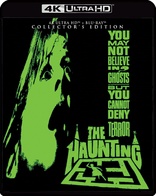
Collector's Edition / 4K Ultra HD + Blu-rayShout Factory | 1963 | 112 min | Rated G | May 26, 2026


Movie rating
7.7 | / 10 |
Blu-ray rating
| Users |  | 0.0 |
| Reviewer |  | 4.5 |
| Overall | | 4.5 |
Overview
The Haunting 4K (1963)
Dr. John Markway, an anthropologist with an interest in psychic phenomena, takes two specially selected women to Hill House, a reportedly haunted mansion. Eleanor, a lonely, eccentric woman with a supernatural event in her past, and the bold Theodora, who has ESP, join John and the mansion's heir, cynical Luke. They are immediately overwhelmed by strange sounds and events, and Eleanor comes to believe the house is alive and speaking directly to her.
Starring: Julie Harris, Claire Bloom, Richard Johnson, Russ Tamblyn, Fay ComptonDirector: Robert Wise (I)
| Horror | Uncertain |
| Supernatural | Uncertain |
| Psychological thriller | Uncertain |
| Mystery | Uncertain |
| Thriller | Uncertain |
| Drama | Uncertain |
Specifications
Video
Video codec: HEVC / H.265
Video resolution: 4K (2160p)
Aspect ratio: 2.35:1
Original aspect ratio: 2.35:1
Audio
English: DTS-HD Master Audio 5.1 (48kHz, 24-bit)
English: DTS-HD Master Audio 2.0 Mono (48kHz, 24-bit)
Subtitles
English SDH
Discs
Blu-ray Disc
Two-disc set (2 BDs)
4K Ultra HD
Packaging
Slipcover in original pressing
Playback
Region A (locked)
Review
Rating summary
| Movie | | 4.5 |
| Video |  | 5.0 |
| Audio |  | 4.0 |
| Extras |  | 3.5 |
| Overall | | 4.5 |
The Haunting 4K Blu-ray Movie Review
Reviewed by Dr. Stephen Larson June 12, 2026Robert Wise's thirtieth directorial feature The Haunting (1963) was covered by Reviewer Emeritus Michael Reuben almost thirteen years ago. Michael wrote about Warner Bros.' BD-25. To read his views of the film and assessment of the disc's a/v presentations, please consult the linked review.
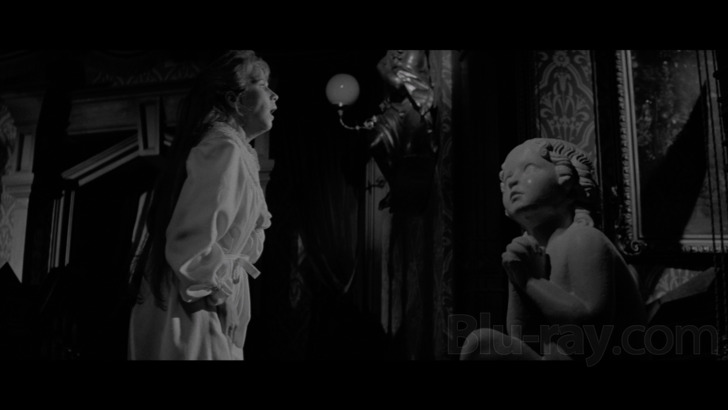
Pray for Eleanor!
The Haunting 4K Blu-ray Movie, Video Quality
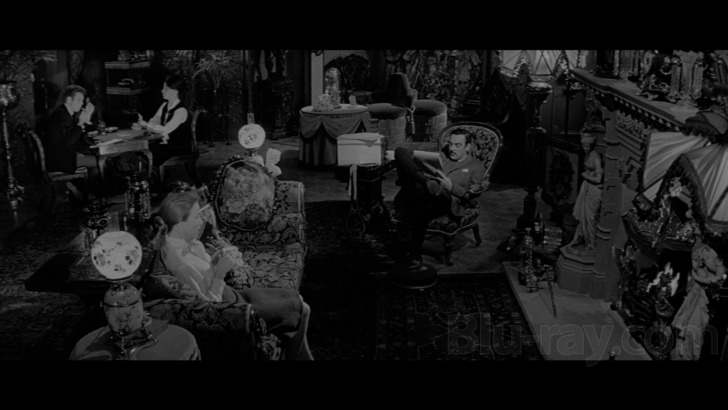
Scream Factory's recent release of The Haunting comprises a two-disc set containing a 4K Ultra HD Blu-ray and standard Blu-ray inside a black case that's housed in a slipcover. The 2160p and 1080p transfers are based on a 4K restoration from the film's original camera negative. The UHD is encoded in Dolby Vision (HDR10 compatible). The picture appears in its original exhibition ratio of 2.35:1, which employs a then-new 30 mm Panavision lens.
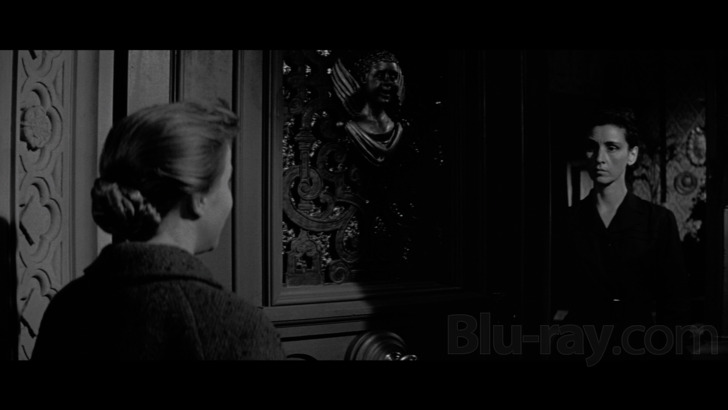
I own the 2013 WB BD, which I have given three complete viewings. Whether you watch the Scream 4K in D.V. or HDR10, the biggest improvements you will notice are in the black levels and grayscale. I also own MGM/UA Home Video's 1993 letterboxed LaserDisc and have included ten screen captures for comparison. Check out the night-and-day difference between the opening exterior shot of Hill House on the LD (#21) and the identical shot on Scream's Blu-ray (#23) and UHD (#24). While the pitch blacks are representative of what appears on the 4K, since I downcoverted the color space from HDR to SDR, the contrasts are far better when viewed with full HDR. The source MGM/UA used for the LD is likely a 35 mm preservation print. I counted around nine change-cue marks on that transfer. You will spot one in the upper right during a shot of Eleanor (Julie Harris) in her car shortly arriving at Hill House (see frame grab # 33). There are no reel-change marks on the WB or Scream presentations. The LD also reveals substantially more wear. For instance, see the short horizontal scratches across the wall paneling and along the door frame inside Eleanor's bedroom (see #19). Ditto for some light scratches along the sculptures in the greenhouse (see #15). Even more conspicuous is a diagonal scratch across Luke Sannerson (Russ Tamblyn) upon the arrival of Grace Markway (Lois Maxwell) to the house. More scratches appear outside Hill House in #25. In addition, a tramline creeps in close to the middle of a high-angle shot in #37. While the Scream doesn't share any of these blemishes, there's a light scratch going down the left side of Eleanor's nose in Screenshot #9. I also picked out a few small scratches on the wall Eleanor stares at in capture #10. The grain pattern on the Scream discs is analogous to how Michael describes it on the WB transfer but I didn't detect any group of shots where they look softer or grainier. This is one of the best-looking transfers for a '60s production on 4K.
The triple-layered disc on the UHD sports a rough average video bitrate of 84.8 Mbps while the full disc boasts an overall bitrate of 93.6 Mbps. Scream's BD-50 incorporates the MPEG-4 AVC encode and delivers a maxed-out video bitrate of 37448 kbps on average. By contrast, Warners' mean video bitrate is only 21957 kbps.
Screenshot #s 1-10, 12, 14, 16, 18, 20, 24, 28, 32, 36, & 40 = Scream Factory 2026 4K Ultra HD BD-100
Screenshot #s 11, 13, 15, 17, 19, 21, 25, 29, 33, & 37 = MGM/UA 1993 LaserDisc (Deluxe Letter-Box Edition) (upscaled to 720p)
Screenshot #s 22, 26, 30, 34, & 38 = Warner Bros. 2013 BD-25
Screenshot #s 23, 27, 31, 35, & 39 = Scream Factory 2026 BD-50 (from a 4K restoration)
A dozen scene selections accompany the 112-minute feature on both discs. These can be accessed through Scream's menus.
The Haunting 4K Blu-ray Movie, Audio Quality
Scream has supplied two sound track options to watch The Haunting (1963): a DTS-HD Master Audio Dual Mono mix (1966 kbps, 24-bit) and a newly created DTS-HD MA 5.1 Surround upmix (3135 kbps, 24-bit). I listened to the DTS-HD MA Single Mono track (1033 kbps, 24-bit) on the WB thrice and unfortunately, the 2.0 Mono on the Scream is a direct port, although it sounds a tad brighter in places. With all due respect to Michael's descriptive remarks about Warners' monaural mix, it doesn't really have a wide dynamic range at all. In fact, while the digitally-encoded PCM mono track on MGM/UA's LD is superior, it doesn't feature a wide (or high) dynamic range either. Not much of The Haunting's budget was probably allocated to the audio mix, although sound design is integral to the film's success.
While I don't own the 2003 WB DVD, I know someone who does and he's trustworthy as well as reliable. He turned his amplifier all the way up and had difficulty discerning some of the words on the Dolby Digital 1.0 track. The lossless mix on the WB BD sounds consistently muffled throughout the runtime. When I listened to the PCM mix on the LD at the same volume level, I could hear dialogue clearly enough to make out all that was said without turning up my receiver once. The WB was definitely subject to some noise management because the LD has moderately better fidelity and a marginally higher pitch (though the differences aren't dramatic).
Thankfully, the recent 5.1 upmix is a big improvement over the post-LD mono tracks. Dialogue benefits from greater amplification. There's palpably a wider dispersal of the mono across the front sound stage. Indeed, low-end sounds (even if they have monophonic origins) are critical to the film's sound design and the front speakers, as well as the .LFE, picks them up with aplomb! I faintly could hear music and f/x inside Hill House along the surround speakers but this is pretty much a front-oriented sonic experience. My audio score for the mono on Scream's disc is 2.75/5.00 while the 5.1 earns a 4.5/5.00.
Scream's optional English SDH are complete and accurate. They are displayed in all block letters.
The Haunting 4K Blu-ray Movie, Special Features and Extras
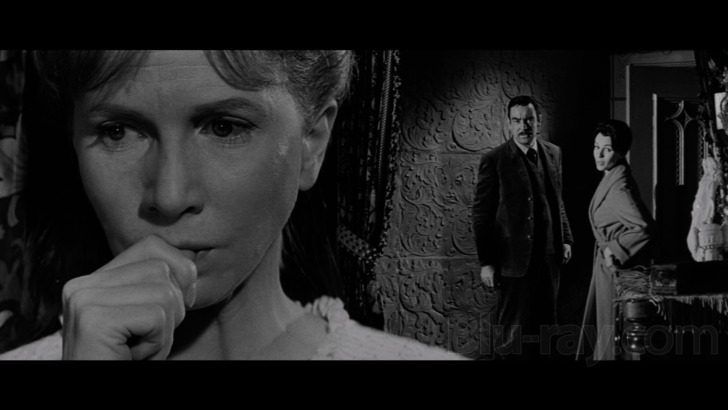
- NEW Audio Commentary with Actor and Writer Tracy Letts and Film Critic Sean Fennessey - at the beginning of this feature-length track, Letts (and much later on, Fennessey) explain that they're not academics or film historians, but just fans of The Hunting (1963). I feel that Letts could have articulated how his experience as an actor gives him the perspective to explain how the actors in Wise's film (especially the male thespians) handled the material they were given and how that shaped a particular performative style. Letts doesn't really evaluate the acting modes and performances of Richard Johnson and Russ Tamblyn. Instead, he and Fennessey discuss the influence of Orson Welles on Wise and Wise's movies with Val Lewton. They also engage in the craftsman vs. auteur debate concerning Wise's status as an established director (and where he falls on either pole). The last section veers in other topics tangentially but not directly related to this film. But it's fascinating to hear Letts's firsthand recollection of seeing a ghost in the early 2000s! Both speak in English, not subtitled.
- NEW Audio Commentary with Dr. Karen Stollznow, Matt Baxter, and Blake Smith - Baxter is an investigator of the paranormal for three decades. Stollznow is a researcher/author. Smith is an investigator and podcaster (co-host of the show, Monster Talk). Baxter reread Shirley Jackson's commentary in preparation for this commentary and unpacks how the movie is similar to its literary antecedent and where it deviates from it. The commentators discuss the relationship between psychology and parapsychology, the film's use of an unreliable narrator, the rivalry between city folk and country folk, and remote sensing/one's psychic senses. Sometimes, especially in the track's second half, they merely watch the movie and wait to comment on it until they come up with a point to make. One commentator mistakes Julie Harris for Claire Bloom. All talk in English, not subtitled.
- Audio Commentary with Director Robert Wise, Screenwriter Nelson Gidding, and Actors Julie Harris, Claire Bloom, Richard Johnson, and Russ Tamblyn - As Michael notes in his review, each participant was recorded separately and then edited into the track. Wise explains how he first became acquainted with Shirley Jackson's novel, The Haunting of Hill House. He also discusses the locations and shooting an exterior with infrared film. Wise reflects on how he chose camera angles and employed dolly tracks. In addition, he recollects seeing Julie Harris perform in a play. More, Wise talks about the production design and sets. He briefly discusses Humphrey Searle's score. Harris looks back on The Haunting's shoot and the "black fog" she witnessed in London. She acknowledges that she had different interpretations of Eleanor than what Wise had. Johnson explains how he approached the character of Dr. Markway. He describes what it was like to be on the spiral staircase. Gidding reflects on his friendship with Wise. He unpacks how he interpreted the material that he adapted from Jackson's book. He additionally offers remarks on the set designs. Bloom describes the clothes she wore in the movie and the relationship she had with Harris on/off screen. Tamblyn provides his character's views of the house being haunted or not. He remembers the cast listening to sound effects similar to the ones that would later be inserted into the film. Despite this commentary having a half-dozen participants, there are still several gaps. All speak in English, not subtitled.
- Theatrical Trailer (2:31, upconverted to 1080p) - MGM's official trailer for The Haunting presented in 2.35:1 anamorphic widescreen. The trailer hasn't been restored as it's littered with film artifacts and appears compressed. Partially narrated by Richard Johnson. In English, not subtitled.
The Haunting 4K Blu-ray Movie, Overall Score and Recommendation
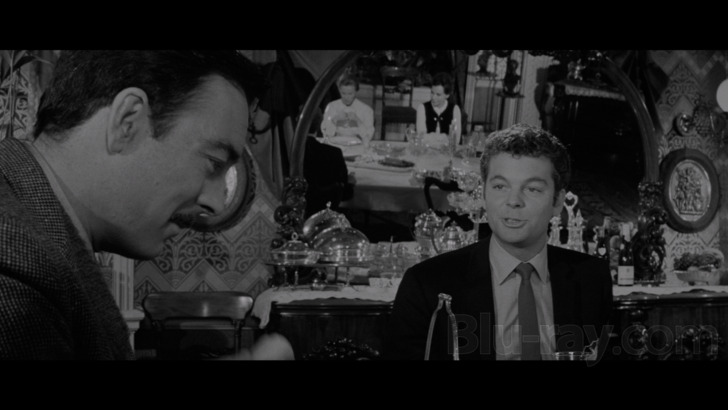
Robert Wise demonstrates that he learned much from his days working with Orson Welles, which he later applied to The Haunting. For example, there's a terrific match dissolve featuring three different actors portraying the same character. In addition, Wise employs deep focus and a cleverly hidden split-focus diopter. I concur with Karen Stollznow on the second audio commentary that this film deserves multiple viewings because a lot is going in the 2.35:1 framing. Moreover, Nelson Gidding's script gives the audience a lot to chew on. Scream Factory's 4K scan of the OCN results in a wonderful UHD and remastered Blu-ray with crisp blacks and an impressive grayscale. For sound options, I would only listen to the 5.1 upmix. (It's more like an enhanced mono.) Of the two recent audio commentaries, I prefer the second track with Stollznow, Baxter, and Smith because it's overall more informative. Fans of '60s horror and Robert Wise will definitely want to add this set to their collections. VERY HIGHLY RECOMMENDED!

Similar titles
Similar titles you might also like

The Haunting of Hill House
Extended Director's Cut
2018

The Legend of Hell House
1973

The Others 4K
2001

Don't Look Now
1973

The Shining
1980

The Innocents
1961

The Other
Limited Edition to 3000 - SOLD OUT
1972

The Orphanage
El Orfanato
2007

Winchester
2018

The Little Stranger
2018

Hereditary 4K
2018

The Skeleton Key
2005

You Should Have Left
2020

The Awakening
2011

Marrowbone
The Secret of Marrowbone
2017

Gothika
2003

Paranoiac
Collector's Edition
1963

The Haunting in Connecticut 2: Ghosts of Georgia
2013

Paranormal Activity
Theatrical + Unrated Alternate Cut
2007

Annabelle Comes Home
2019