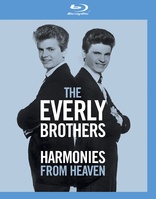
The Everly Brothers: Harmonies from Heaven Blu-ray Movie
HomeThe Everly Brothers: Harmonies from Heaven Blu-ray Movie 
+ Live 1968 DVDEagle Vision Media | 2016 | 59 min | Not rated | Sep 09, 2016
Price
List price:Listed on Amazon marketplace

Movie rating
6.6 | / 10 |
Blu-ray rating
| Users |  | 0.0 |
| Reviewer |  | 3.5 |
| Overall | | 3.5 |
Overview
The Everly Brothers: Harmonies from Heaven (2016)
Documentary which celebrates, over the period covering the end of the 1950s and the beginning of the 60s, the phenomenon of the Everly Brothers, arguably the greatest harmony duo the world has witnessed, who directly influenced the greatest and most successful bands of the 60s and 70s - the Beatles, the Stones, the Beach Boys and Simon & Garfunkel to name but a few. Don and Phil Everly's love of music began as children, encouraged by their father Ike. Little Donnie and Baby Boy Phil sang on Ike's early-morning radio shows in Iowa. After leaving school, the brothers moved to Nashville where, under the wing of Ike Everly's friend, the highly talented musician Chet Atkins, Don and Phil signed with Cadence Records. They exploded onto the music scene in 1957 with Bye Bye Love, written by Boudleaux and Felice Bryant. After Bye Bye Love came other hits, notably Wake Up Little Susie, followed by the worldwide smash hit All I Have to Do Is Dream and a long string of other great songs which also became hits. By 1960, however, the brothers were lured away from Cadence to Warner Bros with a $1,000,000 contract. Their biggest hit followed, the self-penned Cathy's Clown, which sold 8 million copies. Remaining at Warner Bros for most of the 60s, they had further success with Walk Right Back, So Sad and the King/Greenfield-penned track Crying in the Rain
Starring: Del Bryant, Paul Gambaccini, Art Garfunkel, Keith Harris, Graham NashDirector: George Scott (V)
| Music | 100% |
Specifications
Video
Video codec: MPEG-4 AVC
Video resolution: 1080i
Aspect ratio: 1.78:1
Original aspect ratio: 1.78:1
Audio
English: LPCM 2.0
English: DTS-HD Master Audio 5.1
Subtitles
English, French, German, Portuguese, Spanish
Discs
Blu-ray Disc
Two-disc set (1 BD, 1 DVD)
Playback
Region A (B, C untested)
Review
Rating summary
| Movie | | 3.5 |
| Video | | 3.5 |
| Audio |  | 4.0 |
| Extras |  | 2.5 |
| Overall | | 3.5 |
The Everly Brothers: Harmonies from Heaven Blu-ray Movie Review
Reviewed by Jeffrey Kauffman September 10, 2016Some of you who may have worked with singers who are related to each other may be familiar with the term “blood harmony”. It’s an odd, almost vampiric, sounding term that refers to the seemingly genetic consonance that is arrived at when those who are closely connected DNA wise warble as a group. Some of the greatest singing groups in the history of American music have been either siblings or at least pretty closely related (cousins, etc.), including everyone from The Andrews Sisters, The Jackson 5, The Osmonds, The Beach Boys, The Bee Gees, The Pointer Sisters, Clannad, The Lennon Sisters, The Free Design and The Partridge Family, to name just a few (and, yes, that last one was a joke). That’s a huge array of talent in that list, and one which traverses a rather wide array of styles and content, but even with a “musical menu” like this one, The Everly Brothers would still probably be at the very top of “relative groups”, despite that fact that with only two brothers they weren’t able to engage in the multi-part harmonies that many of their other musical kin (pun intended) were. The Everly Brothers hit the big time in 1957 with the first of what would become several signature songs for the duo, “Bye Bye Love”, a single which also started their fruitful collaboration with iconic (if still almost weirdly unknown and underappreciated) songwriters Felice and Boudleaux Bryant. “Bye Bye Love” was a “crossover hit” in a day when such things were pretty much unheard of, denied the top spot on the pop charts by another mid-fifties phenomenon, Elvis Presley, while simultaneously either topping or making the Top 5 of other charts, including the Country and Rhythm and Blues listings. For the next five years, The Everly Brothers would see almost unbelievable success, with a string of huge hit singles that often took not just one Number One spot (i.e., the pop chart), but placing high on all sorts of them (Country, R&B, and, later, MOR or Adult Contemporary). As is made clear by The Everly Brothers Harmonies from Heaven, the duo’s impact wasn’t just felt by record buyers, but by a slew of other musicians who grew up listening to the pair’s propulsive guitar work and, of course, their sumptuous, slightly country-twinged singing style.
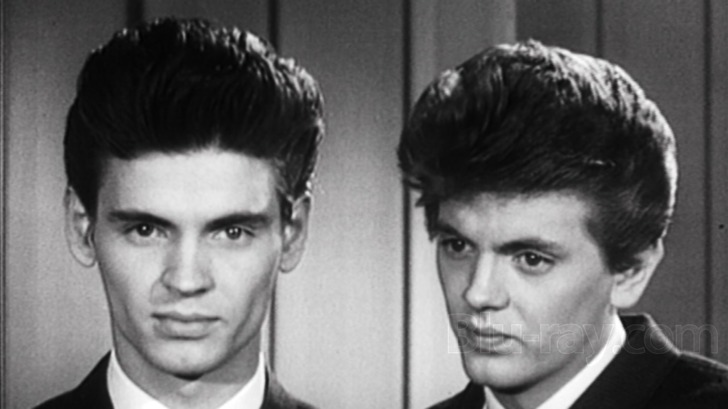
That slew of musicians would seem to be a rather odd aggregation, at least as evidenced by the patently peculiar talking heads on display in The Everly Brothers Harmonies from Heaven, including a bunch who are weirdly British-centric, though the IMDb suggests this was probably broadcast as a UK television special, perhaps explaining this phenonmenon. While hearing a surprisingly coherent Keith Richard opine on the guitar theatrics of the duo is entertaining, other participants are hardly what one would think of as “experts” about the Everly Brothers or even their kind of music (Tim Rice?). While Jake Bugg has made no secret of his affinity with the Everly Brothers, he hasn’t exactly set the United States charts on fire and so may be a complete unknown to some viewing this piece. The American audience will have to be satisfied with some fun reminiscences by Art Garfunkel, who mentions how he and Paul (one assumes Simon) were on a field trip as kids and heard the Everly Brothers on the radio and their lives changed. (I’m going to be a complete musical snob and point out that while Garfunkel rightly explains and demonstrates that the Everlys typically harmonized in thirds, when he gives his final “example”, he actually sings a perfect fifth, not a major or minor third.)
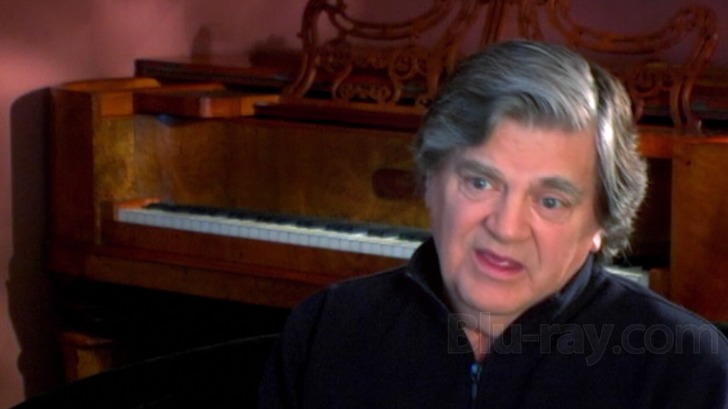
With what are apparently contemporary or near contemporary interviews with Don and some fairly recent archival video with Phil, the two brothers are also copiously on record (sorry) detailing some of their history. But some of the most fun information comes courtesy of Felice Bryant, again from (older) archival interview. She seems to be a real character and talks about her writing “system” with her husband, which was evidently something of a competition at times. A number of other tangentially related people offer their own personal stories, and some of the lesser known aspects of the Everlys’ lives, like their early radio show (as children) with their renowned guitarist father Ike, are some of the best moments in the documentary.
Those wanting a kind of "warts and all" approach toward the pair will probably be disappointed by this piece, since it concentrates on the prime of their careers, before declining record sales and some internecine struggles started entering the fray. While there's a lot of interesting information here, the documentary's relative brevity tends to work against a really in depth look at the duo's career, even within the confines of the five years or so when they were Top 40 material. But even with its generalist approach, The Everly Brothers Harmonies in Heaven should appeal to just about any Everly fan.
The Everly Brothers: Harmonies from Heaven Blu-ray Movie, Video Quality

The Everly Brothers Harmonies in Heaven is presented on Blu-ray courtesy of Eagle Vision, an imprint of Eagle Rock Entertainment, and Universal Music Group with an AVC encoded 1080i transfer (mostly) in 1.78:1 (as should be expected, some of the older archival video which hasn't had its aspect ratio tweaked comes it at narrower aspect ratios, typically around the 1.33:1 mark). This is a pretty typical looking patchwork quilt of sources, with some of the older archival video pretty fuzzy looking and afflicted with anomalies like combing or ghosting. Newer archival video, like that featuring Phil and Felice, is at least somewhat better looking, but never at contemporary levels of sharpness (as again should be expected). The contemporary interview segments look best of course, with decent sharpness and a natural looking palette.
The Everly Brothers: Harmonies from Heaven Blu-ray Movie, Audio Quality
While The Everly Brothers Harmonies in Heaven does boast a DTS-HD Master Audio 5.1 track, truth be told there's really not a significant spike in either surround activity or even low end impact over the also included LPCM 2.0 track, no doubt due to the fact that the Everly Brothers were (obviously) a duo, not a huge group whose sonic overkill would offer more for a surround track to exploit. Both tracks sound fine, however, with very good to excellent fidelity depending on the source material. Aside from baked in damage and fidelity issues with regard to the older audio, there's nothing here that will cause concern for any discerning audiophile.
The Everly Brothers: Harmonies from Heaven Blu-ray Movie, Special Features and Extras

Blu-ray
- Bonus Interviews (1080i; 26:20) feature longer snippets with many of the talking heads seen in the main documentary.
- Jake Bugg takes a crack at some Everly material:
- Cathy's Clown (1080i; 2:32)
- Crying in the Rain (1080i; 1:57)
- The Everly Brothers Live at Chequers Nightclub, Sydney (480i; 47:34) looks like it was probably culled from an old black and white
television broadcast from 1968 (with the brothers dandied up in tuxes!), and features the following songs in Dolby Digital 2.0:
- Lucille
- Walk Right Back
- Susie Q
- Wake Up Little Susie
- Cathy's Clown
- All I Have to Do is Dream
- Bye Bye Love
- So Sad (To Watch Good Love Go Bad)
- Bowling Green
- (Til) I Kissed You
- Bird Dog
- Let it Be Me
- Be Blop a Lula
- Kentucky
The Everly Brothers: Harmonies from Heaven Blu-ray Movie, Overall Score and Recommendation

My only real qualm with The Everly Brothers Harmonies in Heaven is that it wasn't longer and more detailed, especially with some of the interesting if bittersweet developments that started accruing around the pair after their late fifties and early sixties prime. Some of the archival video (and audio) is wonderful to see and hear, and despite the fact that some fans may be questioning this particular assortment of talking head "experts", the commentary by at least some of them is interesting as well. Technical merits are about what you'd expect from a documentary assembled from so many different source elements. Recommended.