The Dry Land Blu-ray Movie
HomeThe Dry Land Blu-ray Movie 
Maya Home Entertainment | 2010 | 92 min | Rated R | Nov 09, 2010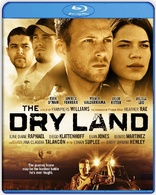

Movie rating
6.3 | / 10 |
Blu-ray rating
| Users |  | 0.0 |
| Reviewer |  | 4.0 |
| Overall | | 4.0 |
Overview
The Dry Land (2010)
James, a veteran of the Iraqi conflict, returns to West Texas and tries to resume his life with the wife, Sarah, he left at home. But as he struggles with post traumatic stress disorder, James realizes that the only people with whom he feels truly at ease are the fellow survivors of a deadly RPG attack on his unit in Iraq - an attack that James can't recall.
Starring: Ryan O'Nan, Jason Ritter, Melissa Leo, Wilmer Valderrama, Diego KlattenhoffDirector: Ryan Piers Williams
| Drama | 100% |
Specifications
Video
Video codec: MPEG-4 AVC
Video resolution: 1080p
Aspect ratio: 2.39:1
Original aspect ratio: 2.39:1
Audio
English: Dolby Digital 5.1
English: Dolby Digital 2.0
Subtitles
French, Spanish
Discs
25GB Blu-ray Disc
Single disc (1 BD)
Playback
Region A, B (C untested)
Review
Rating summary
| Movie | | 4.0 |
| Video | | 4.0 |
| Audio |  | 3.0 |
| Extras | | 3.0 |
| Overall | | 4.0 |
The Dry Land Blu-ray Movie Review
"Thank You for Your Service": What Do the Words Mean?
Reviewed by Michael Reuben October 18, 2011Films about the wars in Iraq and Afghanistan and the toll they take on the soldiers who fight them have been box office poison from day one, even when, as with Best Picture winner, The Hurt Locker, they grab the brass ring on the awards circuit. Stop-Loss, The Lucky Ones, The Messenger, Brothers, In the Valley of Elah -- not one of these has captured the attention of a broad American movie audience. (And the FX TV series Over There was quickly canceled with low ratings.) So what chance does an independent film like The Dry Land have, with a first time writer-director, a tiny budget and no marquis names (unless you count Ugly Betty's America Ferrera, who co-starred and executive produced)? Not much chance in theaters, as it turned out, but writer-director Ryan Piers Williams appears to have had a different audience in mind. When the film was completed, he and Ferrera, who are a couple in real life (they married in June 2011), began screening the film for audiences of former and current members of the military, using contacts they'd developed during two years of research to gain access to military bases. Reactions varied, as they will with any audience, but the interest was there, because Williams had made something unique: a simple and unadorned account of a veteran's efforts to deal with post traumatic stress disorder or "PTSD". In less clinical terms, the film is about the gulf between who the returning soldier was before he left and who he is now. Even he isn't sure, but he knows that the people welcoming him home no longer know him. Hemingway famously wrote about the "lost generation" who survived World War I. Williams has made a similar tale about contemporary American vets, in a plain-spoken style of which Hemingway would have approved.
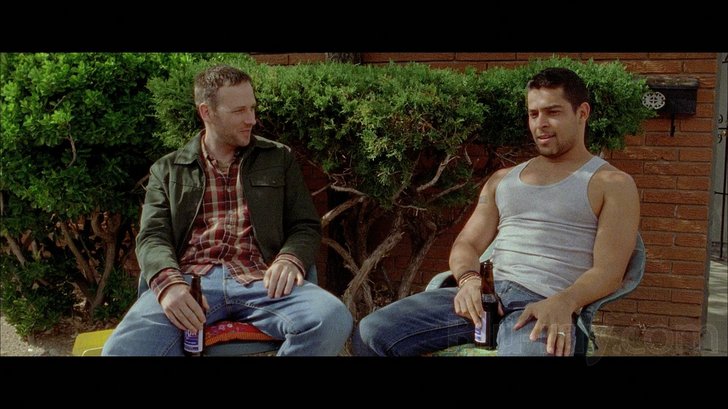
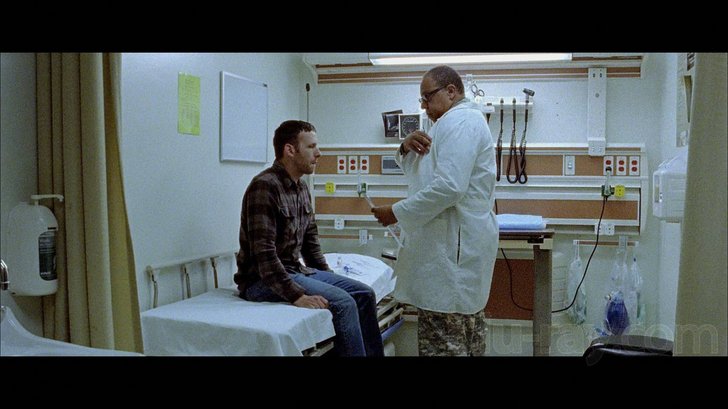
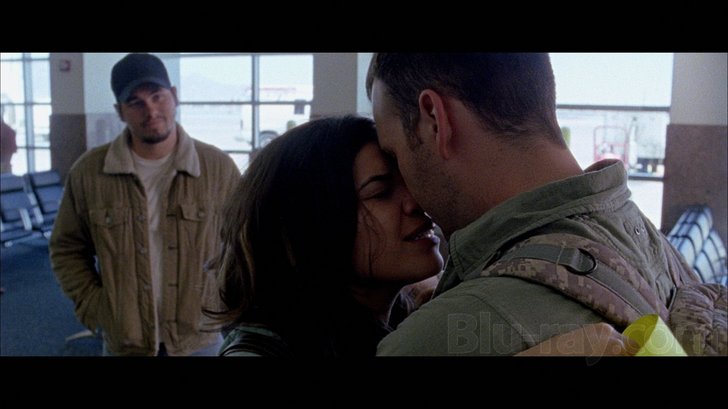
James Scott (Ryan O'Nan) returns to his home in El Paso, Texas, having fully discharged his commitment to the U.S. Army. He's greeted by his ecstatic wife, Sarah (Ferrera), and his best friend, Michael (Jason Ritter), but his mother, Martha (Melissa Leo, who wasn't yet an Oscar winner when she made the film) isn't at the airport, because her emphysema is so bad she can barely make it to her front door without oxygen. Still, she's delighted when James comes to see her. They're obviously close. Sarah and Michael have organized a surprise party attended by James's sister, Susie (June Diane Raphael) her inept husband, Jack (Ethan Suplee, who let the train get away in Unstoppable), their son, Ian (Zion Sandoval), and David Valdez (The Shield's Benito Martinez), a family friend and Michael's employer. The party is a happy affair, although James has to cope with unwelcome questions such as whether he killed anyone. David Valdez owns a successful slaughterhouse and beef packing plant, where James gets a job working with Michael, even though being around blood and guts may not be the best environment for him. One of their co-workers is an old acquaintance, a career smartass named Joe (Evan Jones), who, as James and Michael agree, is "still an asshole". Joe is the kind of guy (and they're everywhere) who enjoys needling someone until they lose their temper, then throws up his hands and says, "Can't you take a joke?" But that's probably not a smart move with someone like James, who no longer feels safe in his own home unless he's first popped a clip into the automatic he keeps in the bedroom. Indeed, once the welcome home is over, James can't relax into his old life. Sarah experiences the difference most directly, and it's not just a matter of sex between them becoming distant and impersonal (the film is unsparing in its depiction). James suffers from recurrent nightmares, during one of which he almost strangles her. He apologizes, but he can't (or won't) talk about it. Then one night after work, Michael and Joe persuade James to go out for a few beers after work; then, in a display of particularly poor judgment, they drive him out into the country, where Joe starts shooting rifles for fun. But James no longer reacts to the sound of gunfire as he did before he went to Iraq, and a tense battle erupts by the roadside. Michael manages to get James home in a stupor, but when he comes to, James attacks both his friend and his wife. The next morning, James drives himself to the nearest V.A. hospital, where he sees a capable army doctor (Barry Shabaka Henley), who starts him on anti-anxiety medication and schedules an appointment with an army shrink. James knows there's something wrong, and the service clearly takes it seriously, but it's not something they can cure with a few stitches. When James returns home, Sarah is moving out. She's afraid to stay until he regains control of himself. As James continues to sink, he seeks out the only people with whom he feels any connection: the two surviving soldiers from his former unit. One, Raymond Gonzales (Wilmer Valderrama), returned home to Texas at the same time as James and sent him a short friendly letter, which was one of the few things that seemed to make him happy. James goes to visit Raymond, and one look at the face of Raymond's wife, Adriana (Ana Claudia Talancón), tells you that the situation in the Gonzales household is no more peaceful than at James's home. James asks Raymond to help him fill in a gap in his memory from an RPG attack on their vehicle in Iraq, when two of their friends died -- a gap the army doctor immediately honed in on. When Raymond can't (or won't) help, James says he's going to Walter Reed Army Medical Center, where a third survivor, Henry (Diego Klattenhoff), is receiving treatment and rehabilitation for major injuries suffered in the attack. Maybe Henry remembers something. At the last minute, Raymond jumps into James's red pickup to accompany him. Their road trip is a like vacation from the civilian reality into which neither of them fits. They horse around like kids accountable to no one, shoplift from convenience stores, build campfires and sleep in the open, and Raymond picks up hookers he manages not to pay. But when they reach Walter Reed, things get serious. Henry's injuries are the most graphic demonstration yet of how radically life has changed for all of them. James gets his memory refreshed, and while the missing recollections are terrible, they don't provide easy answers. They're just an example (of which there are no doubt thousands) of the almost unimaginable stress imposed on soldiers functioning in a treacherous landscape where every single act -- including a moment's compassion or the routine gesture of leaving a vehicle door open -- can have life-or-death consequences. And that's yet one more example of the unique quality of The Dry Land; it doesn't exaggerate or sensationalize. There are no overheated flashbacks (punctuated by explosions and screams), no indifferent government bureaucrats, no callous politicians, no corner-cutting hospital administrators -- none of the convenient targets or cardboard villains that would make the story easy to resolve and James's situation simple to rationalize. There's just an ordinary guy who volunteered to serve his country, came back a changed man and can no longer deal with the daily hard knocks of life without a lot of help and a long period of recovery.
The Dry Land Blu-ray Movie, Video Quality
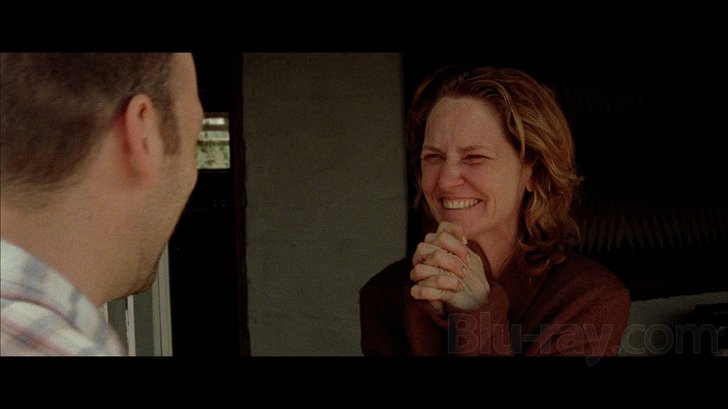
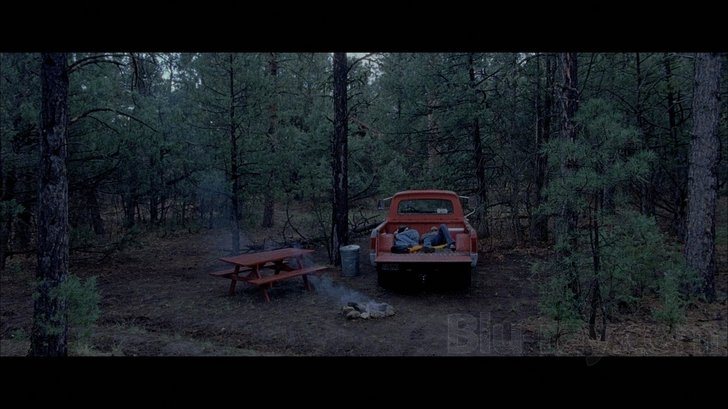
The Dry Land was shot in Super16 and finished on a digital intermediate by Gavin Kelly, an up-and-coming cinematographer who has so far worked almost entirely in independent film. The picture on the 1080p, AVC-encoded Blu-ray is sharp and finely detailed, and the image has obviously been "pushed" in post-production to bring out contrasts. The result is to accentuate the film grain and, on occasion, to add a very small amount of noise to the image, but the effect is well worth the gain in vividness and visual impact. Black levels are very good, as becomes evident in scenes at night both in and out of doors, where detail in shadows and dimly light areas are well delineated. White levels in such scenes as the meat packing plant or the V.A. hospital are appropriately stark without being overly bright. The color palette is realistic with just a slight edge of the surreal from time to time, especially during the road trip sequences. I didn't see any indication of high-frequency filtering, transfer-induced ringing, compression artifacts or other inappropriate digital tampering.
The Dry Land Blu-ray Movie, Audio Quality
Maya Entertainment has yet to use lossless audio, but this particular title has its DD 5.1 track at the lower bitrate of 384kbps that major studios abandoned years ago. Fortunately the soundtrack for The Dry Land is relatively spare and undemanding, consisting primarily of dialogue (which remains front and center), primary sound effects in the front three channels, and a simple but eloquent musical score by Dean Parks that relies almost entirely on a single guitar for its effect. It's a lonely sound to accompany the story of a lonely man. The track sounds quite good, but if one is going to use DD on a Blu-ray, why not at least take full advantage of the highest possible bitrate (which is 640kbps)?
The Dry Land Blu-ray Movie, Special Features and Extras
- Commentary by Director Ryan Piers Williams and Actor America Ferrera: The couple speak continuously about developing the film, the production process and the reactions of various audiences. They both laugh when they reach the sex scene between James and Sarah, as they describe how people always ask what it was like for Williams to direct Ferrera and for Ferrera to perform for Williams (they both decline to answer). Williams offers interesting observations on working within the budgetary constraints of independent film, and Ferrera (who has plenty of experience working with bigger budgets) has interesting comments on the pros and cons of not having a large number of takes to get it right. One disappointment: There are references to scenes deleted in editing, including a substantial monologue by Raymond that Williams hated to lose because the performance was so good. Such comments cry out for a deleted scenes extra.
- Theatrical Trailer (HD; 2.35:1; 2:30): It's an honest trailer, though I doubt it played in many theaters.
- Resources for Care: A kind of PSA, this is a single screen of text with contact information for various organizations that help veterans dealing with PTSD.
- Additional Trailers: At startup, the disc plays trailers, in high definition, for In Therapy (Divã) and Rains of Injustice (Trópico de Sangre). These are not otherwise available once the disc loads.
The Dry Land Blu-ray Movie, Overall Score and Recommendation
The great virtue of a film like The Dry Land is precisely what makes studios and marketing departments avoid it. There's no "high concept" or marketing hook with which to pigeonhole the film and sell it to theater owners and audiences. Paradoxically, that's what makes the film worth watching. It tells a compelling story directly and simply, without a lot of spin or adornment added by marketers or executives hoping to "broaden" the audience by adding unnecessary frills. The Blu-ray presentation is solid, despite the lack of lossless audio, and the film is good enough that the disc is highly recommended.
Similar titles
Similar titles you might also like
(Still not reliable for this title)

The Deer Hunter
1978

Six: Season 1
2017

The Men
Battle Stripe
1950

Paths of Glory 4K
1957

The Big Parade
Warner Archive Collection
1925

The Last Detail
Limited Edition to 3000 - SOLD OUT
1973

The Thin Red Line
1998

Semper Fi
2019

Apocalypse Now Redux
1979

The Best Years of Our Lives
1946

Darling Companion
2012

The Entertainer
1960

Men of Honor
2000

Tunes of Glory
1960

A Raisin in the Sun
1961

Resurrected
Limited Edition to 3000
1989

Overlord
1975

SEAL Team: Season One
2017-2018

The Iceman Cometh
1973

Lebanon
2009