Rating summary
| Movie |  | 4.0 |
| Video |  | 4.5 |
| Audio | | 4.0 |
| Extras |  | 5.0 |
| Overall | | 5.0 |
The Curse of Frankenstein 4K Blu-ray Movie Review
"In any case, Hammer breathed new life into the Mary Shelley myth. And in return, 'Frankenstein' created Hammer." - Peter Cushing
Reviewed by Justin Dekker October 29, 2025
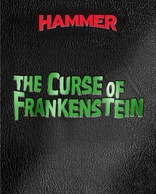
One of the numerous titles that Hammer fans have been waiting for arrives on 4K UHD disc in this new 'The Curse of Frankenstein 4K: Limited
Collector's Edition' courtesy of Hammer Films. The film stars Peter Cushing as the Baron, Christopher Lee as The Creature, and Hazel Court as
Elizabeth, and features numerous Hammer heavyweights behind the camera. A truly massive release in every sense of the word, this edition features
the film in three distinct aspect ratios along with multiple commentary tracks, and a host of on-disc extras. Among the supplemental features included
is Ted Newsom's feature length Hammer documentary 'Flesh and Blood: The Hammer Heritage of Horror', behind-the scenes footage from that
project featuring the last recorded images of Cushing performing work for Hammer, and a wealth of printed material that includes lobby card
reproductions, a double-sided color poster, a perfect-bound graphic novel of the film culled from vintage issues of 'The House of Hammer' magazine,
and a monstrous 164-page perfect bound book featuring writing on the film, those who made it, and Bray Studios where the film was made. The
book is also filled with numerous stills, publicity shots, and other images. This set is made up of six discs: discs 1 and 2 are 4K UHD discs containing
the film in different aspect ratios along with with some extras; discs 3 and 4 are Blu-ray versions of the first two discs; and discs 5 and 6, Blu-rays
that are home to a considerable selection of extras. The contents are housed in a chipboard slipcase which itself is housed in a leatherette and green
foil-enhanced embossed slipbox. The two UHD discs are region-free, whereas the Blu-ray discs, discs 3, 4, 5, and 6, are Region B locked. Viewers will
need a region-free player to view those four discs.
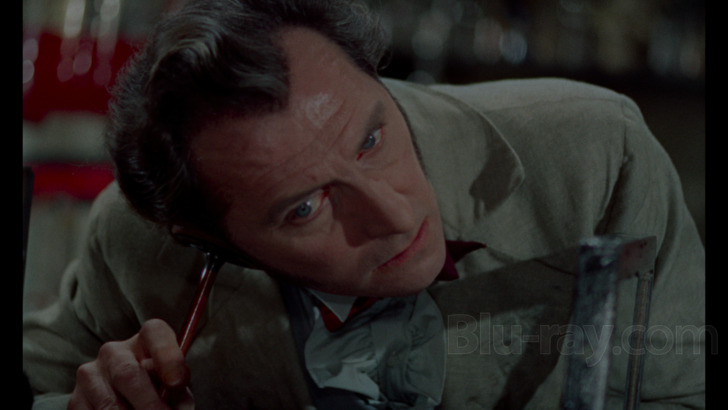
By the middle to end of the 1950s, horror cinema was in a sorry state. Very few true horror films were being produced, and of those that were,
many of them were ultimately
forgettable. While there were a number of science fiction and monster movies that had some horror elements regularly gracing the silver screens
across the US and the world, horror, in the classic sense, as popularized and immortalized by the early Universal offerings of
Dracula,
Frankenstein, and
The Wolf Man had faded. While those films were and are still significant, they no longer resonated in the manner
they once did, due in part to Universal's profit-driven motives to dilute and diminish the macabre creations with strings of sequels of decreasing
quality, and reducing them to punchlines in more comedic fare. The time was ripe for someone to come along and remind viewers why they needed
to fear these unholy creations once again.
When Hammer decided to undertake bringing Mary Shelley's creation to the screen for a new generation of viewers, the events of its origins are a
film-worthy subject in and of themselves. Hammer executives tried to bluster their way around censors, and made promises they'd no intention of
keeping to their American partners in the production. They had been threatened with lawsuits by Universal if their story or their monster bore too
much (or
any) resemblance to their 1931 film. A script penned by Milton Subotsky had been briefly considered, before he was paid off, the
script discarded, and a new treatment by Jimmy Sangster was penned and approved. The rejection Subotsky experienced would go on to inspire, at
least in part,
the creation of Amicus Productions, one of Hammer's chief rivals in the horror resurgence of the 1960s and 70s, and the creators of numerous
memorable films themselves, most notably anthologies such as
The House That Dripped Blood which featured Ingrid Pitt and John Pertwee,
names that should be familiar to fans of television and film from the era.
Due to his previous television work, Cushing was already a known commodity to British audiences. His meticulous preparation made his Baron
Frankenstein believable as carried out experiments, handled instruments, and talked about his scientific work. His well-known generosity to his
fellow actors allowed Melvyn Hayes to better emulate Cushing's mannerisms and posture to effectively sell his portrayal of a younger version of the
Baron. Cushing even gave the young actor a ring to wear to help establish continuity between the older and younger versions of the nefarious
character.
Lee, it's been said, was cast in the role of The Creature due to both his considerable height, and the fact that his daily rate was £2 less than the
other actor who was up for the part. Considering things from a more talent-based perspective, though, yields the notion that his miming skills would
greatly aid the largely non-verbal role of The Creature. Indeed, that creation could have been little more than an object of derision and disgust in
lesser hands, but Lee's performance transforms him into something pitiable and awkward, something not quite human; a creation who didn't ask to
be born and who was treated with very little kindness. With an appearance that lends itself to fear and prejudice, even escaping the confines of the
Baron's familial estate would not net him a better life, as those who knew of his origins would recoil due to his "devilish" beginnings, and those who
didn't would simply find him repulsive. While Lee doesn't receive much screen time here, every frame he's in evokes as certain sadness.
These performances, in confluence with the sumptuous production value inherent in Bray Studios, the excellent costuming, the stellar work of DP
Jack Asher, make up effects from Phil Leakey, Sangster's script, and the deft direction of Terence Fisher conspire to make
The Curse of
Frankenstein the memorable and influential film that it is. Wildly successful, the film put Hammer Studios on the map, ensuring not only
inevitable sequels, but a new slate of other gothic horror films to quench a thirst which they had helped to create. Films focused on Dracula, The
Mummy, The Wolf Man, and even a gender-bending take of Stevenson's characters of Dr. Jekyll and Mr. Hyde would follow over the ensuing years.
While the success or failure of those projects is, to a certain extent, a matter of taste, Lee and/or Cushing would appear in many of them, and
Hammer's distinctive production values would remain fully on display.
The Curse of Frankenstein 4K Blu-ray Movie, Video Quality
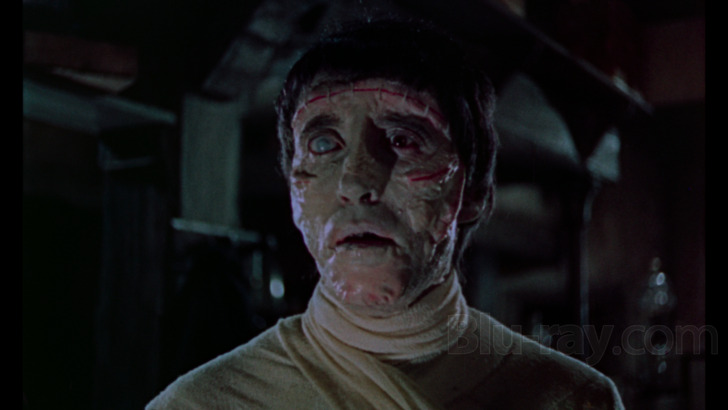
Per the liner notes included with this release, Hammer did not possess a print of this film that was suitable to undertake this type of endeavor. To that
end, they were able to source the 35mm OCN from Warner Bros., which was scanned at 4K resolution, along with the original YCM (yellow, cyan,
magenta) separation protection masters, monochrome reels created as a sort of insurance should the OCN ever become damaged. Warner Bros., after
careful consideration, decided the best course of action was to use these YCM masters as the basis of the restoration, and once scanned, they were
sent to Silver Salt in London for extensive restoration, with each color layer requiring its own body of work. This work also enabled the reinsertion of
the infamous "eyeball sequence".
The end result is as beautiful as it is impressive. The image on display in each of the three aspect ratios is wonderfully filmic, with a layer of film grain
that resolves naturally and is never problematic. Skin tones are healthy. The Dolby Vision grade boasts colors that are robust and stable, and fine
detail is pleasingly high. Even darker areas allow for subtle gradations in shadow that enable viewers to inspect every corner of the cluttered
laboratory,
the Baron's opulent public rooms, and the few exterior shots as well. This is, of course, save for those dark areas that Asher left intentionally
impenetrable, such
as the shadows that consume Cushing's Baron in his prison cell before he chooses to extricate himself from them and dramatically reveals his
presence to
the viewer
for the first time. My colleague, Randy Miller III, was quite justified in his praise of the Warner Archives release from 2020, though this release handily bests it in terms of
picture quality. And it should be noted that Warner Bros., due to their collaboration on the restoration, has its own newly released Region A 4K UHD product
which contains an identically luscious presentation of the film. From its smokey red title sequence forward, The Curse of Frankenstein has
never looked better.
In order to give viewers a sense of how the aspect ratio changes the viewing experience of the film, I captured, as closely as possible, the same (or
very similar) moments for each of the three different aspect ratio options included in this release. Considering the film's origin, the 1.66:1 UK
Theatrical
Version feels like the right choice to me, though I suspect many viewers will default to the aspect ratio in which they first, or have normally viewed
the
film up to this point.
- Screenshots 1 - 7 are from the 1.66:1 UK Theatrical Version
- Screenshots 8 - 14 are from the 1.37:1 As-Filmed Version
- Screenshots 15 - 21 are from the 1.85:1 US Theatrical Version
Screenshots are sourced from the 4K UHD discs and downscaled to 1080 and are in SDR.
The Curse of Frankenstein 4K Blu-ray Movie, Audio Quality
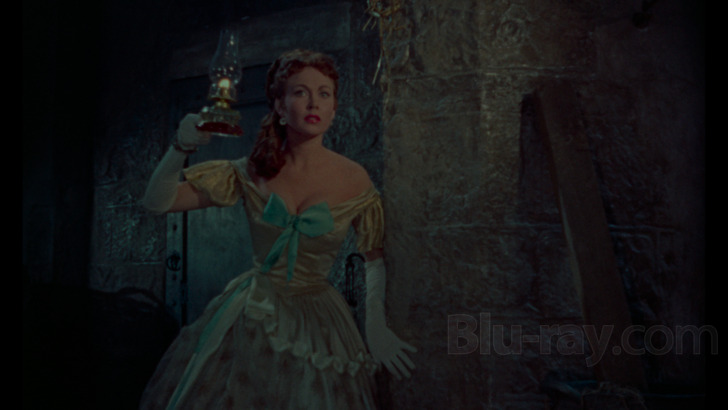
Hammer's The Curse of Frankenstein is equipped with two English audio options, an LPCM 2.0 mono track, and, as is Hammer's established
protocol, a newly created 5.1 HD-Master Audio track crafted by using AI to strip the dialogue from the mono mixed soundtrack, and pushing music and
effects into the surrounds. I viewed the film all the way through with the 2.0 mix, and then a second time with the 5.1 track, and there are certainly
merits to both. The 2.0 track is in line with what long-time fans of the film would expect. It's an appropriate "vintage" soundtrack for a film that first
screened in theaters in 1957. The track sounds excellent, with dialogue being consistently intelligible. Effects are likewise well-rendered, and again,
retain an era-appropriate quality. It's an enjoyable listen, and the only real issue to report here is some very slight sibilance issues that are consistent
throughout the film, with some actors being more heavily impacted than others, but no one is unscathed in this regard. It's not significantly distracting
and it won't pull viewers out of the film, but it is noticeable until the ear grows accustomed to it.
The newly minted 5.1 HD-Master Audio track, as with Hammer's recent The Man in Black, which was created via the same process, is once again quite well done. The track adds
some additional depth and richness to sound effects like thunder, and to the humming, crackling, and bubbling equipment in Victor Frankenstein's
laboratory. The dialogue and many of these sounds are still front and center focused. Surrounds are used to subtly support the score, adding ambiance
and atmosphere but never being overwhelming. Occasionally, effects and dialogue push through the surrounds, such as when Paul knocks on the door
around the 59-minute mark and calls out to Victor. Such instances are infrequent, but they are handled well when they arise. To my ear, though, the
biggest difference between the two tracks is that the 5.1 track exhibits far fewer sibilance issues than the 2.0 mono track. As the 5.1 track doesn't
sound overwhelmingly modern and anachronistic, viewers shouldn't find a strange companion to the film. As there are definite merits to both, the audio
selection is going to boil down to personal preference. Based on what seemed most pleasing to my ear, I'll likely pick the 5.1 track when next I screen
the film.
The Curse of Frankenstein 4K Blu-ray Movie, Special Features and Extras
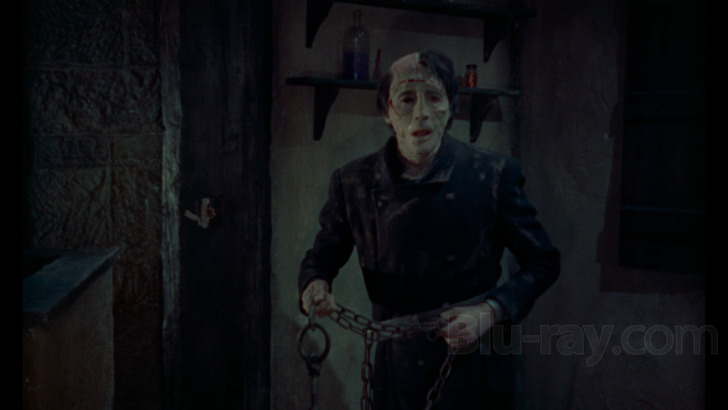
Hammer's release of The Curse of Frankenstein 4K Limited Collector's Edition features an amazing amount of extras. It includes all of the n-
disc supplemental material found on the new Warner Bros. 4K release, in addition to a considerable amount of further on-disc material and a wealth
of printed content, besides. The material is as follows.
Disc 1: 4K UHD
- Widescreen 1.66:1 UK Theatrical Version with 2025 Commentary featuring Kim Newman, Barry Forshaw, and Stephen Jones
- This optional commentary features Forshaw (author of British Gothic Cinema), Jones (author, editor, and horror expert), and
Newman (author, critic, and novelist). The men begin by discussing their first exposure to the film, and Newman quickly shares information on the
impact of budgetary constrictions. From there, they shift to a discussion of the novel on which the film was based and the linkage between science
fiction and horror. They contend that the novel was so different from what had come before, and that the subject matter in combination with the
novel's themes, has led to the tale's endurance. The trio quickly posits that Curse is likely the most influential British horror film, and much
of their subsequent conversation adds evidence to the claim either directly or indirectly. Their conversation moves back to the origin of the film, the
influence of Anthony Hinds, the specter of Universal's potential legal action, and screenwriter Sangster's work to craft a unique picture. The
commentary is rarely driven by the action on the screen, and the conversation between the three fluidly shifts from one subject to another as they
share anecdotes, tell stories, and relay information about this film and others as well. The conversational track is a spirited and enjoyable listen.
- Fullscreen 1.37:1 As-Filmed Version with 2012 Commentary featuring Marcus Hearn and Jonathan Rigby - This optional
commentary features Hammer Vault author Marcus Hearn and Jonathan Rigby who penned English Gothic and Studies in
Terror. They start by marveling at the opening credits, which contain a veritable "who's who" of some of Hammer's top behind-the-camera
filmmaking talent. Their conversation is much more keyed to the action on the screen, inspiring them to discuss locations, the cast, shot construction
and lighting, and the like. They again comment on Milton Subotsky's original script that was eventually discarded and replaced by the one authored
by Jimmy Sangster that would ultimately make it to the screen. By all accounts, it was vastly superior. The cast receives a substantial amount of
focus, covering not only the stars but also pointing out trivia like the cameo of Hazel Court's daughter in an early scene. Not as lively as the track
recorded by Newman, Forshaw, and Jones, it is more film-focused. While they may occasionally refer to other actors and other films (such as Top
Secret!), they rarely stray for long. It's a deeply informative commentary.
- Beside the Seaside: Wayne Kinsey and Madeline Smith Remember Peter Cushing (50.17) - Shot in the Whitstable Museum
in the midst of the Peter Cushing exhibit, they begin by grounding viewers in biographical information of his youth, and his parents. His theatrical
career began in 1938, before heading to Hollywood in 1939, landing a role in James Whale's (Frankenstein) The Man in the Iron
Mask, and a Laurel and Hardy film as well. Returning to England in 1942, he was rejected from military service due to his rugby-related injuries.
Leaning into his artistic side, Cushing ended up designing the silk scarf for the coronation in 1953. Mentored in painting by Edward Seago, he met the
Queen when Seago was working a portrait of her, and she revealed she was a fan of his theatrical work, which began in earnest in the late 1940s.
The
pair discuss his meticulous preparation for his roles, and his consistent gentlemanly behavior, his presence, and his perfect posture. Their discussion
ends with a reading of Cushing's take on the "The Twelve Days of Christmas". Upon its conclusion the pair wander through the museum, taking in the
items and photographs that comprise the exhibit. From there, they enjoy the Whitstable seaside, sitting on the the bench from his garden which he
donated to the city and installed on the water's edge in 1990. In this setting the conversation turns to his later career, and the Hammer and Amicus
projects he on which he worked, including Frankenstein and the Monster From Hell. Kinsey brings smith to the home in which he lived, before
visiting the Tudor Tea Rooms, an establishment which he used to frequent and would speak to fans for hours. The pair are seated under a plaque
commemorating Cushing as they reminisce and share stories.
- Reviving 'The Curse of Frankenstein' (8.11) - Mark Stanborough, Hammer's Head of Restoration, discusses the less-than
desirable state of the film elements Hammer had, sharing that the best materials were in Warner Bros.' vaults. Warner Bros. took care
of the 4K scan, while Silver Salt Restoration in London would handle the restoration and grading. Staff from Silver Salt discuss the various issues
with the materials used for this release, and the fixes employed. Cuts requested by the censors are also discussed. Stanborough also discusses how
the 5.1
was crafted.
- Alternative Eyeball Scene (1.11) - Alternative footage for the notorious eyeball scene.
- Original UK Theatrical Trailer (2.19)
Disc 2: 4K UHD
- Widescreen 1.85:1 US Theatrical Version with 2020 commentary featuring Dr. Steve Haberman and Constantine Nasr -
Filmmaker, writer, and film historian Constantine Nasr, and writer, producer, and film historian Dr. Steve Haberman. Nasr frames the commentary with
a quick tale of his finding the original Sangster script, including material that never made it to the screen. Those pages serve as the basis of this
script-to-screen commentary, beginning with the matte shot and the framing device the film employs. While conceptually, one may think such a
commentary would be rather dry, it's far from it. The deep Hammer and cinematic knowledge the pair possess provides context when necessary,
analysis when needed, and opinions and reactions when appropriate, and they are especially appreciative of the restored "eyeball scene". It's a lively
and informative track that have great appeal to long-time fans of the film.
- Widescreen 1.85:1 US Theatrical Version with 2025 commentary featuring Heidi Honeycutt and Toby Roan - Film
journalist and film historian Heidi Honeycutt, and
author and film historian Toby Roan team for this commentary track. The audio quality of the two voices belies the fact that the two are not in the
same room and occasionally leads to some labored transitions as they pass the proverbial baton when one finishes a comment and a beat or two
passes before the other begins to speak. This is an issue that smooths out and diminishes the further into the commentary they progress. Cushing is
the initial primary focus of the two, as they dig into his career and his approach to the character of Baron Frankenstein. Honeycutt also touches on
the work Cushing did to prepare Melvin Hayes to portray a younger version of the Baron. Asher's work behind the camera receives some necessary
focus as well, as does Sangster's efficient script, both of which were influential on subsequent gothic horror films. The most conversational of the
commentary tracks, Honeycutt's presence also drives the commentary into some different territory than the others that are exclusively populated by
men, providing not only a refreshing perspective but some great differentiation in the topics that receive attention. It's a relaxed, fun, and
informative listen.
- Recreating the Creature (34.41) - David Elsey (Make Up Artist), and James Swanton (Actor) recreate the original make up
from the film, aiming for the look of Lee's Creature, but using more modern techniques than were available at the time. Intercut with Elsey's work,
audio from an archival interview with Phil Leakey, who worked on Lee's make up, plays out over footage from the film and a series of stills. He goes
into some detail about needing to make their Creature look very different from the one played by Boris Karloff to stay out of legal trouble with
Universal. Leakey's son Peter adds more detail at various times as well. Elsey shares that Leakey had approximately three days to do the work. Due
to the time constraints, Leakey had to perform the work directly on Lee's face, rather than a mold or cast, a process which Lee didn't enjoy, and once
it was finalized and filming began, he was unable to eat when the make up was on. Time-lapse photography speeds through the end of Elsey's work,
and the final result in impressive.
- A Fitting Vocation (10.11) - Josephine Botting discusses costumer Molly Arbuthnot, beginning with biographical
information. She relates that Arbuthnot appeared in several shorts and films near the end of the 1920s and her short film career continued into the
early 1930s. Stage work followed. After WW II, Arbuthnot is first credited with working in the wardrobe department, eventually landing at Hammer
with her her brother, Assistant Director Don Weeks. She worked extensively on Hammer's gothic films demonstrating a drive for authenticity and
understanding how costumes help shape and define characters. She worked on The Curse of Frankenstein, The Witches, The
Mummy's Shroud, and others, before retiring at age 57.
- Topped and Tailed (16.21) - Melvyn Hays (Young Baron Frankenstein) comments on the look of his character before
Josephine Botting and Melanie Bell appear to discuss the impact of costuming on the film. The three comment on the work of Molly Arbuthnot, and
time is spent on the importance of certain pieces and elements worn by the main characters.
- Good or Tuesday? (39.06) - Filmed in The Cinema Museum, Authors David Pirie and Stephen Laws, and screenwriter
Stephen Gallagher discuss Jimmy Sangster and his career leading up to The Curse of Frankenstein. Others, including Mark Gatis appear as
well, and the topic shifts to the films Sangster worked on that followed, writing numerous thrillers, including The Nanny, Taste of
Fear, and Snorkel. He would later move to directing, beginning with Horror of Frankenstein and Lust for a Vampire, a
production he joined at the last minute. They discuss the work he would produce later in his career and also weigh in on their perception of his role at
and importance to Hammer.
- Painting with Fine Brushes (11.49) - Richard Klemensen (Publisher, "Little Shop of Horrors" Magazine) talks about
Hammer Director of Photography Jack Asher
- A Gothic History of Frankenstein (24.15) - Screenwriter (Gothic (1986)) Stephen Volk walks viewers through the
history of Frankenstein, from its beginnings as a ghost story written by the soon-to-be Mary Shelley at Lord Byron's lake home, before it
would be published for the first time in 1818. The book would be adapted for the stage during her lifetime, ultimately leading to its greater success.
Volk covers the earliest film adaptation of the book, before arriving at Universal's landmark film starring Boris Karloff. From there, he moves on to
discussing the tropes and conventions which, in his mind, typify gothic horror, and how Frankenstein meets that definition. He discusses the
copyright concerns Hammer needed to work around, Cushing's performance as the Baron, and the impact of color. Christopher Lee's performance and
make-up receives some attention as well, before he closes with his thoughts on writing and the legacy of Hammer horror.
- Image Gallery (13.48) - A host of still images auto-advance and consist of posters, lobby cards, ads, head shots, publicity
materials, and the like. A mix of color and black-and-white images comprises the slide show. As the images advance rather quickly, viewers will want
to keep their remotes close at hand to pause elements they would like to study more closely.
Discs 3 and 4: Blu-rays that repeat the programming of discs 1 and 2
Extras Disc 5: Blu-ray
- Jimmy Sangster 1997 Interview (24.10) - From the Festival of Fantastic Films in Manchester and moderated by Stephen
Laws, Sangster begins at the beginning and discusses how he got started in film, winding up doing his first work for Hammer (then Exclusive) at age
20, before switching to writing at the age of 30. His early works are discussed quickly, before talking about Curse of Frankenstein, a script for
which he received £400. They discuss the film Taste of Fear, his first outing as a producer, before moving on to Pirates of Blood River,
and other films. Several of the stories Sangster tells are laced with humor as he talks about creative ways to work around and through budgetary
restrictions and limitations. The source is rough, but it's the content here that matters. Viewers should note, though, that a "warning" precedes the
segment informing them of the limitations of the sources, which include freezing and sound holes.
- Frankenstein Reborn (34.45) - Produced for a 2012 restoration of the film, Michael Carreras, Jimmy Sangster, authors
Denis Meikle, David Huckvale, and David Miller, actor Melvin Hayes, and others cover a variety of topics including the era and the origins of the
project, Cushing's extensive preparation for a role, his generosity to other actors, and how Christopher Lee reportedly secured a role in the film. The
partnership between Lee and Cushing gets a fair amount of airtime as well, as do the make-up effects and the film's score. The technical information
about the restoration pertains to a previous release.
- Life with Sir (12.31) - Joyce Broughton, Peter Cushing's secretary beginning in 1958, shares memories of Cushing the
man, his hobbies, his gracious reaction to fans, and his love for his wife, Helen. She states he never quite got over the death of Helen, tells how his
health began to deteriorate, and his final days.
- The Resurrection Men (21.51) - Richard Klemensen (Publisher of "Little Shoppe of Horrors") discusses the serious rebirth
of horror cinema thanks to Hammer's Curse of Frankenstein. Beginning with a discussion of The Quatermass Xperiment and how it
led to The Curse of Frankenstein, Klemensen discusses early issues with the original script, and Universal's reaction to Hammer working on
the project. Sangster's script is discussed, as are the other key Hammer creatives, such as Terence Fisher, who were part of the richest portion of
Hammer's history and Hammer's distinctive look. Casting receives a fair amount of focus, and Klemensen talks about how television star Peter
Cushing approached Hammer about portraying the Baron and securing Christopher Lee. He shares information bout the censors' reaction, and his
personal reaction to the restoration of this film and its importance to the horror genre.
- Hideous Progeny (22.49) - Author and Cultural Historian Sir Christopher Frayling discusses gothic fiction, which gave rise
to gothic cinema. Frayling pays attention to Lee's makeup and Shelley's own words regarding the fantastical creation. He believes the film got many
of Shelley's themes and ideas right, capturing the best of the film in under 90 minutes. He talks bout the transgressive nature of the film and
Sangster's reaction to critical reviews. He closes with a discussion of the book and the volume of films that have been based on Mary Shelley's
historic work that continues to be influential today.
- Torrents of Light (15.14) - DP Jack Asher's work takes center stage in this segment as Cinematographer Dennis Miller
talks about his work lighting The Curse of Frankenstein due to his experience and learnings on black-and-white films. He highlights Asher's
style, development, and innovation over the course of his future horror outings.
- Diabolus in Musica (17.05) - Composer Christopher Drake (The Dark Knight Returns) shares his impressions on
James Bernard's scores beginning with The Quatermass Xperiment and moving on to The Curse of Frankenstein and beyond, and
his use of dynamic and more modern musical elements, treading a line that was gothic, melodic, frenetic, and atonal, and the signature tritone
chords.
- Hammer Horror for Hugh Harlow (11.05) - Hugh Harlow, third assistant director, receives the bulk of the screentime here
as he talks about his time at Hammer, and shares his recollections of cast and crew. Cushing is a significant topic of conversation, and thoughts
around him are particularly warm. Harlow also recounts the difficult makeup Lee had to wear, and how he would sing beautifully in the makeup room.
Stuntwork is also discussed.
- 8mm Cutdown (10.35) - An unrestored, abbreviated, black-and-white 8mm iteration of The Curse of
Frankenstein. It's one part curiosity and one part treasure.
Extras Disc 6: Blu-ray
- Flesh and Blood: The Hammer Heritage of Horror (2.27:43) - Fittingly graced with narration by Christopher Lee and Peter
Cushing (though Lee does most of the work), this feature-length documentary focuses on Hammer Studios' legendary and influential horror films.
The documentary begins with the foundation of the elements that sexuality and the supernatural in gothic literature and the more lurid penny
dreadfuls that would translate into cinematic success for Hammer and the beginnings of the studio and those involved with the work. Val Guest,
Michael Carreras, Jimmy Sangster, Anthony Hinds, Freddie Francis, and numerous others whose names will be well-known to Hammer fans appear
over the runtime of the doc, adding critical information and singular points of view. Directors John Carpenter, Joe Dante, and Martin Scorsese share
their thoughts and the impact the studio's films had on them. Stars such as Hazel Court, Peter Cushing, Christopher Lee, Veronica Carlson, David
Prowse, and more share their recollections and experiences. It's filled with clips from countless films, behind-the-scenes footage, segments from
interviews, stills, posters, and the like, which are intermixed. It's a well-crafted, entertaining, and informative feature that is essential viewing for any
Hammer fan. The project is helmed by Ted Newsome (Super Ninja Doll, Bikini Frankenstein).
- Mr. Cushing and Mr. Lee (47.47) - The opening text relays that Cushing and Lee recorded their narration for Ted
Newsom's Flesh and Blood on 18 May 1994, and that it was to be Cushing's final piece of work for Hammer. As his work was integral to
some of the studio's most iconic works, its success, and its revered status, it's fitting he should add his voice to a retrospective documentary
alongside his frequent screen partner. This candid feature captures Lee and Cushing's reunion for this project. They seem genuinely happy to see
each other, though Cushing looks frail while Lee appears much more hale and hearty. The men laugh, joke, pose for pictures, share stories and
inside jokes, and generally carrying on as if no time had passed since they last saw each other. Lee even tries out his Yosemite Sam impression, much
to Cushing's
delight. Their exchange is heart-warming, and the work at hand seems to be the furthest thing from their minds. At about the midpoint, Newsom
intercedes and tries valiantly to get the two men to settle into their work. He meets with limited success. With less than ten minutes left in the
segment, the men are
finally down to business, and viewers get a chance to see the two at work before catching a few more moments with the pair
as they depart, and Cushing weighs in on his Hammer legacy. Cushing would pass away a few months later on August 11, 1994. The footage is
not without defect and reveals the limitations of its source, but the material here is priceless.
- 'Flesh and Blood' Narration Outakes (20.44) - Audio of the errant narration plays out over stills of the two men from the
day of recording, along with others who were also in the studio, and behind-the-scenes shots. The images are in color and black-and-white.
- 'Tales of Frankenstein' Pilot (27.26) - Playable with or without commentary from Ted Newsom, Gary Smith, and Stuart
Gilbraith that was recorded in 2001, the unrestored black-and-white footage provides a glimpse at the proposed 1957 Frankenstein-inspired
anthology series. It features Anton Diffring as Baron Frankenstein. The unrestored footage is largely in good shape, though defects and limitations are
visible, and the commentary track is densely packed with information.
- The Tale of 'Tales of Frankenstein' (27.52) - Directed by Dave DeCoteau and narrated by Ted Newsom, the segment
provides context with information on how Columbia was able acquire the rights from Universal and was able to work with Hammer on the proposed
series. Sangster was tasked with writing for the series, and he provided a wealth of interesting ideas, and Curt Siodmak (Black Friday) was
asked to helm the show, the plot of which was a rather pedestrian effort. Anton Diffring (The Man Who Could Cheat Death) was tapped for
the titular role. Newsom provides a great deal of information in a winding tale that is more interesting than the pilot episode itself.
Printed Material
- Full-color Double-sided Poster.
- Eight Lobby Card Reproductions.
- 'The Curse of Frankenstein' Graphic Novel - Culled from vintage issues of The House of Hammer magazine. The
perfect-bound black-and-white book is 63 pages in length.
- The Books of Frankenstein: Volume One - This 164-page perfect-bound book features writing on a number of topics
including the making of the film, Peter Cushing's remembrances of his portrayal of the Baron, set designer Bernard Robinson, and more. The eleven
essays included here are highly informative and it's something every Hammer fan will want to read from cover to cover. The book is also packed with
a
host of color and black-and-white images.
The Curse of Frankenstein 4K Blu-ray Movie, Overall Score and Recommendation
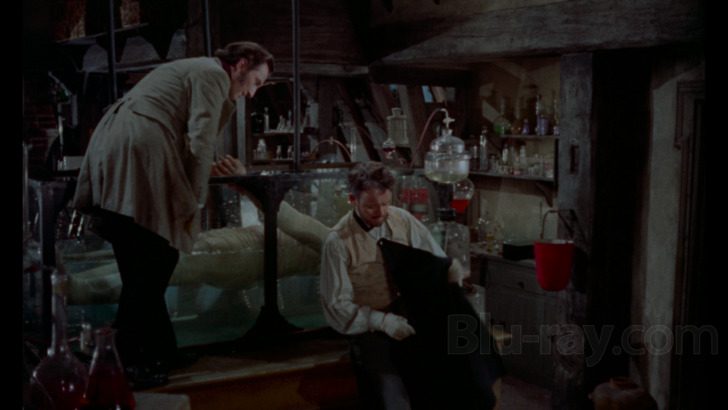
The Curse of Frankenstein was a watershed moment in horror. Its success not only catapulted Hammer Studios into the consciousness of
filmgoers on both sides of the Atlantic, but it also paved the way for the horror films that were to follow in the 60s, 70s, and beyond. Lee and Cushing
would find themselves paired in many subsequent Hammer films, though this one is unique, capturing the pair at the moment before they would vault
into the upper echelon of horror stardom. Many of the qualities that made Hammer's films distinctive and memorable are found here; the canny mix of
sexuality and the supernatural, liberal doses of violence mixed with boundary-pushing gore, incredible levels of talent behind the camera, and, of
course, exemplary production values. The film looks and sounds better here than it ever has before, and the amount of attention, craftsmanship, care,
and the incredible volume of on-disc and printed supplemental material not only make Hammer's The Curse of Frankenstein 4K: Limited Collector's
Edition an easy contender for the best release of the year, it also earns the release my highest possible recommendation.