The Craving Blu-ray Movie
HomeThe Craving Blu-ray Movie 
Undercrank Productions | 1918 | 52 min | Not rated | Jul 30, 2024
Price
List price:Amazon: $13.23 (Save 40%)
Third party: $13.23 (Save 40%)
Only 11 left in stock (more on the way).

Movie rating
Movie has not been rated yetBlu-ray rating
| Users |  | 0.0 |
| Reviewer |  | 3.5 |
| Overall | | 3.5 |
Overview
The Craving (1918)
Starring: Francis Ford, Duke WorneDirector: Francis Ford, John Ford
Specifications
Video
Video codec: MPEG-4 AVC
Video resolution: 1080p
Aspect ratio: 1.32:1
Original aspect ratio: 1.33:1
Audio
Music: Dolby Digital 2.0
Subtitles
None
Discs
Blu-ray Disc
Single disc (1 BD)
Playback
Region A (B, C untested)
Review
Rating summary
| Movie | | 3.5 |
| Video | | 3.5 |
| Audio |  | 3.0 |
| Extras | | 3.5 |
| Overall | | 3.5 |
The Craving Blu-ray Movie Review
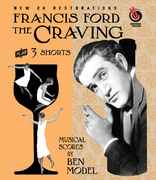
Reviewed by Jeffrey Kauffman July 29, 2024If some younger readers in particular look at the cover of this release and think to themselves, "Hey, where's the Coppola in that name?", it may be one sign that rather strangely the vagaries of fate, fame and/or fortune have somewhat buried a man who was one of the silent era's most protean creators (both in front of and behind the camera), but who later found himself subsumed by the outsized reputation of his little brother. As a brief but interesting biographical overview on this disc gets into, John Ford in fact owed his entire film career to his older brother Francis, since Francis had already made a name for himself in both the nascent East Coast and West Coast film industries, and it was his invitation to his younger sibling that brought John (then still known as Jack Feeney) out to La La Land to pursue his own dreams. If John Ford is by far the better remembered family member these days, Francis was inarguably the bigger name for at least a decade or two from the teens and twenties of the 20th century. This disc aggregates a quartet of features (some officially "shorts") that Ford starred and directed in.
As this review is being written news feeds worldwide are filled with some pretty visceral umbrage reacting to certain "representations" offered in the Paris Olympics opening ceremony, but you know what got my goat? The absolute lack of any commentary whatsoever by NBC's "analysts" when the obvious allusions toward Georges Méliès appeared, and in that regard, there's some absolutely fascinating connective tissues uniting Francis Ford to the Méliès family, as is briefly discussed in the biographical supplement included on this disc. The Craving, the "main feature" offered here, is in its own way a "special effects spectacular" that according to a prefatory intertitle took Ford and his team considerable time to create. While woven into a somewhat tawdry tale, The Craving is rather prescient in its depiction of a man (Ford) struggling to overcome alcoholism, though the main thrust of the film touches on more "thriller" territory, since Ford's character is a scientist who has invented a new super explosive.
The Craving Blu-ray Movie, Video Quality
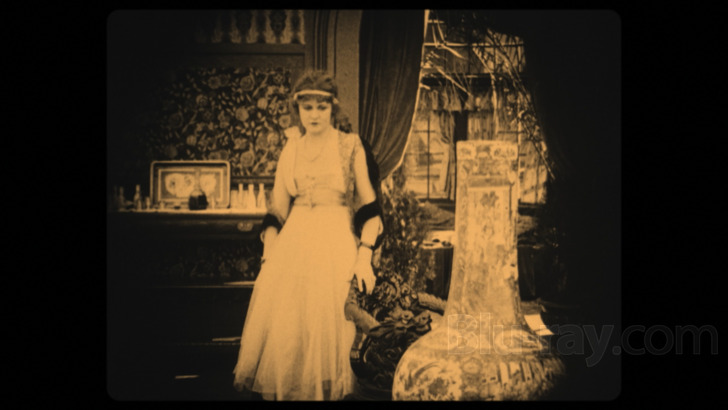
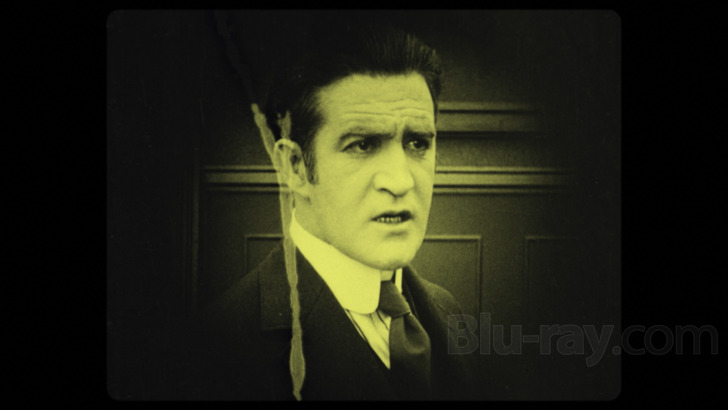
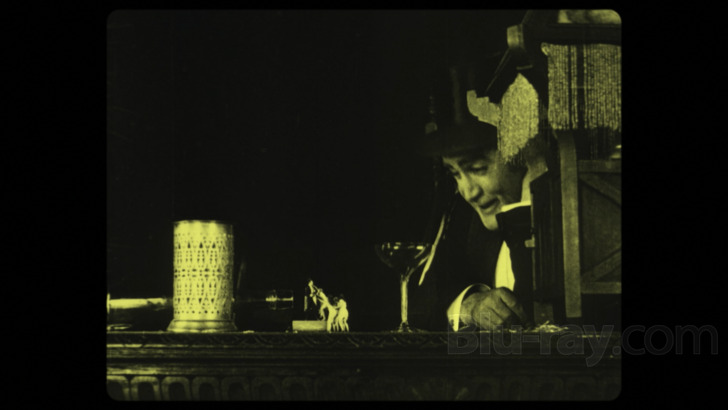
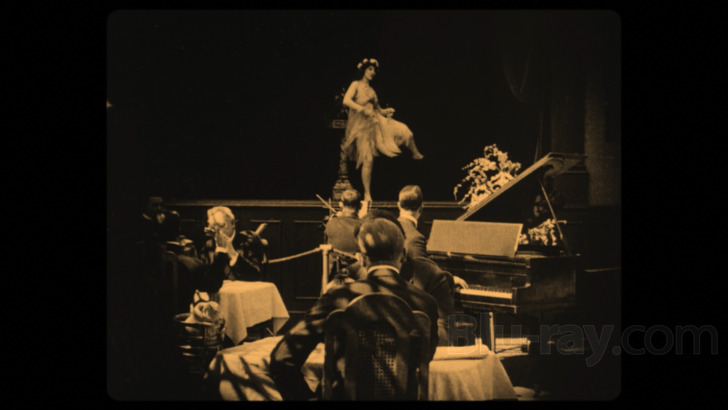
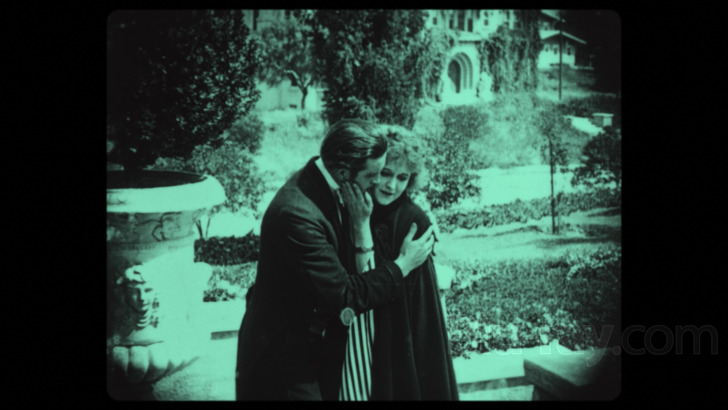
Note: Screenshots 1 through 5 are from The Craving. Screenshot 6 is from When the Tables Turned. Screenshot 7 is
from
The Post
Telegrapher. Screenshot 8 is from Unmasked. Screenshot 9 is from Screen Snapshots. Per Undercrank's standard release
regimen, this disc is a BD-R.
The Craving Plus 3 Shorts is presented on Blu-ray courtesy of Undercrank Productions. All of the films come with some technical
information offered during the closing credits, and The Craving offers the following:
The Craving was preserved by Eye Filmmuseum, the Netherlands, from a tinted nitrate print in the Ennik Collection. This digital restoration from Undercrank Productions derives from a 2K scan of Eye's 35mm preservation print. The intertitles from the Dutch copy were translated and recreated in the style of a Universal Bluebird release.Somewhat interestingly, at least for those who have experienced restorations of silent films in high definition, the unavoidable damage seen in this print is not typically in the form of a multitude of small scratches and the like, but instead tends to be either rather large if thankfully momentary actual rips and/or emulsion damage (see screenshot 1), as well as noticeable warping and general frame instability. Tinting is quite nice looking, including some relatively unusual green tones. Close-ups offer the best detail levels.
The shorts understandably have variant quality levels, both when compared to each other but even inherently, due to the shape of various elements. Information on the transfers is as follows:
When the Tables Turned was digitally restored at 2K resolution by the USC SCA HMH Foundation Moving Image Archive from two nearly identical incomplete 35mm prints, one in the Christopher Bird Collection at USC and the other from the Library of Congress. A new main title was created for identification purposes only.
The Post Telegrapher was digitally restored by Undercrank Productions at 2K resolution from two incomplete 35mm nitrate prints at the Library of Congress, one in English and one in Dutch. The Dutch print, originally in the Desmet Collection of Eye Filmmuseum, the Netherlands, was repatriated to the US in the 1970s. The Dutch intertitles were translated and recreated in the style of an original Bison release.
Unmasked: This film was digitally restored at 2K resolution from a 35mm print preserved by the George Eastman Museum.
Screen Snapshots: 2K scan of archival 16mm material made by the lab of the Library of Congress.
The Craving Blu-ray Movie, Audio Quality
Undercrank Productions is the handiwork of Ben Model, who once again also provides some charming music scores for these silents, all offered in Dolby Digital 2.0, which may disappoint audiophiles who want their Blu-ray discs to come with lossless audio. That said, these piano based scores are not especially "epic" in an orchestral sense, and so a lossy stereo accounting of them may well suffice. Fidelity is fine throughout, with absolutely no tinny sound on the high end, and with some decently full bodied midrange.
The Craving Blu-ray Movie, Special Features and Extras
Note: I'm defaulting to counting the shorts and biographical featurette as the supplements. Your mileage may vary.
- Francis Ford (HD: 8:29) is a short but informational overview of Ford's life and career, with an emphasis on the silent era.
- When the Tables Turned (HD; 11:35) is a surviving fragment of a Ford directed silent that involves mistaken identity in the wild (?) west.
- The Post Telegrapher (HD; 24:40) comes with one of those "product of its time" content warnings, and is an "epic" basically pitting the stalwart United States cavalry against "Indians", who are in fact called "redskins" in the intertitles, which may account for the warning.
- Unmasked (HD; 12:24) is a caper film starring Ford and frequent collaborator Grace Cunard.
- Screen Snapshots (HD; 3:00)
The Craving Blu-ray Movie, Overall Score and Recommendation
John Ford may well be the better remembered of the Ford (Feeney) brothers, but a cursory glance at Francis Ford's credits prove quite easily that he had by far the longer career, one which spanned from the very early silent era to the early fifties, shortly before his demise. This is a really interesting collection of some of Ford's work both in front of and behind the camera. Video technical merits are variable, as they often tend to be with these older silents, but on the whole offer remarkably intact viewing experiences. Recommended.
Similar titles
Similar titles you might also like
(Still not reliable for this title)

MXC: Most Extreme Elimination Challenge - Set 1
SD on Blu-ray
2003-2005

Dangerous to Know
1938

A Child Is Waiting
1963

The Trap
1922

Go West Young Man
1936

Nickelodeon
1976

King of Chinatown
1939

One, Two, Three
1961

October Baby
2011

Two Weeks in Another Town
2 Weeks in Another Town
1962

Sparrows
1926

One Night with the King
2006

Soundies: The Ultimate Collection
1940

Hail Caesar
MVD Rewind Collection
1994

Underground
1928

Sunflower
I girasoli
1970

The Hoodlum
1919

Monkey Business
1931

The Cocoanuts
1929

You Never Know Women
1926