The Complete Jean Vigo Blu-ray Movie
HomeThe Complete Jean Vigo Blu-ray Movie 
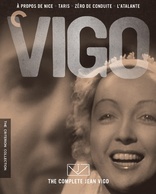
À propos de Nice / Taris / Zero de conduite / L'AtalanteCriterion | 1930-1934 | 4 Movies | 166 min | Not rated | Aug 30, 2011

Movie rating
Movie has not been rated yetBlu-ray rating
| Users |  | 5.0 |
| Reviewer | | 5.0 |
| Overall | | 5.0 |
Overview
The Complete Jean Vigo (1930-1934)
See individual titles for their synopses.
| Drama | 100% |
| Foreign | 94% |
| Romance | 28% |
| Documentary | 13% |
| Short | 12% |
Specifications
Video
Video codec: MPEG-4 AVC
Video resolution: 1080p
Aspect ratio: 1.2:1, 1.33:1
Original aspect ratio: 1.2:1, 1.33:1
Audio
See individual releases
Subtitles
English
Discs
50GB Blu-ray Disc
Single disc (1 BD)
Playback
Region A (locked)
Review
Rating summary
| Movie | | 5.0 |
| Video |  | 4.5 |
| Audio | | 4.5 |
| Extras | | 5.0 |
| Overall | | 5.0 |
The Complete Jean Vigo Blu-ray Movie Review
Reviewed by Dr. Svet Atanasov September 10, 2011The Complete Jean Vigo Collection, which includes the short films "À propos de Nice" (1930), "Taris" (1931), "Zero de conduite" (1933), and the legendary "L'Atalante" (1934), arrives on Blu-ray courtesy of Criterion. The supplemental feature on the disc include a video interview with acclaimed Georgian director Otar Iosseliani; video interview with nouvelle vague directors Francois Truffaut and Eric Rohmer; episode of the French television program Cineastes de notre temps; animated tribute to Jean Vigo by filmmaker Michel Gondry; and an exclusive new audio commentary by author Michael Temple. The Blu-ray disc also arrives with 44-page illustrated booklet featuring essays by film writers Michael Almereyda, Robert Polito, B. Kite, and Luc Sante. In French, with optional English subtitles for all four films included in the collection. Region-A "locked".
She's gone
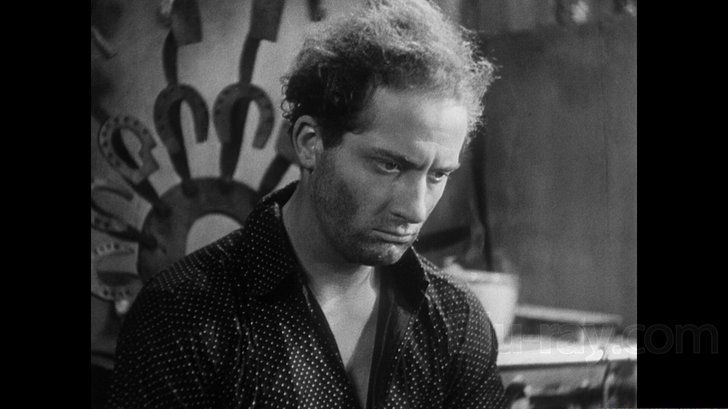
Jean Vigo’s L’Atalante, one of the greatest films ever made, is about two people madly in love with each other who realize that to stay in love they must learn to compromise.
The film opens up with Jean (Jean Dasté, Grand Illusion, The Wild Child) and Juliette’s (Dita Parlo, The Woman of Monte Carlo, Ultimatum) wedding, which is a strange one as there are no festivities to mark the happy event. Jean quickly takes Juliette to his river barge, L'Atalante, where he attempts to make love to her but fails after a few kitties decide to welcome his wife. Soon after, Juliette is also officially welcomed by Jules (Michel Simon, Boudu Saved From Drowning, Port of Shadows), Jean’s noisy right-hand man, and his younger apprentice.
At first excited to be on L'Atalante, Juliette slowly becomes bored and then frustrated with her new life. She begins fantasizing about visiting Paris and its luxury boutiques, but Jean shows little interest in making her dream come true. Sensing that things are heading in the wrong direction, Jules attempts to help but quickly fails and further complicates the situation.
Eventually, L'Atalante reaches the Paris canals. However, on the night when Jean finally agrees to take Juliette dancing and then show her the city, Jules decides to get drunk and see a fortune-teller -- this means that Jean has to stay on L'atalante. Convinced that this is an opportunity that should not be missed, Juliette decides to see Paris alone.
What makes Vigo’s L'Atalante such an intriguing and special film is the fact that it simply does not fit any of the profiles which one would typically use to categorize French films made between 1920-1940. Technically, L'Atalante has plenty in common with many of the classic silent French films and even classic silent Russian films - especially as far as camera movement is concerned, which should not be surprising as the film’s cinematographer was Russian-born Boris Kaufman, the youngest brother of famous Russian director Dziga Vertov – but aesthetically the film has more in common with the works of the Italian neorealists, and particularly the films of Roberto Rosellini.
Portions of L’Atalante feel as if they were taken from a post-war documentary - they look raw and gritty, devoid of glamour and finesse. The rest of the film, however, is infused with the type of poetic beauty that will later on become one of the most distinctive qualities in the works of the French nouvelle vague directors (Jean-Luc Godard, François Truffaut).
Unlike his contemporaries, Vigo loved experimenting. Unsurprisingly, entire sequences in L'Atalante are fully improvised and left unedited. A lot of the sound is also not post-synchronized, thus adding a great deal to the film’s intended rawness.
This unique blending of realism and rawness with poetic beauty and occasionally bold eroticism, however, created mass confusion amongst those who first saw L'Atalante, including its own producers. As a result, after Vigo’s tragic death at age 29, the film underwent numerous edits. The original 1934 Chavance first version of L'Atalante was also lost - until Gaumont located a nitrate version with the original title at the British Film Institute’s National Film Archives in 1989.
Note: Criterion’s Blu-ray contains the 89-minute version of L'Atalante. The high-definition transfer the disc uses was created from the 2001 Gaumont 35mm restoration negative.
The Complete Jean Vigo Blu-ray Movie, Video Quality

Presented in an aspect ratio of 1.33:1, encoded with MPEG-4 AVC and granted a 1080p transfer, Jean Vigo's L'Atalante arrives on Blu-
ray courtesy of Criterion.
The following description (addressing all four films in The Complete Jean Vigo Collection) is included in the booklet provided with this
Blu-ray disc:
"These new high-definition digital transfers were created on a Spirit Datacine form the following elements: A propos de Nice and
Taris are from 35mm fine-grain master positives; Zero de conduite from a 35mm fine-grain master positive and a 35mm
duplicate negative; and L'Atalante from the 2001 Gaumont 35mm restoration negative. Thousands of instances of dirt, debris,
scratches, splices, warps, jitter, flicker, and instability were manually removed from each film using MTI's DRS system and Pixel Farm's PFClean
system, while Digital Vision's DVNR system was used for small dirt, grain, and noise reduction.
Telecine supervisor: Lee Kline.
Telecine colorists: Abdel Benlatreche/Vdm, Paris; Lee Kline, Russell Smith; Giovanni Zimolo/Eclair, Paris."
L'Atalante's transition to Blu-ray is impressive. Though there are numerous inherited limitations - such as frame skips, image instability
around the edges, contrast and clarity fluctuations, damage marks and warps - the improvements are dramatic. Most close-ups look
substantially stronger (I no longer have the old R1 New Yorker DVD release in my library, but I do have Artificial Eye's R2 DVD release) and
clarity far more satisfying than I expected it to be. The most impressive improvements, however, are, in my opinion, in the area of color
reproduction - various color stabilizations have been performed and contrast levels rebalanced. Unsurprisingly, a lot of the darker footage
from inside the barge looks far more convincing. Because Gaumont's restoration was such a massive reconstruction job, film grain is often
underexposed/overexposed, but it is obvious that the fluctuations are inherited from the restoration negative. For the record, I did not notice
any traces of post-production heavy sharpening to report in this review. To sum it all up, this is very likely to be the definitive presentation of
L'Atalante for many years to come.
There are various inherited limitations with the other three films included in the collection as well. A propos de Nice is the healthiest of
the three, boasting very strong detail, pleasing clarity, and well balanced contrast levels. Zero de conduite looks good but not as
convincing as A propos de Nice. The most problematic of the three is Taris - there are various stability issues as well as damage
marks that could not be effectively addressed.
(Note: This is a Region-A "locked" Blu-ray disc. Therefore, you must have a native Region-A or Region-Free PS3 or SA in order to access
it content).
The Complete Jean Vigo Blu-ray Movie, Audio Quality
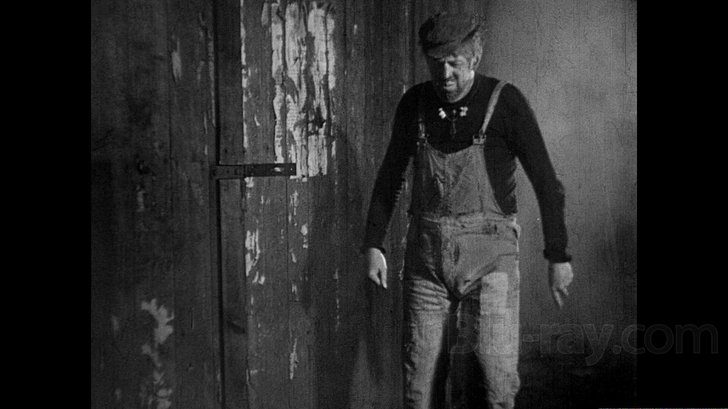
Each of the four films included in The Complete Jean Vigo Collection has received a French LPCM 1.0 track. For the record, Criterion have included
optional English subtitles where necessary.
The following text is included with the booklet provided with this Blu-ray disc:
"The monaural soundtracks were remastered at 24-bit from 35mm positive and negative optical soundtracks. Clicks, thumps, hiss, and hum were
manually removed using Pro Tools HD. Crackle was attenuated using AudioCube's integrated workstation.
The score for A propos de Nice was composed and performed by Marc Perrone in 2001. The sound engineer was Patrick Sigwalt."
The audio for each of the four films appears to have been optimized as best as possible. Obviously, each of the four French LPCM 1.0 tracks has
limited dynamic amplitude, but clarity and overall stability are indeed very pleasing. On L'Atalante some light hiss still remains and
occasionally pops up here and there, but I have to speculate that current presentation is the best possible, respecting the integrity of the
original audio and avoiding unnecessary enhancements. For the record, the English translation is very good.
The Complete Jean Vigo Blu-ray Movie, Special Features and Extras
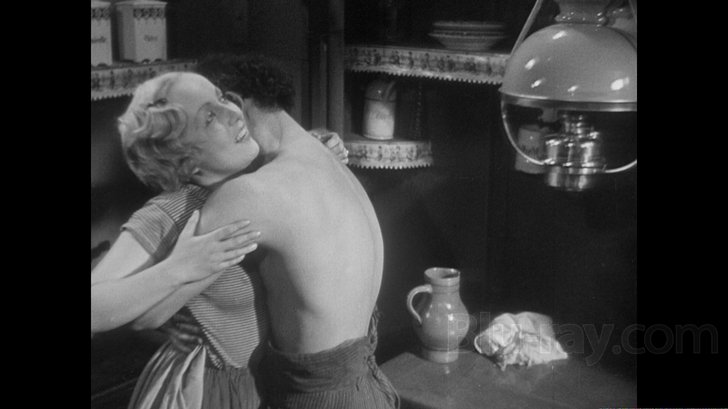
- A propos de Nice (1930) - Jean Vigo's first film is a short documentary about life in the beautiful city of Nice and its
residents. Music only, not subtitled. (24 min, 1080p).
-- Alternate Edit - a collection of sequences, which Jean Vigo intended for a longer version of A propos de Nice. Silent. (22 min, 1080i).
- Taris (1931) - a short film about Olympic swimmer Jean Taris, who demonstrates and discusses various swimming techniques. What is interesting here, however, are the various filming techniques on display (slow-motion filming, underwater filming, etc). In French, with optional English subtitles. (10 min, 1080p).
- Zero de conduite (1933) - based on Jean Vigo's own experiences, this enormously charming "anarchist" film follows four boys in a boarding school who decide to sabotage the system. In French, with optional English subtitles. (45 min, 1080p).
- Commentary - an audio commentary by Michael Temple, author of Jean Vigo. The commentary was recorded exclusively for Criterion in 2011. In English, not subtitled.
- Tribute - a short animated tribute to Jean Vigo by filmmaker Michel Gondry (The Science of Sleep). Music only. (1 min, 1080p).
- Cineastes de notre temps - an episode of the French television program Cineastes de notre temps, which focuses on Jean Vigo's career and legacy. Directed by Jacques Rozier, the episode first aired on October 15, 1964. In French, with optional English subtitles. (99 min, 1080i).
- Truffaut and Rohmer on L'Atalante - in this fascinating video interview, nouvelle vague directors Francois Truffaut and Eric Rohmer discuss Jean Vigo's legacy and L'atalante and its status as a timeless classic. In French, with optional English subtitles. (19 min, 1080i).
- Les voyages de "L'Atalante" - in this documentary, film historian and restorer Bernard Eisenschitz describes the path of L'Atalante over the years, from the savage cuts made to it in 1934 to the more complete version we have today. In French, with optional English subtitles. (40 min, 1080i).
- Otar Iosseliani on Vigo - acclaimed Georgian filmmaker Otar Iosseliani (Pastorali, Monday Morning) discusses Jean Vigo's work and the enormous influence L'Atalante had on him. In French, with optional English subtitles. (20 min, 1080i).
- Booklet - 44-page illustrated booklet featuring essays by film writers Michael Almereyda, Robert Polito, B. Kite, and Luc Sante.
The Complete Jean Vigo Blu-ray Movie, Overall Score and Recommendation
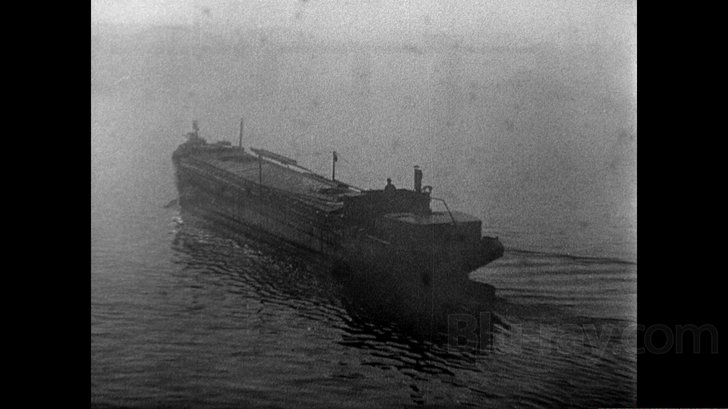
The famous film critic Roger Ebert once wrote that modern movies begin with Jean-Luc Godard's Breathless. I believe that modern movies
begin with Jean Vigo's brilliant L'Atalante. Without it countless great directors, including some of the nouvelle vague directors, would have
never felt inspired to shoot their films. L'Atalante changed everything. Criterion's The Complete Jean Vigo Collection is clearly one
of the year's most important releases. VERY HIGHLY RECOMMENDED.
Note: Julien Temple's Vigo-Passion for Life, currently available on DVD via UK distributors
Park Circus, is an excellent companion piece to Criterion's The Complete Jean Vigo Collection.