The Burmese Harp Blu-ray Movie
HomeThe Burmese Harp Blu-ray Movie 
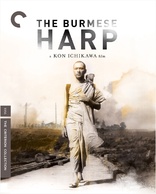
ビルマの竪琴 / Biruma no tategotoCriterion | 1956 | 116 min | Not rated | Aug 05, 2025

Movie rating
7.5 | / 10 |
Blu-ray rating
| Users |  | 0.0 |
| Reviewer |  | 4.0 |
| Overall | | 4.0 |
Overview
The Burmese Harp (1956)
At the close of World War II, a Japanese army regiment in Burma surrenders to the British. Private Mizushima is sent on a lone mission to persuade a trapped Japanese battalion to surrender also. When the outcome is a failure, he disguises himself in the robes of a Buddhist monk in hope of temporary anonymity as he journeys across the landscape – but he underestimates the power of his assumed role.
Starring: Rentarô Mikuni, Shôji Yasui, Jun Hamamura, Taketoshi Naitô, Shunji KasugaDirector: Kon Ichikawa
| Foreign | Uncertain |
| Drama | Uncertain |
| War | Uncertain |
Specifications
Video
Video codec: MPEG-4 AVC
Video resolution: 1080p
Aspect ratio: 1.37:1
Original aspect ratio: 1.37:1
Audio
Japanese: LPCM Mono (48kHz, 24-bit)
Subtitles
English
Discs
Blu-ray Disc
Single disc (1 BD)
Playback
Region A (locked)
Review
Rating summary
| Movie |  | 4.5 |
| Video | | 4.5 |
| Audio | | 4.0 |
| Extras |  | 3.0 |
| Overall | | 4.0 |
The Burmese Harp Blu-ray Movie Review
Reviewed by Dr. Svet Atanasov August 18, 2025Kon Ichikawa's "The Burmese Harp" (1956) arrives on Blu-ray courtesy of Criterion. The supplemental features on the release include archival program with Kon Ichikawa; archival program with actor Rentaro Mikuni; and theatrical trailer. In Japanese, with optional English subtitles for the main feature. Region-A "locked".
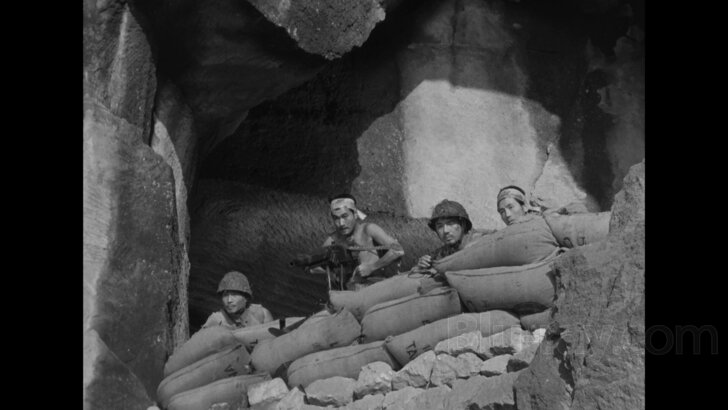
The last stronghold
Note: The text below was first used in our review of British label Eureka Entertainment's release of The Burmese Harp in 2010.
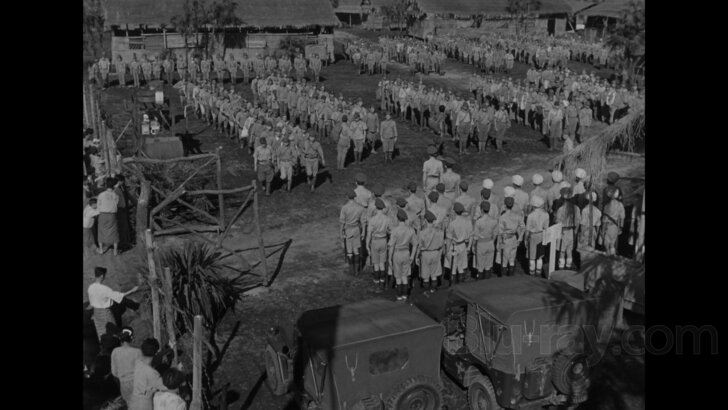
The final days of World War II. A Japanese regiment is sent on a mission in Burma. While moving through the jungle, the invaders begin singing. Occasionally, corporal Mizushima (Shoji Yasui, Kokoro) also plays his handmade harp.
In a secluded village, where they have tried to regain their strength, the invaders are surrounded by British soldiers who have heard them singing from afar. However, moments before the two sides clash, it becomes clear that Japan has surrendered unconditionally to the Allies, effectively ending World War II.
At a prison camp, while the invaders await repatriation, Mizushima is summoned and ordered to persuade another Japanese regiment barricaded at the top of a nearby mountain to surrender. When he fails, the British soldiers launch a massive attack on the stronghold, and Mizushima's comrades assume that he has perished in the ensuing massacre.
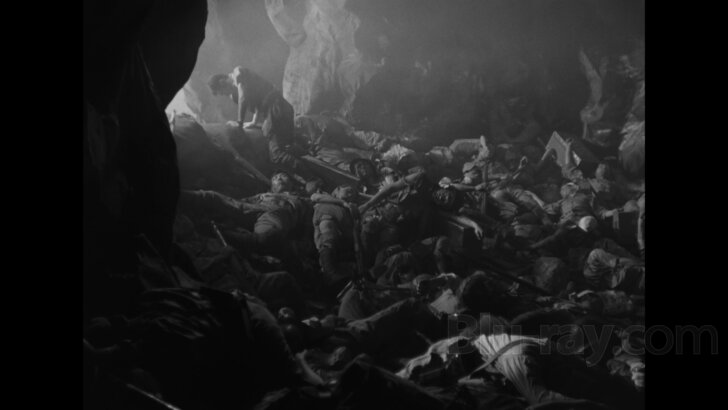
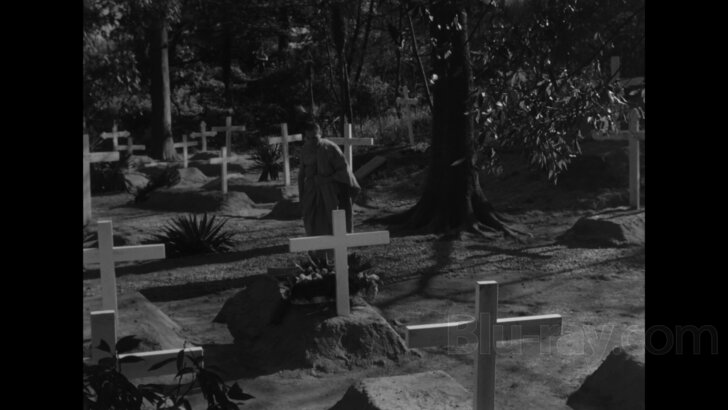
But somehow, despite being badly injured, Mizushima survives, and a Buddhist priest helps him get back on his feet. On the way back to the prison camp, overwhelmed by the human carnage, Mizushima decides to stay in Burma and help the souls of the dead find peace.
Based on Michio Takeyama’s famous novel, The Burmese Harp was Japanese director Kon Ichikawa’s breakthrough film. In 1956, a couple of months after it premiered in Japanese cinemas and became an instant hit, The Burmese Harp was screened at the Venice Film Festival, where it was nominated for the prestigious Golden Lion award. Later the same year, The Burmese Harp also earned an Oscar nomination for Best Foreign Language Film.
The message of The Burmese Harp is simple -- in war, there are no victors, only suffering and death. Mizushima’s journey through Burma is an effective examination of man’s fascination with violence and death, which often fuels wars.
Despite an abundance of material that could have produced plenty of powerful political statements, The Burmese Harp remains a notably subdued film. Mizushima's profound transformation is not idealized either. He is simply one of many men who inevitably realize that war is hell on earth.
The narrative has a very loose episodic structure. A few key events are seen through Mizushima's eyes, and then as witnessed by his comrades, and occasional flashbacks are inserted among them. However, these events are not introduced in chronological order.
In an exclusive introduction included on this release, Asian cinema expert Tony Rayns notes that Ichikawa initially intended to shoot The Burmese Harp in color. However, because of various technical limitations, a decision was made to shoot it in black and white. In 1985, Ichikawa remade The Burmese Harp in color with an entirely different cast.
*In 1956, The Burmese Harp won the San Giorgio Prize and OCIC Award, Honorable Mention at the Venice Film Festival. During the same year, the film also won the Best Film Score Award (Akira Ifukube) at the Mainichi Film Concours.
The Burmese Harp Blu-ray Movie, Video Quality
Presented in its original aspect ratio of 1.37:1, encoded with MPEG-4 AVC and granted a 1080p transfer, The Burmese Harp arrives on Blu-ray courtesy of Criterion.
The following text appears inside the leaflet provided with this release:
"Undertaken by Nikkatsu Corporation and the Japan Foundation, this new 4K restoration was created from two 35mm master positives. The original monaural soundtrack was remastered from an optical soundtrack print.
Mastering supervisors: KON Pro Inc., Chizuko Osada.
Image restoration: Imagica Entertainment Media Services, Inc."
The new 4K restoration of The Burmese Harp is also made available on 4K Blu-ray in this combo pack release. I viewed it in native 4K and later did comparisons with its 1080p presentation on this Blu-ray release and this Region-B Blu-ray release, produced by Eureka Entertainment in 2010.
The 4K restoration offers a meaningful upgrade in quality. However, it has some inconsistencies that can be traced back to source limitations. Also, the new 4K restoration rebalances the gamma levels, and while this is certainly a positive development, I think that some careful adjustments should have been made to avoid light crushing in darker areas. On my system, I could identify various areas where the previous presentation of The Burmese Harp reveals slightly more detail. On the other hand, the new 4K restoration produces many superior close-ups and wider panoramic shots, so if viewed on a very large screen, it is unquestionably the better option. There are no traces of problematic digital corrections. Image stability is very good. My score is 4.25/5.00. (Note: This is a Region-A "locked" Blu-ray release. Therefore, you must have a native Region-A or Region-Free player in order to access its content).
The Burmese Harp Blu-ray Movie, Audio Quality
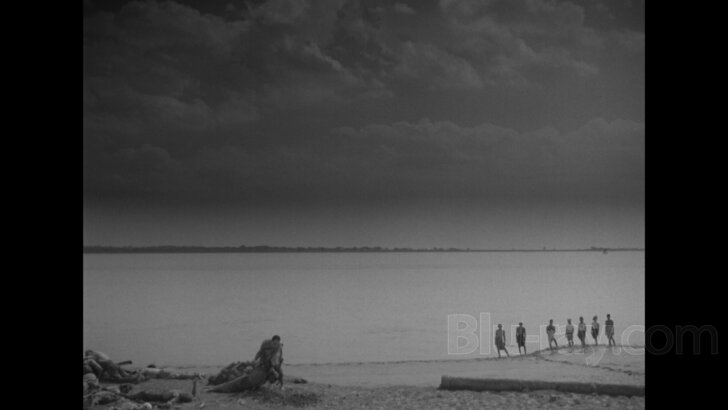
There is only one standard audio track on this release: Japanese LPCM 1.0. Optional English subtitles are provided for the main feature.
I viewed the 4K restoration in native 4K and later spent time with its 1080p presentation on this Blu-ray release. The comments below are from our review of the 4K Blu-ray/Blu-ray combo pack release.
The lossless track on this release seems to be the most nicely rounded. However, there are many areas where the limitations of the original soundtrack create small fluctuations. If you turn up the volume more than you typically do, you will notice that the upper register is now very solid and clean, too. Dynamic contrasts are very, very modest.
The Burmese Harp Blu-ray Movie, Special Features and Extras
- Kon Ichikawa - in this archival program, Kon Ichikawa discusses the production history of The Burmese Harp. The program was produced for Criterion in 2005. In Japanese, with English subtitles. (17 min).
- Rentaro Mikuni - in this archival program, actor Rentaro Mikuni recalls his work with Kon Ichikawa on The Burmese Harp and comments on some of the key themes in the film. The program was produced for Criterion in 2006. In Japanese, with English subtitles. (12 min).
- Trailer - presented here is a trailer for the recent 4K restoration of The Burmese Harp. In Japanese, with English subtitles. (4 min).
- Leaflet - an illustrated leaflet featuring Tony Rayns' essay "Unknown Soldiers", as well as technical credits.
The Burmese Harp Blu-ray Movie, Overall Score and Recommendation
Kon Ichikawa's The Burmese Harp delivers a timeless message about the pointlessness of war. While its style and tone are drastically different, I think that it is one of the closest relatives of Cornel Wilde's masterpiece Beach Red. So, if you choose to acquire one of these films for your library, consider creating a spot for the other as well. Criterion's Blu-ray introduces a very good new 4K restoration of The Burmese Harp. A 4K Blu-ray/Blu-ray combo pack release is available for purchase as well. VERY HIGHLY RECOMMENDED.
Similar titles
Similar titles you might also like
(Still not reliable for this title)

La Grande Illusion
Grand Illusion
1937

The Painted Bird
Nabarvené ptáce / Slipcover in Original Pressing
2019

Fires on the Plain 4K
野火 / Nobi
1959

City of Life and Death
南京!南京! / Nanjing! Nanjing!
2009

Lebanon
2009

Stalingrad
1993

Forbidden Games
Jeux interdits
1952

Ashes and Diamonds
Popiól i diament
1958

Germany Year Zero
Germania anno zero
1948

The Bridge
Die Brücke
1959

Ivan's Childhood
Ива́ново де́тство / Ivanovo detstvo
1962

The Front Line
고지전 / Go-ji-jeon
2011

Come and See
Иди и смотри / Idi i smotri
1985

Faithful Heart
Coeur Fidèle
1923

The Human Condition III: A Soldier's Prayer
人間の條件 / Ningen no jôken / Parts 5 and 6
1961

The Human Condition I: No Greater Love
人間の條件 / Ningen no jôken / Parts 1 and 2
1959

The Cranes Are Flying
Летят журавли / Letyat zhuravli
1957

Cemetery of Splendor
2015

Hiroshima
ひろしま / Arrow Academy
1953

The Image Book
Le livre d'image
2018