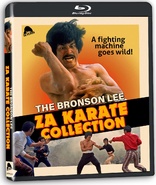
The Bronson Lee Za Karate Collection Blu-ray Movie
HomeThe Bronson Lee Za Karate Collection Blu-ray Movie 
Standard EditionSeverin Films | 1974-1975 | 3 Movies, 4 Cuts | 258 min | Not rated | May 26, 2026

Movie rating
Movie has not been rated yetBlu-ray rating
| Users |  | 0.0 |
| Reviewer |  | 4.0 |
| Overall | | 4.0 |
Overview
The Bronson Lee Za Karate Collection (1974-1975)
See individual titles for their synopses.
| Foreign | 100% |
| Martial arts | 34% |
| Action | Insignificant |
Specifications
Video
Video codec: MPEG-4 AVC
Video resolution: 1080p
Aspect ratio: 2.39:1
Original aspect ratio: 2.39:1
Audio
Japanese: DTS-HD Master Audio 2.0 Mono
English: DTS-HD Master Audio 2.0 Mono
Subtitles
English, English SDH
Discs
Blu-ray Disc
Two-disc set (2 BDs)
Playback
Region A (locked)
Review
Rating summary
| Movie |  | 3.5 |
| Video |  | 4.5 |
| Audio |  | 5.0 |
| Extras | | 5.0 |
| Overall | | 4.0 |
The Bronson Lee Za Karate Collection Blu-ray Movie Review
Reviewed by Dr. Svet Atanasov July 14, 2026"The Bronson Lee Za Karate Collection" (1974-1075) arrives on Blu-ray courtesy of Severin Films. The supplemental features on the release include new audio commentaries with star Tadashi Yamashita and actor/director/Bruceploitation expert Michael Worth; new program with co-star Donnie Williams; vintage promotional materials for the three films; and more. In Japanese, with optional English subtitles. Region-A "locked".
The Bruceploitation films exist for the same reason the Eurospy films do. They did their best to capitalize on the enormous international success of the classic Bruce Lee films, just as the Eurospy films attempted to do the same after James Bond became an international sensation. However, there are a couple of crucial differences between the Bruceploitation and Eurospy films.
Not all Bruceploitation films were shot or dubbed in English. For this reason, quite a few of them reached big international markets some years after premiering overseas. In America, for instance, many Bruceploitation films began appearing in the late 1980s, almost exclusively on VHS, and not always through legitimate distributors. Additionally, the Bruceploitation films did not feature internationally recognizable actors and were not made by internationally recognizable directors. Unsurprisingly, they were most popular in the countries where their stars originated from. (Taiwan, Hong Kong, Japan, and China). Lastly, even the most ambitious Bruceploitation films remained notably small films.
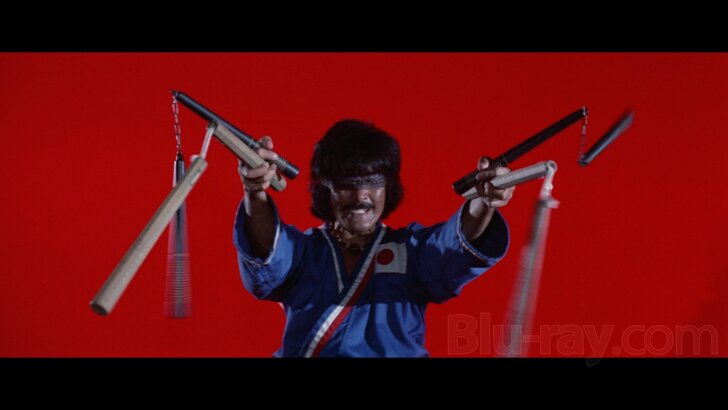
The Bronson Lee Za Karate Collection gathers three films starring Tadashi Yamashita, a Japanese Bruceploitation clone with rather impressive martial arts skills. The three films are: Bronson Lee: Champion a.k.a. The Karate (1974), The Karate 2 (1974), and The Karate 3: Flash of Lighting (1975). Of the three, only the first was officially dubbed in English. The other two were made and presented with Japanese audio.
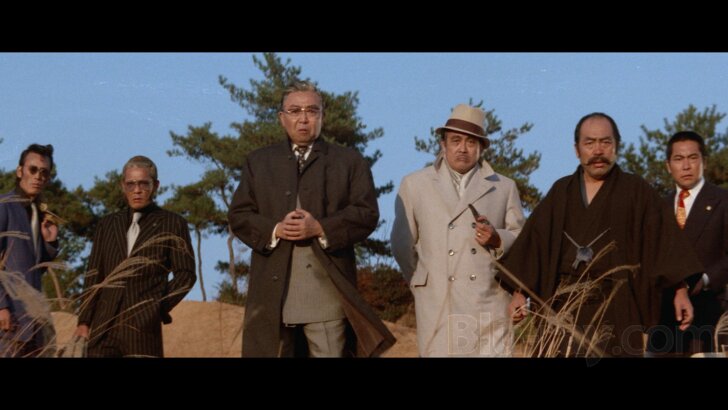
In the first film, Yamashita emerges in a small town somewhere in Ohio, where he has been raised by his elderly American grandmother. After learning about an upcoming tournament in Japan set to produce the first international karate champion, Yamashita packs his bags and arrives in the ancient Japanese capital of Kyoto, determined to win the grand prize, $50,000, which can permanently alter his family’s fortune. However, while trying to figure out the best way to enter the tournament, Yamashita is drawn into a dangerous rivalry between local crime bosses aiming to take control of the new karate association. After he is allowed to represent Japan, Yamashita then faces several international fighters, including Singapore’s brutal champion Nicom Prancha. Somewhere along the way, during a cowardly attack, Yamashita runs out of luck and gets blinded.
In the second film, Yamashita, now officially recognized as the first international karate champion, becomes a target for several new challengers from across the world. While still unable to see, Yamashita easily neutralizes his attackers. However, he is once again drawn into a dangerous rivalry after his master, Masafumi Suzuki, has the priceless Orikirimaru Sword stolen from him, and a local criminal boss with delusions of grandeur sets in motion a complex plan to eliminate both.
In the final film, Yamashita regains sight and begins making ends meet as a truck driver, determined to save enough and purchase his own dojo. However, when the leaders of several corrupt local schools organize to prevent an elderly Chinese master from becoming the leader of the Japanese karate association, Yamashita steps up to help him and his daughter, with whom he has fallen in love, stay alive.
Directed by Yukio Noda, the three films offer fireworks and cheese galore, most of which easily could have been extracted from bigger and better-known Japanese genre films, like the Wandering Ginza Butterfly films with Meiko Kaji released a couple of years earlier. They share a similar sense of humor as well.
The second film has the best fireworks. A young and very lean Bolo Yeung emerges as the lethal killer Dracula Jack. However, the third film has the most interesting story with the best secondary characters.
Severin Films’ two-disc set presents exclusive new 4K restorations of the three films, sourced from their original camera negatives. The first film can be seen in two versions: a fully uncut Japanese version and a slightly shorter U.S. version.
The Bronson Lee Za Karate Collection Blu-ray Movie, Video Quality
Presented in their original aspect ratios of 2.39:1, encoded with MPEG-4 AVC and granted 1080p transfer, the three films in The Bronson Lee Za Karate Collection arrive on Blu-ray courtesy of Severin Films.
Severin Films' two-disc set presents exclusive new 4K restorations of the three films, sourced from their original camera negatives. The first film can be seen in two versions: a fully uncut Japanese version and a slightly shorter U.S. version.
Only one area of the presentation of these films could have been managed better. I noticed a few nicks and a couple of marks that should have been addressed with digital tools. Everything else is great. Each 4K restoration produces magnificent, very solid organic visuals that look gorgeous on a large screen. Each 4K restoration is wonderfully graded as well. In fact, I would say that these are some of the best recent 4K restorations of Japanese color films that I have seen. I especially liked how the third film looked because it has the most diverse material. There are no traces of any problematic digital corrections, such as sharpening, filtering, contrast boosting, etc. Image stability is outstanding. My score is 4.75/5.00. (Note: Both discs are Region-A "locked". Therefore, you must have a native Region-A or Region-Free player in order to access its content).
The Bronson Lee Za Karate Collection Blu-ray Movie, Audio Quality
Each film is presented with a Japanese DTS-HD Master Audio 2.0 track. The first film can also be seen with an English DTS-HD Master Audio 2.0 track. Optional English subtitles are provided for the Japanese tracks. Optional English SDH subtitles are provided for the English track. When turned on, they appear inside the image frame.
I viewed all films with the Japanese tracks. Each film is complemented by a trendy 1970s jazzy/funk score that creates plenty of excitement. However, there is action galore and a plenty of it is enhanced with a lot of interesting effects. Considering that all three tracks are Mono, I think it is fair to declare that they are quite impressive. The English translation is excellent.
The Bronson Lee Za Karate Collection Blu-ray Movie, Special Features and Extras
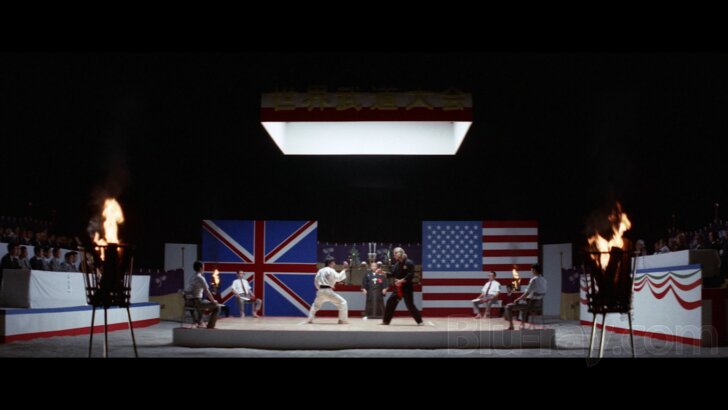
DISC ONE - BRONSON LEE CHAMPION A.K.A. THE KARATE
- Commentary One - this audio commentary, available only on the fully uncut Japanese version, was recorded by star Tadashi Yamashita, actor/director/Bruceploitation expert Michael Worth, and August Ragone, author of Eiji Tsuburaya: Master of Monsters. The commentary is one big trip down memory lane, providing plenty of information not only about the filming of The Karate, but the popularity of genre films during the 1970s. Also, the commentators share plenty of curious bits about various supporting actors, locations, and the action choreography in all three films that Yamashita made.
- Commentary Two - this partial audio commentary was recorded by critic Lovely Jon. It is available only on the U.S. version of the film.
- Bronson Lee, Thespian - in this new program, Tadashi Yamashita discusses his contribution to the three films in The Bronson Lee Za Karate Collection and Japanese martial arts cinema with critic Michael Worth. In English, not subtitled. (28 min).
- Promotional Materials -
1. Japanese Teaser
2. Japanese Trailer
3. U.S. Trailer
- Commentary - this audio commentary was recorded by star Tadashi Yamashita, actor/director/Bruceploitation expert Michael Worth and boxer/fighter A.J. 'The Rabbit' Richardi.
- Promotional Materials -
1. Japanese Teaser
2. Japanese Trailer
- Commentary One - this audio commentary was recorded by star Tadashi Yamashita, actor/director/Bruceploitation expert Michael Worth and fight choreographer John Kreng.
- Commentary Two - this scene specific audio commentary was recorded by co-star Donnie Williams and Michael Worth.
- The Donnie Williams Show - in this program, co-star Donnie Williams discusses his martial arts background and work on The Karate 3: Flash of Lightingwith Michael Worth. In English, not subtitled. (20 min).
- Trailer - presented here is an original Japanese trailer for The Karate 3: Flash of Lighting. In Japanese, with English subtitles. (3 min).
The Bronson Lee Za Karate Collection Blu-ray Movie, Overall Score and Recommendation
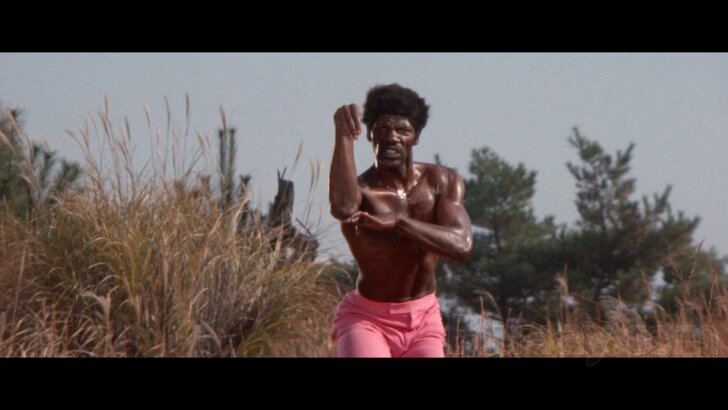
The three films in this two-disc set offer some very tasty Japanese cheese. I am tempted to declare that Tadashi Yamashita is one of the best Bruce Lee clones, but he proudly borrows Charles Bronson's mustache, too. Also, while in the company of various gangsters, Yamashita's sensei looked a lot like Santiago Segura's classic Spanish character Torrente. I had a great time with these films. All three are fully restored in 4K and look spectacular on Blu-ray. HIGHLY RECOMMENDED.