Tchaikovsky: Pique Dame Blu-ray Movie
HomeTchaikovsky: Pique Dame Blu-ray Movie 
Opus Arte | 2011 | 183 min | Rated G | Jul 26, 2011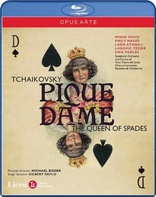
Price
List price:Listed on Amazon marketplace

Movie rating
6.7 | / 10 |
Blu-ray rating
| Users |  | 4.5 |
| Reviewer |  | 4.0 |
| Overall | | 4.0 |
Overview
Tchaikovsky: Pique Dame (2011)
Tchaikovsky's opera is based on a Pushkin novella and deals with a compulsive gambler who becomes haunted by the ghost of a Countess he has tricked into divulging a winning combination at cards.
Starring: Emily Magee, Lado Ataneli, Ludovic Tézier| Music | 100% |
Specifications
Video
Video codec: MPEG-4 AVC
Video resolution: 1080i
Aspect ratio: 1.78:1
Original aspect ratio: 1.78:1
Audio
Russian: DTS-HD Master Audio 5.1
Russian: LPCM 2.0
Subtitles
English, French, Spanish, German, Catalan
Discs
50GB Blu-ray Disc
Single disc (1 BD)
Playback
Region A (B, C untested)
Review
Rating summary
| Movie | | 4.0 |
| Video | | 4.0 |
| Audio | | 4.5 |
| Extras |  | 0.5 |
| Overall | | 4.0 |
Tchaikovsky: Pique Dame Blu-ray Movie Review
Ghost: The Opera.
Reviewed by Jeffrey Kauffman July 25, 2011Everyone probably has completely trivial memories seared into their synapses for no other reason than that they were so utterly, inescapably ridiculous. One of my favorite hilarious adolescent memories was catching a little bit of an old Pyramid game show (I think when it still had some sort of dollar figure prefixing its title) and the category had something to do with music. The answer “Tchaikovsky” came up and the contestant blurted out the timeless clue, “Not Beethoven, the other one,” at which point the celebrity player, as if on cue, stated firmly “Tchaikovsky!” Ding!—point earned. This struck me as so completely absurd that I dissolved into helpless giggles, and as I recall, I actually had to turn off the television because I was simply laughing too hard to even hear what was going on. The sheer lunacy of this clue and then a correct guess had me in such fits I could hardly breathe. If you had been presented with that incredible clue, would you have thought of Tchaikovsky? Bach, sure. Even Brahms. Heck, maybe even Karlheinz Stockhausen (I jest, of course). But Tchaikovsky? The mind boggles. “Not Beethoven, the other one” has become a mantra of sorts in my family life, a shorthand for the everyday absurdities which nevertheless seem to instantly make sense to others, as the phrase obviously did to the celebrity.
Now as odd as it may seem to anyone who has even a mere pittance of knowledge about classical composers, Tchaikovsky and Beethoven might in fact be linked for at least one reason other than being coupled together in one of the funniest game show moments ever (at least to some easily amused viewers): neither composer, as iconic as they both inarguably are, ever made much of an impact in the operatic world. Beethoven is certainly even less prolific than Tchaikovsky in this regard. At least Peter Ilyich managed to crank out two handfuls of operas over his brief lifetime, but only two of them are ever performed with much regularity, Eugene Onegin and The Queen of Spades (Pique Dame). One of the things that may strike armchair psychoanalysts as being at least a little strange about this dearth of output is that Tchaikovsky especially seems rather well suited temperamentally for the hyperbolic emotional content of opera. His life careened from tragedy to tragedy, his interpersonal relationships were frequently roiled with dissension and downright devolution, and there are many of course who still insist his death was self-inflicted. But Tchaikovsky seemed more well equipped to pour this inner torment into orchestral rather than vocal music, as if he needed an escape from rather than an adaptation (so to speak) of his personal problems.
It’s more than a little ironic that Tchaikovsky, who is of course best remembered today for his ballets and symphonies, drew fairly consistent critical brickbats with his offerings in those genres, while his largely forgotten operas often were the object of considerable critical rapture at the time of their premieres. Such was the case with Pique Dame, a piece which premiered in St. Petersburg in 1890. Adapted from a novella by Alexander Pushkin by Tchaikovsky’s brother and frequent collaborator, Modest, the opera is a typically Russian meditation on fate and the human condition, wrapped up in a rather interesting cloak of the supernatural and mysticism. Compulsive gambler Hermann (Misha Didyk) has heard of a legend involving a Countess (Ewa Podles) where the Countess’ mastery of three “magical” cards allowed her to win back a fortune she had lost. The legend states that when a third man asks her the secret of the cards, she will die. Hermann figures out that the Countess has been quizzed twice previously about this secret, and decides that he will be that third figure. He inveigles his way into the arms of the Countess’ granddaughter Lisa (Emily Magee) and is thus able to worm his way into the Countess’ chamber, where he does indeed extract the secret, leading to the Countess’ demise. A series of tragedies ensues, capped by a kind of “be careful what you ask for” comeuppance that is perfectly Russian in its rather dour assessment of Man’s incipient tendency toward mendacity and evil.
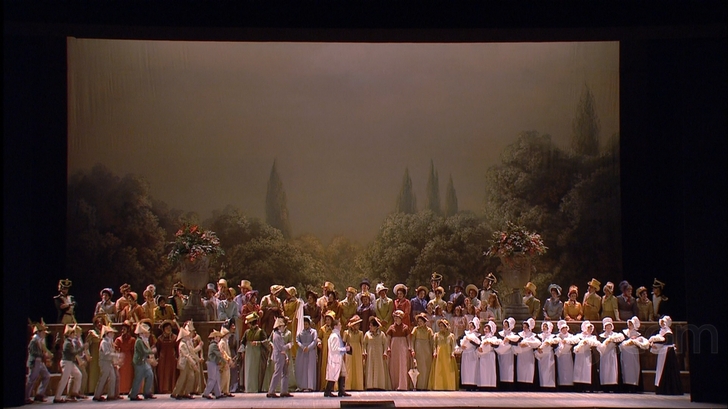
This opulent production from Barcelona’s Liceu Opera House is largely a successful outing, with an excellent international cast featuring an especially resplendent Ludovic Tézier as Prince Yeletsky and the iconic Ewa Podles doing a sort of operatic Maggie Smith as the Countess. Didyk is also in very fine vocal form throughout the evening. While this is a huge production by any standard, director Gilbert Deflo often seems to be a member of the “stand in a line” school with his larger ensemble moments, leading to a certain static quality in several of the grander scenes (the opening park sequence is an excellent example). But the sets and costumes aptly recreate the era of Catherine the Great and elevate the overall visual appeal of the opera immensely.
Michael Boder leads the Orchestra and Chorus of the Gran Teatre del Liceu (along with the Chorus Intermezzo Escolania de Montserrat) in an appealing reading of the score, one which emphasizes its lyrical qualities over its occasional bombast. This is really a rather gorgeously wrought score, and some who haven’t previously heard it may in fact like it better than Tchaikovsky’s “other” (there’s that word again) big operatic success, Eugene Onegin. (In the irrelevant but kind of amusing category, take a gander at the wild vest the bassoon player is wearing).
Pique Dame is a rather odd but extremely entertaining combination of old time ghost story with a more modern, sociological, even psychological, edge to it. Hermann’s slow mental deterioration due to a virtually obsessive-compulsive gambling issue is the prime dramatic narrative at play, but Modest Tchaikovsky’s libretto wisely opens up the subtext so that the opera almost becomes a commentary on Man’s seemingly inerrant ability to shoot himself in the foot. Hermann may be haunted by the ghost of the Countess but it's his own desperate spirit which provides Pique Dame with its motivating force, and this very capable, if somewhat staid, presentation keeps that idea front and center.
Tchaikovsky: Pique Dame Blu-ray Movie, Video Quality
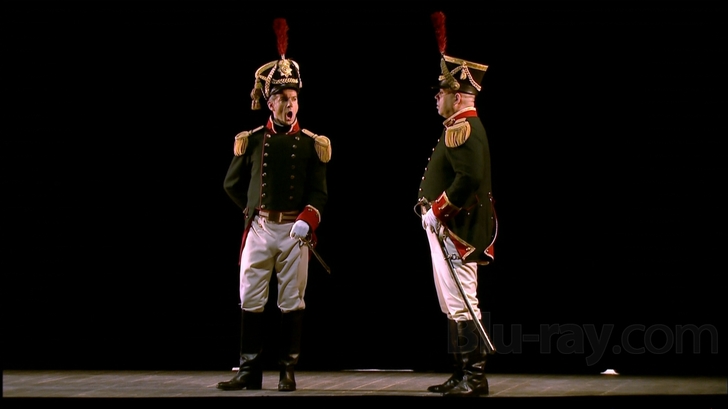
Pique Dame is presented on Blu-ray courtesy of Opus Arte, with an AVC encoded 1080i transfer in 1.78:1. This is a visual presentation which seems to depend largely on what camera and/or angle is being used in terms of how sharp the image is. Generally the wide shots which take in the entire proscenium suffer from overall softness and a somewhat blurred, fuzzy image. On the other hand, the many shots featuring close-ups or even midrange coverage exhibit really excellent sharpness and clarity, and it's in these shots where the truly gorgeous costumes and sets are most resplendent, with really nicely saturated color and a generally clean, artifact free presentation. Black levels are really excellent throughout this piece, and that's important because director Deflo plays with various apertures created by drawing the curtains to different openings, almost as if a film featured several aspect ratios, and despite this approach, there's little if any crush evident even as the background black areas vary widely in size and scope.
Tchaikovsky: Pique Dame Blu-ray Movie, Audio Quality
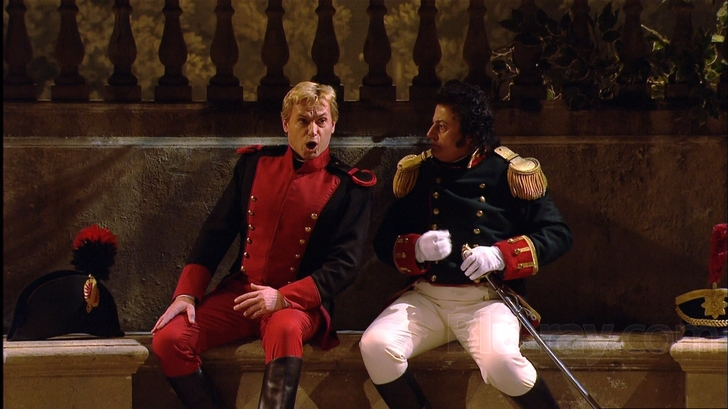
Pique Dame features two excellent lossless audio options, a DTS-HD Master Audio 5.1 surround mix and an LPCM 2.0 stereo fold down. The DTS-HD Master Audio 5.1 mix is very nicely balanced between the excellent orchestral forces and the often exceptional principal cast and ensemble. Winds and reeds sound especially nice throughout this mix, including some wonderful work by the clarinetist. All of the vocalists sound at least very good, and in the case of Didyk and Tézier, a good deal better than that. Dynamic range is very impressive throughout the track, as Tchaikovsky provides huge changes in dynamics at the drop of a hat throughout the score. Fidelity is also very strong, and the surround mix provides a very appealing hall ambience. There are some occasional actual performance synching issues, where the ensemble especially tends not to jibe exceptionally well with the orchestral accompaniment, but these are relatively minor passing issues that ultimately don't detract from the overall sonic impact of the score and track.
Tchaikovsky: Pique Dame Blu-ray Movie, Special Features and Extras
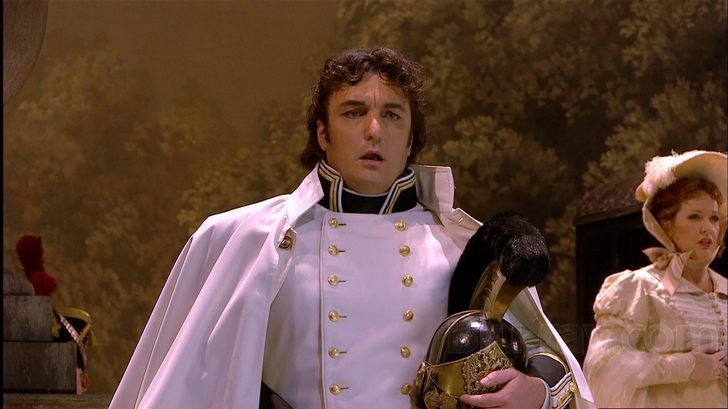
Only a Cast Gallery (1080i; 1:05) is included on the disc. The insert booklet includes the requisite brief essay and plot synopsis.
Tchaikovsky: Pique Dame Blu-ray Movie, Overall Score and Recommendation
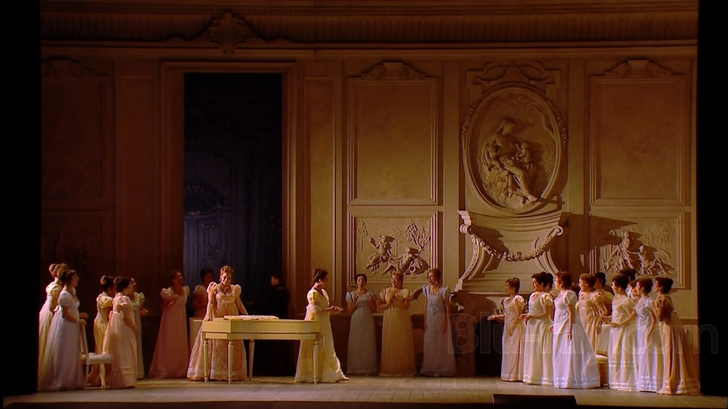
A musical version of the Whoopi Goldberg-Patrick Swayze-Demi Moore film Ghost is currently playing in London (with a score co-written by the Eurythmics' Dave Stewart), but one could argue at least partially feasibly that the Tchaikovsky brothers scanned much the same territory with Pique Dame. True, the Ghost here is bent on revenge, not reuniting with a former lover, and in fact the love story here may well be between Hermann and the cash he desires seemingly more than anything, but the supernatural element is one of the most distinctive things about this opera, and it's one which this opulent production masters quite handily. If this production isn't exactly bursting with innovation, it's at least solid musically and offers an incredibly opulent production design. Recommended.