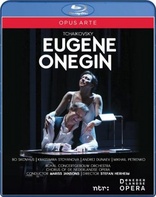
Tchaikovsky: Eugene Onegin Blu-ray Movie
HomeTchaikovsky: Eugene Onegin Blu-ray Movie 
Opus Arte | 2011 | 151 min | Not rated | Apr 24, 2012
Price
List price:Amazon: $17.86 (Save 55%)
Third party: $17.86 (Save 55%)
Temporarily out of stock.

Movie rating
6.6 | / 10 |
Blu-ray rating
| Users |  | 4.0 |
| Reviewer |  | 4.5 |
| Overall | | 4.0 |
Overview
Tchaikovsky: Eugene Onegin (2011)
ORCHESTRA: Royal Concertgebouw Orchestra
CONDUCTOR: Mariss Jansons
ARTISTS: Krassimira Stoyanova, Bo Skovhus, Mikhail Petrenko, Nina Romanova
| Music | 100% |
Specifications
Video
Video codec: MPEG-4 AVC
Video resolution: 1080i
Aspect ratio: 1.78:1
Original aspect ratio: 1.78:1
Audio
Russian: DTS-HD Master Audio 5.1
Russian: LPCM 2.0
Subtitles
English, French, German, Italian, Spanish, Dutch
Discs
50GB Blu-ray Disc
Single disc (1 BD)
Playback
Region A (B, C untested)
Review
Rating summary
| Movie | | 4.5 |
| Video | | 4.0 |
| Audio | | 4.5 |
| Extras |  | 2.0 |
| Overall | | 4.5 |
Tchaikovsky: Eugene Onegin Blu-ray Movie Review
Timeless.
Reviewed by Jeffrey Kauffman April 11, 2012While every nation great and small has had their fair share of misfortune and calamity, somehow Russia seems to be in the running for most unfortunate country of all time, at least with regard to the world’s major superpowers. Centuries of disasters, including social, economic and political, have visited the vast expanse of the erstwhile nation over and over again until it’s little wonder that a sense of pervading melancholy seems to be imprinted on the Russian Soul as perhaps no other country in the world. Somehow out of that very melancholy Russia has managed to engender some of the greatest artists of all time in a wide variety of genres, and two of the greatest, poet – novelist Alexander Pushkin and composer Pyotr Ilyich Tchaikovsky (as his name tends to be transliterated these days) joined together in a way for one of the glories of Russian opera Eugene Onegin. Of course Pushkin had been dead for some time before Tchaikovsky decided to adapt the poet’s famous “verse novel” into operatic form, but because Pushkin’s opus was already a libretto of sorts, it was perhaps more easily adapted to the world of musical theater than other “novels”. Tchaikovsky and Konstantin Shilovsky (with evidently some help from Pyotr’s brother Modest) reshaped and retooled Pushkin’s rhyming novel to their own uses, but managed to leave intact large swaths of the original in the process. The result is something like a collaboration across time, and perhaps that feature was part of the inspiration for this rather startling 2006 production of Eugene Onegin by De Nederlandse Opera, featuring the redoubtable Royal Concertgebouw Orchestra in the pit and none other than Mariss Jansons at the conductor’s podium. Stage director Stefan Herheim anchors this fascinating new take on a hoary classic in a sort of timeless continuum that nonetheless repeatedly references the entire, often tragic, history of Russia even as it remains firmly bound to something akin to both Pushkin’s and Tchaikovsky’s original conceptions.
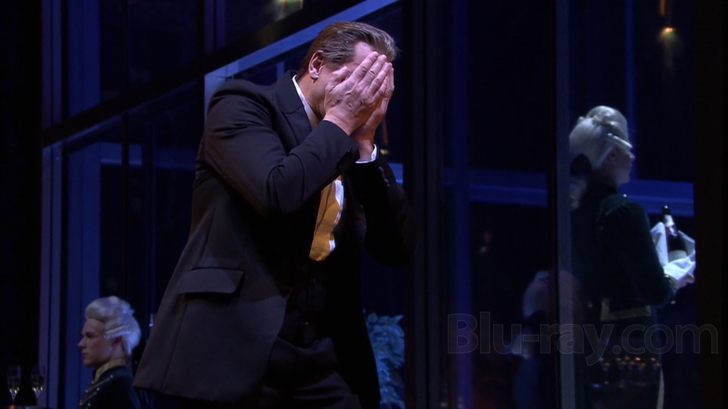
Eugene Onegin is basically the story of a star-crossed love affair between its snobbish, dandified title character (played here by Bo Shovhus) and a winsome country lass named Tatyana (Krassimira Stoyanova). What director Herheim seems to want to do with this production is generalize outward from this mismatched unconsummated love affair to something broader, a sort of philosophical rumination about the star-crossed love affair (if indeed that’s the right term to use) between Russia and Fate. As the basic storyline of the opera goes on in and around a glass house (no need to wonder why that symbol is used), Herheim brings in a number of “extra-curricular” elements that point to Russia’s long and tortured history. (Perhaps not so coincidentally, a Nederlandse Opera production of Shostakovich's Lady Macbeth of Mtsensk, which was conducted by Jansons, also prominently featured a glass house in its production design.) It’s a surprisingly compelling gambit and one which rather unexpectedly invests Eugene Onegin with a whole new level of emotional impact.
Herheim plays with time both within the context of the opera and as a separate, though unifying, concept. He has slightly tweaked the opera’s usual running order by having Onegin on stage from the opera’s opening, casting everything as, yes, a melancholy remembrance of things past. But within the opera itself, Herheim recasts characters and events within the tumultuous history of Russia, so that, for example, Onegin’s country neighbor Lensky (Andrej Dunaev) becomes a personification of the Proletariat while Onegin is of course a sterling example of the Bourgeoisie. Therefore, when Onegin’s boorish attentions to Lensky’s fiancée Olga (Elena Maximova) seem to be returned by the young woman, Lensky adopts the banner of Communism as part of his responsive arsenal. This may seem to some like an unneeded layering of “meta” meanings on what is on its face a romantic tragedy (albeit with elements of class distinction), but what is so bracing about this production is how seamlessly it all works.
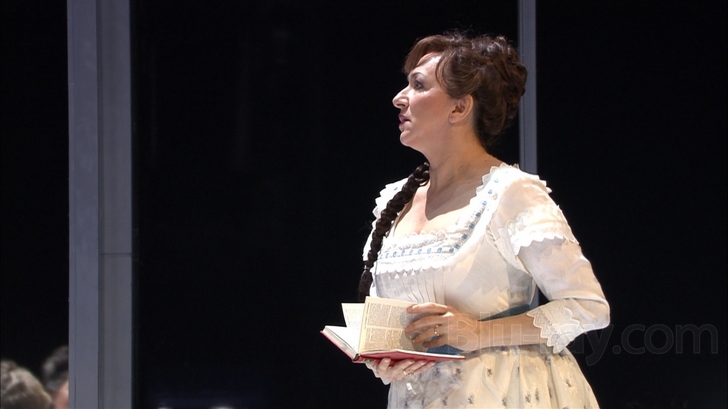
Eugene Onegin works as a slow seesaw where the relative balance of power between Onegin and Tatyana shifts ever so subtly until Onegin’s once imperious reaction to the starstruck young girl is completely reversed, with Onegin a doddering mess and Tatyana, if not imperious, at least impervious to Onegin’s entreaties that they finally consummate their relationship. The acting in this production is part of what makes it so successful, and the final scenes between Skovhus and Stoyanova are beautifully heartfelt and appropriately tragic. Herheim also adds a neat little coda of sorts with Onegin "dueling" someone other than Lensky; it's a fascinating addition that brings a whole new level of meaning to Onegin's self-loathing character.
The contributions of Mariss Jansons and The Royal Concertgebouw Orchestra can also not be underestimated. Jansons has long been one of the more acclaimed Tchaikovsky conductors in the world, and he brings his fine balance of emotionalism and rationalism to his reading of a score which tends, as with a lot of Tchaikovsky, toward the hyperbolic and (dare I say it?) saccharine at times. This is a finely wrought reading of Eugene Onegin that emphasizes the lyrical nature of Tchaikovsky’s writing while losing none of its devastating emotional impact. Jansons is quoted in the insert booklet’s excellent background essay as saying that Tchaikovsky’s music is so emotionally charged that performers should not attempt to overdo it. Jansons quotes his own father Arvid, another well-known conductor, who used to aver, “Don’t add sugar to the honey, it becomes too sweet”. It’s too Jansons’ credit that this Eugene Onegin is both ravishingly beautiful without that tendency toward artificial sweetness which hampers too many readings of Tchaikovsky’s oeuvre, operatic or otherwise.
Tchaikovsky: Eugene Onegin Blu-ray Movie, Video Quality
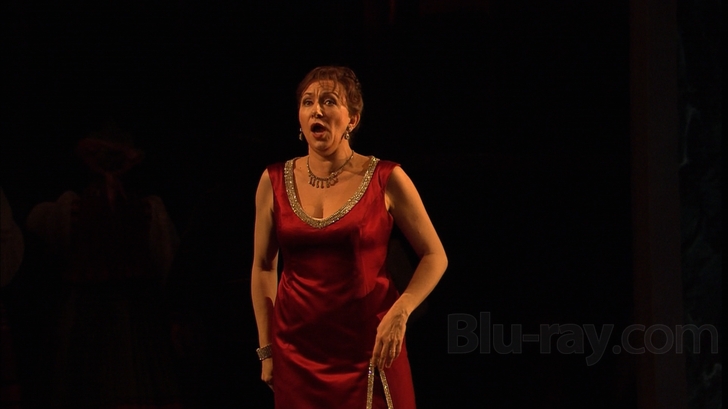
Eugene Onegin is presented on Blu-ray courtesy of Opus Arte with an AVC encoded 1080i transfer in 1.78:1. The bulk of this high definition presentation is incredibly sharp and well detailed, with the minimalist set design assuming several different nicely saturated hues due to an inventive lighting scheme, and a wide variety of costumes which evoke various time periods looking precisely defined, especially in close-ups. Colors are nicely saturated throughout this presentation, and fine detail is excellent, though as is usually the case midrange and far range shots suffer in comparison to the many close-ups. There is some minor but noticeable crush throughout this presentation; eagle eyed videophiles will see Onegin's black tux apparel disappear into the shadowy upstage areas on more than one occasion, and a similar situation attends some of the butlers' dark waistcoats, which aren't very well delineated in shadowy moments.
Tchaikovsky: Eugene Onegin Blu-ray Movie, Audio Quality

Eugene Onegin features two lossless audio options in the opera's original Russian language, a DTS-HD Master Audio 5.1 mix and an uncompressed LPCM 2.0 stereo fold down. Taken as a whole, both of these tracks are exceptionally clear and well balanced, though I personally wished that the opening scenes had been mixed a little differently. Part of this is due to a glut of offstage or upstage singing in the opera's opening moments, which results in some inadequate volume from the soloists and ensemble with regard to the lustrous playing of the Royal Concertgebouw Orchestra. The good news here is that these offstage elements offer really exceptional use of the surround channels, especially with regard to spaciousness and hall ambience. Once we get past these opening qualms, things improve dramatically, with good balance between the singers and the orchestra. Both vocally and instrumentally this is a largely stellar Eugene Onegin, and both lossless tracks present the score with sterling fidelity and some excellent dynamic range.
Tchaikovsky: Eugene Onegin Blu-ray Movie, Special Features and Extras
- Documentary Film (1080i; 30:01). This generically titled featurette looks like it probably aired on television to promote the opening of the opera. A festive premiere night crowd is served drinks by waiters in royal finery (who are also part of the stage production itself), and then host Hans Haffmans takes us on a tour backstage and during the rehearsal process, interviewing some of the cast and director Herheim.
- Cast Gallery (1080i; 00:53)
Tchaikovsky: Eugene Onegin Blu-ray Movie, Overall Score and Recommendation
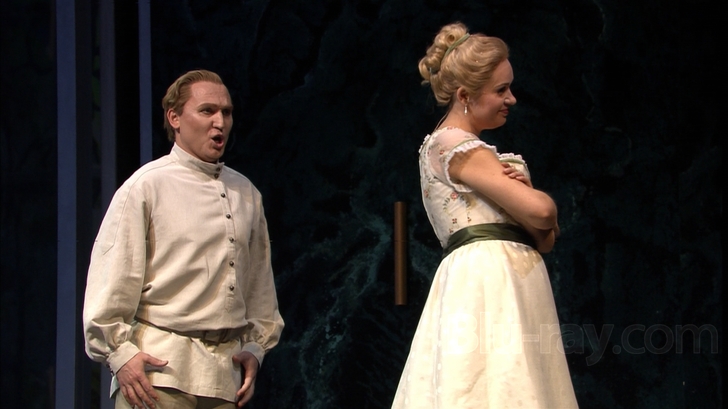
It must be admitted that there are a few anachronistic moments in this production of Eugene Onegin, such as the tableau late in the opera that presents everything from Russian peasant girls to Soviet cosmonauts, each in their "official" apparel, along with everything from Soviets to rampant capitalists along for the ride. But it's to stage director Stefan Herheim's immense credit that his production is as cohesive and in fact meaningful as it is. From a purely musical standpoint, this is an exceptional Eugene Onegin, with brilliant performances from Skovhus and Stoyanova, and absolutely gorgeous playing by the Royal Concertgebouw Orchestra under the direction of one of the finest Tchaikovsky conductors currently working, Mariss Jansons. This production wisely eschews the "too sweet" elements that often hamper Tchaikovsky performances, and this Eugene Onegin ends up being a devastating emotional experience. With solid video and audio and decent (albeit relatively slight) supplements, this release comes Highly recommended.