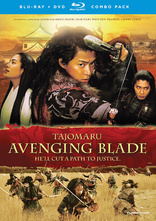
Tajomaru: Avenging Blade Blu-ray Movie
HomeTajomaru: Avenging Blade Blu-ray Movie 
Blu-ray + DVDFUNimation Entertainment | 2009 | 132 min | Rated TV-MA | Sep 20, 2011

Movie rating
6.6 | / 10 |
Blu-ray rating
| Users |  | 0.0 |
| Reviewer |  | 3.0 |
| Overall | | 3.0 |
Overview
Tajomaru: Avenging Blade (2009)
"TAJOMARU is the famous 'bandit' of the forest from RASHOMON. Whoever kills Tajomaru inherits his name, status and sword. A royal brother leaves his kingdom to protect the princess he loves, only to find a series of harrowing adventures along the way which lead him back to where he came from, and then disinheriting his past to become the bandit TAJOMARU."
Starring: Shun Oguri, Yuki Shibamoto, Kei Tanaka, Hiroyuki Ikeuchi, Kyôsuke YabeDirector: Hiroyuki Nakano
| Foreign | Uncertain |
| Action | Uncertain |
| Drama | Uncertain |
| Crime | Uncertain |
Specifications
Video
Video codec: MPEG-4 AVC
Video resolution: 1080p
Aspect ratio: 1.78:1
Original aspect ratio: 1.85:1
Audio
Japanese: Dolby TrueHD 5.1
English: Dolby TrueHD 5.1
Subtitles
English
Discs
25GB Blu-ray Disc
Two-disc set (1 BD, 1 DVD)
DVD copy
Playback
Region A (B, C untested)
Review
Rating summary
| Movie |  | 2.5 |
| Video |  | 4.5 |
| Audio | | 4.5 |
| Extras |  | 1.0 |
| Overall | | 3.0 |
Tajomaru: Avenging Blade Blu-ray Movie Review
Rashomon redux.
Reviewed by Jeffrey Kauffman September 12, 2011Michele Bachmann may not know how to pronounce chutzpah, but from her recent statement where she utilized the term, unfortunately pronouncing it phonetically, she at least seems to understand what the term means. (An even more egregious mispronunciation occurred on Portland’s Oregon Public Broadcasting radio one morning when a news reader was talking about the Jewish skullcap and pronounced this word phonetically: yarmulke, which of course should have been pronounced “yah-muh-kuh”). Chutzpah to use the crudest analogy means having the balls to do something, usually something that does in fact require a certain unbridled hubris, to cop a term from another ancient language. And there has to be some sort of special award for a filmic chutzpah that would dare to reimagine one of the all time classics of international film, Akira Kurosawa’s iconic Rashomon. This is a film that is so iconic that its very title has entered the public lexicon as shorthand for competing versions of the same event, with the “truth” of what happened remaining forever elusive. But reimagining Rashomon is more or less exactly what director Hiroyuki Nakano and scenarists Shin’ichi Ichikawa and Rikiya Mizushima have done with Tajomaru (Avenging Blade), a film which takes the same short story source as Kurosawa’s film and casts a new light on its “hero,” the bandit Tajomaru, played by Toshiro Mifune in Rashomon in one of his most famous roles, and here taken on by Japanese heartthrob Shun Oguri. Aside from one not very well thought out “alternate” perspective placed late in the film, Tajomaru is less about the philosophical conundrums for which Rashomon is so rightfully remembered and more about a traditional star-crossed lover drama (some would argue melodrama) playing out on a fairly vast canvas amid a world of strictly defined class relationships and dictated societal roles.
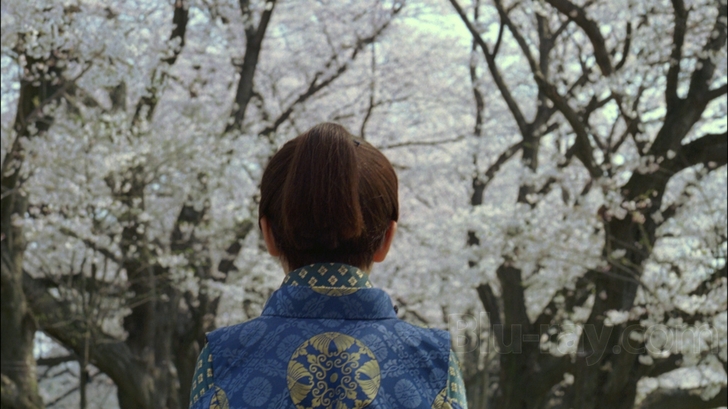
Tajomaru (Avenging Blade) begins with a brief prelude which introduces us to the film’s four main characters when they are all still children. In a feudal era when roles were determined by a family’s class and then within that family by birth order, we’re introduced to narration by Naomitsu, who is the second sun of the Hatakeyama family, thus forever consigned to doing whatever his elder brother Nobutsuna (played by Hiroyuki Ikeuchi once we get to the adult years). The Hatakeyama family has evidently been the Shogun’s Deputy for at least a generation, and Nobutsana is fated to fulfill that role once he attains adulthood. Also in this quartet are Ako (played by Yuki Shibamoto as an adult), a young girl who obviously has designs on Naomitsu, but who even as a very young female isn’t above using her wiles to play one brother off the other. The three romp homeward one day to interrupt a theft by the homeless child Sakuramaru (played by Kei Tanaka in the adult version), whom Naomitsu takes an immediate liking to and decides can be a family servant.
The film then segues forward a decade or so to reveal that Sakuramaru has become something of a plaything (with sexual overtones implied) of the Shogun, while the Hatakeyama brothers are feuding over who will assume the family mantle of Deputy, as well as marry Lady Ako. Sakuramaru uses this family discord to his own advantage, giving each brother conflicting information about the other’s plans and motives, leading to a complete rending of their relationship. Naomitsu and Ako decide to escape together, despite the Shogun’s pronouncement that Nobutsana should marry Ako and become his Deputy. Sakuramaru’s nefarious plotting continues, leading to a series of events that sees several deaths and Naomitsu and Ako left alone to fend for themselves, not quite sure what’s going on. That sets up the sequence which is most referential to Rashomon, as Naomitsu walks Ako through a forest as she rides a palomino and wears a large hat with a veil. They are accosted by famous bandit Tajomaru, who quickly knocks out Naomitsu. When he awakes, he’s tied to a tree and is supposedly witnessing the aftermath of Ako having been raped by the bandit. Somewhat surprisingly Ako begs Tajomaru to kill Naomitsu, which understandably upsets the young man, leading to a fight where he actually dispatches the bandit. According to legend, that means that Naomitsu must now assume to identity of Tajomaru, which he decides to do. In the meantime, Ako has escaped into the forest and Naomitsu (now known as Tajomaru) sets off to find her.
Tajomaru (Avenging Blade) starts out incredibly well, with a gorgeous prelude which introduces us to four disparate and extremely well drawn characters. But as the film continues, it too often basks in a really sticky melodramatic approach, with some acting that can only be termed soap operatic. Any film which dares to dart even around the edges of Rashomon had better have its act together, and while Tajomaru (Avenging Blade) is frequently lush and beautifully shot, dramatically it’s too turgid for its own good, and it’s simply too long to support its rather fragile story. The film wants to be a sort of postmodern revision of “In the Grove,” the iconic short story that inspired Kurosawa’s film, but instead it comes off as a Cliff Notes version of some unrecognizable project that is nowhere near Rashomon’s brilliance but which still wants to evoke that iconic property.
The film is not helped by one of the most anachronistic scores in recent memory, one which can only be compared to the similarly boneheaded attempt to shoehorn a pop hit into the ill conceived (but still fitfully entertaining) Costner Robin Hood: Prince of Thieves. Here we get Japanese pop and, believe it or not, something that can only be termed Samurai rap, and it completely disrupts the flow of the film, drawing far too much attention to itself and accomplishing little if anything in terms of helping to create a mood.
On the plus side, though, Tajomaru (Avenging Blade) is often incredibly beautiful to watch, with some truly stunning location photography helping to evoke a distant time and place. Production design is also very strong, and the costumes are unbelievably sumptuous and well crafted. Though some of the performances are just this side of laughable, Kei Tanaka’s glowering presence as Sakuramaru helps to elevate the film, at least until the final moments when even Tanaka gives into a sort of Snidely Whiplash villain portrayal, replete with cackling laugh. If only he had a mustache he could twirl.
Tajomaru (Avenging Blade) probably would have done much better to have disguised its source inspiration and to have perhaps renamed its titular character, to more capably remove the film from Rashomon’s portentous orbit. While some of the film is simply too florid for its own good, it’s the comparison to the Kurosawa masterpiece which ultimately most hobbles Tajomaru, keeping it from being more objectively assessed on its own terms. It still wouldn’t be a masterpiece, and certainly not anything approaching the Kurosawa epic, but at least that way it might have had a fighting chance.
Tajomaru: Avenging Blade Blu-ray Movie, Video Quality
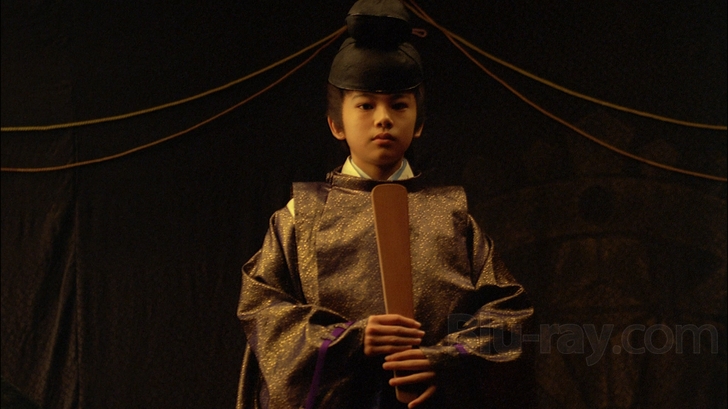
Tajomaru (Avenging Blade) slashes onto Blu-ray with an AVC encoded 1080p transfer in 1.78:1. This is an often stunningly beautiful film and it looks sumptuous throughout this high definition presentation, at least most of the time. From the opening moment when we see a grove of cherry trees in full blossom slowly come into focus. The drifting blossoms almost look like snow, but as the image sharpens there's a gorgeous white-pink color that augurs well for this Blu-rays ability to delineate the subtlest differences in hues. Fine detail is often exceptional, especially with regard to several of the gorgeous costumes, many of which pop magnificently throughout the film. There is a curious softness to some midrange and far shots which detracts slightly from the overall crisp appearance of this offering.
Tajomaru: Avenging Blade Blu-ray Movie, Audio Quality
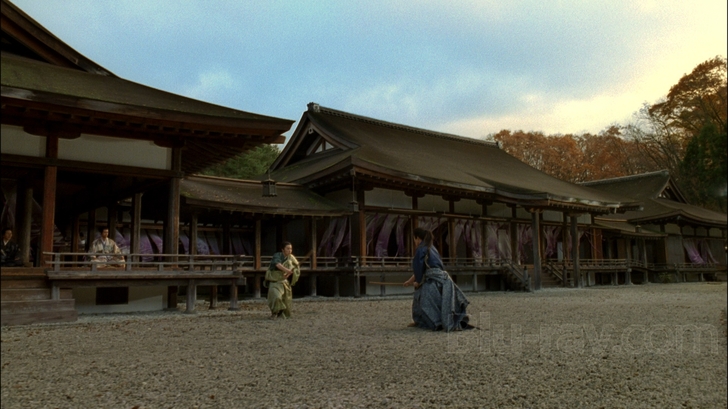
Tajomaru (Avenging Blade) is presented with two lossless audio options, the original Japanese language track in Dolby TrueHD 5.1 and an English dub also presented via Dolby TrueHD 5.1. This is one film where even those who don't like reading subtitles will probably want to stick with the original Japanese track, as some of the voice work in the English dub is less than artful. That said, both of the tracks offer excellent fidelity and have virtually identical mixes. The Japanese track has fairly consistent surround activity, with some excellent placement of sound effects, both ambient environmental sounds as well as some great discrete effects tied to action scenes, which offer very good to excellent immersion. Though the choice of this score is lamentable, it's at least presented with excellent fidelity, for what that's worth.
Tajomaru: Avenging Blade Blu-ray Movie, Special Features and Extras

Making of Tajomaru (HD; 17:07) has the usual assortment of on set footage, interspersed with film clips and interviews. The best part of this is the unintentionally funny original Japanese trailer that starts out the piece.
Tajomaru: Avenging Blade Blu-ray Movie, Overall Score and Recommendation
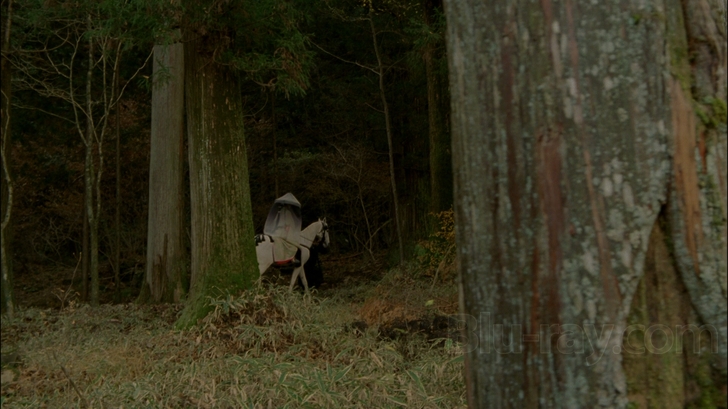
If you didn't know about the connection to Rashomon, chances are you'd find a lot to like about Tajomaru (Avenging Blade), especially from a visual perspective. The film is too long and too melodramatic for its own good, but it is absolutely gorgeous to behold a lot of the time. Tajomaru (Avenging Blade) would have played better with a less florid approach and with about 20-30 minutes of its running time excised. But it is a beautiful film, and if you're willing to deal with its flaws, there's at least a lot to watch here.
Similar titles
Similar titles you might also like

Goemon
ゴエモン
2009

The Blind Swordsman: Zatoichi
座頭市, Zatōichi
2003

Three Outlaw Samurai
三匹の侍 / Sanbiki no samurai
1964

The Great Killing
大殺陣 / Daisatsujin
1964

Sword of Desperation
2010

Cruel Tale of Bushido
武士道残酷物語
1963

Connected
保持通話 / Bo chi tung wah
2008

Why Don't You Play in Hell?
Jigoku de naze warui
2013

Crazy Samurai: 400 vs. 1
Crazy Samurai Musashi / 狂武蔵 / Kyō Musashi
2020

Crime Story
1993

The Sword of Doom
大菩薩峠 / Dai-bosatsu tôge
1966
Killer Constable
Wan ren zhan / Man yan jam / 萬人斬
1980

Bloody Spear at Mount Fuji
血槍富士 / Chiyari Fuji | Arrow Academy
1955

The Great Okinawa Yakuza War
沖縄やくざ戦争 / Okinawa Yakuza sensô
1976

The Viral Factor
逆戰
2012

Kundo
2014

The Roundup: Punishment
범죄도시4 / Beomjoedosi4
2024

The Eunuch
Gui tai jian
1971

Re:Born
2016

A Better Tomorrow
Mujeogja
2010