Szymanowski: Symphonies Nos. 1 and 2 Blu-ray Movie
HomeSzymanowski: Symphonies Nos. 1 and 2 Blu-ray Movie 
Naxos | 2008-2009 | 53 min | Not rated | May 31, 2011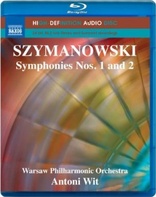

Movie rating
Movie has not been rated yetBlu-ray rating
| Users |  | 0.0 |
| Reviewer |  | 3.5 |
| Overall | | 3.5 |
Overview
Szymanowski: Symphonies Nos. 1 and 2 (2008-2009)
Starring: Antoni Wit| Music | Uncertain |
| Foreign | Uncertain |
Specifications
Audio
Music: DTS-HD Master Audio 5.0 (96kHz, 24-bit)
Music: LPCM 2.0 (96kHz, 24-bit)
Discs
25GB Blu-ray Disc
Single disc (1 BD)
Playback
Region A (B, C untested)
Review
Rating summary
| Movie | | 3.5 |
| Video | | 0.0 |
| Audio |  | 4.0 |
| Extras | | 0.0 |
| Overall | | 3.5 |
Szymanowski: Symphonies Nos. 1 and 2 Blu-ray Movie Review
Two little performed symphonies receive a nice Blu-ray audio treatment.
Reviewed by Jeffrey Kauffman December 31, 2011Karol Szymanowski described his first symphony as a monstrosity. Well, he actually called it a contrapuntal harmonic orchestral monstrosity, but who’s counting? Szymanowski was a composer caught between two worlds, the pseudo- Polish nationalism of his erstwhile countryman Chopin, and the burgeoning modernism of Wagner and others that was taking the world by storm in the late 19th century, just as Szymanowski was stretching his own compositional wings. You can hear that struggle in a lot of Szymanowski’s works, as he attempts to come to terms with his own take on chromaticism and an expanded tonal vocabulary, first as a devoted acolyte of Wagner, and then, later, taking some tentative steps back toward the sort of nationalism that Chopin espoused in some of his patently Polish pieces. Szymanowski actually disavowed his First Symphony, as that comment above might hint at ever so subtly. The composer felt it was too redolent of Wagner, although modern ears might hear more of a Brucknerian or Regerian influence than anything. Szymanowski came to believe that Wagner’s music was nothing much more than “empty rhetoric,” but cynical listeners might in fact accuse his own First Symphony of falling into that selfsame category, with its huge slathering slabs of sound and little apparent formal cohesion. It is in fact a wandering sort of mélange that brings to mind Bruckner’s more dissembling approach than Wagner’s often brusque and astounding flashes of melody and orchestral color.

Szymanowski’s First Symphony begins with a rush of string sequences which ably set up a mysterious, tempestuous environment that is at times slightly redolent of Mahler, without Mahler’s piquant sense of humor or flashes of morbid obsessive-compulsive qualities. Szymanowski’s melodies waft briefly in flashes of exuberance in a very Brucknerian manner, but there isn’t the “T-square and slide rule” feeling of measured architecture with Szymanowski that there is in Bruckner. The First Symphony is a two movement affair, with the second movement being at least a bit more on the lyrical side of things, albeit a lyricism infused with acerbic commentary from the winds, which helps to counteract the soaring strings. Some astute listeners may wonder if those soaring strings are meant to be quoting Richard Strauss' Ein Heldenleben a time or two.
Strings, notably a solo violin and viola (played by Ewa and Marek Marczyk) are highlights of the much grander Second Symphony, which plays out as a sort of theme and variations, albeit interestingly enough with a sort of First Movement prelude before the Second Movement’s announced “Theme.” The variations tumble out attaca, one after the other, and in fact if you’re not paying attention to the track numbers changing, you might be hard pressed to notice the actual segue from movement to movement, so seamlessly does Szymanowski traverse the compositional territory. The Second is in a way a much quieter, more introspective piece than the First, and it’s also a good deal more playful (the fun Variation 3: Scherzando finds Szymanowski working again in a quasi-Mahlerian vocabulary where he seems to actually be having a bit of fun).
It may surprise some who are not all that familiar with Szymanowski that despite the composer being linked to a sort of neo-nationalism with regard to Poland and Polish music, he was actually born (and raised, off and on) in the Ukraine, to parents of both Russian and Swedish ancestry. In fact there’s a certain internationalist fervor to a lot of Szymanowski’s music, which might be evident from this review’s allusions to so many other composers, and also this release’s liner notes, which also point to other influences, such as Scriabin. What’s most interesting from a formal, if not thematic, standpoint with Szymanowski’s music is how it seems to erupt in fits and starts, bursting forth with a few bars of rapture before retreating into a seemingly unrelated idea. On the other hand, Szymanowski proves himself the master of larger, more structurally challenging, forms with such movements as the huge Fugue which caps the Second Symphony.
Szymanowski seems to be on the verge of a major reassessment. The relatively recent release of his opera Szymanowski: King Roger on Blu-ray hopefully helped to pave the way for a new appreciation for this very distinctive, if at times patently odd, composer. It took a good half century or so for Mahler’s music to really come into its own, despite the best attempts of any number of other composers and conductors to champion it, and since Szymanowski’s approach doesn’t even have the at least relatively more accessible “hooks” that Mahler’s orchestral music does, it perhaps should be no great surprise to realize that it may be closer to the century mark after Szymanowski’s 1937 death until audiences are fully able to grasp what the composer was after in his extremely distinctive sound world. Antoni Wit and the Warsaw Philharmonic deliver brilliantly forceful interpretations of both of these works, and they obviously seem culturally perfectly poised to best interpret Szymanowski, so hopefully this marriage of artist with orchestra can lead to the greater dissemination of a composer whose works are still sadly underappreciated.
Szymanowski: Symphonies Nos. 1 and 2 Blu-ray Movie, Video Quality

As with all of these Naxos "audio only" releases, there is an on screen menu allowing those who want to to actually see what the track listings are and to make their choices that way. There's no actual need to do that, however; choices can be made via the remote as with any regular CD. Also, toggling between the two audio options is possible either by using the Audio button on the remote, or the colored buttons (red for surround, green for stereo).
Szymanowski: Symphonies Nos. 1 and 2 Blu-ray Movie, Audio Quality
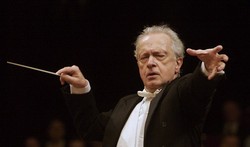
I'm somewhat at a loss to explain why the Naxos releases of other Wit/Warsaw Philharmonic recordings, notably Chopin: Piano Concerto No 1, Chopin: Piano Concerto No 2, and Mahler: Symphony No. 8, are so relatively lackluster when they all feature 96kHz 24-bit renderings delivered via DTS-HD Master Audio 5.0 or LPCM 2.0 mixes. That perplexing trait is even more mind boggling when one considers how bright and clear this audio Blu-ray is, especially when compared to the other releases. Unlike the Mahler for example, there is no clipping of upper registers, all frequencies shine bright and clear and there's abundant precision and clarity delivered throughout all sections of the orchestra. There is also none of the over-reverbed hall ambience that seems to be at least partially to blame for those other recordings' muffled, murky sound. Perhaps the difference is something as simple as microphone placement or different engineers. The good news, though, is that these Szymanowski Symphonies sound wonderfully transparent and well resolved on both the 5.0 and 2.0 tracks. The 5.0 track streamed at around an average of a decently hefty 5.0-plus Mbps and often surged up to close to 7.0 Mbps. There's abundant low end on the 5.0 track and similarly highs are free and open without sounding brittle or strident. Szymanowski tends to like huge slabs of orchestral sound, and both of these lossless tracks deliver those slices of sonic activity effortlessly.
Szymanowski: Symphonies Nos. 1 and 2 Blu-ray Movie, Special Features and Extras

There are no supplements per se on the Blu-ray disc. The insert booklet offers an in-depth biography of Szymanowski, as well as information on Wit and the soloists.
Szymanowski: Symphonies Nos. 1 and 2 Blu-ray Movie, Overall Score and Recommendation
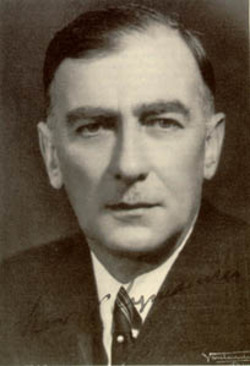
Karol Szymanowski hasn't quite come into his own in terms of the international orchestral and operatic repertoire, though that tendency seems to be changing slowly but surely. King Roger is more and more accepted as a modern masterpiece in the operatic canon, and similarly Szymanowski's Third Symphony at least receives sporadic, if not regular, performances. A number of Szymanowski's other orchestral achievements occasionally get recognized, but there haven't been a lot of recordings of the First and Second, which is what makes these Antoni Wit and Warsaw Philharmonic performances so notable. Though Szymanowski may have disavowed the First, it's still an interesting, if lurching, piece that offers some compelling ideas if not an overall cohesive structure. Szymanowski is much more assured with the often bristling Second, a symphony which is also nicely balanced between bombast and lyricism. Wit and the Warsaw Philharmonic offer solid, appealing performances here which accentuate the visceral qualities of Szymanowski's writing. The best news is that this Naxos release is not plagued by the less than stellar audio that has been problematic on some other Wit/Warsaw Philharmonic releases. Szymanowski is far from a household name, but fot the adventurous listeners out there, this release is Recommended.