Sweetwater Blu-ray Movie
HomeSweetwater Blu-ray Movie 
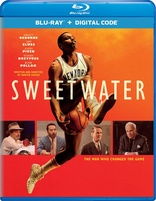
Blu-ray + Digital CopyUniversal Studios | 2023 | 118 min | Not rated | Jun 13, 2023
Price
List price:Listed on Amazon marketplace

Movie rating
6.6 | / 10 |
Blu-ray rating
| Users |  | 0.0 |
| Reviewer |  | 3.0 |
| Overall | | 3.0 |
Overview
Sweetwater (2023)
In the fall of 1950, Nat "Sweetwater" Clifton forever changed the game of basketball when he entered the NBA. The story of the first African American to land a contract to play in the NBA.
Starring: Cary Elwes, Richard Dreyfuss, Eric Roberts, Jeremy Piven, Kevin PollakDirector: Martin Guigui
| Sport | Uncertain |
| Drama | Uncertain |
Specifications
Video
Video codec: MPEG-4 AVC
Video resolution: 1080p
Aspect ratio: 2.39:1
Original aspect ratio: 2.39:1
Audio
English: DTS-HD Master Audio 5.1
Subtitles
English SDH, French, Spanish
Discs
Blu-ray Disc
Single disc (1 BD)
Digital copy
Packaging
Slipcover in original pressing
Playback
Region A (B, C untested)
Review
Rating summary
| Movie | | 3.0 |
| Video |  | 3.5 |
| Audio |  | 4.0 |
| Extras | | 0.0 |
| Overall | | 3.0 |
Sweetwater Blu-ray Movie Review
Reviewed by Justin Dekker January 28, 2025Inspired by true events, 'Sweetwater', the film detailing Nat "Sweetwater" Clifton's journey to become the first African American player to sign an
NBA contract arrives on Blu-ray courtesy of Universal. Starring Everett Osborne, in his first leading role in a feature film, as the titular Sweetwater,
he's joined by Cary Elwes ('Princess Bride') as New York Knicks owner Ned Irish, and Jeremy Piven ('Entourage') as Knicks coach Joe Lapchick. A
slipcover and a Digital Code redeemable through Movies Anywhere are both included.
As the film opens in Chicago in 1990, a man gets in the back of a cab. After he makes a comment about the awe-inspiring play of Michael Jordan,
the driver quickly retorts that players were doing amazing things on the court well before Jordan's time and quickly rattles off a list of greats from
the 1970s. No slouch in basketball knowledge himself, the passenger, a sports writer, inquires if that history of amazing players goes back further.
With that, his driver obliges him by relaying the tale of how Nat "Sweetwater" Clifton made his unlikely but almost inevitable journey to the NBA,
starting with Sweetwater's stint with the world-famous Harlem Globetrotters as they faced the then NBA champions Minneapolis Lakers in 1949 at
Madison Square Garden. During that game, Sweetwater comes to the attention of Lapchick and Irish, both of whom are in attendance. Impressed with
what
he sees, Lapchick wastes no time making contact with Sweetwater and plants the seed of the star player leaving the Trotters to join the
Knickerbockers. Noting that the NBA was devoid of diversity at the time, Sweetwater quickly dismissed the notion. For Lapchick, though,
this would become a mission.
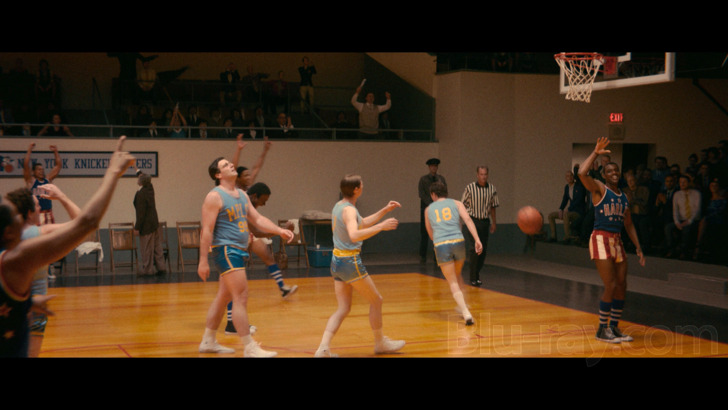
The rest of the film's runtime documents Sweetwater's evolving and revolutionary playstyle which wins him fans at every game regardless of the venue's location. As a counterpoint to the on-court fireworks, the viewer is frequently but mildly reminded of the racially prejudiced attitudes and behavior of the 1950s. Based on race, signage dictates where people sit, enter, and so on. Sweetwater and his teammates receive less pay than their white opponents. Most NBA owners resist the notion of adding African Americans to their teams. And, slurs and racially motivated violence periodically bubble to the surface. Such instances are, however, brief and never allowed to get too overpowering as the film clearly wants the focus to remain on basketball and Sweetwater's journey. Though, as viewers will find out, the hardwood was not a safe haven from racist attitudes.
Smartly, the viewer is reminded that basketball is a business. Lapchick and Irish were, first and foremost businessmen. While it would have been wonderful to depict these two men as altruistic and bent on signing Sweetwater into the NBA simply because it was the right thing to do, the film more realistically shows their motivations were much more business-focused. Lapchick and the Knicks players believe that Sweetwater is the key to one or more league championships, while Irish sees dollar signs, knowing Sweetwater's unparalleled skill, athleticism, and on-court showmanship is a guarantee of packed stands. Their relentless push would spark a change for the Knicks and the NBA, and Nat "Sweetwater" Clifton would forever change the game of professional basketball.
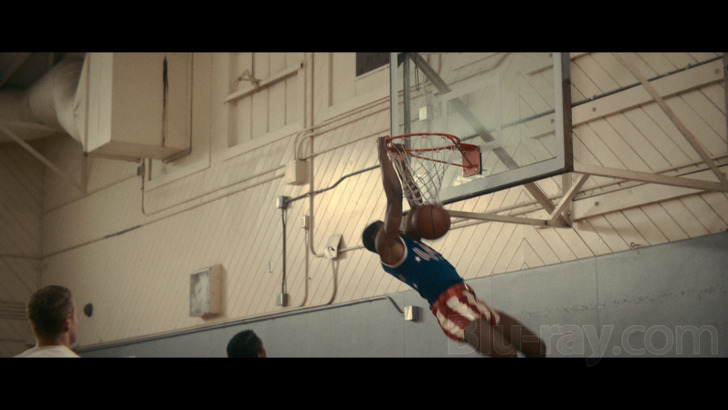
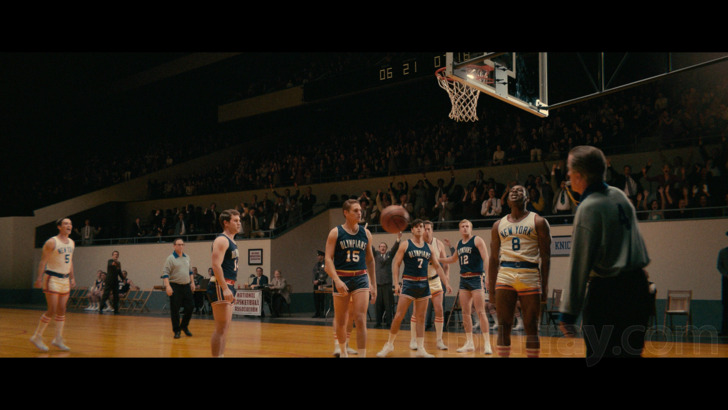
For as big as the story is, the film telegraphs its budgetary limitations in a number of ways. Locations are few. Much of the basketball that's played, both before and after Sweetwater joins the Knicks occurs on the Madison Square Garden set. While the set conveys the feel of a smaller arena from a time before professional basketball became the wildly popular multibillion dollar industry it is today. However, the devil is, as they say, in the details. The MSG court seems too smart, crisp, and sterile to feel appropriately "lived in", lacking the type of set dressing needed to make the locations seem real. Even the barn where Sweetwater and the other Globetrotters play one of their games looks too clean and new, with the prevalent wooden surfaces not showing the age, wear, dirt, and dust that they should. Similarly, too many scenes are set in the immediate vicinity of the remote gas station where the team encounters the shop's racist owner, played with venom and nastiness by a gun-totting Eric Roberts. And, while Sweetwater puts on exhibition after exhibition wherever and whenever he plays, though large crowds are discussed, they are very seldom seen.
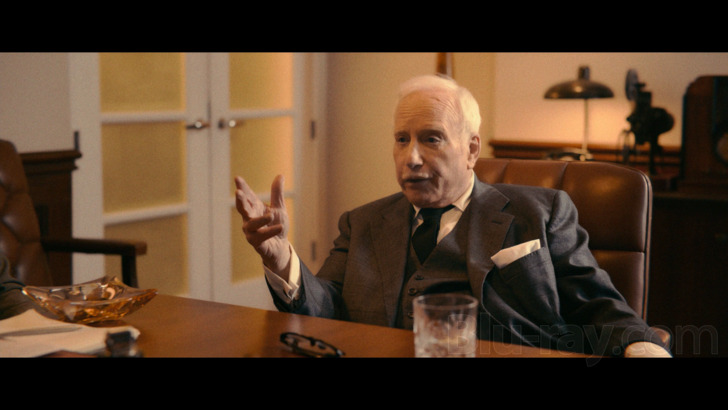
The cast does well with the material, and initially and somewhat unsurprisingly Kevin Pollack (The Usual Suspects) does his level best to dominate if not outright steal every scene that he's in. His performance of Abe Saperstein, the Globetrotter's manager and promoter since 1928, covers a wide range, from ardent support to relentless showman to conniving, shrewd businessman. He explores each of these aspects of his character with conviction and energy, his presence bringing electricity to each scene. Piven's Lapchick, the everyman coach of the Knickerbockers, is the catalyst in the equation. His belief and motivation to bring Sweetwater into the NBA is unwavering from the first moment he sees the man play. Elwes, ever the charmer, never fails to be likeable, even when his character isn't supportive of Coach Lapchick's vision. Cinema legend Richard Dreyfus appears in a small role as NBA president Maurice Podoloff. His character, who's journey from mild resistance to acceptance is short and easy, mirror's that of Elwes' Ned Irish, with both men able to get on board with the Knicks adding Sweetwater to their team as long as increased profits are assured.
If Sweetwater's script has an issue, it's the overwhelming feeling of inevitableness for the film's desired (and for those deeper in historical basketball knowledge than I, well-documented) outcome. While those at the owners' meeting initially support the NBA remaining an all-white league, their reaction to the thought of integration is not portrayed as being overly vigorous or contentious. In a very short amount of time, several other owners elect to draft African American players with only one coach displaying displeasure at the thought, though his reactions are largely limited too frustrated or flabbergasted looks. While other instances of racism are presented, most never escalate beyond a comment or two or a "polite" refusal of service, one of which is mitigated in mere seconds. Only once does the specter of racism devolve into violence, and even then, it transpires in just a few seconds, being quickly and easily ended. While these moments are intended to elevate the tension and demonstrate exactly what Sweetwater is up against, they are far too few, generally too mild, and often far to brief to create much of a threat.
Likewise, due to the script, Sweetwater is never shown as being overly concerned with being in the NBA. He is most often relegated to simply going where his managers tell him to go, and playing who and when he's told to play. While there is one scene where Osborne's character has the opportunity to express what being one of the first African American players in the league means to him, he's never seen as a driving force or even vocal proponent of that goal. Part of this may be due to the film never taking time to show Sweetwater's life outside of basketball. We don't know how he lives and how he would expect it to improve should he join the NBA. Aside from a place in the history books, we don't know how the goal or its achievement is tangibly real to him. Regarding emotional impact, aside from a few uncomfortable and nervous looks, the viewer is also not given much to understand the impact of the racist treatment he receives. Does he look at the NBA as a way to buy the lifestyle he wants? Does he look at being an NBA champion as being a way to earn respect and change hearts and minds. These ideas which would add greater depth to the character and the story are never adequately explored if they're touched on at all. Rather than digging into meatier events, emotions, or conversations, the film plays it safe. It's this risk aversion that keeps everything in the film operating at surface level and depriving it of the tension, risk, and drama that the best sports films possess, and also preventing the film's lead, Everett Osborne, from being able to explore a proper range of human emotions.
Sweetwater Blu-ray Movie, Video Quality
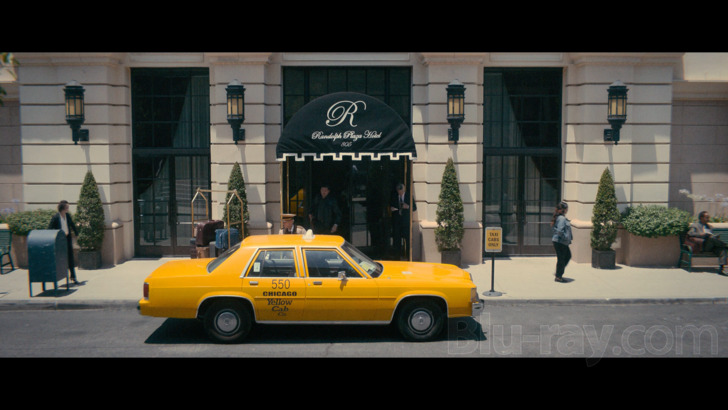
Sweetwater 1080p transfer is solid enough for what it needs to accomplish but is lacking in the heightened level of fine details that characterize some of the best recent Blu-ray releases from Universal and others. Facial and costuming particulars are sometimes on display, but not consistently so. Skin tones typically appear healthy and natural, but can, at times, push a shade or two too tan. Black levels are satisfying but can occasionally crush. Still, the reds and blues of the Globetrotter uniforms pop nicely and are often on display in the first half of the film. Woods, seen on the court and other environments, are warm with wood grain and texture discernable.
Sweetwater Blu-ray Movie, Audio Quality
The jazz-inflected DTS-HD Master Audio 5.1 soundtrack that supports Sweetwater is consistently pleasing. Bass is deep and appropriately powerful enough to produce a healthy bottom end to musical selections, whether performed at a club that Sweetwater visits or those that underscore games or other on-screen action. Basketballs hit the court and backboards with a convincing and realistic thump. Directionality is fluid and accurate. Dialogue is clean and properly prioritized, and surrounds are often employed to provide ambient sounds such as crowd noise and the authentic echoing of empty gymnasiums, taking an opportunity to lend a hand to music as well. It's a very solid track.
Sweetwater Blu-ray Movie, Special Features and Extras
This release of Sweetwater does not include any on-disc supplemental material.
Sweetwater Blu-ray Movie, Overall Score and Recommendation
Sweetwater is a rather by-the-numbers retelling of how Nat "Sweetwater" Clifton would become the first African American to sign an NBA contract. To it's disservice, the film simplifies the tale to a finite selection of moments that, while important, do not allow the production to generate needed tension or drama, and robs it of the ability to explore the more difficult themes or emotions that should be part and parcel to the tale. Sweetwater's impact on the game was profound and still resonates through the league some seventy years after he first stepped on the court. But what of the game's impact on the man? What of the price he paid to get there? Osborne is convincing in his portrayal of the basketball great in a performance that is more comfortable and assured than his prior experience would indicate. For fans of the game looking for something more akin to a biography than a typical sports movie Sweetwater comes recommended.
Similar titles
Similar titles you might also like
(Still not reliable for this title)

Cornbread, Earl and Me
1975
He Got Game
1998

The Way Back
2020

Coach Carter
2005
Dynasty
1981-1989

Believe In Me
2006

Glory Road
2006

Drive, He Said
1971

Hurricane Season
2009

This Sporting Life
1963

Goldengirl
1979

Hoosiers
25th Anniversary Edition
1986

Coming Apart
1969

Downhill Racer
1969

We Are Marshall
2006

Fast Company
1979

Blue Chips
1994

The Hawaiians
1970

American Flyers
Warner Archive Collection
1985

Fat City
Limited Edition to 3000
1972