Stray Dog Blu-ray Movie
HomeStray Dog Blu-ray Movie 
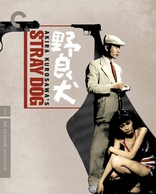
野良犬 / Nora inuCriterion | 1949 | 122 min | Not rated | May 05, 2026

Movie rating
7.8 | / 10 |
Blu-ray rating
| Users |  | 0.0 |
| Reviewer |  | 4.0 |
| Overall | | 4.0 |
Overview
Stray Dog (1949)
Murukami, a young homicide detective, has his pocket picked on a bus and loses his pistol. Frantic and ashamed, he dashes about trying to recover the weapon without success until taken under the wing of an older and wiser detective, Sato. Together they track the culprit.
Starring: Toshirô Mifune, Takashi Shimura, Isao Kimura, Keiko Awaji, Eiko MiyoshiDirector: Akira Kurosawa
| Foreign | Uncertain |
| Drama | Uncertain |
| Film-Noir | Uncertain |
| Crime | Uncertain |
| Thriller | Uncertain |
Specifications
Video
Video codec: MPEG-4 AVC
Video resolution: 1080p
Aspect ratio: 1.37:1
Original aspect ratio: 1.37:1
Audio
Japanese: LPCM Mono (48kHz, 24-bit)
Subtitles
English
Discs
Blu-ray Disc
Single disc (1 BD)
Playback
Region A (locked)
Review
Rating summary
| Movie | | 4.0 |
| Video | | 4.0 |
| Audio | | 4.0 |
| Extras |  | 2.5 |
| Overall | | 4.0 |
Stray Dog Blu-ray Movie Review
Reviewed by Dr. Svet Atanasov May 22, 2026Akira Kurosawa's "Stray Dog" (1949) arrives on Blu-ray courtesy of Criterion. The supplemental features on the release include archival audio commentary by author and critic Stephen Prince, and archival documentary short. In Japanese, with English subtitles for the main feature. Region-A "locked".
Stray Dog and Bicycle Thieves share many striking similarities. Both come from the 1940s. In both films, a thief steals a precious item, and the ensuing efforts to recover it are a classic cinematic ruse. Both films explore the evolving urban landscapes of two countries that were defeated during WWII. In both films, two pairs of characters process what they observe differently. Both films carry identical neorealist genes.
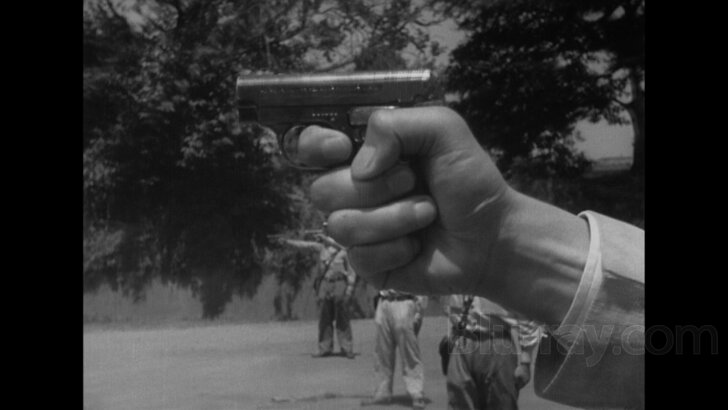
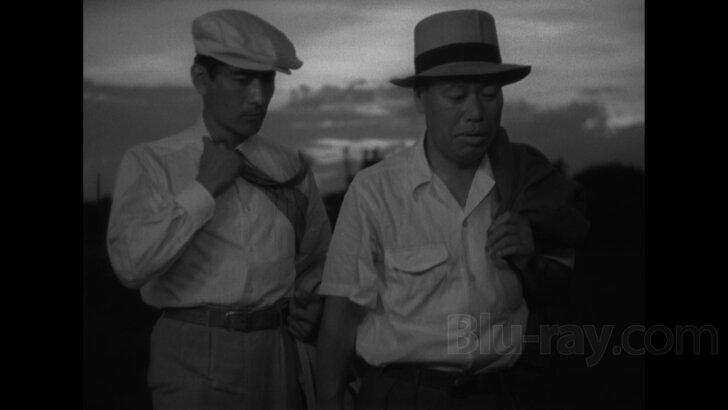
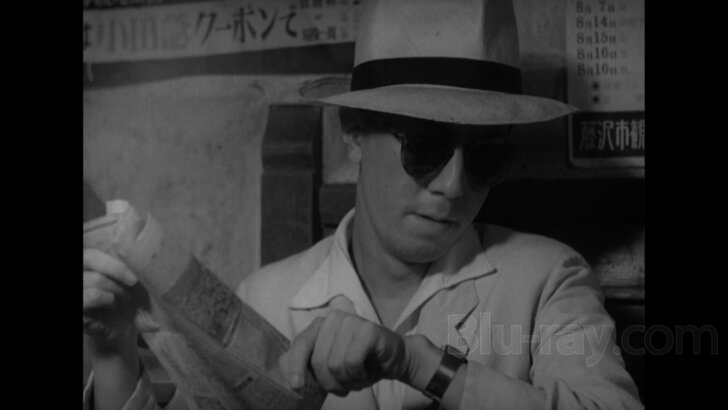
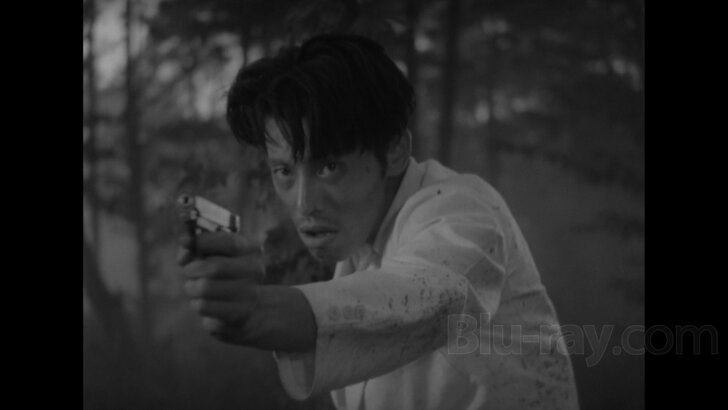
In Stray Dog, the theft occurs during an unbearably hot and humid summer day, somewhere in a busy district of Tokyo. In a crowded bus, the rookie Detective Murakami (Toshiro Mifune) loses his Colt pistol and panics. Initially, he chooses not to report the theft, concerned that his reputation would be permanently tarnished, and attempts to recover the Colt pistol alone. However, it is not long before he realizes that tracking down the thief who has embarrassed him in Tokyo’s underworld is like trying to find a needle in a haystack. Murakami then reaches out to Chief Detective Sato (Takashi Shimura), an old-timer with an impeccable reputation, and together they enter the slums where the thief may be hiding. However, while slowly making progress, the thief fires Murakami’s Colt gun, killing an innocent woman. Later, after he is cornered, the thief fires at Sato, too.
One of Akira Kurosawa’s better early films, Stray Dog is a stylized neorealist film trapped inside the body of a conventional crime thriller. Indeed, it creates a fine atmosphere of the kind that post-war conventional crime thrillers were known for, and occasionally behaves as one, but it does not attempt to impress as one. Like Bicycle Thieves, it seeks to accurately preserve a post-war reality and the efforts of ordinary people to cope with it. For this reason, large portions of it resemble extracts from a documentary feature.
Old claims that Stray Dog is a film noir are wildly deceiving. In a film noir, the hunt for the thief would have been the dominating event, giving the film its identity and dictating how Murakami and Sato behave. As directed by Kurosawa, Stray Dog is focused on the unfiltered reality in which Murakami and Sato are placed, how they observe and process it, and their contrasting philosophies of life. There is a generational clash of ideas between the two that is bigger than the hunt for the thief. Murakami is a rookie whose entire philosophy of life is structured around idealistic views that are at odds with the gravitational forces of post-war Japan. Sato is an aging cynic with an accurate grasp of these gravitational forces who begins using simple time-tested truths to reveal to Murakami that his maturation will be part of his transformation into one as well. In a film noir, the finale would have been about the resolution of the hunt for the thief. In Stray Dog, Kurosawa wraps up the hunt for the thief with the collapse of Murakami’s idealistic views.
Kurosawa shot Stray Dog in the slums of Tokyo with director of photography Asakazu Nakai, who soon after lensed Seven Samurai, Throne of Blood, and High and Low.
Criterion’s release presents a new 4K restoration of Stray Dog, sourced from a 35mm master positive. The 4K restoration was completed at Tokyo Lab Ltd.
Stray Dog Blu-ray Movie, Video Quality
Presented in its original aspect ratio of 1.37:1, encoded with MPEG-4 AVC and granted a 1080p transfer, Stray Dog arrives on Blu-ray courtesy of Criterion.
The release presents a new 4K restoration of Stray Dog, sourced from a 35mm master positive. The 4K restoration was completed at Tokyo Lab Ltd. The 4K restoration is also made available on 4K Blu-ray in this combo pack release.
The new 4K restoration brings a much-needed upgrade in quality. However, it also retains many obvious source limitations affecting delineation, clarity, and depth in different ways. Most are significantly toned down so that the visuals look as good as possible. I think that the best improvements, or the easiest to appreciate, are during well-lit close-ups. However, they are not consistent. Some reveal flatness, and some also reveal small surface imperfections. I prefer how the majority of the roughest areas look in 1080p because the native 4K presentation tends to exacerbate them quite a bit. Still, they are impossible to brush aside, whether one views the 4K restoration in native 4K or 1080p. The grayscale is pleasing. However, ideally, blacks, grays, and whites should be healthier and more vibrant. Image stability is good, but some sporadic bumps and shaky transitions remain. All in all, given the history of Stray Dog and the surviving elements for it, this 4K restoration should remain its definitive presentation. (Note: This is a Region-A "locked" Blu-ray release. Therefore, you must have a native Region-A or Region-Free player in order to access its content).
Stray Dog Blu-ray Movie, Audio Quality
There is only one standard audio track on this release: Japanese LPCM 1.0. Optional English subtitles are provided for the main feature.
I viewed large portions of the new 4K restoration of Stray Dog on 4K Blu-ray and Blu-ray. The comments below are shared in our review of the combo pack release as well.
The lossless track reveals inconsistencies as well. However, clarity and stability are easy to describe as good. The fluctuations affect sharpness and dynamic strength. However, large portions of the film are shot outdoors, in natural conditions, so random sounds and noises definitely add to the fluctuations. The English translation is very good.
Stray Dog Blu-ray Movie, Special Features and Extras
- Commentary - in this archival commentary, Stephen Prince, author of The Warrior's Camera: The Cinema of Akira Kurosawa, deconstructs Stray Dog and comments on the socio-cultural environment in which it was conceived and made. The commentary was recorded for Criterion in 2003.
- Akira Kurosawa: It Is Wonderful to Create - this 2002 documentary short on the making of Stray Dog, part of the Toho Masterworks series Alira Kurosawa: It Is Wonderful to Create, features interviews with Akira Kurosawa, production designer YoshiroMuraki, actress Keiko Awaki, and others. In Japanese, with English subtitles. (33 min).
- Leaflet - an illustrated leaflet featuring an essay by film critic Terrence Rafferty and an excerpt from Akira Kurosawa's book Something Like an Autobiography, as well as technical credits.
Stray Dog Blu-ray Movie, Overall Score and Recommendation
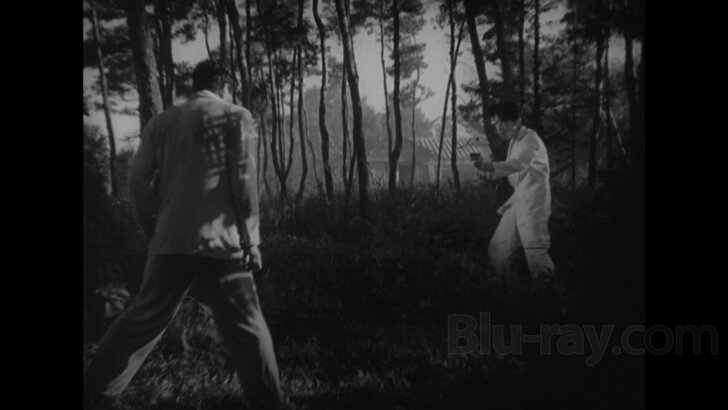
In Akira Kurosawa's Stray Dog, a rookie detective asks a senior colleague to help him recover his Colt pistol after a thief steals it and disappears in the slums of Tokyo. Shortly after, the hunt for the thief becomes an eye-opening, bruising educational experience for the rookie, and his philosophy of life, structured around idealistic views at odds with the gravitational forces of post-war Japan, begins to change. Stray Dog and Bicycle Thieves share many striking similarities. Needless to say, they are both very interesting neorealist time capsules. Criterion's Blu-ray release presents a good new 4K restoration of Stray Dog, which is also made available on 4K Blu-ray in this combo pack release. HIGHLY RECOMMENDED.

Similar titles
Similar titles you might also like

The Bad Sleep Well
悪い奴ほどよく眠る / Warui yatsu hodo yoku nemuru
1960

High and Low
天国と地獄 / Tengoku to jigoku
1963
Drunken Angel
醉いどれ天使 / Yoidore tenshi
1948

Le Samouraï
1967

Violent Cop
その男、凶暴につき
1989

Bullhead
Rundskop
2011

Mother
마더 / Madeo
2009

Badge 373
Limited Edition
1973

On Dangerous Ground
Warner Archive Collection
1951
Red Beard
赤ひげ / Akahige
1965

Pioneer
Pionér
2013

Kiss Me Deadly
1955

Quai des Orfèvres
1947

Ikiru
生きる
1952

The Big Heat
1953

Monsieur Hire
1989

Where the Sidewalk Ends
Limited Edition to 3000 - SOLD OUT
1950
Dodes'ka-den
どですかでん / Dodesukaden
1970

Memories of Murder
살인의 추억 / Salinui chueok
2003

Insomnia
1997