Strawberry Marshmallow OVA Blu-ray Movie
HomeStrawberry Marshmallow OVA Blu-ray Movie 
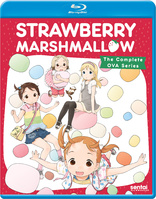
Ichigo MarshmallowSentai Filmworks | 2007-2009 | 130 min | Rated TV-14 | Jul 12, 2016
Price
List price:Listed on Amazon marketplace

Movie rating
7.8 | / 10 |
Blu-ray rating
| Users |  | 0.0 |
| Reviewer |  | 2.5 |
| Overall | | 2.5 |
Overview
Strawberry Marshmallow OVA (2007-2009)
Nobue Itou may be attending college, but her real lessons come from dealing with her 12-year-old sister Chika and her equally adorable friends. There's Miu Matsuoka, the troublemaking girl next door who's never found a diabolical plan that she wasn't willing to hatch. Then there's the perplexing Ana Coppola, who was born in England but has lived in Japan for so long that she's forgotten most of her English and is unsuccessfully attempting to re-learn her British heritage based on some rather erroneous assumptions. After those two handfuls, shy, sensitive Matsuri Sakuragi should be a welcome dose of normality, but unfortunately Matsuri is also incredibly gullible. And then there's Chika herself, who's actually the most mature and sensible person in the Itou household… which comes in handy when her older sister attempts to raid Chika's savings in order to buy cigarettes! Get ready for a cute overload so intense that it can be used as a deadly weapon when slices of everyday life get whipped to frothy perfection in STRAWBERRY MARSHMALLOW!
Starring: Hitomi Nabatame, Saeko Chiba, Ayako Kawasumi, Mamiko Noto, Junko MinagawaDirector: Takuya Satô (I)
| Foreign | Uncertain |
| Anime | Uncertain |
| Comedy | Uncertain |
| Comic book | Uncertain |
Specifications
Video
Video codec: MPEG-4 AVC
Video resolution: 1080p (upconverted)
Aspect ratio: 1.78:1
Original aspect ratio: 1.78:1
Audio
English: DTS-HD Master Audio 2.0 (48kHz, 24-bit)
Japanese: DTS-HD Master Audio 2.0 (48kHz, 24-bit)
Subtitles
English
Discs
Blu-ray Disc
Single disc (1 BD)
Playback
Region A, B (C untested)
Review
Rating summary
| Movie | | 2.5 |
| Video |  | 4.0 |
| Audio |  | 3.5 |
| Extras |  | 0.5 |
| Overall | | 2.5 |
Strawberry Marshmallow OVA Blu-ray Movie Review
Reviewed by Dr. Stephen Larson November 5, 2016Strawberry Marshmallow (Ichigo Mashimaro) originated as a Barasui-created manga series that follows the adventures of four elementary
school girls and their college-aged big sister in Hamamatsu, Japan. In 2005, it became an anime series and was also adapted into a PlayStation 2
video game. Three original video animation (OVA) episodes were released two years later by the Daume studio between February and April, 2007.
This was followed by a two-episode OVA series titled Strawberry Marshmallow Encore, which was released between late January and
March, 2009. Sentai Filmworks has collected the latter five episodes and released them on a single BD-25 as part of "The Complete OVA Series."
Each episode runs twenty-five minutes on average and contains the internal eyecatches (or ad bumpers) that aired between commercial breaks on
the TBS Japanese television network. Each episode can be played through Sentai's main menu. (I could not find a "play all" option.)
1. "Scenery" ("Keshiki" [けしき]): Nobue Ito, the twenty-year-old college student, goes on a job hunt but has her application tampered with by Miu
Matsuoka, who is prone to playing pranks on the girls. The three girls have a long day at school.
2. "Always" (aka "The Usual"; "Itsumo" [いつも]): This is probably my favorite episode of the bunch. The girls play hide-and-seek, dress up in
different costumes, and are up to their usual tricks. Everyone is concerned about how Matsuri Sakuragi, who is one of the youngest, will be able to
grapple with life's challenges as she matures.
3. "Everyday" ("Mainichi" [まいにち]): The gang goes on a holiday trek where they visit the public bath, tell ghost stories, and go for an evening
stroll in the moonlight.
4. "Hello" (aka "Good Afternoon"; "Haisai" [ハイサイ]): In one of the series' few action scenes, Miu bangs her head and ascends to heaven. She
stirs a lot of commotion there before regaining consciousness. The girls go on a school trip where they paint in a park.
5. "See You Tomorrow" ("Mata Ashita" [またあした]): Miu stimulates the girls into thinking about what their friendships mean. Mui also acts as
prognosticator for how her friends will do in junior high. The episode culminates with Nobue escorting them to the beach.
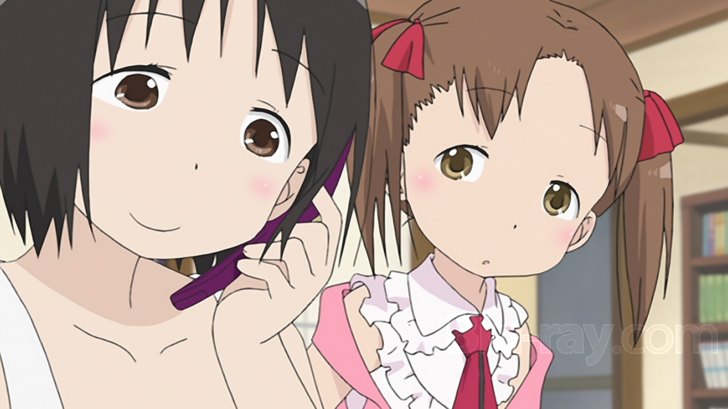
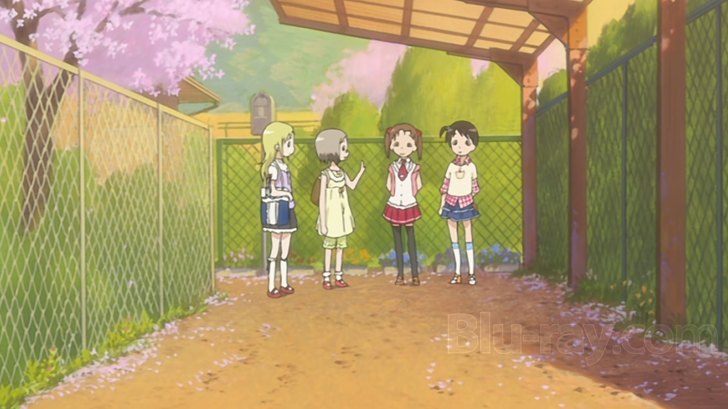
The episodes, particularly the first three, begin with a catchy ballad that depicts the girls active and playing outdoors. Strawberry Marshmallow typically consists of a series of vignettes or skits involving the girls and their day-to-day activities. The series is geared toward the female adolescent demographic and while it contains adult characters such as teachers and a wise old blind man, it is best enjoyed by pre-teens. While the verdant colors are often stunning to behold, the animation is not on the same level as bigger-budgeted animated features released in commercial cinemas. A lot of the backgrounds have a very flat, two-dimensional look to them and lack much detail. Sky, trees, and other objects in the periphery often remain static. It is a creative decision on the animators' part to choose stasis over movement (or vice versa) but narratively speaking, I thought that there should have been more going on in the frame during the wide shots.
Strawberry Marshmallow OVA Blu-ray Movie, Video Quality
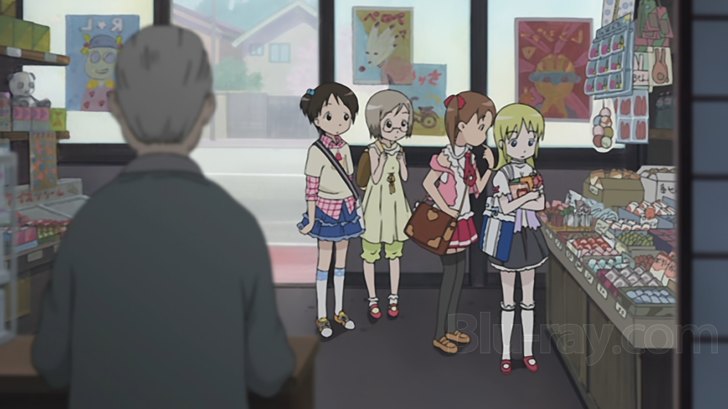
All five episodes appear in the aspect ratio of 1:78:1, which is presumably how they were presented during their original air dates. The source print is very clean with few defects to spot. The image is frequently overly bright, which makes me wonder if there may have been some contrast boosting. Color delineation is good, although not all colors appear to be completely "filled in." Some hues have better definition than others. All in all, a more than acceptable transfer without any issues.
Strawberry Marshmallow OVA Blu-ray Movie, Audio Quality
Sentai has provided Strawberry Marshmallow's sound track with two audio options: an original Japanese DTS-HD Master Audio 2.0 and an English dubbed DTS-HD Master Audio 2.0. I listened to the original track for this review. Dialogue and sound effects are directed largely through the center and front channels. The track sounds solid without any technicalities. The surrounds get some action when pop songs are played. Sentai has supplied optional yellow English subtitles for the Japanese dialogue. It also translates essentially any Japanese text that is in the frame. The captions are thorough and you will probably need to pause the disc to read them in full.
Strawberry Marshmallow OVA Blu-ray Movie, Special Features and Extras
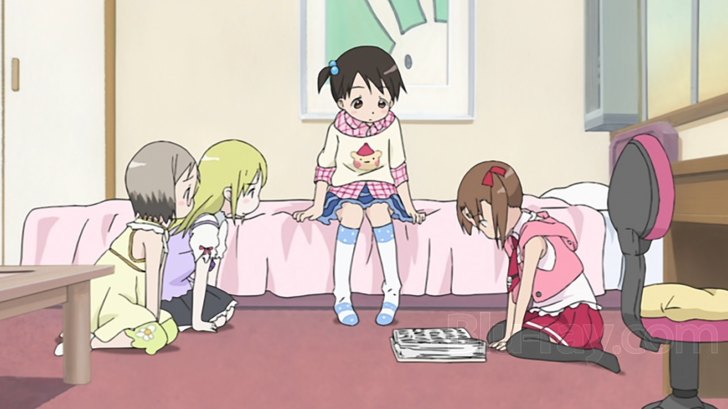
Sentai has included two very minor extras.
- Clean Opening Animations (3:23, 1080p) - the opening without any titles, credits, or subtitles for the song's lyrics.
- Clean Closing Animations (4:59, 1080p) - the finale sans scrolling end credits or subtitles.
- Sentai Trailers - trailers for four of Sentai's catalog titles.
Strawberry Marshmallow OVA Blu-ray Movie, Overall Score and Recommendation
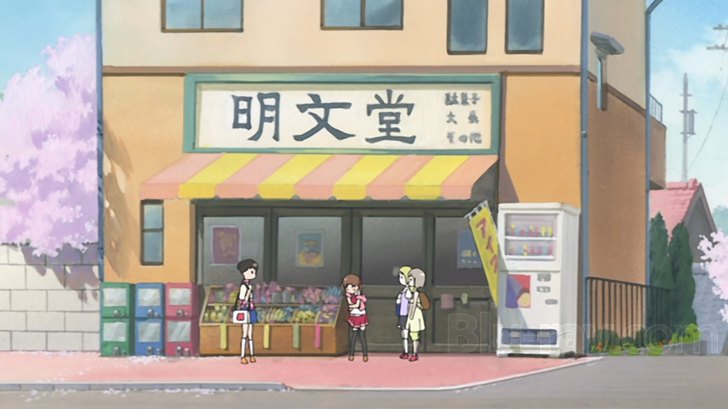
Admittedly, I am not part of the target audience that the producers of Strawberry Marshmallow sought to reach and while the series moves fast, I had difficulty sustaining interest in the characters and their dilemmas. Sentai offers above average video and serviceable audio but doesn't deliver hardly anything in the way of bonus features. If you're a big fan of this series and also want to own all twelve episodes of the original 2005 episodes, Sentai has also put out a two-disc Strawberry Marshmallow: Complete TV Series Blu-ray.
Other editions
Strawberry Marshmallow: Other Seasons

Similar titles
Similar titles you might also like
(Still not reliable for this title)

Is the Order a Rabbit? BLOOM: Complete Collection
2020

Non Non Biyori: Complete Collection
2013

Non Non Biyori Repeat: Complete Collection
のんのんびより りぴーと
2015

Flying Witch: Complete Collection
ふらいんぐうぃっち
2016

The Pet Girl of Sakurasou: Complete Collection
さくら荘のペットな彼女 / Sakurasou no Pet na Kanojo
2012-2013

Tamako Market: Complete Series
たまこまーけっと / Tamako Maketto
2013

K-ON! Season 2: Collection 1
けいおん!!
2010

Lucky Star: The Complete Series & OVA
らき☆すた
2007-2008

Hidamari Sketch: Season 1
2007

Hidamari Sketch x 365: Season 2
2008-2009

Azumanga Daioh: Complete Collection
あずまんが大王
2002

Haven't You Heard? I'm Sakamoto: Complete Collection
坂本ですが? / Sakamoto desu ga?
2016

Maria Holic Alive: Complete Collection
まりあ�ほりっく / Maria†Horikku
2011

Maria Holic: Complete Collection
まりあ†ほりっく / Maria†Horikku
2009

Tanaka-Kun Is Always Listless: Complete Collection
田中くんはいつもけだるげ
2016

New Game!: Complete Series
Essentials
2016-2017

Dagashi Kashi: Season 2
Dagashi Kashi 2 / Essentials
2018

Himouto! Umaru-chan R: Complete Collection
干物妹!うまるちゃん
2017

Mysterious Girlfriend X: Complete Collection
2012

The Comic Artist and His Assistants: Complete Collection
マンガ家さんとアシスタントさんと / Mangaka-san to Ashisutanto-san to
2014