Stravinsky: The Rake's Progress Blu-ray Movie
HomeStravinsky: The Rake's Progress Blu-ray Movie 
BBC | 2010 | 140 min | Not rated | Jan 31, 2012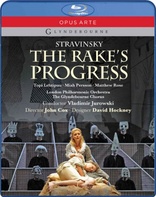

Movie rating
7.3 | / 10 |
Blu-ray rating
| Users |  | 2.0 |
| Reviewer |  | 4.5 |
| Overall | | 4.2 |
Overview
Stravinsky: The Rake's Progress (2010)
The celebrated John Cox - David Hockney production of Stravinsky's opera is revived in this 2010 presentation at the Glyndebourne Festival.
Starring: Topi Lehtipuu, Miah Persson| Music | 100% |
Specifications
Video
Video codec: MPEG-4 AVC
Video resolution: 1080i
Aspect ratio: 1.78:1
Original aspect ratio: 1.78:1
Audio
English: DTS-HD Master Audio 5.1
English: LPCM 2.0
Subtitles
English, French, Spanish, German
Discs
50GB Blu-ray Disc
Single disc (1 BD)
Playback
Region A (B, C untested)
Review
Rating summary
| Movie |  | 5.0 |
| Video | | 4.5 |
| Audio | | 4.5 |
| Extras |  | 2.5 |
| Overall | | 4.5 |
Stravinsky: The Rake's Progress Blu-ray Movie Review
Finally, the Cox-Hockney production arrives on Blu-ray.
Reviewed by Jeffrey Kauffman April 11, 2012It’s not often that a series of illustrations has served as inspiration for an opera, but that’s exactly what happened when Igor Stravinsky serendipitously stumbled upon William Hogarth’s iconic A Rake’s Progress, which the painter and social satirist committed to canvas in 1732-33 and which were later published as engravings around 1735, and which Stravinsky caught in an art exhibition taking place in Chicago in 1947. The “anecdotal” nature of these depictions of the increasing moral turpitude of one Tom Rakewell struck Stravinsky as perfect fodder for an opera, and during Stravinsky’s long exile in California, the legendary composer set about writing a musical version of the story to a libretto by noted poets W.H. Auden and Chester Kallman. The Rake’s Progress remains one of Stravinsky’s most playful pieces, one which perfectly captures the arch ambience of the Hogarth procession of misfortunes and which subtly ping pongs between a Neoclassical quasi-Mozartian feel and more astringent modernism, as was Stravinsky’s wont during this era. In 1975, director John Cox enlisted designer David Hockney to go back to those original Hogarth depictions to derive yet more inspiration for a new production of The Rake’s Progress, and the result was one of the most acclaimed collaborations in modern operatic history. Hockney reinvented the Hogarth illustrations as living, breathing cartoons, bringing a sort of John Tenniel Alice in Wonderland ambience to another kind of fable. Hockney’s designs are a riot of color and invention and though they tend to give the opera s certain “two dimensional” feel, they also are surprisingly evocative and help to immediately create a mood that is both playful and perhaps unexpectedly strangely sinister and haunting.
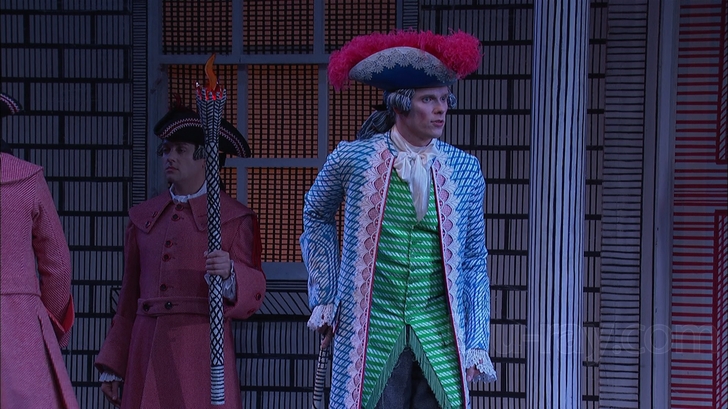
The irony is on display from virtually the first second of The Rake’s Progress, a piece which starts with happily ever after and then systematically degrades its supposed hero, Tom (Topi Lehtipuu) while at the same time devastating his paramour, Anne Trulove (Miah Persson). The progress here is obviously not progress in any sense other than forward movement, except that each movement leads Tom to a new level of smarminess and debauchery. Lehtipuu and Persson are extremely well cast in this production, and both bring a sort of ingenuous naïvete (at least in the early scenes) that is extremely ingratiating. The two real scene stealers here (aside from Hockney, who after all created the scenes to be stolen) are Matthew Rose, giving a lugubriously menacing performance as Nick Shaeow, and Elena Manistana, who simply takes over the opera as Baba the Turk.
It might seem as contrary to an opera’s success, or maybe even its intrinsic worth, when the production design is such a central part of a presentation, and in fact may well be its ultimate calling card, but the simple fact is Stravinsky’s piece, while often deemed problematic, is in fact one of his most accessible pieces, infused with a sly wit and acerbic humor that plays especially well now, probably more so than when it premiered more than a half century ago. And given that indubitable musical and dramatic worth, there’s nothing that says a sterling production design can’t aid and abet an opera’s ultimate level of visceral impact, and that is most certainly the case here. Hockney pulls out all the stops, with one virtuoso element after another (probably highlighted by the “black and white” auction sequence), so that there is visual splendor galore to entrance the eye as much as Stravinsky’s bi-temporal music enchants the ear.
Something this admittedly outré might be seen as a gimmick by the more cynical, and yet the staying power of this production certainly argues that it isn’t only mere stagecraft. Bringing the Hogarth series alive was a brilliant tour de force on the part of Cox and Hockney, and this presentation of The Rake’s Progress has become justifiably famous as the benchmark by which all subsequent productions of the opera have been judged. The good news is, some thirty five years on now, the production has lost little of its energy and wit, and this Glyndebourne outing proves that sometimes everything old is new again, sparklingly so.
Stravinsky: The Rake's Progress Blu-ray Movie, Video Quality
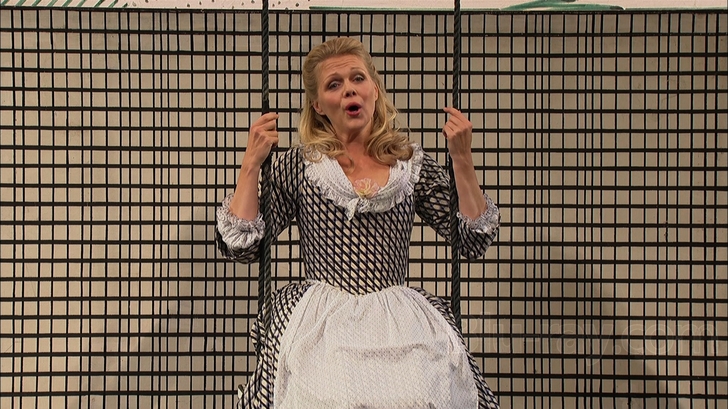
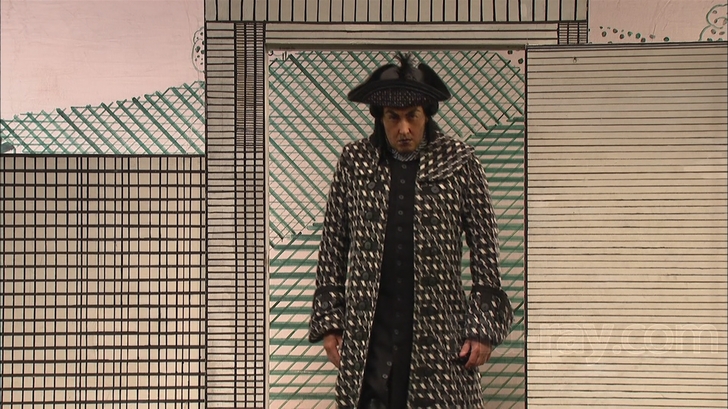
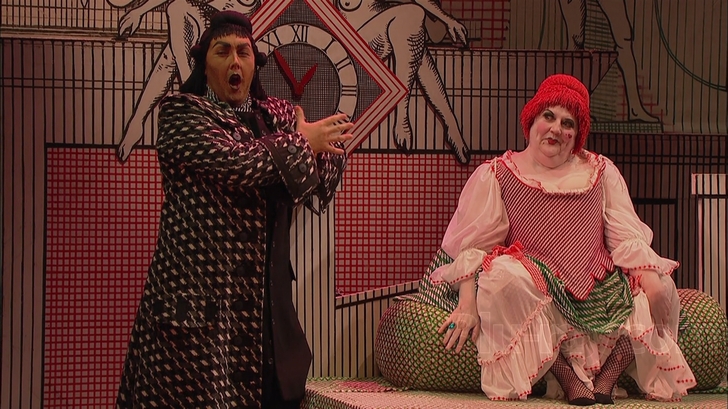
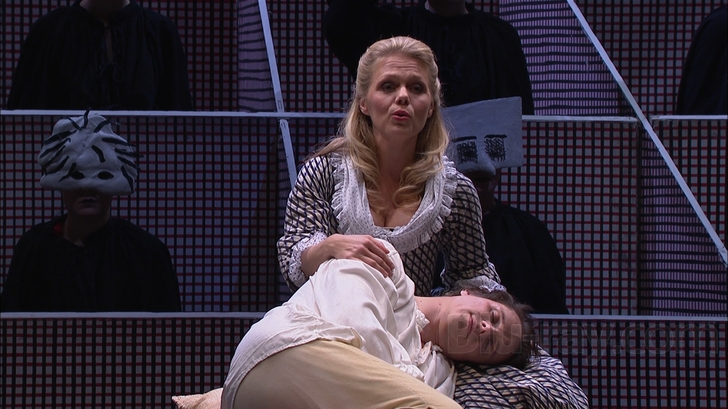
The Rake's Progress is presented on Blu-ray courtesy of Opus Arte with an AVC encoded 1080i transfer in 1.78:1. The wonder here is not that there's occasional moiré and aliasing, but that there is so amazingly little of it, considering the incredible cross-hatched, close-cropped patterns that are on display in virtually every moment of this production. (A cursory review of the screencaps included with this review will show just how ubiquitous these patterns really are in this production.) Hockney's backgrounds are full of cross-hatched lines and parallel lines, as are his costumes, and it's rather astonishing that these elements present few if any problems in resolving correctly, and intead remain steadfast, stable and brilliantly sharp and clear. Where moiré and aliasing do crop up, they tend to afflict some of the non cross-hatched costumes, including a natty Houndstooth jacket that Tom wears early in the opera. This is overall a brilliantly sharp and clear presentation with gorgeously saturated colors and often impeccable fine detail, detail which helps bring out every nuance of Hockney's astounding production design.
Stravinsky: The Rake's Progress Blu-ray Movie, Audio Quality
The Rake's Progress offers two lossless audio options, a DTS-HD Master Audio 5.1 surround mix and an uncompressed LPCM 2.0 stereo fold down. This is one of Stravinsky's most colorful and at times achingly lyrical (if typically astringent) scores, and both of these lossless tracks present the full panoply of Stravinsky's elegant orchestration in full sonic splendor, with superb fidelity and some nicely varied dynamic range. Balance between the London Philharmonic Orchestra (under the very capable baton of Vladimir Jurowski) and the principal cast is excellent for the most part, and the ensemble singing of The Glyndebourne Chorus is likewise crisp and clear. Stravinsky's convoluted vocal lines make deciphering some of the English libretto more than a bit hard at times, though there are optional English subtitles (as well as several other languages) to help make out the words.
Stravinsky: The Rake's Progress Blu-ray Movie, Special Features and Extras
- Introduction to The Rake's Progress (1080i; 7:24) provides some good general background on both the opera and especially this iconic John Cox – David Hockney production. Hockney refers to this production as "The Phantom of the Opera of the opera world," a reference to this production's long-lived existence, akin to the Andrew Lloyd Webber musical. Conductor Vladimir Jurowski and John Cox are also interviewed and give quite a bit of background on how Stravinsky came to write the piece (which Hockney refers to as "the greatest opera ever written in Hollywood".
- Behind The Rake's Progress (1080i; 11:52) is a good behind the scenes featurette, showing the set being constructed in time lapse photography and featuring interviews with cast and crew.
- Cast Gallery (1080i; 00:56)
Stravinsky: The Rake's Progress Blu-ray Movie, Overall Score and Recommendation
The 2009 Blu-ray release of a reimagined The Rake's Progress was a brilliant (if at times odd) placeholder for lovers of this classic Stravinsky opus, but true aficionados were probably hoping all along for a high definition release of what has become the most iconic presentation of the piece for the last thirty five years or so. (A DVD exists of the original production, conducted by Bernard Haitink, but the video quality is pretty horrid, to say the least.) Now those ardent wishes have been answered, and the really good news here is the excellence extends far beyond the smart direction of John Cox and the brilliant production design of David Hockney. The cast here is by and large perfectly cast, and the singing is generally marvelous. The London Philharmonic is more than capably directed by Vladimir Jurowski, and the entire production simply bristles with energy and wit. Even those who don't care one whit for opera (or even Stravinsky) may well want to check out this incredible presentation. With amazingly solid video (especially considering the patterns, which could have been an aliasing- fest) and great audio, and with some good (if brief) supplements, this release easily comes Highly recommended.