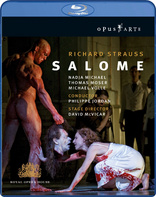
Strauss: Salome Blu-ray Movie
HomeStrauss: Salome Blu-ray Movie 
Royal Opera HouseOpus Arte | 2008 | 169 min | Jul 27, 2010
Price
List price:Listed on Amazon marketplace

Movie rating
7.1 | / 10 |
Blu-ray rating
| Users |  | 3.5 |
| Reviewer | | 3.5 |
| Overall | | 3.5 |
Overview
Strauss: Salome (2008)
Starring: Nadja Michael, Michaela Schuster, Thomas Moser, Joseph Kaiser (I), Michael VolleDirector: Jonathan Haswell, David McVicar
| Music | 100% |
Specifications
Video
Video codec: MPEG-4 AVC
Video resolution: 1080i
Aspect ratio: 1.78:1
Audio
German: DTS-HD Master Audio 5.1
German: LPCM 2.0
Subtitles
English, French, Italian, Spanish
Discs
50GB Blu-ray Disc
Single disc (1 BD)
Playback
Region A (B, C untested)
Review
Rating summary
| Movie | | 3.5 |
| Video |  | 4.5 |
| Audio |  | 5.0 |
| Extras | | 3.5 |
| Overall | | 3.5 |
Strauss: Salome Blu-ray Movie Review
David McVicar presents his version of "Salo-Me". If you wonder what that means, read on. . .
Reviewed by Jeffrey Kauffman July 27, 2010If you’ve ever pined for an operatic adaptation of Pier Paolo Pasolini’s notorious 1975 film Salo, or the 120 Days of Sodom, look no further. Scottish opera director enfant terrible and/or wunderkind (depending on your point of view) David McVicar has taken Pasolini’s decadent, fascistic vision and melded it wholesale onto Richard Strauss’ Salome. For McVicar, the opera indeed becomes his “Salo-me,” as he exploits the seedy underbelly of depravity that Strauss often dances around, with or without seven veils in attendance. Strauss could evoke the unseemly aspects of the dysfunctional family of Herod Antipas and his comely stepdaughter with grandiose orchestration and lugubrious melodies and harmonies. Here, in this Royal Opera House presentation, McVicar lays it all on the line, with full frontal nudity (both male and female) and a lasciviousness that may have made even original playwright Oscar Wilde blush. (Well, probably not, but you get the idea). McVicar’s Salome is an evening of shocking incongruities: Wilde’s original French—yes, French—text (which made it into German from an intermediary English language version and thus to Strauss virtually unchanged word and meaning-wise despite these two generations of translation) clashes strangely with the mid-1930’s Fascist setting McVicar has chosen; the production wants to substitute sometimes gratuitous appalling imagery in the place of Strauss’ sexually provocative music; and, vocally, star Nadja Michael struggles on the admittedly gargantuan ambitus that Strauss requires for this role. One way or the other, though, this is a Salome that won’t soon fade from memory, for better or worse.
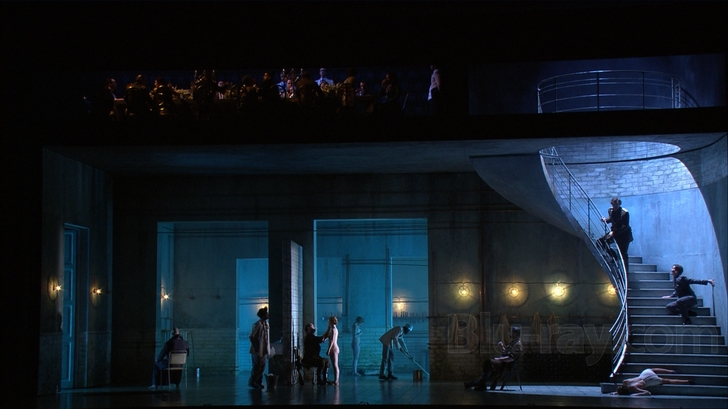
Es Devlin's striking bifurcated unit set.
Salome’s story has fascinated artistic and literary types for millennia, but Wilde’s interpretation of the story took it a new psychological level which it may not have had previously, at least on the surface. Wilde’s Salome plays with the author’s well known sexual proclivities in sometimes ironic fashion, as if Wilde is goading his audience into reacting, certainly something which in his private life brought a certain amount of tragedy and ruin. But could Wilde really be making a point about the aberrations of the ostensibly “normal” (read: heterosexuals) when so much anger was aimed at the “Sodomite” practices (so appropriately labeled with a Biblical term in this context) with which Wilde would soon find himself publicly embroiled. This is a simplistic analysis, to be sure, but the emotional subtext is there, certainly, of a cynical and bitter artist making very trenchant observations about human behavior.
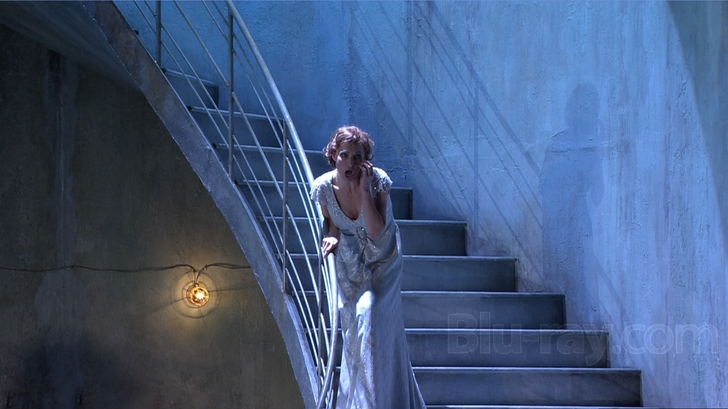
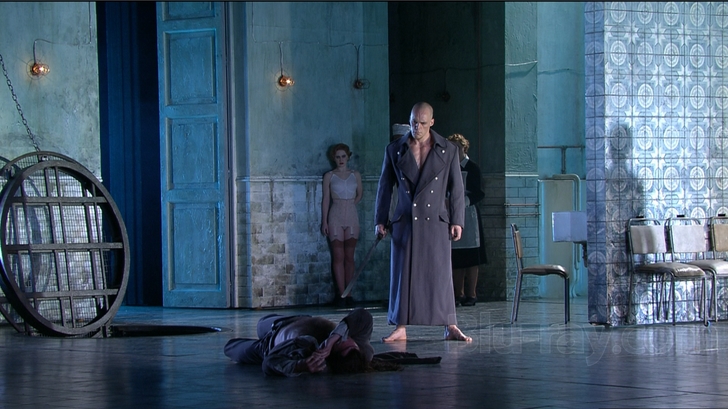
This particular Salome divides its world into a sort of proto-Upstairs, Downstairs morality play, albeit one where both levels are filled to the brim with depravity. As the curtain opens on Es Devlin’s striking set, we catch a glimpse of an ornate dinner party upstairs, where Herod (Thomas Moser) and his wife Herodias (Michaela Schuster) entertain a gaggle of glamorous guests. The bulk of the stage, however, is given over to the “subconscious” realm of the basement, where a combination of a bathroom and wine cellar is filled with various guards and at least one naked prostitute (the other prostitute lies sprawled on a gargantuan descending staircase, still in her girdle). Beneath even this level is the hidden cistern where John the Baptist, Jokanaan (Michael Volle) is imprisoned, his voice echoing up, capturing first Salome’s interest and then, later, the entire dinner party’s.
McVicar is a director who languishes in the psychological subtexts of the libretti he’s exploring, and there’s certainly a wealth of that in Strauss’ Salome. Probably McVicar’s crowning theatrical achievement in this production is his vivid and striking reimagining of the Dance of the Seven Veils, which McVicar transports into a Freudian catharsis, as Salome and Herod move together, in a sort of furtive pas de deux, in front of a series of projections, which make clear that the two have had a sexual history together. This casts a whole new light on Salome’s motivations and her own sexual proclivities, and Michael does a formidable job evincing the character’s moral and mental breakdown as the opera reaches its shattering climax.
A bit less understandable, if no less striking, is the odd use of a completely naked Executioner (Duncan Meadows, who evidently got the role when McVicar saw him “busking” outside of Covent Garden). Though Meadows possesses a muscular and imposing physique, there’s a certain “eww” factor when he arises from the prison cistern with John’s head precariously close to his own “smaller” head. It’s a perfectly Pasolini-esque image, to be sure, but I’m not quite sure what it’s doing in the putative late-Romantic world of Richard Strauss.
As good as an actress as Michael is, she struggles vocally with the role. Trained as a mezzo, Michael easily fills the burnished lower depths of Strauss’ vocal lines, and those are some of the most important moments for the character’s psychological development. However, the lilting higher range which Strauss contrasts with the darker elements find Michael strident and near shrieking at times. The unquestioned vocal presence of the evening is once again Michael Volle, who is quickly becoming the “can’t take your eyes—or ears—of him” baritone at Royal Opera productions. His Jokanaan is a force of nature and one of the strongest interpretations of this role I’ve experienced.
McVicar can be a self-indulgent director, which is often balanced with his really insightful analyses of texts and scores. Here, he’s half right: he has the decadent, depraved world of these characters down pat. Unfortunately, he’s also half wrong: he relies too much on a source—namely Pasolini’s Salo—which ultimately is at odds with the very text and score he’s trying to elucidate. It’s an odd, discomfiting evening as a result, but that’s not entirely a bad thing. Salome (or, as I indicated above, McVicar’s “Salo-me”) is an opera of ultimate discomfiture and perhaps smashing these disparate elements together will help bring it alive for some audience members.
Strauss: Salome Blu-ray Movie, Video Quality
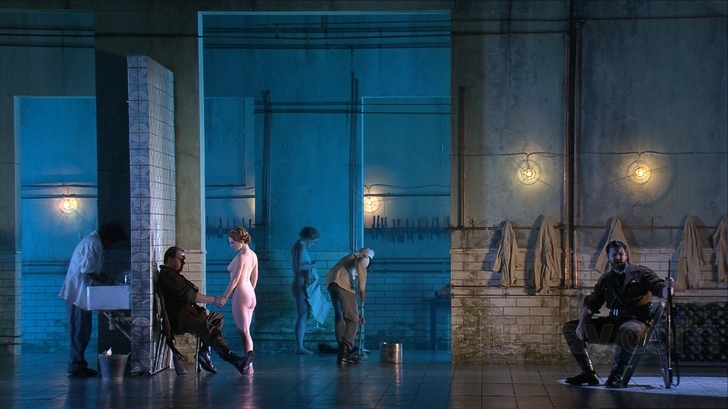
As the opening lines of Strauss' libretto make clear, these characters are all moonstruck in their own way, and Salome's AVC encoded 1080i "live" transfer (in a 1.78:1 aspect ratio) is full of the silver-blue light of a full moon. This is a strikingly visual production, which while offering some muted color sensibilities, is still sharp and full of amazing detail. Depth of field is surprisingly strong for a staged presentation, so that the "basement" set's upstage area is clear and ominous looking. The upstairs dining area is somewhat dark, but the deep blues of the costumes ring out with appealing clarity. Once Salome has coated her simple white dress with John's blood, we're offered a gruesomely drenched palette which is unforgettable. Black levels and contrast are quite good, though due to some backlighting issues during the Dance of the Seven Veils sequence, some of the whites edge toward blooming.
Strauss: Salome Blu-ray Movie, Audio Quality
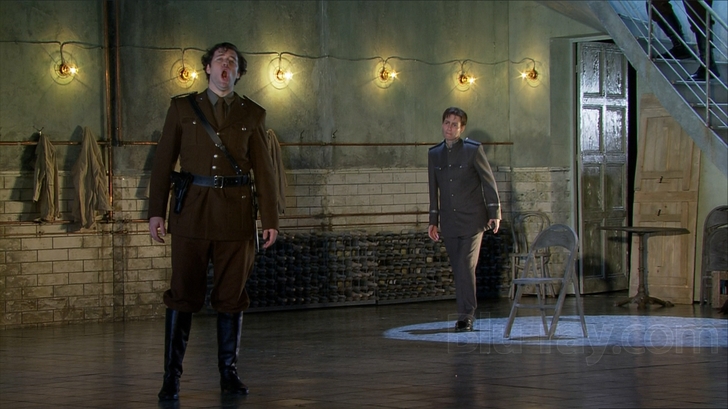
Conductor Philippe Jordan may bring a bit too much Gallic reserve to his interpretation of this incredibly bombastic score, but Salome's two lossless tracks, a DTS-HD Master Audio 5.1 and an LPCM 2.0, are amazing recordings. Strauss' dense orchestral vocabulary is presented with remarkable clarity here, and balance is great, especially notable since Strauss gives an unusual amount of solo instrument material against the orchestral masses. This is one of the most robust low ends I've experienced in an operatic recording in recent memory, with some of the tympani effects seemingly rocking my floorboards. Otherwise, though, there's an appealing lightness to the high end, especially the glorious strings. Voices, despite some of the technical issues alluded to above, sound wonderful, especially Volle's towering baritone. Surrounds are also used effectively when Volle is offstage, singing from the "dungeon." What Jordan's mannered approach may lack in athleticism, it more than makes up for in finesse, and these lossless recordings support that finesse perfectly.
Strauss: Salome Blu-ray Movie, Special Features and Extras
As is typically the case with these Opus Arte opera Blu-rays, we are offered an illustrated synopsis (5:39) and a cast gallery on the disc. There's also an excellent documentary entitled David McVicar's Salome: A Work in Progress (51:23), which traces the production back to its earliest pre-production phases in 2006 through its ultimate first staging and beyond. The insert booklet has a good essay on Wilde's Salome.
Strauss: Salome Blu-ray Movie, Overall Score and Recommendation
If McVicar's goal was to sear certain images into his audience's minds, his Salome is an unmitigated success. Once you start to actually ponder the import of those images, though, there are some nettlesome issues to contend with. But thinking about a piece as deep and multilayered as Strauss' Salome is a virtual requirement, anyway, so despite my misgivings about certain aspects of this production, I still recommend it.