Strauss: Elektra Blu-ray Movie
HomeStrauss: Elektra Blu-ray Movie 
Opus Arte | 2010 | 126 min | Not rated | Jan 25, 2011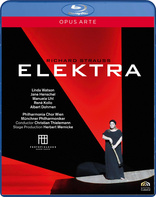

Movie rating
Movie has not been rated yetBlu-ray rating
| Users |  | 0.0 |
| Reviewer |  | 4.5 |
| Overall | | 4.5 |
Overview
Strauss: Elektra (2010)
Starring: Linda Watson (II), Jane Henschel, Manuela Uhl, René Kollo, Albert DohmenDirector: Andreas Morell
| Music | 100% |
Specifications
Video
Video codec: MPEG-4 AVC
Video resolution: 1080i
Aspect ratio: 1.78:1
Original aspect ratio: 1.78:1
Audio
German: DTS-HD Master Audio 5.1
German: LPCM 2.0
Subtitles
English, French, German, Spanish
Discs
50GB Blu-ray Disc
Single disc (1 BD)
Playback
Region A (B, C untested)
Review
Rating summary
| Movie | | 4.5 |
| Video | | 4.5 |
| Audio | | 4.5 |
| Extras |  | 3.0 |
| Overall | | 4.5 |
Strauss: Elektra Blu-ray Movie Review
Elektra gets back to her mythic roots in this amazing production.
Reviewed by Jeffrey Kauffman January 25, 2011When Stanley Kubrick perhaps fortuitously chose Richard Strauss iconic Also Sprach Zarathustra as one of the most memorable cues of 20th century film, it instantly elevated the composer to a level of pop culture consciousness that he had never experienced before, certainly not in his own lifetime. Strauss’ achievements were never ignored, to be sure, and he was a titan of German and international music for most of his life, but after his death in 1949 the misapprehension that he was somehow involved with Hitler and the Nazis colored the post-War appreciation and performance of his music. Slowly but surely, however, Strauss’ reputation rose from the ashes through the 1950’s and 1960’s until Kubrick made that opening C major-minor triad of Zarathustra an international “hit”, aided a few years later by Brazilian pianist-arranger Deodato’s funky remake of the basic melodic idea. Suddenly Strauss was an “it” composer, and his tone poems especially became regular repertory pieces all over the world. His operas, however, with the possible exception of Der Rosenkavalier, continued to be a bit more of a thorny matter, due both to their sometimes explicit subject matter, but perhaps more realistically for their often strident musical content. Strauss pushed the envelope quite forcefully in his vocal music, and that’s nowhere more apparent than in his “mythic” operas like Salome and Elektra.
The world of Greek mythology fascinated the German psyche is a way that is perhaps not so understandable to modern Western sensibilities. But to take just one example, Wagner utilized mythic elements culled from the Greeks, albeit shoehorned into Norse tropes, in virtually all of his major pieces. Strauss, like Wagner, was drawn to the epochal nature of the Greek myths, though his approach was perhaps to stray less from the source material than the Bard of Bayreuth. Strauss had in fact been lured into both Salome and, later, Elektra by seeing the dramatic adaptations by Hugo von Hofmannsthal, who would go on to provide the libretti for Strauss’ operatic takes on the stories. Von Hofmannstahl utilized music itself as a metaphor for various psychological issues that crop up in both operas, operas which feature famously fractured leading “heroines,” although in both instances, anti-heroines might be more apt. Strauss sensed this musical underpinning from the very first time he saw the original plays, and created some of his own most challenging compositions in attempting to further elucidate the “music” in von Hofmannstahl’s text.
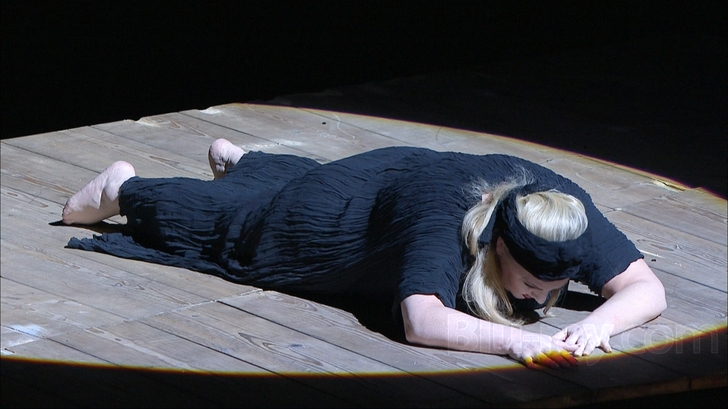
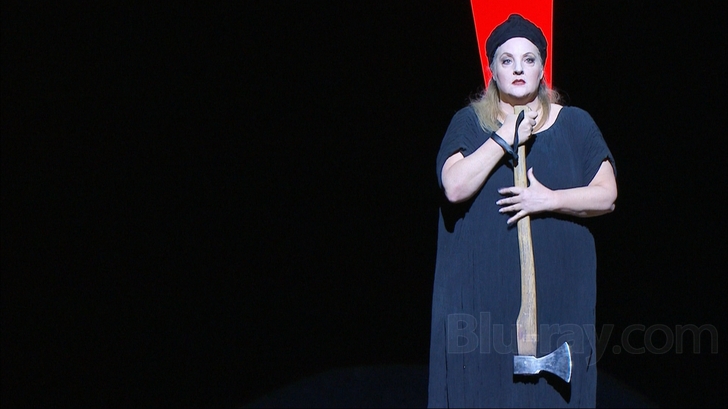
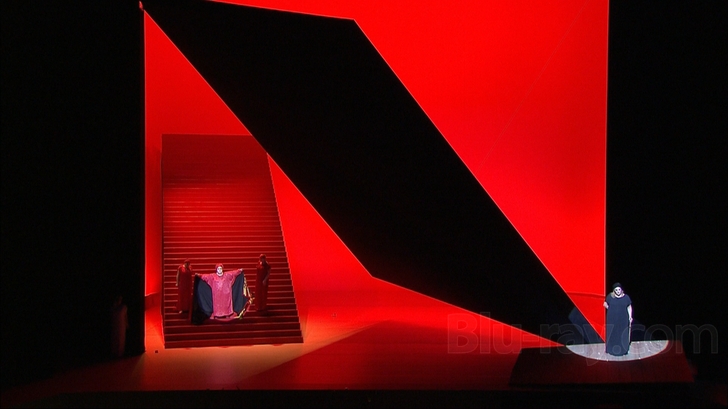
Elektra appeared previously on Blu-ray, in a Zurich production that was at best unseemly and at best saved by an interesting production design, certainly not the highest recommendation one could have for watching an opera. This new 2010 production recorded at Baden-Baden’s Festspielhaus offers a more classical interpretation of the source material, in a production diametrically opposed to the Zurich, but featuring a production design that is at least as striking as that other version. Spare, lean, and stripped to its devastating emotional core, this Elektra is cast almost uniformly in shades of black, red and white, something that evidently von Hofmannstahl himself advocated in the early 20th century. This production is based upon the late Herbert Wernicke’s version, first done in Munich in 1997.
Elektra is the female equivalent of Oedipus, a conflicted character who wreaks havoc on her family, although unlike Oedipus, her devastation is conscious and not unwitting. The revenge fantasy which plays out in Strauss’ opera is highlighted by some of his most expressive and violent music. Elektra is not for the faint of heart, and it frankly is not always “easy” to listen to, but it immediately creates a disjointed, emotionally debilitating ambience that is like a window into its title character’s fractured soul.
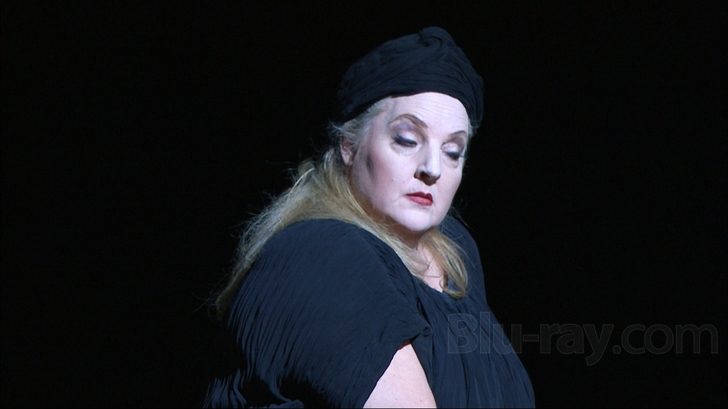
Linda Watson has become one of the better known interpreters of Wagner, and she brings that same lugubrious vocal quality and intense dramatic presence to her portrayal of Elektra. She is a magnetic force of nature in this production, and most viewers will not be able to pry their eyes off of her. The entire cast, though, rises to the occasion rather splendidly throughout this production, and it’s all the more notable because there really isn’t a wealth of bells and whistles here to keep the viewer otherwise occupied. Attention always remains resolutely on the singers, probably as it obviously should be, but seldom is in the world of tarted up reimaginings of classic pieces.
Christian Thielemann conducts here with panache and ferocity, leading the Munich Philharmonic (where he makes his conducting home) and the Vienna Philharmonic Choir in a blistering account of one of Strauss’ most problematic scores. With huge intervallic leaps and brittle dissonances, a helmsman of impeccable vigor, but also a certain degree of restraint, is required, and Thielemann does excellent work here. The singing and playing is at a very high level, helping to smooth out some of what can be rough edges in productions not handled as well as this one is.
It’s bracing to experience Elektra stripped back to something akin to its Grecian roots. One almost imagines one is in an ancient Greek amphitheater, seeing these mythic characters as Sophocles himself may have imagined them, without a lot of set dressing and other distractions getting in the way. This is certainly one of the most visceral productions of Elektra you’re likely to see, something quite remarkable when the pure visceral impact of Elektra is one of its most salient characteristics in even the worst productions.
Strauss: Elektra Blu-ray Movie, Video Quality
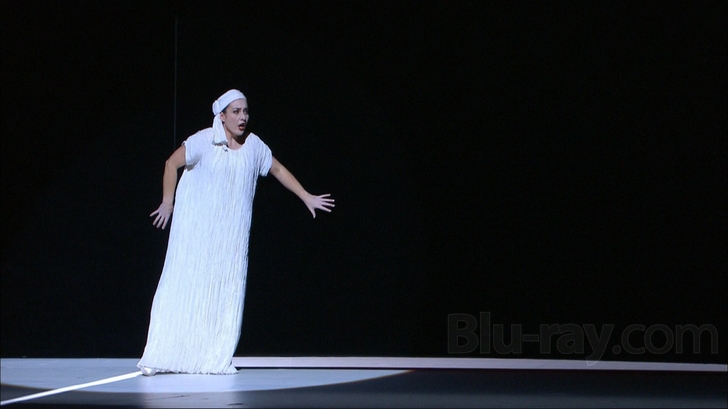
Despite, or perhaps exactly because of, being cast in a handful of stark colors, this AVC encoded 1080i Blu-ray (in 1.78:1) looks brilliantly sharp and is amazingly effective within the confines of its extremely limited palette. What you get here are pale whites, shadowy blacks, and blood reds and royal blues. That's really about it, but there is such a spare beauty to this production that the lack of mind blowing kaleidoscopic effects only adds to the emotional turmoil of the characters. This is one of the most interesting looking operas we've had on Blu-ray for a long time, specifically because of how minimal it all is. The stage is often lit and masked into oddly asymmetrical geometric shapes, and only the humans provide any relief from the hard edges of this approach. The image here is wonderfully sharp, clear and well detailed. Just don't be expecting Speed Racer: The Opera.
Strauss: Elektra Blu-ray Movie, Audio Quality
There are occasional niggling balance issues which keep me from giving Elektra's lossless audio mixes a perfect score, but otherwise you'd be hard pressed to find better fidelity than either the DTS-HD Master Audio 5.1 or LPCM 2.0 tracks included on this Blu-ray. This is not the most gorgeously melodic of Strauss' scores, not to state the obvious, but the strident and hyperbolically emotional aspects of the score are presented with stunning clarity and absolutely astounding dynamic range on this Blu-ray. The orchestra is sharp and brittle and Watson and her co-stars are bright without being overly harsh. As tends to be the case with Strauss' gargantuan orchestral forces and overpowering orchestrations, at times the singers are just slightly buried underneath the orchestral masses, and that's really my only complaint of any import with regard to this stellar release.
Strauss: Elektra Blu-ray Movie, Special Features and Extras
Aside from the usual Cast Gallery, Elektra also features:
- The Making of Elektra (1080i; 14:35) a kind of fun featurette where we get to see some backstage shenanigans, some of which seem sort of out of place considering the dramatic excesses of the opera. Watson actually knows how to smile and laugh!
Strauss: Elektra Blu-ray Movie, Overall Score and Recommendation
Elektra epitomizes the angst and encroaching terror that surrounded the early 20th century's most gifted artists and seemed to affect them on an almost subliminal level. This is not an easy piece by any stretch, and it takes a certain intestinal fortitude to make it through two hours of such relentless fury. This production helps ground the soaring peaks and devastating valleys of one of Strauss' most difficult scores by removing any production design excesses and stripping the elements back to their mythical bases. Expertly sung and played, this Elektra is Highly Recommended.