Strauss: Capriccio Blu-ray Movie
HomeStrauss: Capriccio Blu-ray Movie 
Metropolitan OperaDecca | 2011 | 148 min | Not rated | Dec 20, 2011

Movie rating
7.3 | / 10 |
Blu-ray rating
| Users |  | 0.0 |
| Reviewer |  | 4.5 |
| Overall | | 4.5 |
Overview
Strauss: Capriccio (2011)
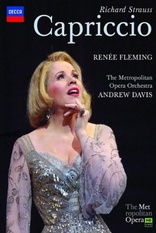
Strauss' final opera, first seen at the Met in 1998 in this John Cox production, was revived in 2010 for Renee Fleming. One of the world's great Strauss interpreters, she brought a "plush and alluring" voice and "noble phrasing" to her portrayal of the Countess, "a role that suits her iedal" (The New York Times). Fleming is joined in this Live in HD production by an extraordinary cast (Joseph Kaiser, Russell Braun, Peter Rose) under the musical direction of Andrew Davis.
Starring: Renée Fleming, Sarah Connolly, Joseph Kaiser (I), Peter Rose, Russell Braun| Music | 100% |
Specifications
Video
Video codec: MPEG-4 AVC
Video resolution: 1080p
Aspect ratio: 1.78:1
Original aspect ratio: 1.78:1
Audio
German: DTS-HD Master Audio 5.1
German: LPCM 2.0
Subtitles
English, French, Spanish, German, Cantonese
Discs
25GB Blu-ray Disc
Single disc (1 BD)
Playback
Region A (B, C untested)
Review
Rating summary
| Movie | | 4.5 |
| Video | | 4.5 |
| Audio |  | 5.0 |
| Extras | | 0.0 |
| Overall | | 4.5 |
Strauss: Capriccio Blu-ray Movie Review
Rodgers v. Hammerstein.
Reviewed by Jeffrey Kauffman January 4, 2012There’s a very telling moment in Richard Strauss’ 1898 tone poem Ein Heldenleben (A Hero’s Life), where snarling reeds, woodwinds and brass seem to slither out of some sonic pit of hell and meander with chromatic fury across the sound stage, confronting the tone poem’s Hero with an aural assault that Strauss labeled as "Des Helden Widersacher" (The Hero's Adversaries). What’s so bracing about this portrayal of the Hero’s critics is not just its scabrous humor and bristling energy, it’s how Strauss utilized a nascent atonality to depict not just the critics of the generic Hero, but perhaps of Music (with a capital M) itself. Usually analysts have relegated this depiction to “actual” critics like Eduard Hanslick, who famously wasn’t all that enamored of Strauss’ music, but could Strauss have been presciently warning of us the atonality that would soon become the defining movement of early 20th century music at the hands of the serial composers like Schoenberg? The early 1940’s find an obviously much mellower Strauss, but perhaps one no less consigned to going quietly into an atonal night. What’s fascinating about his last major operatic work, Capriccio, is how the composer has become his own critic, as it were, positing all sorts of philosophical ideas in the voices of a small coterie of parlor dwellers who debate the relative merits (and “importance”) of music, lyrics, and theater in general. Unlike the almost manically vigorous Critics Section of Ein Heldenleben, Capriccio finds Strauss in a much calmer, diatonic and pensive, though sensuous, mood. This is perhaps nowhere more evident than in the opera’s opening, which gets underway with a string sextet! What an odd choice of orchestration (even when linked to the idea the opera's characters are listening to one of the character's sextets), and one seemingly at odds with Strauss’ long penchant towards “bigger is better.” There’s little bombast in Capriccio, at least in terms of its orchestral presence. Instead Strauss infuses some of the characters with pomposity and dogmatism, perhaps not so subtly tipping the scales in favor of music as at the very least the more genteel Art, if not ultimately the most important.
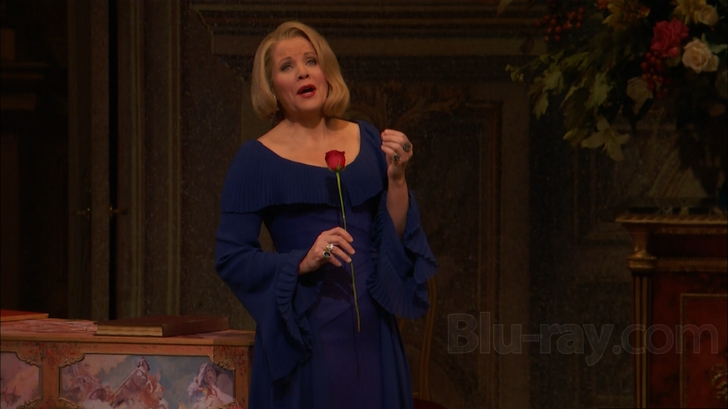
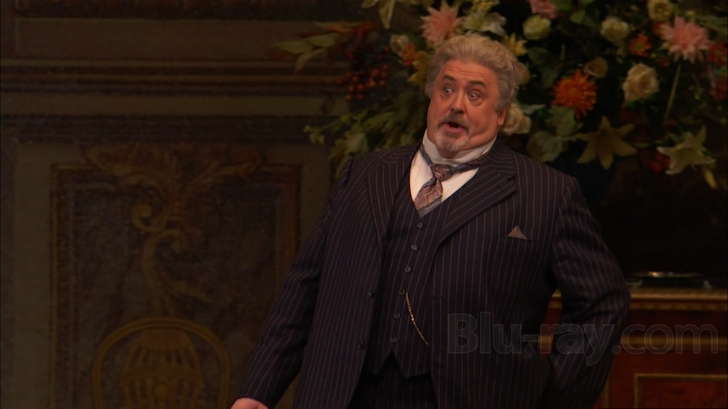
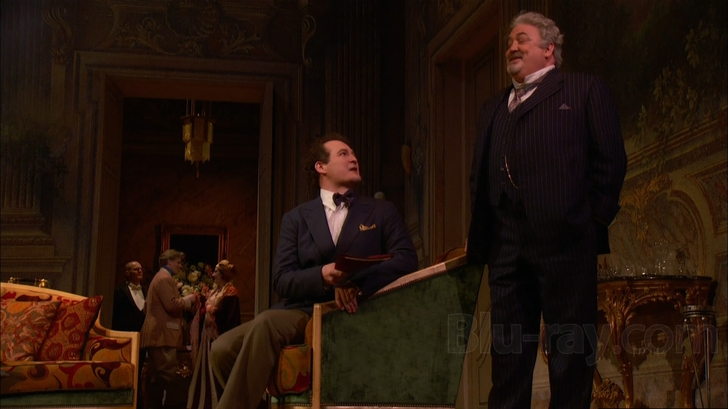
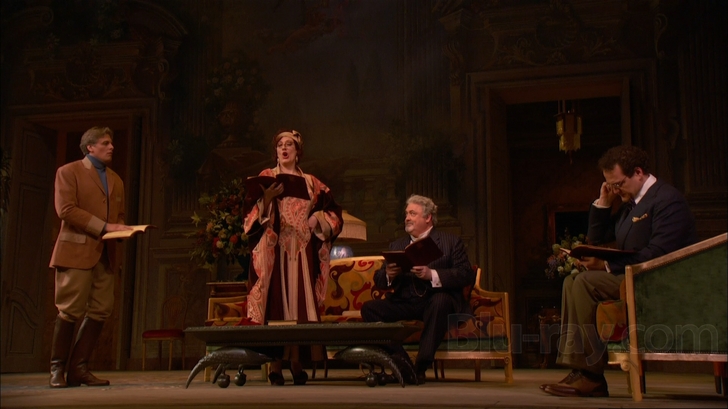
Strauss co-wrote his own libretto for Capriccio (with Clemens Krauss), and he subtitled the piece “a conversation in music,” and for an opera—especially a Strauss opera—it’s a deliberately polite and introspective affair. Madeleine, The Countess (Renée Fleming), hosts a glittering salon in her palatial manse that includes a coterie of artistic types in attendance, including Olivier (Russell Braun), a poet; Flamand (Joseph Kaiser), a composer; La Roche (Peter Rose), a theater director; Clairon (Sarah Connolly), an actress; and various hangers-on, including singers and dancers. Flamand and Olivier both have their amorous sights set on The Countess, and they debate what Art will more readily sway her to their cause, music or poetry. They haltingly come to the conclusion that the only fair way is to let The Countess herself decide, at almost the same time that La Roche, who has been snoring quietly in a plush velvet chair, suddenly awakens and tells them they’re both being ridiculous. Neither music nor poetry are primary Arts, they both fall under the aegis of Theater, and it’s Theater that is the reigning formulation.
Capriccio is more of a chamber opera than anything else, a relatively small cast affair that takes place all in one setting and more or less in real time. What’s so bracing about the piece is how effortlessly Strauss becomes the arbiter of whole histories of artistic pursuits. La Roche declaims about the easy entertainment value of opera buffa, something which appeals (in La Roche’s disdainful eyes) to “the man in the street.” Madeleine, on the other hand, sits at her harpsichord and laments that Couperin is so shallow. All sorts of composers and authors are put under the magnifying glass of these characters’ withering assessments, while at the same time they’re eagerly weighing the merits of whether music or spoken word is more “meaningful.” There’s a certain wry satiric quality to Capriccio which may not be at surface level but which is certainly there, and Strauss is not above pillorying those who have gone before in any number of Arts.
This is an elegantly staged and performed production that is highlighted by a gorgeous turn by Fleming, who has made Capriccio’s famous final scene something of a concert showcase in her solo appearances over the past few years. But the supporting cast here is also wonderful, with full throated offerings from both Kaiser and Braun. Connolly is also immensely appealing as a sort of operatic counterpart to the Dianne Weist role in Bullets Over Broadway. Sir Andrew Davis conducts The Metropolitan Opera Orchestra in a thrillingly precise reading of the score (though what’s that odd grunting noise in the opening string sextet—is it one of the players getting overly Glenn Gould declamatory on us?).
Capriccio is perhaps most famous for its closing scene, a solo aria (more or less) for The Countess that goes on for upwards of 15 minutes, as she attempts to resolve her feelings for both Flamand and Olivier. She sits at her harp (and Fleming does indeed seem to be playing it herself), moves about her salon, and engages in one of the most sensuously gorgeous pieces of music Strauss ever wrote, all the while attempting to divine her deepest thoughts and feelings about the twin powers of music and poetry. (In an aside, it should be mentioned that the dress costume designer Robert Perdziola has saddled Fleming with for this iconic scene—a huge, tinseled silver thing with an absurdly long train that Fleming repeatedly gets her feet caught in—is a ridiculous choice). The unspoken (no pun intended) irony here is that Madeleine herself is providing her own answer, in a way at least, by joining word to song, something she herself mentions in one of the aria’s most salient moments. But whom will she choose? Strauss cheats us a little by not actually revealing if Madeleine ends up with Flamand or Olivier. But this opera does take place in Paris, after all (though this production moves the time setting up considerably, placing it in the 1920’s). With that French setting, it’s not inconceivable that the only suitable conclusion would be joining a brilliant singer with a wonderful composer and a thoughtful librettist. Ménage à trois, anyone?
Strauss: Capriccio Blu-ray Movie, Video Quality
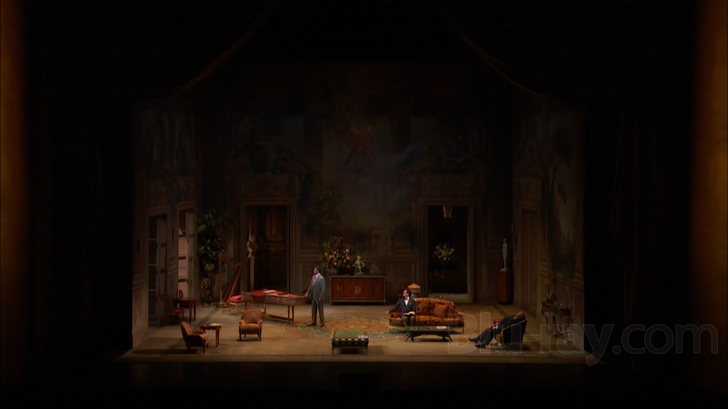
Capriccio is presented on Blu-ray courtesy of Decca with an AVC encoded 1080i transfer in 1.78:1. This is a nicely
sharp and well detailed looking transfer that ably reproduces the live performance ambience of what seeing this production
at The Metropolitan Opera must be like. Best of all, director Gary Halvorson covers the proceedings remarkably well, and
really quite cinematically at times, especially with his nice, repeated usages of slow tracking shots across the proscenium,
which considerably opens up the visual allure of the production. Colors are warm and inviting, and the costumes pop
especially well throughout the presentation. Fine detail is also very good, especially in the copious close-ups. There is one
brief lighting miscue or mishap shortly after Fleming sits at the harpsichord for the first time; you'll notice the brightness on
her face changes dramatically and she's in partial shadow just for a moment until the anomaly is corrected, but otherwise
things proceed without a hitch, with good contrast, excellent shadow detail and nicely consistent black levels.
It should be noted that this is another "Live at the Met" offering, but unlike others in this series, while we do get some brief
introductory comments by Joyce DiDonato, as well as DiDonato interviewing Fleming backstage, because Capriccio is
performed without intermissions or act breaks, there's none of the disconcerting backstage interstitials that have marred
some of the other Met Blu-rays.
Strauss: Capriccio Blu-ray Movie, Audio Quality
The depth and profundity of Strauss' last great operatic score are offered via two sterling lossless tracks on the Blu-ray, a DTS-HD Master Audio 5.1 surround mix and an uncompressed LPCM 2.0 stereo fold down. From the quiet whispers of the opening sextet to the gloriously rapturous finale where Fleming soars to the highest ranges of her impressive capabilities, the DTS track offers splendid fidelity and really remarkable dynamic range. There's not an immense amount of directionality here, perhaps due to The Met's somewhat narrow stage, though when only two or three people are on stage there's clear separation between them, especially if they're positioned far stage left or stage right. The balance between the orchestra and the singers is impeccable here, and the playing under Davis' baton is simply revelatory at times, bringing out the full luster of Strauss' ever-prodding discourses into the outer reaches of what is basically a diatonic offering.
Strauss: Capriccio Blu-ray Movie, Special Features and Extras
No supplements of any kind are offered on this Blu-ray.
Strauss: Capriccio Blu-ray Movie, Overall Score and Recommendation
This is about as lovely and loving a production of Capriccio you're likely to see. Beautifully cast, and with expert conducting by Davis, this presentation brings out the philosophical nuances of Strauss' dialectic while sacrificing none of the inherent drama (and playfulness) of the score. While this Blu-ray doesn't offer any supplements to gild the figurative lily, it's still an impressive package boasting excellent video and audio. Highly recommended.