Steven Spielberg Director's Collection Blu-ray Movie
HomeSteven Spielberg Director's Collection Blu-ray Movie 
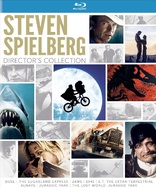
Duel / The Sugarland Express / Jaws / 1941 / E.T.: The Extra-Terrestrial / Always / Jurassic Park / The Lost World: Jurassic ParkUniversal Studios | 1971-1997 | 8 Movies | 1083 min | Not rated | Oct 14, 2014
Price
List price:Amazon: $29.99 (Save 16%)
Third party: $29.99 (Save 16%)
Only 8 left in stock - order soon.

Movie rating
Movie has not been rated yetBlu-ray rating
| Users |  | 4.7 |
| Reviewer |  | 4.0 |
| Overall | | 4.2 |
Overview
Steven Spielberg Director's Collection (1971-1997)
See individual titles for their synopses.
| Drama | 100% |
| Adventure | 88% |
| Sci-Fi | 64% |
| Action | 53% |
| Thriller | 49% |
| War | 46% |
| Fantasy | 36% |
| Family | 30% |
| Horror | 30% |
| Mystery | 25% |
| Romance | 13% |
| Crime | Insignificant |
| Comedy | Insignificant |
Specifications
Video
Video codec: TBA
Video resolution: 1080p
Original aspect ratio: 2.39:1, 1.85:1, 1.33:1
Audio
See individual releases
Subtitles
None
Discs
50GB Blu-ray Disc
Eight-disc set (8 BDs)
Playback
Region free
Review
Rating summary
| Movie | | 4.0 |
| Video | | 4.0 |
| Audio | | 4.5 |
| Extras |  | 3.0 |
| Overall | | 4.0 |
Steven Spielberg Director's Collection Blu-ray Movie Review
Selected Early Works
Reviewed by Michael Reuben October 23, 2014Universal Home Video has assembled the first eight films directed for the studio by Steven Spielberg (with the exception of Schindler's List) in a single "Director's Collection". Four of the films—Jaws, E.T.: The Extra-Terrestrial, Jurassic Park and The Lost World: Jurassic Park—have been previously issued, and the Blu-rays in this collection are identical to those already released. Four films, however, are new to Blu-ray. Although standalone releases will undoubtedly follow at a future date, for the moment the "Director's Collection" is the only way to acquire these new Blu-ray editions. The four newly released films—Duel, The Sugarland Express, 1941 (in both its theatrical and extended versions) and Always—have been individually reviewed, and links are provided below. No attempt has been made to revisit the films already released, including those (notably, Jurassic Park) about which substantial controversy raged at the time of release over the quality and accuracy of the video presentation. The interested reader can find all aspects of that controversy vigorously explored in the Blu-ray.com forum. (NOTE: Scores are averages of those for the eight individual reviews.)

For a detailed discussion of Duel, please see the Duel Blu-ray review. For a detailed discussion of The Sugarland Express, please see The Sugarland Express Blu-ray review. For a detailed discussion of 1941, please see the 1941 Blu-ray review. For a detailed discussion of Always, please see the Always Blu-ray review. Jeffrey Kauffman's discussion of Jaws can be found in the previous Jaws Blu-ray review. Kenneth Brown's discussion of E.T.: The Extra-Terrestrial can be found in the previous E.T. Blu-ray review. Jeffrey Kauffman's discussion of Jurassic Park and The Lost World: Jurassic Park can be found in The Jurassic Park Ultimate Trilogy Blu-ray review.
Steven Spielberg Director's Collection Blu-ray Movie, Video Quality
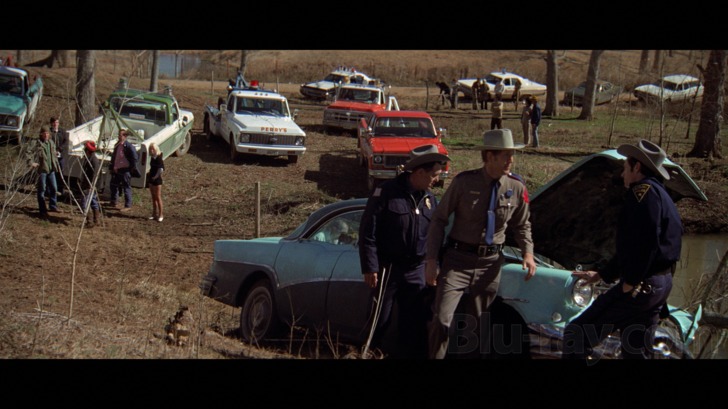
Duel (follow the link for screenshots) The 1.85:1 aspect ratio of Universal's Blu-ray of Duel will no doubt be a source of controversy, since it could be fairly argued that the film's original aspect ratio should be 1.33:1, which was its format on DVD. Then again, the OAR of this version of Duel, which was created for theatrical exhibition, was arguably 1.85:1; so it could also be said that the Blu-ray's presentation corrects the DVD's error. Spielberg was involved to at least some extent in the creation of the widescreen version, as evidenced by his shooting of the additional scenes and his reference in various interviews (including the "Conversation" in this disc's extras) to discovering that opening up the frame in some of the shots revealed that he was in the back seat of the car giving direction to Dennis Weaver. In a perfect world, two versions of Duel would be included, the 74-minute broadcast version framed at 1.33:1 and the 90-minute (technically, 89-minute) version framed at 1.85:1. As far as the 1.85:1 version on Universal's 1080p, AVC-encoded Blu-ray is concerned, the image capably reproduces the kinetic energy of the location cinematography by studio veteran Jack Marta (Cat Ballou, Plaza Suite). Detail is excellent in moments where the scenery isn't rushing past, and it's often much better than the screen captures indicate, because the camera itself is so frequently in motion that it's difficult to stop the action without creating motion blur. Although the image does not completely escape the processed look that is the hallmark of Universal catalog transfers, the digital tampering appears to be minimal. Natural-looking film grain is evident, and to the extent that any electronic sharpening has been used, the application is minimal. Contrast is strong throughout, and this is no doubt intentional for a film that its makers knew would be seen on TV screens with limited resolution. Because of the high contrast levels and a slight overbrightening, even strong colors are somewhat muted. For example, the red sedan driven by David Mann (the color was stipulated by Spielberg so that the car would stand out against the brown, green and gray landscape) isn't especially bright, although it is always distinctively red. The high quality of the Blu-ray's presentation is especially evident in the famous final confrontation between Mann's automobile and the tanker truck adversary: a long, continuous shot with multiple moving elements, all of which are rendered with impressive clarity and fine detail. It doesn't hurt that Universal has mastered Duel with a high average bitrate of 34.03 Mbps. The film is filled with many such scenes of complex action that make good use of the bandwidth. The Sugarland Express (follow the link for screenshots) The Sugarland Express was Spielberg's first collaboration with Hungarian DP Vilmos Zsigmond, with whom he would reunite for Close Encounters of the Third Kind, for which Zsigmond would win an Oscar for cinematography. Sugarland was made before home video began making directors and cameramen wary of using the full 2.35:1 frame to its best advantage, lest too much be cut off in panning 'n' scanning for the home screen. As a result, Spielberg's and Zsigmond's compositions are often striking in their use of the entire frame. Universal's 1080p, AVC-encoded Blu-ray is consistent with the other films new to Blu-ray in the Steven Spielberg Director's Collection, which is to say that it's an overall faithful presentation, with only minor evidence of digital manipulation to compromise its film-like appearance. The film's grain pattern appears to be largely intact and natural, although the coarsening that is sometimes a sign of artificial sharpening appears from time to time. Contrast is sometimes understated, and levels of black aren't always well-differentiated, but this may be inherent to the source, reflecting limitations in the location photography and/or compromises required for the slower anamorphic lenses of the era. In most shots, however, fine detail is remarkably good, allowing the viewer to savor Spielberg's complex compositions, in which people and objects are frequently arrayed across the frame in different planes but all in focus. (In one famous shot at the Looby house, the focus changes radically during the course of a shot; it's the equivalent of a camera move without moving the camera.) The strongest colors in Sugarland tend to be red and blue, consistent not only with the flashing lights of the police vehicles but also with the peculiarly American streak of anti-authoritarianism that makes people sympathize with the Poplins during their fifteen minutes of fame. Otherwise, the film's palette reflects the dusty, dry surroundings of the Texas countryside. Universal has mastered The Sugarland Express with a generous bitrate of 36.04 Mbps, which is helpful given the film's many scenes with multiple moving elements (usually vehicles) in the frame. 1941 (follow the link for screenshots) 1941 was shot by veteran cinematographer William A. Fraker, who discusses the technical challenges of the massive shoot in "The Making of 1941". Probably the single biggest challenge for the film's cinematography was blending live-action footage with miniatures in a manner that looked convincing, a process that Spielberg also addresses in discussing the explosions intended to simulate the impact of the Japanese submarine's artillery shells. Smoke was a critical element in many of the miniature shots, which is one of the reasons why many of 1941's nighttime scenes are filled with fog, smoke and diffusion, all of which creates a challenge for any transfer to video. Previous versions of 1941 have suffered from poorly resolved grain and a variety of artifacts. Universal's 1080p, AVC-encoded Blu-ray of 1941 offers a massive improvement over previous home video presentations, though not without some digital tinkering. The graininess is largely gone. Although grain is certainly visible, more so in some scenes than others, it has been largely tamed by what appears to my eye to be the application of sophisticated de-graining software of the kind now commonly used in digital intermediate suites. Note that I am not talking about the kind of detail stripping that is typically meant by "DNR". The image remains detailed and sharp, except in scenes where it shouldn't be (e.g., the many scenes on the deck of the surfaced Japanese sub, which are shrouded in fog). I did not detect any effort to simulate detail with artificial sharpening, which would most likely have coarsened the grain. Overall, Universal appears to have reined in their past tendency to transform film into video, while still managing to clean up a challenging film for modern tastes. Purists (including myself) may have wished for a more authentically grainy presentation, but this one isn't bad. The colors are superb, ranging from the dingy interiors of the Japanese sub to the eye-popping primaries of the USO dance hall (and everything in between). Solid blacks are essential to the effective presentation of effects man A.D. Flowers' wonderful miniatures, and the disc provides them. Measured by the longer extended cut, Universal has mastered 1941 with an average bitrate of 27.18 Mbps, and it needs all of it. It should be noted that the extended cut has retained the opening disclaimer from the Signature Laserdisc stating that frame jumps may be observed where scenes were reinserted. That was true on the laserdisc, but those jumps appear to have been digitally mended for Blu-ray. Either that, or I was too absorbed in the film. (If anyone spots these, please send me a time mark, and I will update the review.) Always (follow the link for screenshots) Always was one of the last films shot by Danish cinematographer Mikael Salomon (The Abyss) before he switched entirely to directing. Although the usual criticisms of Universal catalog titles are certain to be leveled at this 1080p, AVC-encoded Blu-ray, fans of the film have reason to celebrate, as the Blu-ray is a huge step up from Universal's 1999 DVD release of Always, which was probably its worst treatment of a Spielberg film on that format: non-anamorphic, with a pale image and far too much aliasing and video noise. The Blu-ray is another story entirely. The greens of the forest, yellows and orange of the flames and reds of the fire retardant are all strong, as are the various shades of blue light that mark Pete and his plane both before and after his crash. The white of Dorinda's dress during the party scene pops out of the frame, as it should, against the smokey brown and yellow background of the firefighter crew surrounding her. Hap's outfit, which came from Audrey Hepburn's personal wardrobe, has an even brighter white glow. Even the red of Marg Helgenberger's hair (in this film, she's what passes for a "plain" girl) is distinctive. Detail is plentiful throughout, although there's somewhat less of it in darker shots where the lighting has been deliberately manipulated to differentiate areas of the frame (a long scene in the cockpit of a plane near the film's end is a noteworthy example). This phenomenon has always been part of the film and is not a fault of the transfer. The film's grain pattern is readily evident, and Universal's frequently heavy hand with digital manipulation is not evident in the final results. The miniature and optical effects used to create some of the flying scenes look remarkably good, with only occasion softness caused by the optical duplication. Universal has mastered Always with an average bitrate of 31.998 Mbps, which is excellent and serves the elaborate scenes of aerial action admirably. Video evaluations of the four previously released titles can be found in their respective reviews: Jaws Blu-ray review E.T. Blu-ray review The Jurassic Park Ultimate Trilogy Blu-ray review
Steven Spielberg Director's Collection Blu-ray Movie, Audio Quality
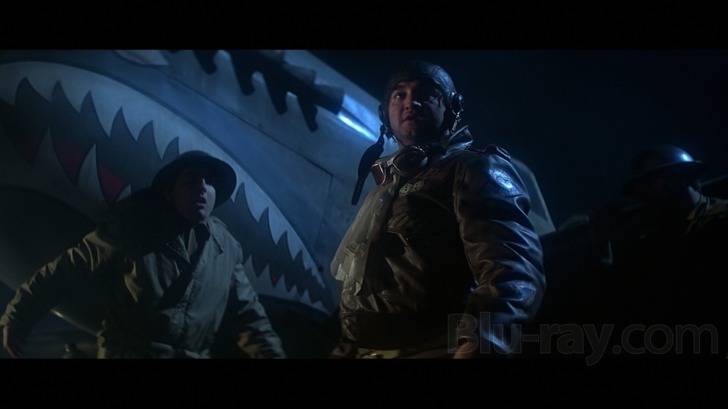
Duel Duel was originally released in mono, which is supplied here in lossless DTS-HD MA 2.0 with identical left and right front channels. The soundtrack was remixed for 5.1 for the 2003 DVD release, and that mix is also offered as the default audio track in lossless DTS-HD MA. The remix is conservative, leaving almost all of the sound in front where it belongs, and adding only the slightest sense of stereo expansion to the elaborate sound mix, most of which had to be created after the fact with dubbing and foley. The roar of the truck, the sound of the highway rushing by, the blare of train whistles and the background noise of the lunch crowd in Chuck's Café are just some of the essential sonic elements that amplify the tension in Duel, and the track reproduces them with good fidelity and surprisingly broad dynamic range (far better than what most TV speakers could have managed in 1971). The inventive score by Billy Goldenberg (Play It Again, Sam), which Spielberg discusses in his interview in the extras, blends so effectively into the mix that you're often unaware of its unnerving contribution to the film's sense of peril. The Sugarland Express The Sugarland Express was released in mono, and that track is included on Blu-ray in lossless DTS-HD MA 2.0 with identical left and right front channels. It's an effective and interesting mix, especially when Spielberg and his two editors (Edward M. Abroms and Verna Fields) are cutting back and forth between the chaos on the highway and the relative quiet of the Looby home. The road's combination of police sirens, screeching tires, shouted conversation and radio chatter is expertly balanced, and the occurrences of gunfire have surprisingly solid impact for a track of this era. The dynamic range is good enough to do justice to the numerous demolition-derby-style collisions that are inevitable when so many vehicles come together at high speed. Sugarland's soundtrack is a prime example of why original mono mixes should be left alone. If they worked then, they still work now. 1941 1941 was released in both stereo and a six-track mix for a 70mm blow-up. The Signature Laserdisc used the stereo mix, but the DVD had a 5.1 mix in Dolby Digital, which is encoded here in lossless DTS-HD MA. I cannot be certain whether this mix was derived from the 70mm version or represents a remix of the stereo, but I suspect the latter, because the additional footage in the extended version would have required a new 5.1 track in any case. The extended version still carries the disclaimer from the Signature Laserdisc cautioning that some lines of dialogue were distorted in the original recording and that sound effects have been "enhanced to take advantage of the improved dynamic range of today's home theater technology". However, the soundtrack of 1941 is so perpetually busy that I doubt that anyone except the original sound team could pick out the differences. Times have changed, though. Viewers accustomed to the sonic assault of, say, a Transformers film will wonder why anyone complained about 1941 when it was released in 1979. The film's 5.1 remix is sufficiently conservative not to attempt to re-route sound effects all around the listening space, where they would no doubt be placed if the film were made today. Nevertheless, the aerial sequences, cannon fire and machine gun used by Sgt. Tree have sufficient punch and bass extension to make themselves felt, especially with contemporary home theater equipment. The dialogue can be slightly hollow and tinny at times, but it's always intelligible. John Williams' score, which has a great martial theme that could almost be taken seriously, has been reproduced with fine fidelity, and it is a critical element in lassoing the onscreen chaos and keeping it from running wild. Always Always was released in Dolby Stereo Surround, and there were also 70mm prints with a six-track mix. The 1999 DVD had Dolby Digital 4.1 track, which was presumably taken from the unmatrixed Dolby Surround master. The source for the Blu-ray's 5.1 track, presented in lossless DTS-HD MA, is unknown, but it sounds terrific. The flying scenes are the showcase, as the Fire Eaters dive past and into burning trees, scraping their wings (and more) against branches and hearing flames lick at them from all sides. The sound mix puts the viewer into the pilot's seat, which, depending on one's taste for such things, can be either exciting or unnerving. The scenes with the ground crews are equally powerful, with the sound of uncontrolled blazes all over. Scenes near the film's end involving a water escape (I don't want to be more specific for those who haven't seen the film) are equally enveloping. The dialogue is always clear, which is critical for a film with such a literate script. Spielberg's musical alter ego, John Williams supplied the carefully calibrated score, which traverses the film's complex emotional territory with the composer's characteristic delicacy. Audio evaluations of the four previously released titles can be found in their respective reviews: Jaws Blu-ray review E.T. Blu-ray review The Jurassic Park Ultimate Trilogy Blu-ray review
Steven Spielberg Director's Collection Blu-ray Movie, Special Features and Extras

Extras on individual discs are listed in their separate reviews. The eight discs are stored in a gatefold digipack inside a large slipcase that also contains a 58-page book entitled Steven Spielberg: A Journey in Film. Filled with photos, storyboards, posters and concept art, the book contains a general overview of Spielberg's career, plus a short chapter on each of the films in the collection. The pages in the gatefold pack also contain additional notes on each of the films.
Steven Spielberg Director's Collection Blu-ray Movie, Overall Score and Recommendation
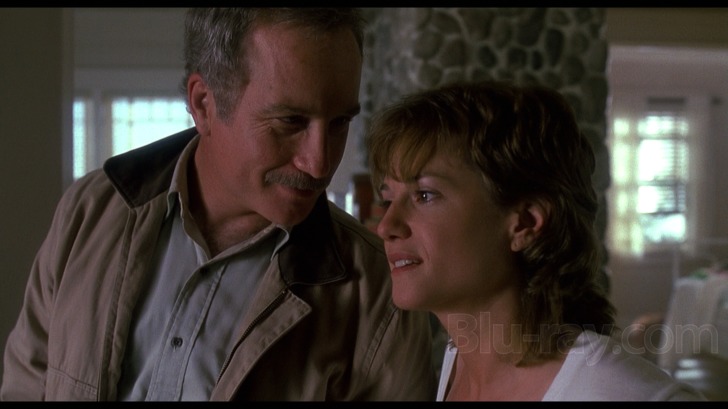
For anyone who doesn't already own all or most of the four previously released films in the Steven Spielberg Director's Collection, this is an easy choice. All of these films have something to recommend them, and three are bona fide classics of cinema. Those who already own half the collection face a much tougher decision. Even the current street price of $92 is a lot to pay for the four newly issued films, most of which lack the same broad appeal of a Jaws or an E.T. Viewers in such a position may want to wait for a major sale or separate releases. Either way, the presentations are, with some minor caveats noted in the individual reviews, worthy of the films.