Steve Reich: Phase to Face Blu-ray Movie
HomeSteve Reich: Phase to Face Blu-ray Movie 
Ideale Audience | 2009 | 52 min | Rated G | Oct 25, 2011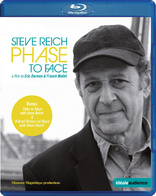

Movie rating
Movie has not been rated yetBlu-ray rating
| Users |  | 0.0 |
| Reviewer |  | 4.0 |
| Overall | | 4.0 |
Overview
Steve Reich: Phase to Face (2009)
Composer Steve Reich is profiled in this French television documentary.
Starring: Steve Reich| Music | Uncertain |
| Documentary | Uncertain |
Specifications
Video
Video codec: MPEG-2
Video resolution: 1080i
Aspect ratio: 1.78:1
Original aspect ratio: 1.78:1
Audio
English: LPCM 2.0
Subtitles
French, Japanese, German
Discs
25GB Blu-ray Disc
Single disc (1 BD)
Playback
Region A (B, C untested)
Review
Rating summary
| Movie | | 4.0 |
| Video |  | 3.0 |
| Audio | | 4.0 |
| Extras |  | 2.5 |
| Overall | | 4.0 |
Steve Reich: Phase to Face Blu-ray Movie Review
A thousand year Reich?
Reviewed by Jeffrey Kauffman December 9, 2011When I was working on my undergraduate degree at the University of Utah, I had an absolutely fantastic composition-theory teacher named Bruce Reich. Bruce had been something of a wunderkind, and was one of the “star" Professors of what was then one of the very best Music Departments of any “state” school. (Say what you will about the sociopolitical climate of Salt Lake City or Utah in general, culturally the Mormon influence meant top flight orchestras, theater and ballet productions). Some wiseguy made a crack at Bruce one day, asking, “Hey, are you related to the Third Reich?”, which Bruce in his typically gracious fashion laughed off (despite his Jewish heritage), and he said, “No, and I’m not related to Steve Reich, either.” And my curiosity was immediately piqued, as I had not up to that point heard of Steve Reich, something I tried to correct as soon as possible. I was already acquainted with the “phased” compositions of Terry Riley, whose In C was still seen as the touchstone for a new kind of compositional technique, but when I sat down to get to know (and study) Steve Reich’s oeuvre, I was immediately struck by how brilliantly melodic he was when working in that same “phased” technique of short repeating patterns which segue into each other. Riley’s approach seemed at least relatively bland, more in tune with washes of sound than outright themes, when compared to Reich’s work, and by the time I got to Reich’s glorious Tehillim (“Psalms” in Hebrew), I was hooked for life. Those who disparage the minimalists like Glass or Adams (and I have occasionally be unashamedly in their number) would do well to revisit their disdain for the genre in general by spending some time with Steve Reich’s music, for Reich has the largely inerrant ability to utilize some of the minimalist ideas without ever forsaking real musicality. Reich is also one of the most ineffably lyrical composers of our age, even when working in what most people would term non-traditional forms and with supposedly non-melodic instruments like the percussion section, and his often gorgeously sonic vistas seem to give a glimpse of a sort of musical eternity, one glistening with light and love, a true harmony of the spheres.

Steve Reich may not indeed be related to Bruce (who sadly passed away a few years ago at a relatively young age), but he certainly has the same self-effacing quality my university teacher did. This French television documentary opens with a great little vignette, audio only, with Reich picking up a phone which has evidently been ringing nonstop as the documentary crew had been attempting to set up its interview shot. Reich, initially sounding a little perturbed, wants to know who it is who’s been calling over and over. It turns out it’s an NPR reporter asking Reich if he knows he won the Pulitzer Prize for Music that morning. Of course, Reich is unaware, but he’s also surprisingly nonplussed, simply saying, “Wow, at age 72. Will wonders never cease,” as he finally takes his seat to begin the interview process.
Steve Reich: Phase to Face takes us more or less chronologically through Reich’s career, with his own reminiscences interspersed with several snippets of live performances, many of them including the composer in attendance as either listener or even as one of the performers. Reich talks about reaching up to his piano as a toddler and playing open fifths and singing what he thought were “cowboy songs,” and how the repetition of playing that perfect interval may have somehow prepared the way for the supposed “minimalism” with which he’s usually associated, rightly or wrongly. Reich actually admits that his real musical birth came when he was around 14 and some of his friends played him albums of music by Stravinsky, Bach, and perhaps most interestingly, some bebop albums by the likes of Miles Davis. Reich compares this to living in a house your whole life and then suddenly being shown a room you never knew existed before. “That’s my room,” Reich avers, “It’s where I live now.”
Reich’s evolution is rather interesting, in that he moved to San Francisco after graduating Juilliard, meeting up with other iconoclasts like Luciano Berio, but realizing quite quickly he didn’t want to do serial music or standard musique concrete. Nevertheless, Reich dabbled in all of the then-trendy techniques, and there are some fantastic anecdotes and examples of Reich’s early works in these idioms. What’s fascinating is how Reich turned to percussion to find his way out of electronica and tape effects. It’s even more fascinating how melodic Reich’s pieces featuring only percussion are, again a testament to the inherent lyricism of the composer. Listening to Reich extract actual musical content beyond mere rhythm from an ensemble made entirely of claves or bongos is not just an intellectual delight, it's aurally incredibly pleasing as well.
Reich talks about his evolution being akin to “one step forward, two steps backward,” especially as he finally moved into more quasi-traditional vocal stylings with such iconic works as Tehillim. But Reich’s self-deprecation is probably at least slightly misplaced, as he proves in several pieces which followed Tehillim, pieces which started to combine video elements with such fascinating effects as instruments mimicking the dialogue—often deconstructed into short, repeated snippets—that talking heads were spouting on multiple screens behind the ensemble. It's in fact in these more recent pieces that it becomes completely apparent that every step Reich has taken has contributed something to his overall approach, and even his now discarded experiments in tape loops and other "ancient" techniques are now paying new dividends. Reich’s questing spirit is perfectly revealed in these final pieces and they help highlight one of the seminal musical thinkers of our age.
Steve Reich: Phase to Face Blu-ray Movie, Video Quality
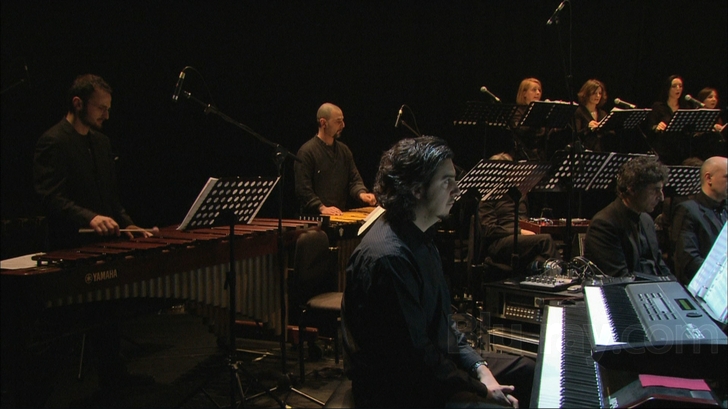
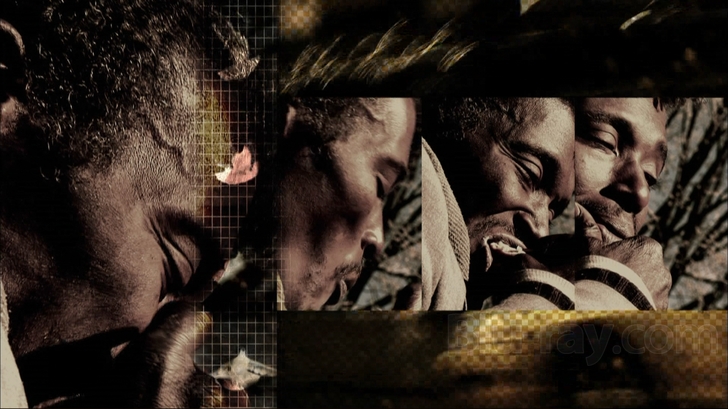
Steve Reich: Phase to Face is presented on Blu-ray courtesy of Idéale Audience with an MPEG-2 encoded 1080i transfer in 1.78:1. This was a made for French television production, and as such its video source elements are quite noticeable, with washed out color, sometimes fuzzy detail, and less than stellar contrast and black levels. The interview segments, which make up the bulk of the documentary, look passable if not fantastic, though even there flesh tones are kind of pallid and nothing really pops very well. Some of the concert footage suffers from quite a bit of crush, though strangely other segments offer surprisingly good black levels and shadow detail.
Steve Reich: Phase to Face Blu-ray Movie, Audio Quality
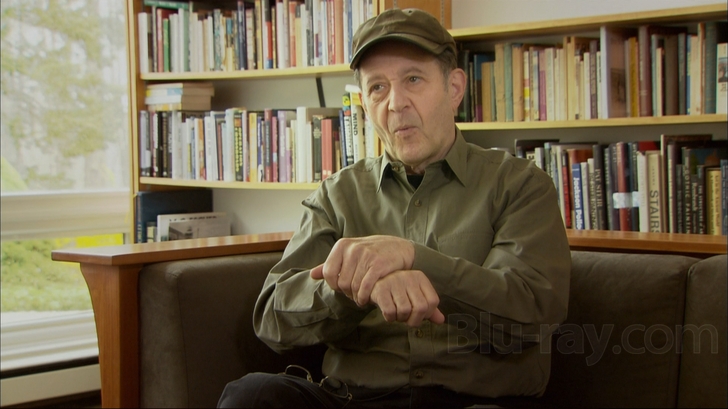
Steve Reich: Phase to Face features a lossless LPCM 2.0 stereo track that offers excellent fidelity within its narrow soundfield. Since so much of this documentary is simply Reich talking to the camera, there's not a whale of a lot of opportunity for this track to be overly showy, but in the many concert snippets, it more fully comes alive, especially since so much of Reich's work features such aggressive percussion. The click of clavés or high pitched thump of bongos sound fantastic here, and more "musical" percussive elements like vibes and marimbas also sound brilliant without ever lapsing into stridency. All frequency ranges sound great here, and dynamic range is quite impressive.
Steve Reich: Phase to Face Blu-ray Movie, Special Features and Extras
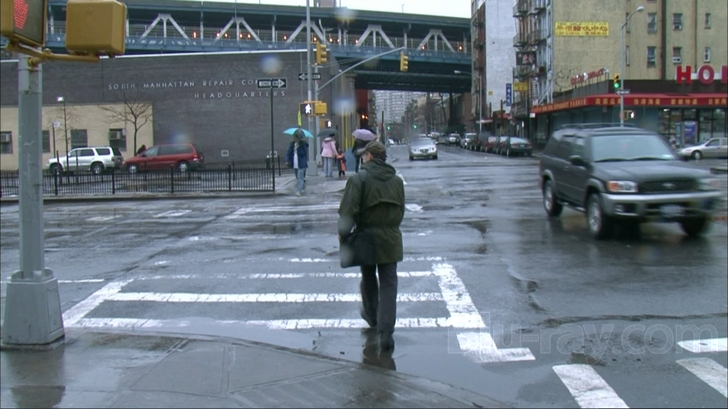
- Talks in Tokyo With Steve Reich (1080i; 18:02) has the composer discussing "You Are: Variations" with a Tokyo audience. Beware—there is a very loud audio anomaly of static at 00:04 just as the featurette begins.
- A Brief History of Music by Steve Reich (1080i; 9:19) is a brief but fascinating interview, obviously culled from the same sit down that makes up the bulk of the main feature. Reich goes over a number of subjects like the seemingly "out of the blue" rise of various phenomena like opera and the sudden rise of counterpoint.
Steve Reich: Phase to Face Blu-ray Movie, Overall Score and Recommendation
If you're not very well acquainted with the music of Steve Reich, there's probably no easier way to start than with Steve Reich: Phase to Face. This documentary provides a nice generalist overview of the composer's career in his own words, with some great examples from some of his best known pieces. On the other hand, if you are familiar with Reich, you might wish there were at least some complete performances here, even perhaps as bonus material, rather than the snippets of this piece or that piece we're offered instead. That detriment is alleviated somewhat by the wealth of fantastic anecdotes and insight Reich himself provides in his genial interview segments. Overall this is a well constructed, albeit fairly brief, documentary that lets Reich reassess his career, with enough examples of the man's music to provide ample proof as to why he's considered such a seminal force in the contemporary arts scene. Recommended.