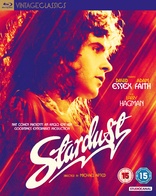
Stardust Blu-ray Movie
HomeStardust Blu-ray Movie 
Vintage ClassicsStudio Canal | 1974 | 112 min | Rated BBFC: 15 | Oct 21, 2019

Movie rating
7 | / 10 |
Blu-ray rating
| Users |  | 0.0 |
| Reviewer |  | 4.5 |
| Overall | | 4.5 |
Overview
Stardust (1974)
Stardust was the sequel to That'll be the Day, a 1973 film à clef about the rise of a Beatles-like rock group. Real-life rock star David Essex plays singer Jim Maclaine (read: John Lennon), whose sudden rise to fame has enriched him beyond his wildest dreams. His perspective and sense of values skewered by sex, drugs, and booze, Maclaine becomes little more than a singing cipher, outwardly successful but hollow inside. Ironically, Keith Moon of The Who, whose own life paralleled the fictional Maclaine's in many ways, appears in a supporting role. Dave Edmunds, who appears in as Alex, co-wrote the film's pulsating musical score with Lord David Puttnam (the film's producer).
Starring: David Essex, Larry Hagman, Rosalind Ayres, Edd Byrnes, Paul Nicholas (I)Director: Michael Apted
| Music | 100% |
| Drama | Insignificant |
Specifications
Video
Video codec: MPEG-4 AVC
Video resolution: 1080p
Aspect ratio: 1.85:1
Original aspect ratio: 1.85:1
Audio
English: LPCM 2.0
Subtitles
English SDH
Discs
Blu-ray Disc
Single disc (1 BD)
Packaging
Slipcover in original pressing
Playback
Region B (locked)
Review
Rating summary
| Movie | | 4.5 |
| Video |  | 5.0 |
| Audio | | 5.0 |
| Extras |  | 3.5 |
| Overall | | 4.5 |
Stardust Blu-ray Movie Review
Reviewed by Dr. Svet Atanasov November 7, 2019Michael Apted's "Stardust" (1974) arrives on Blu-ray courtesy of StudioCanal. The supplemental features on the disc include vintage production and promotional materials, as well as exclusive new interviews with producer David Puttnam, screenwriter Ray Connolly, and director Michael Apter. In English, with optional English SDH subtitles for the main feature. Region-B "locked".
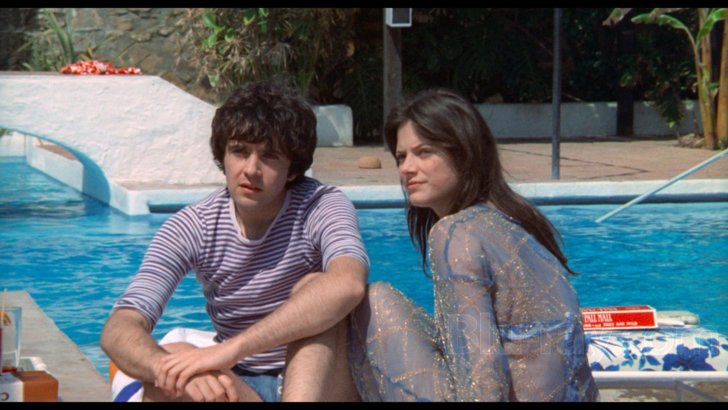
Stardust picks up a couple of years after That'll Be the Day. Jimmy MacLaine (David Essex) has walked away from his family and rediscovered his freedom as a vocalist of The Stray Cats, a tiny rock band that only occasionally gets booked to do lousy gigs in Liverpool. No one complains because it seems like booze and girls are never in short supply, but eventually Jimmy realizes that the band is on the fast track to oblivion and reaches out to old pal Mike (Adam Faith) with an offer to take over as a manager. The move has the desired effect and soon after Mike helps the band record a single that puts them on the charts. However, when The Stray Cats become Jim MacLaine and The Stray Cats -- to reflect Jimmy’s growing prominence as a songwriter and vocalist -- the rest of the band members slowly begin to turn against their frontman.
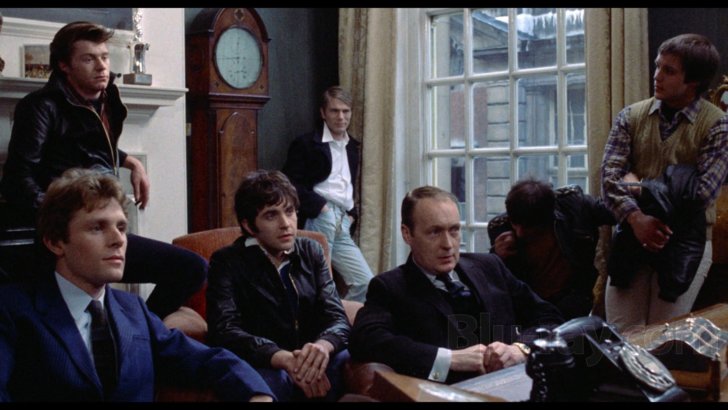
But success comes anyway and the band hits the road to meet its growing fanbase, first across Britain and eventually in the good ol’ U.S. of A. The bigger the band becomes, however, the clearer it becomes that Jimmy and his mates are seeing their future very differently. In the States, Mike is also forced to work with millionaire and big-time promoter Porter Lee Austin (superb Larry Hagman), who immediately goes to work to milk the band’s popularity as best as he can. After that, it is only a matter of time before the grueling performing schedule that Austin negotiates permanently splits the band, which then gives Jimmy the excuse to officially go solo.
For a while it looks like Jimmy won’t miss the band at all, but when Porter and his business buddies decide to squeeze every last dollar out of him, he snaps and retreats to a secluded castle somewhere in the Spanish countryside. Here he gets even worse, and then despite Mike’s support gradually gives up on life.
Michael Apted’s follow-up to That’ll Be the Day produces far more dramatic contrasts and its tone is a lot more cynical, but for legit reasons. For example, after Jimmy and the band taste ‘real success’ -- and exactly as he had imagined it ought to materialize -- they effectively begin losing a lot of their freedom. Then, slowly but surely, they lose the ability to distinguish between the people that should matter in their lives and the people that are there simply to benefit from their success. Unsurprisingly, as their paychecks grow bigger, the world in which they are allowed to operate as normal human beings actually shrinks quite dramatically. Because it is the nature of the business, however, they are forced to learn to live with the madness.
Nevertheless, in the second half Jimmy attempts to escape the grinder, but it quickly becomes obvious that the emotional damage he has suffered is irreparable. This is where the film becomes most cynical, but it is also where it is most effective because it produces a vision of ‘the top’ precisely as it is -- a very, very lonely place where stars usually self-destruct.
While some similarities between The Stray Cats and The Beatles do exist, and Jimmy’s personal struggles do remind of John Lennon’s, the film is really about the cycle that produces big stars and then takes over their lives.
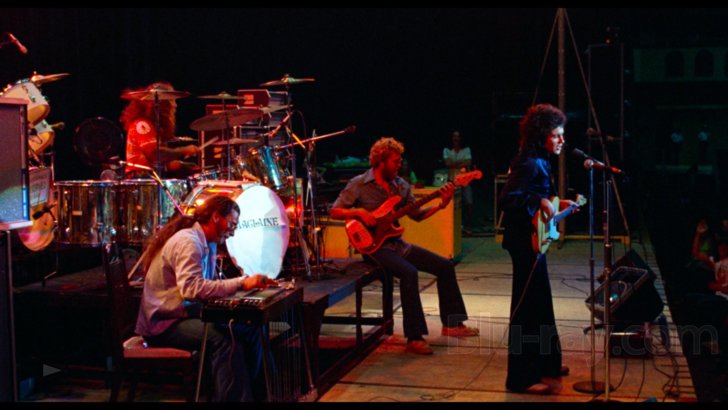
The film uses a lot of great tunes to strengthen the already excellent period atmosphere. In addition to Essex performing the title track and “Dea Sancta” (a classic rock opera piece), Dave Edmunds sings “C'mon Little Dixie”, “Let It Be Me”, and “Make Me Good”, The Lovin' Spoonful do the classic “Summer in the City”, etc.
Apted had cinematographer Anthony B. Richmond behind the camera, whose also credits include Don't Look Now, The Man Who Fell to Earth, and Ravenous.
Stardust Blu-ray Movie, Video Quality
Presented in its original aspect ratio of 1.85:1, encoded with MPEG-4 AVC and granted a 1080p transfer, Stardust arrives on Blu-ray courtesy of StudioCanal.
The release is sourced from a very beautiful new restored master that makes revisiting Stardust a very special experience. Obviously, the cinematography emphasizes a wide range of period qualities, plus there is some 'authentic' concert footage that produces a few unusual density fluctuations, but these are stylistic characteristics. So, what is important to underscore is that the new master is free of digital anomalies, and as a result the entire film has a splendid organic appearance. The color grading job is excellent. The primaries are lush, stable, and looking very healthy, and there are equally impressive ranges of supporting nuances. Image stability is great. The encoding is very good, though there is a bit of room for minor optimizations. All in all, this is a great presentation of Stardust that is guarantee to please its fans. My score is 4.75/5.00. (Note: This is a Region-B "locked" Blu-ray release. Therefore, you must have a native Region-B or Region-Free player in order to access its content).
Stardust Blu-ray Movie, Audio Quality
There is only one standard audio track on this Blu-ray release: English LPCM 2.0. Optional English SDH subtitles are provided for the main feature.
There are no technical issues to report. The audio is very clean, crisp, and easy to follow. There are a few segments, typically with crowd noise, where balance is a tad uneven, but this is how the film's soundtrack was created. The music tracks sound great.
Stardust Blu-ray Movie, Special Features and Extras
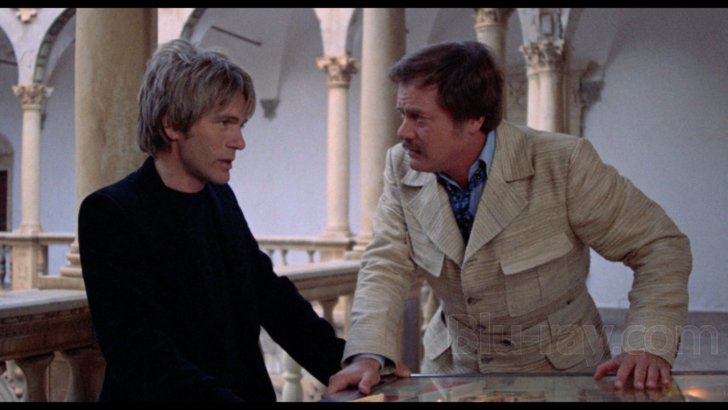
- Interview with David Puttnam - in this new video interview, producer David Puttnam remembers the exact time in which Stardust emerged, how the film was mapped out and shot, Michael Apted's work, the music scene and the realistic curve that is reproduced in the film, David Essex's performance, The Stray Cats and Dave Edmunds' contributions, etc. The interview was recorded exclusively for Studio Canal. In English, not subtitled. (20 min).
- Interview with Michael Apted - in this new video interview, director Michael Apted remembers how he was hired to to do Stardust, the music scene at the time and his initial impressions of The Beatles, the casting of David Essex and his attitude in front and behind the camera, Adam Faith's performance, his initial encounter with Larry Hagman, the period atmosphere throughout the film, etc. The interview was recorded exclusively for Studio Canal. In English, not subtitled. (20 min).
- Interview with Ray Connolly - in this new video interview, screenwriter Ray Connolly explains how the original idea for a sequel of That'll Be the Day materialized, and discusses how the great castle in Spain was discovered, the film's budget, Columbia Pictures' involvement and the casting of Larry Hagman, David Essex's performance and the evolution of his career, etc. The interview was recorded exclusively for Studio Canal. In English, not subtitled. (20 min).
- Stills Gallery - a collection of production and promotional stills. (1 min).
Stardust Blu-ray Movie, Overall Score and Recommendation
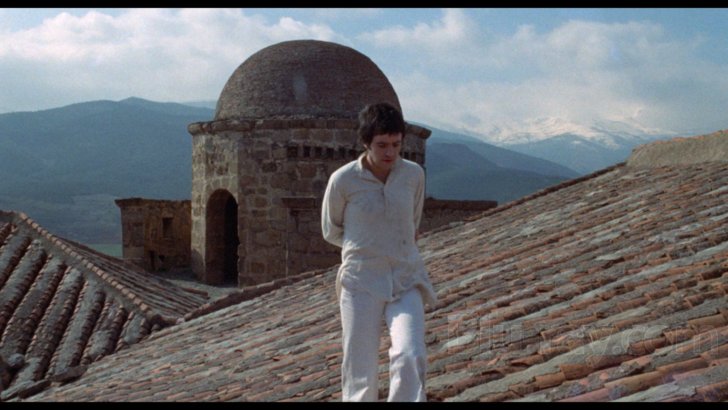
It is difficult for me to explain exactly why I like Stardust so much, because if I attempted to do it, I will almost certainly ignore some small details that are actually crucial pieces of its identity. Its casual cynicism, however, is what holds everything together the right way, so I suppose I could at least say that without it, I most likely would not have enjoyed it as much as I did. If you decide to get it, you absolutely have to pick up its prequel, That'll Be the Day, which was just released on Blu-ray as well. Both films were recently restored by StudioCanal. VERY HIGHLY RECOMMENDED.
Similar titles
Similar titles you might also like
(Still not reliable for this title)

Miles Ahead
2015

Born to Be Blue
2015

A Star Is Born
Special Encore Edition
2018

Vox Lux
2018

When You're Strange: A Film About The Doors
2009

Get on Up
Get on Up: The James Brown Story | Limited Edition
2014

Whitney Houston: I Wanna Dance with Somebody
2022

Roger Waters: Us + Them
2019

Backbeat
1994

The Who: Quadrophenia
Blu-ray Audio / #57 SDE Surround Series
1973

Muse: Live at Rome Olympic Stadium
2013

Great Balls of Fire!
1989

The Buddy Holly Story
1978

Jeff Beck Rock & Roll Party: Honoring Les Paul
2010

Cadillac Records
2008

20,000 Days on Earth
2014

La Bamba
1987

Tommy
1975
Carmen
The Restored Edition
1984

Whitney
2018