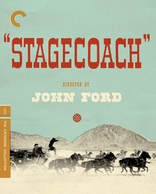
Stagecoach Blu-ray Movie
HomeStagecoach Blu-ray Movie 
includes "Bucking Broadway" (1917)Criterion | 1917-1939 | 2 Movies | 96 min | Not rated | May 25, 2010

Movie rating
Movie has not been rated yetBlu-ray rating
| Users |  | 4.0 |
| Reviewer |  | 4.5 |
| Overall | | 4.0 |
Overview
Stagecoach (1917-1939)
A group of strangers are thrown together into extraordinary circumstances while traveling a dangerous route from Arizona to New Mexico.
| Western | 100% |
| Adventure | Insignificant |
Specifications
Video
Video codec: MPEG-4 AVC
Video resolution: 1080p
Aspect ratio: 1.37:1
Original aspect ratio: 1.37:1
Audio
English: LPCM Mono (48kHz, 24-bit)
Subtitles
English SDH
Discs
50GB Blu-ray Disc
Single disc (1 BD)
Playback
Region A (locked)
Review
Rating summary
| Movie | | 4.5 |
| Video | | 4.0 |
| Audio | | 4.0 |
| Extras |  | 5.0 |
| Overall | | 4.5 |
Stagecoach Blu-ray Movie Review
Reviewed by Dr. Svet Atanasov May 4, 2010John Ford's "Stagecoach" (1939) arrives on Blu-ray courtesy of Criterion. The supplemental features on the disc include an audio commentary with film historian and western scholar Jim Kitses; "Bucking Broadway" (1917), a forty-four-minute silent film directed by John Ford; an extensive interview with John Ford, conducted by British journalist and television presenter Phillip Jenkinson; an interview with Peter Bogdanovich; "Dreaming of Jeanie", a video essay by writer Tag Gallagher; "True West", a video interview with Pulitzer Prize-winning author Buzz Bissinger; "Yakima Canutt", a video piece about the legendary stuntman; an interview with John Ford's grandson and biographer Dan Ford; "Screen Director's Playhouse", a radio adaptation of Stagecoach; and the film's original theatrical trailer. The disc also arrives with a 34-page illustrated booklet. With optional English subtitles. Region-A "locked".
The Ringo Kid
There is a good reason why Peter Bogdanovich once described John Ford's Stagecoach as "the first adult Western". Based on Ernest Haycox’s story "Stage to Lordsburg", this is a film that transformed the entire genre - it introduced surprisingly complex and in-depth characterizations that would be imitated for years to come and it openly addressed a variety of social and political issues in a manner no other Western before it had. Stagecoach also made John Wayne a star.
The film tells a fairly simple story. In the town of Tonto, a stagecoach picks up a motley crew of passengers: Gatewood (Berton Churchill, The Spanish Cape Mystery), an obnoxious and outspoken banker; Boon (Thomas Mitchell, The Hurricane), a local doctor with a serious drinking problem; Hatfield (John Carradine, Waterfront), a reformed gambler; Peacock (Donald Meek, Barbary Coast Gent), a quiet whiskey seller with a bag full of samples; Lucy Mallory (Louise Platt, Captain Caution), a pregnant beauty looking for her husband; and Dallas (Claire Trevor, The High and the Mighty), an equally attractive prostitute. The passengers are joined by the town sheriff, Curly Wilcox (George Bancroft, Thunderbolt), who has just been informed that Geronimo, the famous Apache war chief, and his men, as well as the Ringo Kid (John Wayne, The Man Who Shot Liberty Valance), a bandit who has broken out of jail, are in the area. Buck (Andy Devine, Night Time In Nevada) is the man in charge with the stagecoach.
The journey begins and inside the stagecoach things quickly heat up. Boon grabs Peacock's bag and insists on trying every single one of his samples. Gatewood begins criticizing the government but is immediately told to change the subject by Hatfield, who wants to impress Lucy Mallory. Dallas is the only one who prefers to be quiet and listen to what everyone else has to say.
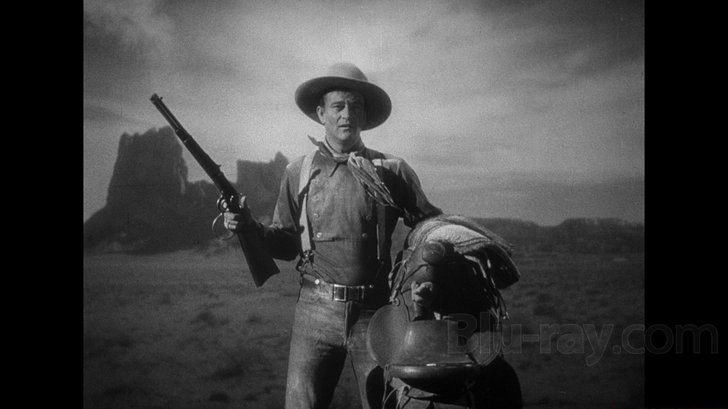
Much to Curly Wilcox's delight, out of nowhere the Ringo Kid shows up. He is heading to Lordsburg to settle an old score but does not have a horse. Curly Wilcox quickly arrests the Ringo Kid but then lets him join the passengers. He also lets him keep his gun, just in case Geronimo and his men show up. The Ringo Kid immediately impresses everyone with his manners, and Dallas in particular.
The stagecoach stops at a way station where Boon gets sober for a couple of hours and Lucy Mallory gives birth to a beautiful baby girl. The Ringo Kid asks Dallas to marry him but is quickly reminded by Curly Wilcox that once they get to Lordsburg, he is heading straight to the jailhouse.
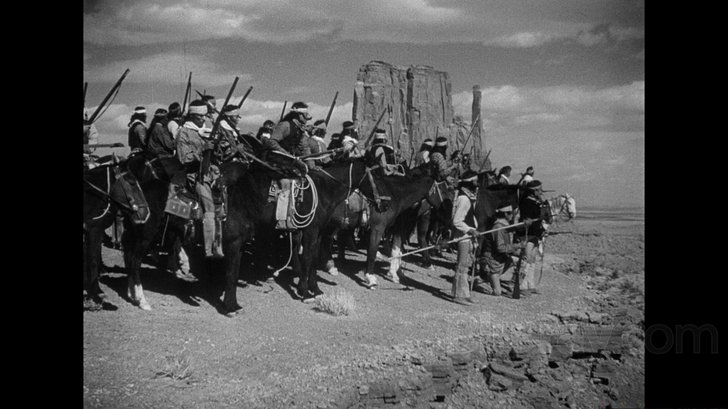
On the following day, the stagecoach heads to Lordsburg. Shortly after, Geronimo and his men appear and launch a fierce attack on it. Peacock is seriously injured while Hatfield is killed. Before the Indians can stop the stagecoach, however, the Calvary arrives and chases them away.
In Lordsburg, the Ringo Kid kills the Plummer brothers and then asks Curly Wilcox to help Dallas, who has finally agreed to marry him, get to his ranch in Mexico. Meanwhile, the sheriff of Lordsburg and his boys arrest Gatewood for stealing money from his customers.
Ford shot Stagecoach in 1939. At the time, the world was rapidly changing and so was America. Morality, class, equality, tolerance, and acceptance were on everyone's mind. Ford, who was born in the family of Irish immigrants living in Maine, was particularly sensitive to these issues, which is why he eventually addressed them in his films.
It is true that at least some of these issues had already been tackled in other Westerns (see King Vidor's The Texas Rangers and Sam Nelson's Cattle Riders). None of these films, however, offered characterizations that would force the audience to seriously consider, let alone respond to them all. Stagecoach was the first to do so, which is why it is credited as the film that single-handedly transformed the Western into a "serious" genre.
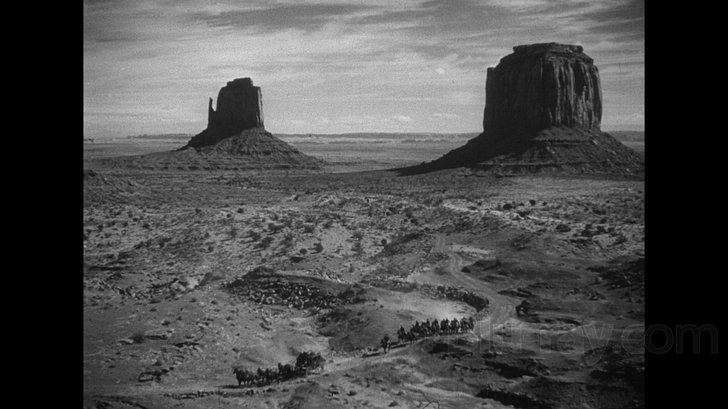
For a Western made in the late 30s, the camerawork in Stagecoach is exceptional. Ford shot some of the best scenes in it in the Monument Valley, Utah, which he kept coming back to later in his career.
Stagecoach also marked the beginning of one of the greatest relationships in the history of American Cinema - Ford and Wayne. The two men made more than thirty five films together, some of which are amongst the most beloved Westerns of all time.
Note: In 1940, Stagecoach won Oscar awards for Best Actor in a Supporting Role (Thomas Mitchell) and Best Music (Richard Hageman, W. Franke Harling, John Leipold, and Leo Shuken).
Stagecoach Blu-ray Movie, Video Quality
Presented in its original aspect ratio of 1.37:1, encoded with MPEG-4 AVC and granted a 1080p transfer, John Ford's Stagecoach arrives on Blu-ray courtesy of Criterion.
The following text appears in the booklet provided with this Blu-ray disc:
"The original negative for Stagecoach has been considered lost for decades. For this edition, we evaluated several of the best surviving prints, both restored and original, before we found a 1942 nitrate duplicate negative that showed exceptional detail, gray scale, and clarity. We chose it as the primary source for this new high-definition digital transfer, created on a Spirit 2K Datacine, because we believed it was the best surviving film material of Stagecoach. For safety, a new 35mm fine-grain positive was made from from the negative as a preservation.
Inevitably, certain defects remain. The picture suffered from thousands of instance of blended-in scratches and debris, especially around reel changes and in action sequences. In cases where the damage was not fixable without leaving traces of our restoration work, we elected to leave the original damage. Through hundreds of hours of restoration work, we've manually removed the worst of the damage, along with dirt, splices, warps, jitter, and flicker, using MTI's DRS system and Pixel Farm's PFClean system, while Digital Vision's DVNR system was used for small dirt, grain, and noise reduction. Additional restoration was performed with the help of Reliance Mediaworks and its propriety software".
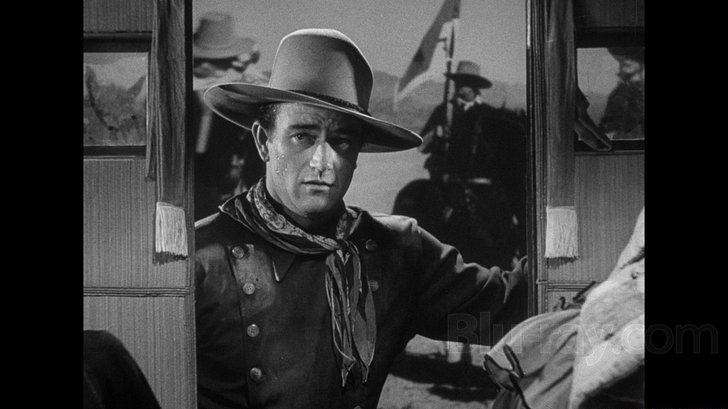
Considering the serious issues Criterion had to address in order to produce this Blu-ray release, I believe that many of you would be pleasantly surprised to see how strong the high-definition transfer is. Fine object detail and clarity vary, and contrast levels are not always consistent, obviously due to the inherited limitations, but I feel very confident stating that Stagecoach has never looked this good. For example, many of the close-ups convey pleasing depth and dimension. A number of the panoramic vistas from Monument Valley, Utah also look surprisingly strong, especially during the second half of the film. Generally speaking, the film's color-scheme is also convincing. Yes, certain scenes look slightly faded - and scratches, cuts, and warps are often easy to spot - but never unhealthy. Additionally, the film grain has been retained, which is one of the key reasons why Stagecoach looks so impressive. When blown through a digital projector, the film also remains relatively stable. There are a couple of small transition issues - the reel changes - but I don't think that the overwhelming majority of you would be bothered by them. To sum it all up, I think that this is a very strong and convincing presentation of a classic American film, and Criterion deserve a lot of credit for it. (Note: This is a Region-A "locked" Blu-ray disc. Therefore, you must have a native Region-A or Region-Free PS3 or SA in order to access its content).
Stagecoach Blu-ray Movie, Audio Quality
There is only one audio track on this Blu-ray disc: English LPCM 1.0. For the record, Criterion have provided optional English SDH subtitles for the main feature.
According to the booklet provided with this Blu-ray disc, the monaural soundtrack was mastered from multiple track elements, including soundtrack negatives and prints. Naturally, there are small fluctuations with the audio that you are likely to notice. Still, the dialog is relatively stable and easy to follow. There is also mild background hiss - but this is certainly not something that affects dramatically the integrity of the English LPCM 1.0.
Stagecoach Blu-ray Movie, Special Features and Extras

Commentary - an audio commentary, recorded exclusively for Criterion in 2009, with film historian and western scholar Jim Kitses (Horizon West). I thought that this was a very strong commentary, offering excellent analysis of the film, the conditions under which it was made, as well as the impact it had on the genre it belongs to. Mr. Kitses' comments on the different political and social stereotypes the film addresses are particularly interesting.
Bucking Broadway - a forty-four-minute silent film from 1917 directed by John Ford. A rollicking western about a cowboy (Harry Carey) whose true love is whisked away by a city slicker, Bucking Broadway showcases the underdog protagonist, jovial humor, regard for family unity, and epic visual style that would become hallmarks of the director. Featuring a new score by Donald Sosin, the film has been restored by the Arhives francaises du film, CNC. (55 min, 1080i).
John Ford interview - an extensive interview with John Ford, conducted by British journalist and television presenter Phillip Jenkinson in 1968. In this interview, Mr. Ford talks about his love for cinema, the type of locations he preferred for his films, the fact that many of his scripts were improvised, his fascination with the Monument Valley, etc. In English, not subtitled. (73 min, 1080i).
Peter Bogdanovich - famous critic, filmmaker and John Ford biographer Peter Bogdanovich talks about Stagecoach, its characters, how it transformed the genre it belongs to, the type of actor John Wayne was, etc. In English, not subtitled. (15 min, 1080p).
Dreaming of Jeanie - this video essay by writer Tag Gallagher (John Ford: The and His Films) analyzes the visual style Ford employs in Stagecoach, and explains how his technique allows us to both deeply empathize with and remain objective toward the film's many characters. In English, not subtitled. (22 min, 1080p).
John Ford Home Movies - in this short interview John Ford's grandson and biographer Dan Ford (Pappy: The Life of John Ford) talks about the creative environment his grandfather favored, how he interacted with his family and friends as well as those he worked with, his Irish roots, etc. In English, not subtitled. (8 min, 1080p).
True West - in this video interview Pulitzer Prize-winning author Buzz Bissinger (Friday Night Lights) explains the key role that 1920s trading post operator Harry Goulding played in bringing Monument Valley to the attention of the Stagecoach production, thereby establishing a new cinematic icon of the American West. In English, not subtitled. (11 min, 1080p).
Yakima Canutt - in this video piece renowned stunt coordinator and stuntman Vic Armstrong (Raiders of the Lost Ark) talks about "the father of all stuntmen", Yakima Canutt, who revolutionized the film industry with his skills, insight, and desire for perfection. Mr. Canutt did all of the doubling/stunts for John Wayne in Stagecoach. In English, not subtitled. (11 min, 1080p).
Screen Director's Playhouse - a radio adaptation of Stagecoach, originally broadcast on January 9, 1949, starring John Wayne and Claire Trevor, reprising their film roles. In English, not subtitled. (28 min).
Trailer - the original theatrical trailer for Stagecoach. (4 min, 1080i).
Booklet - a 34-page illustrated booklet containing David Cairns' essay "Taking The Stage" (the author is a writer and filmmaker based in Edinburgh, Scotland); as well as Ernest Haycox's story "Stage to Lordsburg", which inspired John Ford to shoot Stagecoach.
Stagecoach Blu-ray Movie, Overall Score and Recommendation
Stagecoach is a film that does not need to be overanalyzed. It is simple and genuinely honest about everything it tackles. I believe, however, that it is quite ironic to see that many of the social issues and especially stereotypes about race, ethnicity and citizenship the film addresses are still passionately debated by politicians and civil leaders in America today. It makes one wonder how much things have changed since the late 30s. The Blu-ray disc herein reviewed, courtesy of Criterion, looks and sounds very good. The supplemental features that are included with the film are also of exceptionally high quality. VERY HIGHLY RECOMMENDED.