Spaceways 4K Blu-ray Movie
HomeSpaceways 4K Blu-ray Movie 
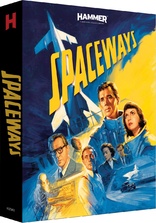
Collector's Edition / 4K Ultra HD + Blu-rayHammer Films | 1953 | 74 min | Rated BBFC: U | Mar 23, 2026

Movie rating
6.9 | / 10 |
Blu-ray rating
| Users |  | 0.0 |
| Reviewer |  | 4.0 |
| Overall | | 4.0 |
Overview
Spaceways 4K (1953)
A small group of closely-guarded British scientists test their first rocket amidst indications of matrimonial strife in the community. After the partial failure of the firing, a couple go missing - have they gone off together or are their murdered bodies circling the earth in the remains of the rocket?
Starring: Howard Duff, Eva Bartok, Alan Wheatley (II), Philip Leaver, Michael MedwinDirector: Terence Fisher
| Sci-Fi | 100% |
Specifications
Video
Video codec: HEVC / H.265
Video resolution: 4K (2160p)
Aspect ratio: 1.37:1
Original aspect ratio: 1.37:1
Audio
English: LPCM 2.0 Mono
English: DTS-HD Master Audio 5.1
Subtitles
English SDH, French, German, Italian, Spanish
Discs
Blu-ray Disc
Two-disc set (2 BDs)
4K Ultra HD
Playback
Region B, A (C untested)
Review
Rating summary
| Movie |  | 3.5 |
| Video | | 3.5 |
| Audio | | 4.0 |
| Extras |  | 5.0 |
| Overall | | 4.0 |
Spaceways 4K Blu-ray Movie Review
Reviewed by Justin Dekker April 9, 2026An early science fiction outing, 1953's 'Spaceways' arrives on 4K UHD disc courtesy of Hammer Studios. The film sees American actor Howard
Duff (Kramer vs. Kramer') and Hungarian actor Eva Bartok ('Blood and Black Lace') headlining a cast that also includes Philip Leaver ('The Lady
Vanishes'), and Alan Wheatley ('The Adventures of Robin Hood'). The releases boasts excellent technical specifications, an impressive assortment of
on-disc extras including two commentary tracks, and a 116-page perfect bound book featuring a variety of essays and stills. All contents are housed in
an attractive slipbox. A Blu-ray disc is also included, but a Digital Code is not.
The scientists at Deanfield are tasked with launching the first permanent man-made satellite into Earth's orbit. With the work nearing completion, the
disappearance of several people from the secure base prompts fears of murder and an investigation commences in which everyone is a suspect. As the
investigator tightens the net, one scientist will propose a drastic and historic plan in a bid to prove their innocence.
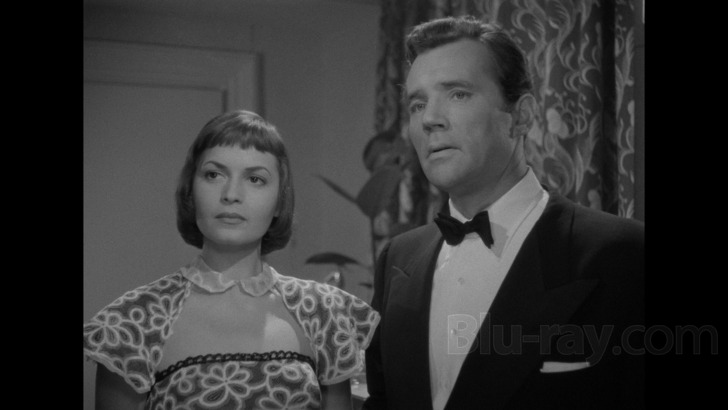
World War II was barely over and the Cold War had just begun when Spaceways made its way to the screen. Shot on a budget that was anecdotally much more appropriate for simple romantic comedy than a film with its sights set on the stars, Terence Fisher, in his sixth outing in the director's chair for the Hammer, crafts a film that is much more murder mystery than space-faring epic. As was the strategy for producer Robert Lippert, he cast an American, Howard Duff, in the lead role to help assure distribution overseas. The addition of Hungarian-born Eva Bartok adds a bit of continental appeal as well with her icy, film-noirish sex appeal scarcely held in check underneath her well-mannered behavior and somewhat boxy lab attire.
Spaceways is a picture that is simmering with tension, suspicion, greed, and paranoia long before there's the slightest hint of a crime having been committed. A product of it's time, the Red Scare is in full swing and as such, security is high and trust is in short supply. To underscore that fact, Vanessa Mitchell (Cecile Chevreau), wife to Howard Duff's Dr. Stephen Mitchell, laments that, while living on the base, she can't even get a hairdresser that hasn't gone through extensive security screening. And as we later learn, a pass that gets one into the top secret base does not carry with it any guarantee of one's ability to exit. That liberty requires a separate pass. In this space race, primacy is of the utmost importance, as is duty to one's country or ideology. Duff's Dr. Mitchell, with his skills, knowledge, and experience, could certainly obtain a much more lucrative position in the private sector, but he makes the conscious decision to see the project through to the end, even though it's successful terminus could be four or five years away, much to his aggressively capitalistic wife's chagrin. But to Dr. Mitchell, and the leadership of the project, beating the communists in the pursuit of placing a permanent satellite in orbit has significant and innumerable scientific advantages and benefits. Militaristic advantages as well, as his superiors are keen to point out, as they eye these orbital assets as potential launch pads for atomic weapons.
The film's small budget is also an unlikely ally in crafting tension and suspicion. Given the limited financial resources, most of the action of Spaceways plays out on a handful of small sets. Characters are therefore kept in close proximity for much of the time, allowing them, and the viewer, to catch glimpses of activities that may be innocent, but could just as easily be more nefarious. Those at odds with each other have few opportunities to avoid the other person, and those with secrets to keep don't have many hiding places available to them. While Vanessa seems to imply that living on the base is akin to being in a prison, and not at all the more posh and glamorous life she had envisioned as the beautiful wife of a rocket scientist, a more apt analogy would be that to live at Deanfield is to live under a microscope. Everything is controlled. Everything is monitored. Everything is discoverable.
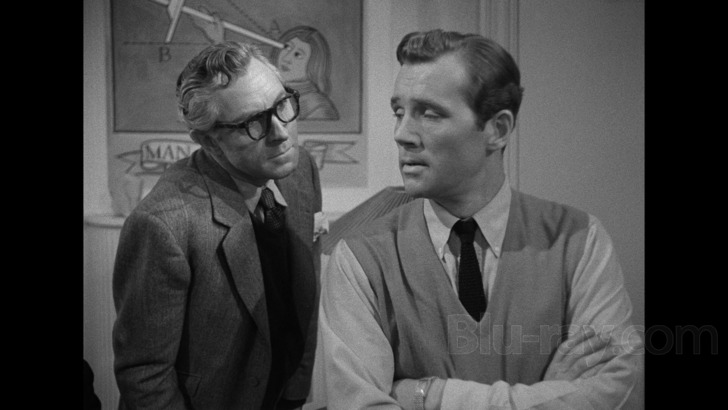
Once people go missing, due to the extreme levels of security on the base, murder and the clever concealment of the bodies is the logical assumption for those overseeing the base's activities, Duff's already almost permanently furtively knitted brow becomes begins to emote even more concern and worry. Bartok's savvy and professional Dr. Lisa Frank begins to make some not-so-subtle advances at the unhappily married man, that may be sweetly innocent or just enacted to appear that way. But it's the appearance of the investigator, Alan Wheatley's inscrutable Dr. Smith, that ratchets up tension even further, in a manner that invests the film's second half with good deal more energy than the first. For Dr. Smith, no line of questioning is out of bounds, and any theory, no matter how outlandish, is worth chasing down once he's had a pinch or two of snuff.
While Duff and Bartok turn in excellent performances here, and Bartok's casting may seem to be something of a triumph, it's likely that it will be Wheatley that many viewers will remember most fondly when they think of Spaceways. While it was my first time seeing this film, it wasn't my first exposure to the accomplished character actor. Alan Wheatley's film and television career spanned from 1931 through 1969, and the actor is perhaps best known to most for his portrayal of the Sherriff of Nottingham on ITV's The Adventures of Robin Hood which ran from 1955 to 1960. My favorite performances of his prior to seeing this film were on a host of enduring series of which I'm a fan, including, Danger Man, Department S (in the excellent episode "A Ticket to Nowhere"), The Avengers (during the Linda Thorson era), and Doctor Who. In that show's first season in 1964, Wheatley plays a pacifistic Thal named Temmosus. He's optimistic about forging a lasting peace with the Daleks. As he prepares to meet them, he says to the younger and impetuous Alydon, "I think you misjudge them....And you must throw off these suspicions. They're based on fear. And fear breeds hatred. And war." But for those familiar with the series and the Daleks, his optimism is most certainly misplaced and during their initial meeting, in the episode "The Ambush" of The Daleks (penned by Terry Nation), Wheatley earns the unique distinction of being the first person killed on-screen by a Dalek. While that particular episode hasn't made it's way to Blu-ray yet, it can be found on the DVD release Doctor Who: The Beginning. Prior to William Hartnell assuming the role of the first Doctor, Wheatley also appeared on-screen with Hartnell (in a much different role) in 1946's noir thriller Appointment With Crime, a film that's worth checking out for fans of either actor.
Spaceways 4K Blu-ray Movie, Video Quality
Per the included restoration notes, the original 35mm negative for the US version was located in Warner's archives, while the BFI was in possession of a
35mm combined fine grain for the UK version. The primary issue for the restoration to resolve, beyond the traditional dirt and scratches, was flickering
caused by instability and density fluctuations. After handling theses problems, it was given HDR grading with Dolby Vision. Upon comparison, despite
being listed as a "US" version and a "UK" version, there were no differences between the two save for the opening and closing credits. The end result on
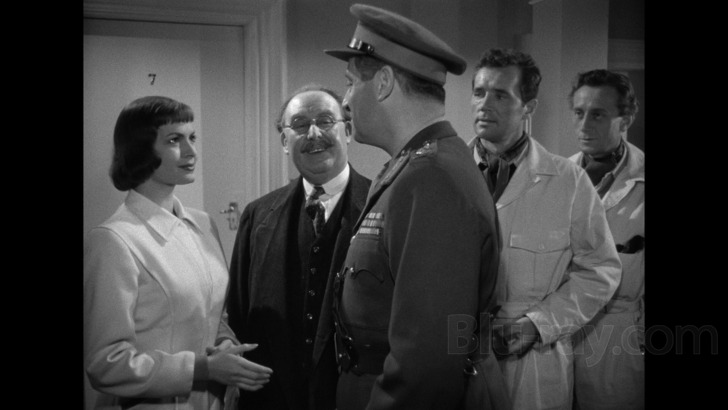
display is that Spaceways looks pleasingly filmic and healthy on 4K UHD. Fine film grain is present and resolves naturally throughout. Detail
levels are typically high, with the tweed jackets of the male cast members and Vanesa's fur wrap presenting with tactile realism. Fine lines and wrinkles
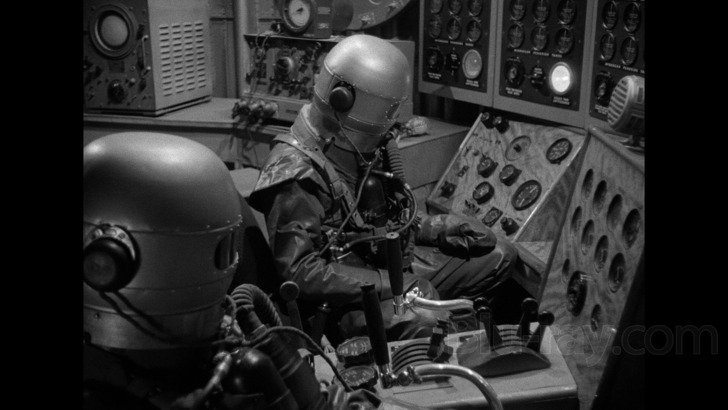
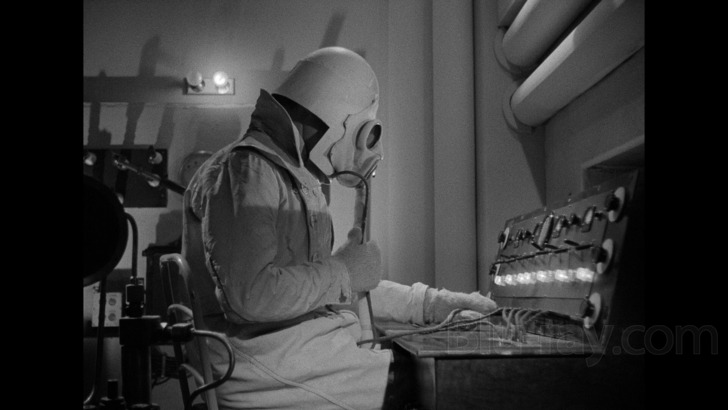
are visible on the faces of the more mature male cast members, and hairstyle particulars are appreciable on Dr. Lisa Frank and Vanessa. The space suits
worn by our intrepid astronauts allow viewers to inspect stitching and metallic components. Set elements such as various dials, gauges, and levers on
the numerous workstation panels in the control center and in the rocket show appropriate wear. Process shots can see a dip in clarity and tend to be a
bit grainier, and the reduction in the quality of the brief clips of stock footage is similarly as expected and excusable. While whites never truly dazzle,
blacks are more than sufficiently deep and inky. It's a great transfer.
Screenshots are sourced from the included 1080p disc.
Spaceways 4K Blu-ray Movie, Audio Quality
The release of Spaceways comes with two audio options. One is an LPCM 2.0 Mono track, and the other, as is their standard, is a newly created DTS-HD Master Audio 5.1 track. After spending a fair amount of time with both, I found the LPCM 2.0 Mono to be my preferred companion for the film. While the 5.1 track does offer some very slight ambient sounds during the early cocktail party, for example, but in that same scene the placement of Professor Koepler's voice in the surrounds as the camera lingers on Bartok and Duff and then flipping to the center as the camera cuts to him, feels awkward and abrupt. There are other instances as well where the movement and placement of voices and sounds isn't as smooth and intuitive as it should be. Musical cues fare better, but during certain swells they feel out of balance and too aggressive. Dialogue also looses a bit of its power. The 2.0 track, though is era appropriate and performs more energetically overall. Dialogue is well-reproduced and in line with other tracks of that vintage, with mild sibilance issues that appear from time to time but are never egregious. The film's score has a decidedly 1950s aesthetic, it being dominated by strings and being populated with treble and mid-range notes with bass being underrepresented. Again though, as a primarily earth-bound dramatic affair, dialogue reproduction is the top concern, and the track does that well.
Spaceways 4K Blu-ray Movie, Special Features and Extras
Hammer's 4K release of Spaceways includes a healthy assortment of both on-disc and printed supplemental material as below.
- UK Theatrical Version with 2025 Commentary Featuring Sarah Morgan and Heidi Honeycutt - The two writers and critics begin with an overview of the cast, and Honeycutt expresses her love of producer Robert Lippert, and they share how this film borrowed a bit from his Rocketship X-M. They also discuss how to more accurately classify the film, cover a bit of related gossip, and shine a light on Lippert's formula as well. The two go off on tangents from time to time and have a bit of fun with Alan Wheatly and his character, but their affection for the film is clear. It's a very conversational and entertaining listen that contains a few spoilers.
- US Theatrical Version With 2025 Commentary Featuring David Flynt - The writer and pop culture historian begins with a spoiler warning and his notion that the film has been somewhat mistreated over the years, with Flint believing that The Quatermass Xperiment is a bit of a convenient dividing line for Hammer's output, though he notes a few exceptions, of which this film is one. The commentary doesn't strictly follow the film, and Flint spends a great deal of time discussing other topics, beginning with a broader genre discussion, thoughts on cast members and their bodies of work, and occasionally chiming in on the on-screen action. It's a very informative track.
- UK Censor Card (0.15) - "Spaceways has been Passed for GENERAL EXHIBITION (capitalization in original)".
- Mute Textless Trailer (2.07)
- US Trailer (1.23)
- Bartok and Duff (32.21) - Seated at a table in bright room, Neil Sinyard and Melanie Williams go into great deal about Spaceways' two leads, American Howard Duff and Hungarian Eva Bartok. They begin with Bartok, taking an in-depth at her personal life, her career, and her autobiography. The pair move to Duff at about the the halfway point, and provide a similarly detailed look at him and his body of work. Their conversation is intermixed with black-and-white and color stills, lobby cards, and film posters
- Two Nations Divided by a Common Genre (20.04) - In the 1950s, as the original horror boom as driven by Universal was declining in America, audiences were turning their attention to the stars. Wayne Kinsey and Ted A. Bohus provide an assessment of Britain's science fiction film output in comparison to that of the US. While not exhaustive, it directionally proves the point that US studios were significantly more interested in science fiction films than were those in the UK by a not inconsiderable margin.
- Sidebar: 'Spaceways' (1:07.07) - Tim Lucas and Stephen R. Bissette join forces to discuss the film, and the projects origin as a radio play which was also novelized. Bissette addresses some of the differences between the book and the film, which are substantial. They discuss the production of the film, and share a rather colorful anecdote from the time. They also go into more detail on material learned from Bartok's autobiography, before turning their attention to Duff, Wheatley, and director Terence Fisher. There are also quite a few references to Four Sided Triangle, a sci-fi/horror mix which Fisher had also directed for Hammer.
- Man of Mystery: Alan Wheatley in Spaceways (27.40) - Recorded at The Cinema Museum, Gavin Collinson and Richard Holliss have a discussion of Wheatley in the museum's cafe. They delve into Wheatley's extensive career on stage, radio, and in film and television and speak warmly of their personal favorites of the actor's wide-ranging performances.
- Image Gallery (11.04) - A series of lobby cards, posters, stills and marketing materials auto-advance as music from the accompanies them. In color and black-and-white.
- The Hammer Sci-Files: Spaceways - A 116-page perfect-bound book featuring eight essays, color and black-and-white photos, and credits for the release.
- Booklet - Images of advertising, posters, and promotional material are found in this six-page booklet.
Spaceways 4K Blu-ray Movie, Overall Score and Recommendation
Those coming to Spaceways looking for the kind of science fiction film promised by the front and rear cover art are in for a bit of a shock. It takes most of the film's runtime to put members of the cast into space, the rocket we're shown as a model and in matte paintings doesn't match the repurposed footage depicting its flight, and by today's standards the ship's interior isn't convincing. No, it's the Earth-bound action with its Cold War elements and overtones that generate Spaceways' most interesting moments; the race to claim space for the free world, the enemy who could be anyone and anywhere, and the realization that the best and the brightest are driven by the same motivations - some lofty and others base - as the rest of us. Fisher handles the material well, and Duff, Bartok, and Wheatley turn in memorable performances. For those interested in exploring Hammer's output that lies outside the realms of horror, or fans of Fisher, Bartok, Wheatley, or Duff, Spaceways 4K comes recommended.
Similar titles
Similar titles you might also like

Invasion of the Body Snatchers
1956

Earth vs. the Flying Saucers
Ray Harryhausen
1956

The Alpha Incident
The Alien Incident
1978

Def-Con 4
1985

Quatermass 2 4K
Enemy From Space | Limited Edition
1957

Invasion of the Body Snatchers
1978

Them!
1954

Invaders from Mars
1953

Children of the Damned
Warner Archive Collection
1964

The Thing from Another World!
1951

Threads
Remastered | Special Edition
1984

The Andromeda Strain 4K
Limited Edition
1971

StarCrash
1978

First Men in the Moon
Indicator Series
1964

The Damned
Indicator Series
1962

Room 237
2012

They Came from Beyond Space
1967

The Blob
1958

When Worlds Collide
1951

This Island Earth
1955