Sokurov: Early Masterworks Blu-ray Movie
HomeSokurov: Early Masterworks Blu-ray Movie 
Cinema Guild | 1979-1994 | 3 Movies | 282 min | Not rated | Dec 18, 2012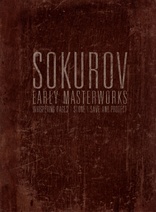

Movie rating
6.5 | / 10 |
Blu-ray rating
| Users |  | 0.0 |
| Reviewer |  | 4.0 |
| Overall | | 4.0 |
Overview
Sokurov: Early Masterworks (1979-1994)
A deluxe collector's set featuring three early masterworks by visionary Russian filmmaker Alexander Sokurov in newly translated and restored director's cuts.
Starring: Aleksandr Cherednik, Sergey Barkovskiy, Yelizaveta KorolyovaDirector: Aleksandr Sokurov
| Drama | 100% |
Specifications
Video
Video codec: MPEG-4 AVC
Video resolution: 1080p
Aspect ratio: 1.40:1
Original aspect ratio: 1.37:1
Audio
Russian: DTS-HD Master Audio 2.0
Subtitles
English
Discs
50GB Blu-ray Disc
Three-disc set (1 BD, 2 DVDs)
Playback
Region A (B, C untested)
Review
Rating summary
| Movie |  | 3.5 |
| Video |  | 3.0 |
| Audio | | 3.0 |
| Extras |  | 4.5 |
| Overall | | 4.0 |
Sokurov: Early Masterworks Blu-ray Movie Review
Sokurov and the Soul of Russian Cinema
Reviewed by Casey Broadwater January 3, 2013In one of his final interviews before succumbing to cancer, the great Russian filmmaker Andrei Tarkovsky said, "In Leningrad, there is a young director,
a cinematic genius. His name is Alexander Sokurov." This might well be considered a passing of the torch. Sokurov became Tarkovsky's protege of sorts
at the Gerasimov Institute of Cinematography, and though his films certainly have their own stylistic and thematic distinctions, they also bear the
influence of his mentor—starkly austere imagery, extremely long takes, a low shot-to-runtime ratio, and an overwhelming concern with the
existential and metaphysical aspects of love and suffering, spirit and flesh.
Sokurov is best known in the west for his stunningly choreographed 2002 film, Russian Ark, which takes us through 300 years in Saint
Petersburg history in a single, uninterrupted 96-minute Steadicam take. More recently, his 2011 adaptation of Faust won the prestigious
Golden Lion prize at the 68th Venice Film Festival and closed out his so-called "Tetrology of Power," four films that explore corruption through the
personas of Faust, Hitler (1999's Moloch), Lenin (2000's Taurus), and the Japanese Emperor Hirohito (2004's The Sun). Like
Tarkovsky, Sukurov was suppressed by the state through the 1980s for his "anti-Soviet" sentiments, and many of his early films are under-seen and
under-appreciated. Boutique distributor Cinema Guild is hoping to remedy that with their new Blu-ray/DVD collection, Early Masterworks,
which gathers together Save and Protect, Stone, and Whispering Pages, three films made prior to Sokurov's international
breakthrough with 1997's Mother and Son. I'll direct most of my remarks toward Whispering Pages, as it's the lone film included on
Blu-ray, but all three are required viewing for followers of Russian cinema.
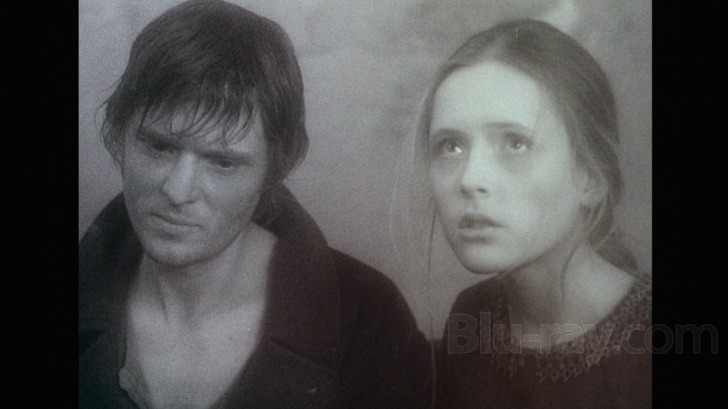
The opening credit sequence of Whispering Pages declares that the film is "based on the works of Russian writers of the 19th century." There might be some Gogol here, and a bit of Chekhov too, but the primary influence is Dostoyevsky. Imagine leafing through Crime & Punishment at random, reading a few pages, and then moving on to another chapter, with no concern for complete understanding or continuity—that's approximately how Whispering Pages works. There are snatches of story here, but the film is primarily non-linear and non-narrative; it moves through the world of Dostoyevsky's novel, more concerned with atmosphere and image than character, plot, or dialogue.
There are only three recognizable roles. Aleksandr Cherednik plays Raskolnikov, the destitute former student-turned-psychologically tortured murderer, and he certainly fits the novel's description of the character as "exceptionally handsome, above the average in height, slim, well built, with beautiful dark eyes and dark brown hair." With bed-head and a ratty overcoat over a droopy shirt, he looks simultaneously like a hobo and a male model straight off the runway of an avant-garde fashion show. Raskolnikov has a mundane encounter with a bureaucrat who might possibly be the novel's Inspector Porfiry (Sergie Barkovsky), who suspects him of killing the elderly pawnbroker Alyona Ivanova. Near the end, there's a scene where Raskolnikov confesses to his redeeming angel, the prostitute Sonya (Elizaveta Koroljova), who urges him: "Get down on your knees in the city square. Prostrate yourself. Kiss the ground you desecrated. Then tell all the world, 'I have killed.' Then God will give you a new life." But Raskolnikov doubts even God's existence, and questions the worth of turning himself in to a government that is itself murderous and unjust. (You can see why Soviet authorities weren't too keen on the film.) This is essentially it for the film's "story," a slow-boiled reduction of Crime & Punishment to its insoluble essence.
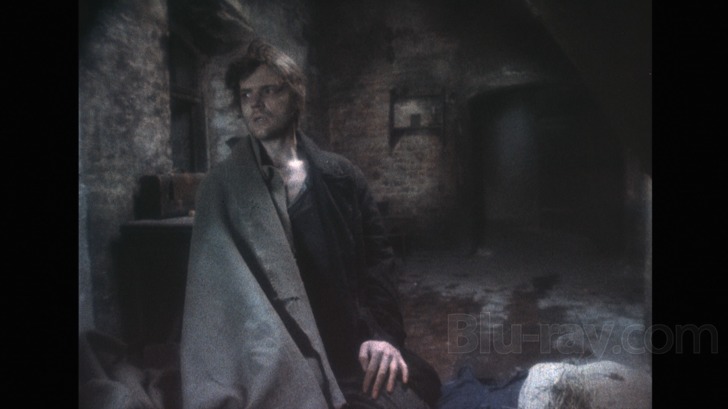
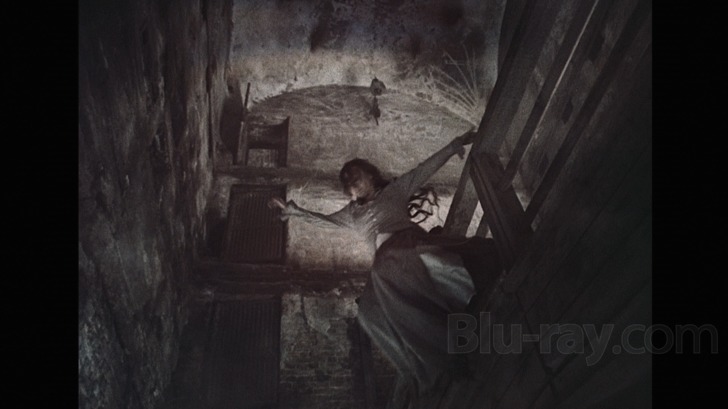
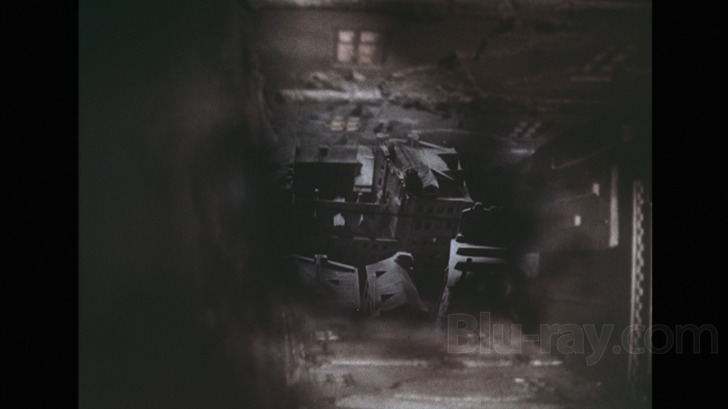
Raskolnikov spends most of the 77-minute film in a dreamy, episodic haze, wandering through a decrepit, almost apocalyptic vision of Saint Petersburg —all crumbling brick facades, darkened tunnels, and hopeless stairwells. Muggers shake him down for cash. Laughing, sallow-faced prostitutes drag him into a brothel, where he silently witnesses some kind of indeterminate orgy/scuffle. Later, he watches several men and women jump over a ledge and out of a window, and when Sokurov cuts to the downward view, we see a surreal scene, a miniature of the city reflected in rippling water. We feel what this means, even if we don't fully understand it.
This is a film meant to be intuitively experienced, and it plays out—slowly, ever slowly—like an immersive, unsettling dream. Sokurov's cinematography is bleak but beautiful, fading almost imperceptibly between color and black and white, and using warped lenses and off-kilter angles to subtly shift our perception. (One scene shows us hundreds of work boots, and it's filmed in such a way that we're not sure if they're spread across an enormous floor or hanging upside down from a ceiling.) Even more disorienting is his use of audio; he constructs soundscapes that don't seem to immediately match what we see on screen. There are echoey, disembodied voices and distant cackles, dripping water and hushed conversations and piercing screams—it's like being in some dark nightmare of a subway station.
It should go without saying that Whispered Pages is not for all audiences. Even some connoisseurs of "difficult" cinema may find their patience tested by Sokurov's lack of concession to accessible narrative. That said, there's great beauty and a satisfying friction of ideas here for those with the mindset to parse, confront, or otherwise enjoy a challenging work of filmic art.
Sokurov: Early Masterworks Blu-ray Movie, Video Quality
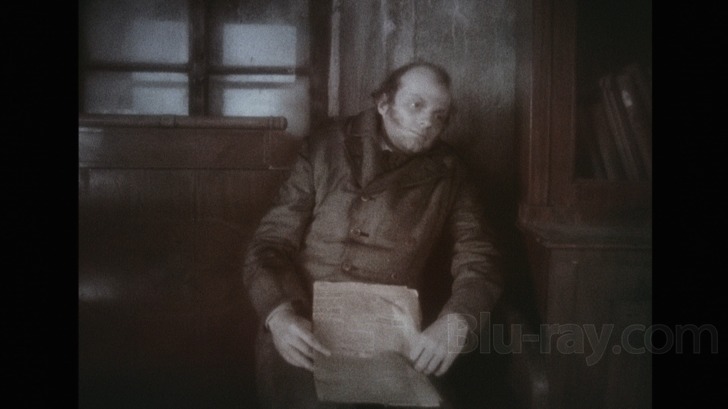
On the menu of each disc, you'll find this "About the Transfers" disclaimer: "The features Whispering Pages, Stone, and Save and
Protect were mastered from the best available source materials. Unfortunately, after years of neglect, both Stone and Save and
Protect show signs of wear in certain places. The original negative of Whispering Pages was completely unusable. It was the discovery of a
35mm negative in Germany that allowed its inclusion in this set."
Which is to say, don't expect a pristine image. Considering the rarity and condition of these prints, some grace is in order. Cinema Guild
essentially presents Whispering Pages' 1080p/AVC-encoded transfer "as is"—with no significant digital cleanup—so you will spot near-constant
white and black specks, occasional larger bits of debris, vertical scratches, mild staining, and other age-related artifacts that are unavoidable without the
significant investment of time and money for a restorative overhaul. With that in mind, the picture is still beautiful to behold and distinctly filmic, with no
noise reduction or edge enhancement. (Grain is exceptionally heavy, though, presumably because this is a duped negative.) And while it's nigh
impossible to place any value judgements on the color reproduction here—Sokurov drifts between color and black and white, with the color ultra-
desaturated to begin with—it all looks natural to me. I can say basically the same for the DVDs of Save and Protect and Stone, which
look as good as can be expected.
Sokurov: Early Masterworks Blu-ray Movie, Audio Quality
The back of the box set says Whispering Pages features a Dolby Digital 2.0 track, but I was pleased to boot up the disc and find a DTS-HD Master Audio stereo track instead. It's debatable, of course, how much a lossless codec will actually improve a mix like this—which has its share of age and source-related quirks—but we know we're at the very least getting nominally better sound quality. Sokurov is known for his dense and sometimes unsettling sound mixes, and Whispering Pages is no exception, featuring reverb-heavy drips and drops, madly tweeting birds, distant voices and coughs and cackles, and a whole soundscape of subterranean unease, back-scored by classical music cues that drift in and out of consciousness. There's some noticeable peaking in the high end during certain scenes, a low but audible hiss at times, and a few pops and crackles, but given the condition of the print, this is to be expected. Although some of the errant, unintended noise probably could've been attenuated somewhat digitally, the track is always listenable. Where dialogue is supposed to be understandable—and there are scenes where it isn't—the actors voices are generally easy enough to make out. The disc defaults to English subtitles, but they can be turned off in the menu or via your remote.
Sokurov: Early Masterworks Blu-ray Movie, Special Features and Extras
Disc One - Whispering Pages (Blu-ray)
- Soviet Elegy (1989, SD, 36:34): Sokurov made this "subjective portrait of Boris Yeltsin" just before the collapse of the U.S.S.R. Expect a somber biography, languorous shots of cemeteries, a five minute, nearly unmoving sequence of Yeltsin sitting at a table, looking depressed, and a drawn- out middle section where portraits of one Russian leader after another are shown on screen, with the narrator simply reading out their names. I'm sure this interests someone, presumably, somewhere, but it's very tedious material to get through. In Russian, w/ English subtitles.
- An Example of Intonation (1991, SD, 50:04): Likewise, Sokurov's second film on Yeltsin—this one made after he'd become Russia's first president—is a long, dry affair, opening with a four and a half minute shot of some trees. We also see Yeltsin shuffling in the snow between buildings, answering questions about his life/career, and—in the last section—wearing track pants. I don't know why that's funny to me. Shot on grubby-looking video. In Russian w/ English subtitles.
- Questions About Cinema (2008, SD, 59:51): Much more interesting is this nearly hour-long interview with Sokurov himself, who talks about auteurism, painting, his use of color and black and white, the relation between images and ideas, and more. In Russian w/ English subtitles.
- Alexandra Trailer (2008, SD, 1:43)
- Stone (1992, SD, 1:18:34): One of Susan Sontag's favorites, Stone is set inside the isolated Chekhov Museum, where a young guard and an old man who may or may not be the ghost of the famed writer pass the night in obscure conversation. An eerie dream of a film.
- Audio Commentary by Film Critic and Curator James Quandt
- "The House that Chekhov Built" (27:51, audio): A BBC audio program about the Chekhov's home in Yalta, where Stone was shot. This essentially plays as an audio track over the film.
- Diary of St. Petersburg: Kozintsev's Flat (SD, 48:36): Sokurov's homage to filmmaker Grigori Mikhaylovich Kozintsev, known for his adaptations of King Lear and Don Quixote. In Russian w/ English subtitles.
- Sonata for Hitler (SD, 10:26): Completed in 1979 but banned until '89, this short is spliced together from archival WWII-era footage of Hitler's speeches.
- Save and Protect (SD, 2:12:49): A loose, eroticized adaptation of Flaubert's Madame Bovary, Save and Protect is arguably one of Sokurov's more accessible films, earthy and comic and surreal. Pair this with Jean Renoir's 1933 version of the story for an examination of how two directors can approach the same material in drastically different ways.
- Whispering Pages in SD: This also disc contains a copy of Whispering Pages in standard definition.
Sokurov: Early Masterworks Blu-ray Movie, Overall Score and Recommendation
It's a shame Cinema Guild couldn't have acquired high definition masters for all three films in this collection, but given the rarity of these Early Masterworks by Alexander Sokurov, fans of the Russian filmmaker will be glad to have them in any form. And, to be fair, Save and Protect and Stone both look decent on DVD, age-related print damage aside. The gem of the set is the Blu-ray remaster of Whispering Pages, a haunting journey through the bleak world of Dostoyevsky's Crime & Punishment, but you'll also find a short film, three documentaries, and an an hour-long interview with Sokurov himself. Recommended!
Similar titles
Similar titles you might also like
(Still not reliable for this title)

Bergman Island
2021

Morvern Callar
Standard Edition
2002

The Manxman
1929

I Need a Ride to California
1968

Connecting Rooms
1970

Elysia: Valley of the Nude
1933

Drylongso
1998

Passages
2023

Way Down East
1920

Heaven Knows What
2014

The Servant
1963

Man Push Cart
2005

Death in Venice
Morte a Venezia
1971

The Story of Temple Drake
1933

My Dinner with André
1981

Requiem for a Village
1975

To Sleep with Anger
1990

Clouds of Sils Maria
2014

Sherlock Holmes
1922

Small Axe
includes "Uprising" (2021)
2020