So Unreal Blu-ray Movie
HomeSo Unreal Blu-ray Movie 
Altered Innocence | 2023 | 98 min | Not rated | Sep 16, 2025

Movie rating
6.9 | / 10 |
Blu-ray rating
| Users |  | 0.0 |
| Reviewer |  | 4.0 |
| Overall | | 4.0 |
Overview
So Unreal (2023)
Explores film as a conduit for the anxiety, fear, exhilarating joy and obsession from humanity over emerging technology at the end of the millennium, all through the cyberspace cinema from 1981-2001 like The Matrix, Tron, Tetsuo.
Narrator: Debbie HarryDirector: Amanda Kramer (V)
| Documentary | 100% |
Specifications
Video
Video codec: MPEG-4 AVC
Video resolution: 1080p
Aspect ratio: 1.78:1
Original aspect ratio: 1.78:1
Audio
English: DTS-HD Master Audio 2.0
Subtitles
English SDH
Discs
Blu-ray Disc
Single disc (1 BD)
Playback
Region A (B, C untested)
Review
Rating summary
| Movie |  | 3.5 |
| Video | | 3.5 |
| Audio | | 4.0 |
| Extras |  | 4.5 |
| Overall | | 4.0 |
So Unreal Blu-ray Movie Review
Reviewed by Brian Orndorf September 27, 2025The world of tomorrow is often used to power the imagination of cinema. But what happens when such futurism actually becomes part of daily life? “So Unreal” is a visual essay that explores the pursuit of technological advancement in moviemaking, with co-writer/director Amanda Kramer endeavoring to track the history of media prediction as she examines two decades of productions that set out to understand the changing world of technology. Computers are the key to it all in “So Unreal,” and Kramer is joined by music legend Debbie Harry, who provides narration for the odyssey into examples and moods, focusing on cinematic adventures that tried to make sense of the previously unthinkable, and optimism was certainly not a priority.
“So Unreal” is broken up into chapters for easier digestion. Some history is supplied as Kramer provides a look at the development of the computer and its eventual rise to power in the 1960s and ‘70s, but she’s most interested in the concept of the computer as a dramatic device or even setting as moviemaking in the 1980s began to develop. This includes a look at early music videos, which served as an introduction to early computer graphics for most viewers, helping to deliver unusual visuals in an increasingly crowded marketplace, with “You Might Think” by The Cars offered as an example of this new frontier. The big screen understanding of “So Unreal” begins where it should, with 1982’s “Tron,” which dared to take ticket- buyers inside a computer for an alien journey into heroism and villainy. Kramer also samples the extremity of 1981’s “Looker,” 1983’s “Brainstorm,” and 1984’s “Electric Dreams” to understand examples of immersion and personality when dealing with machines, and even the danger of replacement as human flaws become unnecessary, as computers are capable of producing a form of perfection.
“So Unreal” aims to generate a dreamlike state while it walks through footage from its examples. There’s synth-y scoring to help sell the mood, along with liquid visuals mixed with cinematic achievements. And there’s Harry, who’s not normally associated with narration assignments, handed some echo to help boost her voice, giving her the presence of a deity as she shares plot points for movies like 1985’s “Weird Science,” 1993’s “Ghost in the Machine,” and 1985’s “D.A.R.Y.L.” “So Unreal” has a certain hallucinatory quality, and Kramer continues her mission into the realm of hacking, highlighting a movement from storytellers to address the vulnerability of computer advancement, exploring the “technological battleground” of pictures such as 1983’s “WarGames,” which presents a bleak view of suburban access to secret government dealings. And, of course, there’s 1995’s “Hackers,” which provided a highly exaggerated understanding of the subculture, turning it into a vibrant cartoon.
As “So Unreal” ventures into the 1990s, focus on virtual reality is provided, catching up with an era that tried to sell universal access to alternate worlds through computer power. Kramer submits the obscure 1993 feature, “Arcade,” as a prime example of her argument, also taking a look at 1997’s “Nirvana,” an equally forgotten movie about digital escape. Time is also spent on 1995’s “Virtuosity” and “Strange Days,” with the latter investing in a grim understanding of human decay as users seek out extreme violence and lust while visiting VR realms. And there’s 1992’s “The Lawnmower Man,” which arguably helped to bring the concept of virtual reality to the mainstream, inventing tech with help from unusual visual effects.
And don’t worry, Kramer gets around to cybersex in “So Unreal,” though it’s presented as a “brief interlude” for a topic that’s fairly vast. It’s a sample of the “jack in, jack off” experience, though it seems Kramer is almost reluctant to include it, pulling back on perhaps one of the defining movements of the 1990s as companies worked on ways to bring sex to home users, and B-movies embraced the possibilities of digital desires.
So Unreal Blu-ray Movie, Video Quality
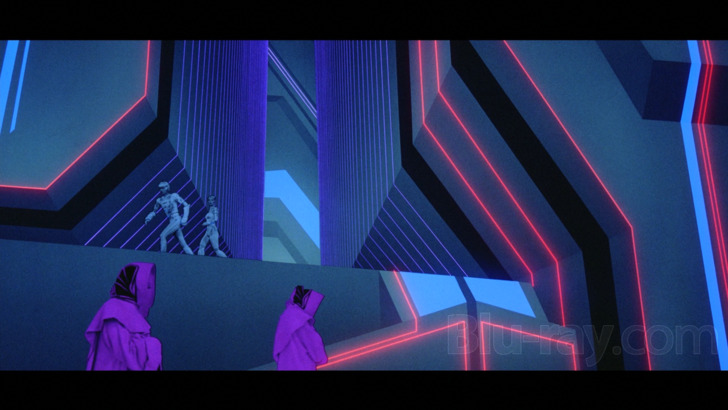
The visual presentation (1.85:1 aspect ratio) for "So Unreal" works with a collection of film and video clips to help bring its themes and ideas to life. These disparate examples range in quality, exposing the limitations of the source materials, but most of the visual essay remains stable, with some degree of detail as the movie works with highly textured tech thrillers and fantasies. Color is most compelling, showcasing the big hues of titles like "Tron" and the coolness of "The Matrix," while assorted digital examples also maintain varied appearances, favoring the silvers, blues, and reds of cyber exploration. Banding is periodically encountered.
So Unreal Blu-ray Movie, Audio Quality
The 2.0 DTS-HD MA mix offers decent immersion into the world of "So Unreal," which maintains a steady flow of musical accompaniment, staying crisp and wide during the listening event. Debbie Harry's narration maintains an echoed, ethereal quality, remaining intelligible. Sound effects are appreciable, adding to the digital mood of the visual essay.
So Unreal Blu-ray Movie, Special Features and Extras
- An Isolated Music and Sound Design track is included.
- Commentary features co-writer/director Amanda Kramer, co-writer Britt Brown, editor Benjamin Shearn, and executive producer Brian Miller.
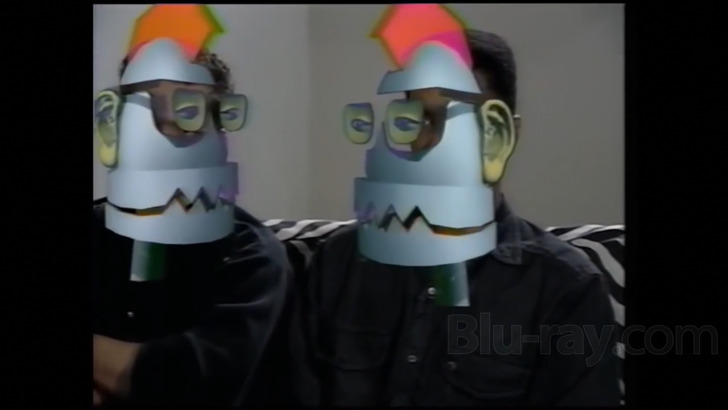
- Interview (63:15, HD) is a 2024 Rotterdam Film Festival discussion of "So Unreal" with co-writer/director (and "polymath") Amanda Kramer and narrator Debbie Harry. Kramer takes the role of the interviewer, initially drawn to Harry due to her participation in "Videodrome," taking special note of her voice, which the narrator is still working on, preparing to visit a speech therapist. Some talk of Harry's experience in Blondie is offered, focusing on the band's interest in making music videos, challenging the form during its early years, getting past simple promotional demands. The subject's relationship with music is analyzed, along with concentration on imagery, sharing stories about the creation of her debut solo album, "KooKoo," which involved a collaboration with H.R. Giger. Harry experiences with Andy Warhol is discussed as well. Talk turns to sci-fi entertainment, with Harry sharing her fandom for the genre, which led to work with author William Gibson, and her acting career is inspected, returning to Cronenbergian character work in "Videodrome." Kramer looks to end the event on a more philosophical note involving the world of technology, but missing is an actual discussion of "So Unreal."
- "Silk" (92:21, HD) is a documentary on the record label 100% Silk.
- And a Teaser Trailer (:11, HD) and Theatrical Trailer (1:35, HD) are included.
So Unreal Blu-ray Movie, Overall Score and Recommendation
"So Unreal" reaches the study of doomsday, offering a closing chapter that details the intimidation factor of 1984's "The Terminator" and its 1991 sequel. There's the fracture VR reality of 1999's "The Matrix" and "The Thirteenth Floor," and the grungy body horror of 1989's "Tetsuo: The Iron Man." There's potency in the walk down memory lane, and Kramer and her team come prepared, offering editorial labor to back up thematic examination. The endeavor has its interesting ideas, but there's not necessarily a feature-length film to be found here as the effort jumps around examples and ideas. As with most visual essays, there's a limit to the effectiveness of such an informational blast, and while Kramer has a defined presentation for "So Unreal," the feature wears thin in its second half, in danger of losing audience attention as repetition sets in and topics lose their potency.