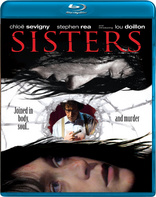
Sisters Blu-ray Movie
HomeSisters Blu-ray Movie 
Image Entertainment | 2006 | 92 min | Rated R | Oct 05, 2010
Price
List price:Amazon: $10.00 (Save 44%)
Third party: $10.00 (Save 44%)
Only 6 left in stock - order soon.

Movie rating
5.7 | / 10 |
Blu-ray rating
| Users |  | 0.0 |
| Reviewer |  | 2.5 |
| Overall | | 2.5 |
Overview
Sisters (2006)
A reporter witnesses a brutal murder, and becomes entangled in a mystery involving a pair of Siamese twins who were separated under mysterious circumstances, one of them forced to live under the eye of a watchful, controlling psychiatrist.
Starring: Stephen Rea, Chloë Sevigny, Lou Doillon, Dallas Roberts, Serge HoudeDirector: Douglas Buck
| Horror | Uncertain |
| Thriller | Uncertain |
| Mystery | Uncertain |
| Crime | Uncertain |
Specifications
Video
Video codec: MPEG-4 AVC
Video resolution: 1080p
Aspect ratio: 1.78:1
Original aspect ratio: 1.85:1
Audio
English: DTS-HD Master Audio 5.1 (48kHz, 16-bit)
Subtitles
None
Discs
25GB Blu-ray Disc
Single disc (1 BD)
Playback
Region A (B, C untested)
Review
Rating summary
| Movie |  | 2.0 |
| Video | | 2.5 |
| Audio |  | 3.0 |
| Extras | | 3.0 |
| Overall | | 2.5 |
Sisters Blu-ray Movie Review
Unnatural Relations
Reviewed by Michael Reuben March 17, 2013Director Brian DePalma has so often been accused of "remaking" Alfred Hitchcock that it must have been a surreal experience for him when producer Edward Pressman, who controls the rights to DePalma's early film Sisters (1973), decided that it was time for someone to remake DePalma. DePalma's film, which starred a pre-Superman Margot Kidder as a successful model with a dark past and featured a scored by the legendary Bernard Herrmann, has become a cult classic and received the Criterion treatment on DVD in 2000. (A Blu-ray edition would be much appreciated.) To give the film a contemporary makeover, Pressman hired first-time feature director Douglas Buck, who co-wrote the script with horror afficionado John Freitas. Despite attracting "name" actors Stephen Rea and Chloë Sevigny for key roles, the production suffered major obstacles, including a last-minute casting crisis over the pivotal role that Margot Kidder had played in the original. Just a few days before production began, an unknown French actress named Lou Doillon was hired. She turned out to be a lucky find, but the seat-of-the-pants approach was typical of the entire project, to which Pressman allocated less funding than would cover craft services for one day on a major Hollywood project. The result has interesting elements, but Brian DePalma has nothing to worry about. The new version of Sisters played a few festivals but never received a theatrical release. Image Entertainment has issued it on DVD and Blu-ray.
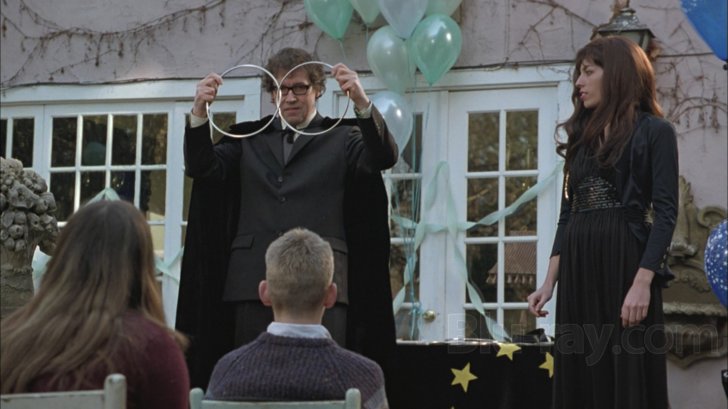
DePalma's film, from his original story, is complex and sometimes baffling on its own terms, but Buck and Freitas attempt to add even further elements to an already difficult narrative. In DePalma's film, a reporter named Grace (played by Jennifer Salt) happens to witness a murder in the apartment next to hers and is drawn into an increasingly bizarre and dangerous world of twisted psychology. In Buck's film, the reporter, who is also named Grace, has her own demons and is actively investigating a world that she knows to be dangerous and twisted. When she witnesses a murder, the sight only adds fuel to a fire that is already raging. The reporter crashes into a world she barely understands, with shocking results. If DePalma's film was about the typical Hitchcock innocent whose life is upended by a chance encounter, Buck's is about the kind of questing soul you might find in a film by Clive Barker or David Cronenberg—a seeker of darkness who gets more than she bargained for. Cronenberg's influence on Buck's film will be obvious to any fan of the Canadian director from the opening shot of a plaque identifying the "Zurvan Clinic for the Study and Treatment of the Psychologically and Physiologically Unique". It's the kind of mocking name that Cronenberg would give to a medical facility. The connection only grows stronger in later portions of Sisters involving organic physiological details that cannot be described without major spoilers. Oddly, though, Buck never mentions Cronenberg when citing his influences in the behind-the-scenes featurette, although he repeatedly refers to Roman Polanski, Dario Argento and Italian giallo films. A brief and furtive reference to Cronenberg appears during the commentary, almost as if Buck wished to avoid the association. DePalma might as well have tried to avoid being associated with Hitchcock. The Zurvan Clinic is run by Dr. Philip Lacan (Rea), an ominous character who is being investigated by the reporter, Grace Collier (Sevigny). We first see Grace in a clown costume she has used as a disguise to infiltrate a party for child patients at the Clinic. Dr. Lacan is entertaining the children by performing magic tricks assisted by Angelique Tristiana (Doillon), a former patient. Or perhaps she's a current patient (or something more). Also attending the party is a young physician, Dr. Dylan Wallace (Dallas Roberts), who is immediately attracted to Angelique. She appears to feel the same about him, or perhaps he is just a convenient means for Angelique to get away from Dr. Lacan. Whatever the reason, Angelique and Dr. Wallace end up in the apartment that Angelique shares with her twin sister, Annabel. However, they are not unobserved. Grace has followed them and is parked across the street, watching the building. And it turns out that Dr. Lacan maintains an apartment in the building directly across from Angelique's, from which he monitors her every move through a network of video surveillance. Strangely enough, Angelique seems to know it's there. Without giving away anything important, I can add that Angelique has a huge, ghastly scar down one entire side of her torso, which she makes sure that her new admirer sees and the director makes sure that we see. And Grace works with another reporter named Larry (J.R. Bourne), who is concerned about her, because she has recently lost her mother, is entirely on her own and seems obsessed with Lacan to the point where her job is on the line. All of the actors do the very best they can with plot points and character concepts that have been overthought intellectually but underimagined in cinematic terms. It's both intriguing and frustrating to watch Buck and Freitas borrow so many elements from DePalma's film, but then freight them with more subtext than they can possibly bear. To take a small example that can be related without giving away anything, in both films a birthday cake is purchased. For DePalma, the purchase became a clue that Grace pursues to prove to the skeptical police that a now-vanished murder victim really existed. In Buck's film, by contrast, the cake becomes one of several weapons used to bash the murder victim, because, as Freitas explains in the extras, the killer has family issues, and birthday cakes represent an image of family normalcy. Well . . . sure, I can understand how someone staring at their monitor typing away might think so. Someone else looking over the writer's shoulder might even get excited about the idea. But for those of us watching the film, that's not what comes across. As a deranged killer bashes a mortally wounded victim with a squishy ice cream cake in a cardboard box, it just looks ridiculous. The tension goes slack, and the horror evaporates.
Sisters Blu-ray Movie, Video Quality
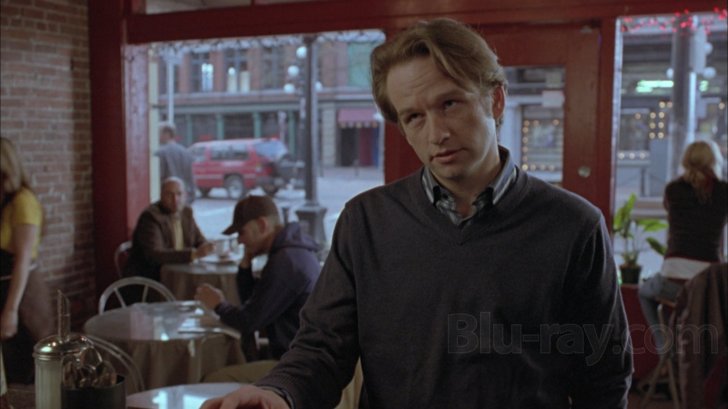
Sisters was made on a shoestring budget, but it had a professional cinematographer, John J. Campbell, who has shot films for Gus Van Sant and Clare Peploe, and it should look much better on Image Entertainment's 1080p, AVC-encoded Blu-ray than it does. Some of the issues may be inherent in the low-budget source, but not all of them. The film was shot on 35mm and, at least according to the credits, completed in post-production by traditional photochemical means. Scanning and color grading technologies were sufficiently advanced by 2006 so that it should been possible to extract and transfer a superior image from the source. What we get instead is a relatively faint image with weak colors, inconsistent black levels, poor contrast and a thin layer of video noise that isn't too severe but shouldn't be there at all. (Note that these criticisms do not apply to a few isolated sequences that have a deliberately "distressed" look to simulate a dream state or a distorted point of view.) It's possible that director Buck was going for a cheap, quasi-grindhouse look, but if so, it was a mistake. Psychological thrillers work best when they look as lush and seductive as the budget will allow, which is how Hitchcock and DePalma made them. Sisters just looks cheesy. Speculation is always dangerous, but it is true that Image released Sisters on DVD two years before it issued the Blu-ray. Sisters has the look of one of those recycled transfers where no Blu-ray release was contemplated at the time, and all the colorist's choices were guided by the demands of optimizing the image for a low-resolution format with a limited color space. In this scenario, when plans changed a few years later, the same master would have been reused, regardless of its limitations. The unusually low bitrate (18.50 Mbps) tends to support this theory, as the transfer would already have been "simplified" for ease of compression. Also consistent with the notion that this transfer was initially prepared for DVD is the blurry lettering of the opening and closing credits.
Sisters Blu-ray Movie, Audio Quality
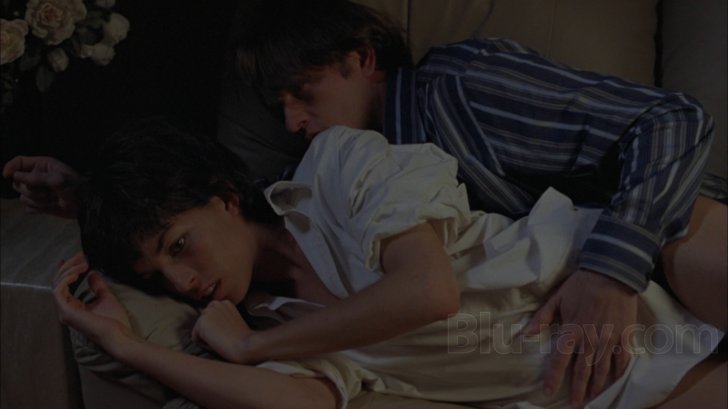
Director Buck notes in his commentary that he had very little time for the sound mix and that he chose to keep it simple, focusing on a few specific sounds in each scene. The Blu-ray's DTS-HD MA 5.1 soundtrack is generally front-centered with clear dialogue (much of its re-recorded in post-production) and functional effects. Indeed, one of the most notable elements of the track is the absence of ambient or environmental sound and the general silence that pervades the surrounds. The spare underscoring is by Edward Dzubak and David Kristian.
Sisters Blu-ray Movie, Special Features and Extras
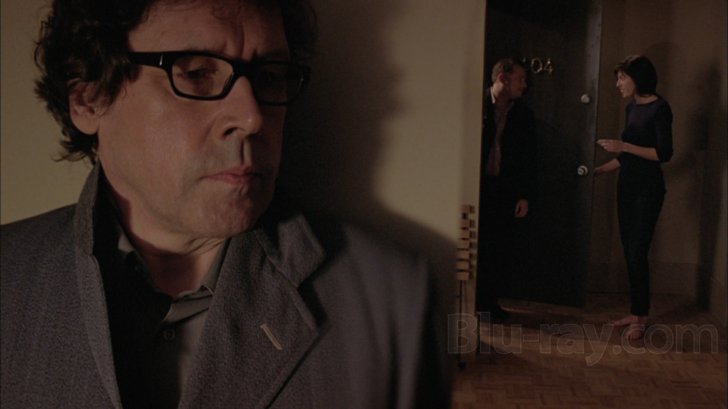
- Commentary with Director/Co-Writer Douglas Buck: Buck sticks closely to the action on screen, discussing the thematic elements and his intentions at each point in the story. He notes shots that he thinks turned out well and is frank in acknowledging shots he thinks he neglected to get. He also offers some interesting thoughts on the use of ADR. The overall impression is of a thoughtful director who made the most of the learning opportunity presented by this first feature outing.
- Behind the Scenes Featurette (480i; 1.33:1; 32:39): The best parts of this featurette focus on the origins of the production, which was clearly motivated by the desire of producer Edward R. Pressman to remake the original DePalma film. The drama of Doillon's last-minute casting provides considerable entertainment value. Notably missing from the interviews is actor Stephen Rea.
- Deleted and Extended Scenes (480i; 1.85:1, enhanced; 15:57): The scenes are not labeled and cannot be selected separately. Nearly all of them are longer versions of scenes that exist in the final film.
- Promotional Trailer (480i; 1.85:1, enhanced; 2:18)
- Slide Show (480i; various; 1:39): Set to music, these still images are primarily behind-the-scenes photos.
- Still Gallery (480i; various; 2:00): This gallery is silent and consists entirely of production photos.
Sisters Blu-ray Movie, Overall Score and Recommendation
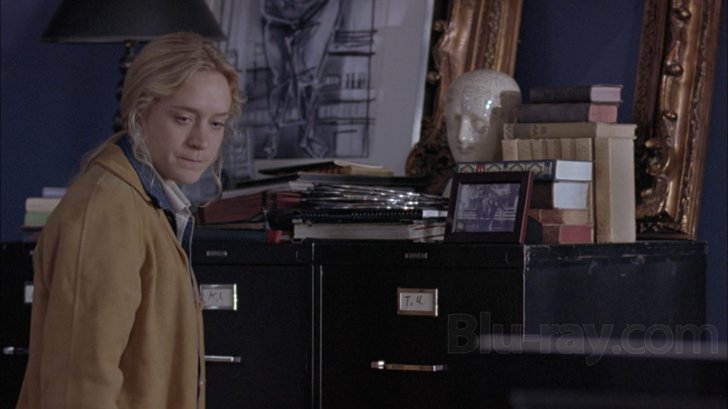
The remake of Sisters is a misfire, but it isn't without interesting elements from a filmmaking perspective. The late director John Frankenheimer famously defended some of the projects he took by saying that he learned more from making a movie than from not making a movie. Douglas Buck has enough talent as both writer and director to have conveyed what he was trying to accomplish with Sisters, even if his reach exceeded his grasp. Measuring the gap between the two can be an informative exercise for those interested in the craft of film. For them I recommend at least renting Sisters and exploring the extras. For everyone else, seek out DePalma's original.

Similar titles
Similar titles you might also like
(Still not reliable for this title)

Sisters
1972

Alice, Sweet Alice 4K
Communion / Holy Terror | Limited Edition
1976

The Pact 2
The Pact II
2014

6 Souls
Shelter
2010

The Cat o' Nine Tails 4K
Il gatto a nove code | Special Edition
1971

Hellraiser: Hellseeker
Hellraiser VI
2002

Winchester
2018

Gore in Venice
Giallo in Venice / Giallo a Venezia
1979

Luz
2018

Kolobos
1999

The Dead Center
2018

Horns
2013

The Crucifixion
2017

I Spit on Your Grave 2
2013

Mara
2018

The Legend of Hell House
1973

From Hell
2001

Don't Let Go
2019

The Medusa Touch
1978

Regression
2015